Skip to content
DevMeme
2372 of 7435
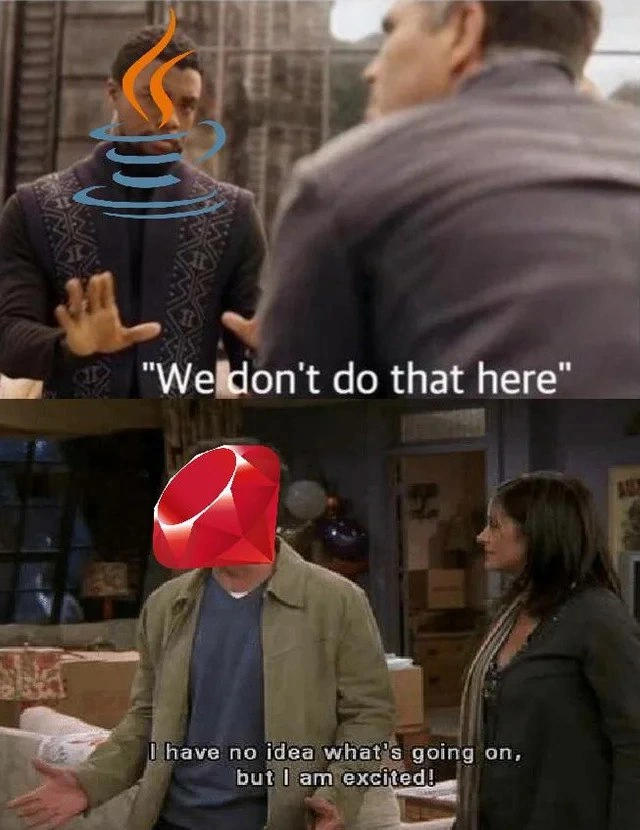
Java's Strict Order vs. Ruby's Enthusiastic Chaos
Languages Post #2638, on Jan 20, 2021 in TG

Java's Strict Order vs. Ruby's Enthusiastic Chaos

Why is this Languages meme funny?

Level 1: Strict Teacher vs Excited Kid

Imagine two people trying to solve a problem like playing a game or building something. One is like a strict teacher who says, “No, no, we must follow all the rules exactly and do it the proper way.” That’s Java – very serious about doing everything by the book. The other is like an excited kid who is jumping up and down saying, “I have no idea what’s going on, but this is so cool and I want to do it!” That’s Ruby – super eager and happy to try things even without understanding all the rules. The strict teacher character saying “We don’t do that here” is funny because it’s like he’s stopping the kid from doing something wild or improper. But the kid (Ruby) doesn’t even care if it’s proper – he’s just thrilled and ready to go. This makes us laugh because we often see this dynamic in everyday life: one person is very serious about rules, and another person is just enthusiastically doing their own thing. In the end, the meme is showing a playful comparison: Java is the rule-following grown-up, and Ruby is the cheerful child who just wants to play and experiment. Seeing them side by side like this is silly in a fun way, because their attitudes are so completely opposite.

Level 2: Java Says "No", Ruby Says "YOLO"

Let’s break down why this image is funny to programmers. It’s comparing two programming languages – Java and Ruby – and their very different styles. Java is a language that’s famously strict and structured. It’s statically typed, meaning you must declare the type of each variable and follow a lot of rules to make the program work. Java was designed for big teams and long-term projects. There’s usually a “right way” to do things in Java, often documented in thick books or company style guides. The Java logo (that orange coffee cup) acting serious in the top panel represents a typical Java developer or team saying, “No, we absolutely don’t do that.” This could be about anything from skipping tests to using some odd coding trick – if it’s not a standard practice, Java folks will reject it to keep the code safe and understandable. In coding terms, Java encourages best practices – tried-and-true ways of solving problems – and tends to avoid quick-and-dirty hacks.

Ruby, on the other hand, is a language known for being flexible and fun. It’s dynamically typed, which means you don’t have to specify types for every variable – Ruby figures it out while running. Ruby was created with the idea of making programmers happy, and it powered the Ruby on Rails framework that let developers build web applications really fast. The Ruby community often says “Optimize for developer happiness.” The shiny red gem logo in the bottom panel is Ruby’s symbol (also the icon for RubyGems, which is Ruby’s system for sharing libraries). In that scene, Ruby’s character excitedly says, “I have no idea what’s going on, but I am excited!” This jokes that Ruby developers can be enthusiastic and dive into new things even if they’re a bit unsure about the details. Why? Because Ruby makes it easy to try stuff out quickly. There’s even a playful term for modifying code on the fly in Ruby: monkeypatching. For example, a Ruby programmer can add new methods to a built-in class (like adding a new function to all strings) at runtime. This is very powerful and can be helpful, but it’s the kind of thing a Java programmer would never dream of doing. In a Java environment, if you suggested changing core behavior on the fly or using some mysterious shortcut, you might literally hear something like “We don’t do that here,” meaning that’s not allowed – it’s too unorthodox.

This contrast is a popular topic in programmer jokes (LanguageWars). We have the strict vs flexible languages dynamic: Java is strict, Ruby is flexible. Imagine a Java developer and a Ruby developer tackling a problem together. The Java dev might say, “Okay, let’s carefully plan this out, follow our design pattern, and make sure everything is typed and checked.” Meanwhile, the Ruby dev might say, “I found this cool gem that might do it, let’s plug it in and see what happens!” The Java approach is cautious and by-the-book (“we don’t do it any other way here”), and the Ruby approach is more experimental and optimistic (“I don’t fully get all of it yet, but it’s exciting and it might just work!”). These are, of course, exaggerations – in real life, good Java devs can be creative and good Ruby devs do care about structure. But the meme exaggerates the differences for a laugh. It shows how dev communities around each language have their own vibe: Java’s culture feels like a well-organized workshop with rules, while Ruby’s culture feels like a playground where people try new toys with glee. If you’re a junior developer, just remember: neither approach is “wrong” – they each have pros and cons. The meme is funny because it’s like seeing two friends with opposite personalities try to handle the same situation in completely different ways.

Level 3: Design Patterns vs Monkeypatches

This developer humor meme is a classic language comparison highlighting a Java vs Ruby culture clash. In the top panel, the Java logo (the steaming coffee cup) plays the stern gatekeeper uttering “We don’t do that here.” This is a nod to Java’s reputation for strict best practices and cautious engineering. Java developers often operate in large-scale, enterprise settings where consistency and safety are paramount. The phrase signals that some proposed action or code style is forbidden in Java-land – perhaps something “unorthodox” that a Ruby dev might suggest. Maybe a colleague wanted to dynamically modify a class at runtime or skip writing an interface for a quick fix, and Java’s response is a firm hand up: not in this codebase! Experienced devs chuckle because they recall countless code reviews or team meetings where a senior Java engineer shuts down a risky idea by basically saying, “No, that’s not how we do things.”

The bottom panel has the Ruby gem logo enthusiastically proclaiming, “I have no idea what’s going on, but I am excited!” This perfectly captures enthusiastic confusion – a hallmark of the Ruby community during the Ruby on Rails boom. Ruby developers are known for their “try it and see” attitude. They thrive on dynamic magic: elegant one-liners, live reloading, and even monkeypatching (altering code or classes on the fly) to get the job done. The Ruby persona is the polar opposite of the Java persona: while Java is rejecting a proposal as against the rules, Ruby is still hyped anyway, diving in headfirst. Seasoned programmers recognize this strict-vs-flexible-languages contrast from the so-called Language Wars. Each panel exaggerates the stereotypes for comedic effect. Java, born out of the 90s enterprise world, preaches structure via design patterns, rigorous type checks, and backward compatibility. Ruby, influenced by Perl and Smalltalk, encourages expressive freedom – “It’s easier to ask forgiveness than permission!” could be the Ruby mantra here.

What makes this meme funny is how it distills a complex Java vs Ruby culture clash into two perfectly paired quotes. If you’ve ever worked on a Java team, you know the unspoken rules: for example, you never randomly add a field to a class without updating all the interfaces and tests (“we don’t do that here” indeed). Java’s philosophy is to prevent surprises: the language won’t even compile if you try something it can’t predict. On the other hand, Ruby’s philosophy is to enable quick joy: you can do wild things at runtime and the code will happily run (until it hits an error, of course). The Ruby dev’s “no idea what’s going on, but excited” vibe lovingly satirizes how Ruby folks sometimes rely on convention-heavy frameworks (like Rails) or magical RubyGems without fully understanding their inner workings – yet everything still comes together, which is thrilling! Veteran developers remember early Ruby on Rails days: a newcomer could generate a web app in minutes, no idea how the magic worked, and still be over the moon when it ran. Meanwhile, the Java veterans looked on, half amused and half horrified, saying “We don’t do that here (we actually want to know how our code works).”

Under the hood, this meme hits on real technical differences. For instance, Ruby allows open classes: you can reopen any class and redefine or add methods at runtime. Java absolutely forbids that – its classes are closed and some, like String, are even final (no subclassing allowed). A Rubyist might cheerfully do something like:

# Ruby: Monkeypatching the String class at runtime
class String 
  def shout
    upcase + "!!"
  end
end

"hello".shout  # => "HELLO!!"

Try suggesting anything similar in a Java codebase and watch the furrowed brows appear. In Java, you’d get an instant, “We don’t do that here,” because you’d violate type safety and confuse future maintainers. The approved Java way might be to create a new class or use a well-known library – design patterns over ad-hoc tweaks. This dramatic difference – spontaneous creativity vs. disciplined structure – is what the meme pokes fun at. Seasoned devs laugh because they’ve lived this: the strict enterprise Java architect versus the free-spirited Ruby startup hacker. It’s an affectionate joke about DevCommunities: each language community has its norms. Java’s community values stability, clarity, and long-term maintainability – they shut down ideas that might introduce chaos. Ruby’s community values expressiveness and developer happiness – they sometimes charge forward with an idea even if not every detail is figured out, trusting that it’ll work out (and often celebrating when it does!). In the end, the meme resonates because it captures a truth every experienced coder knows: different programming cultures can feel like different worlds. Seeing Java “shut it down” while Ruby stays pumped is a humorous reminder of just how diverse our DeveloperHumor and experiences can be across the tech stack.

Description

A two-panel meme that contrasts the development cultures of Java and Ruby. The top panel features a scene from the movie 'Black Panther,' where the character T'Challa, with the Java logo superimposed on his face, holds up a hand and says, 'We don't do that here.' This represents the strict, statically-typed, and pattern-heavy nature of the Java ecosystem. The bottom panel shows a scene from the TV show 'Friends,' where the character Joey Tribbiani, with the Ruby language logo over his face, looks clueless but happy, with the caption, 'I have no idea what's going on, but I am excited!'. This humorously depicts the dynamic, flexible, and often 'magical' nature of Ruby and its popular framework, Rails, where metaprogramming and 'convention over configuration' can leave even experienced developers surprised but delighted by how much works implicitly


Comments

13
Anonymous ★ Top Pick Java is like building with architectural blueprints where every brick is accounted for. Ruby is like being handed a magic wand and told, 'Just wave it in the general direction of a web app.'
  1. Anonymous ★ Top Pick

    Java is like building with architectural blueprints where every brick is accounted for. Ruby is like being handed a magic wand and told, 'Just wave it in the general direction of a web app.'

  2. Anonymous

    Every design review: Java wants a JSR and three interface signatures before lunch; Ruby’s in the corner reopening Object, live-patching prod, and yelling “YOLO, it’s a DSL now!”

  3. Anonymous

    When the Ruby dev suggests monkey-patching ActiveRecord in production and the Java architect who just finished implementing a 47-class AbstractFactoryBuilderStrategy pattern realizes they're about to witness what 'move fast and break things' actually means in practice

  4. Anonymous

    This perfectly captures the eternal dichotomy: Java developers spending three days architecting an AbstractSingletonProxyFactoryBean to ensure 'we don't do that here,' while Ruby developers are monkey-patching core classes at 2 AM, fully aware they're summoning demons but absolutely thrilled about the meta-programming possibilities. One language has 47 design patterns for opening a file; the other has 47 ways to redefine what 'opening a file' even means

  5. Anonymous

    Java: “We don’t do that here.” Ruby: “We already reopened Kernel and method_missing handles it - in prod.”

  6. Anonymous

    Java forbids monkey-patching String; Ruby calls it method_missing and markets it as a DSL

  7. Anonymous

    Java: Compile-time contracts. Ruby: 'eval' and pray - keeps the excitement eternal

  8. @Zedchi 5y

    Куда то контекст наверно потерялся, сложнота короч)

    1. @RiedleroD 5y

      english please

      1. @Sokolovskiy01 5y

        Kuda-to kontekst navernoe poteralsa, slozhnota karoch)

        1. @glcky 5y

          o, vy is anglii?)

          1. @Sokolovskiy01 5y

            Ou daaa

  9. @executor2077 5y

    Duck typing vs static?

Use J and K for navigation