C++ Operator Overloading Elegance vs. Java's Philosophical Stand
Why is this Languages meme funny?
Level 1: Plain Words vs Clever Symbols
Imagine you have two friends giving you directions to find a file in a computer. One friend (like Java) insists on using full words for everything. He’ll say: “Open folder A, then inside it find folder B.” He doesn’t allow any shortcuts or symbols because he thinks that might confuse you. Another friend (like C++) happily uses a shortcut symbol: he’ll just say “Go to A/B.” He uses a slash “/” as a quick way to show one folder inside another. The first friend starts crying and complaining, “No, no, you should never use symbols like that, it’s too confusing and against the rules!” Meanwhile, the second friend just smirks and shows you how easy it is with the shortcut. The joke is funny because it exaggerates both sides: one person is freaking out about keeping things plain and rule-following, and the other is super proud of a clever trick. Even if you don’t know programming, it’s like someone writing a whole paragraph to say “do not use abbreviations!”, while another person simply writes “FYI, abbreviations are fine 😉.” The contrast makes us laugh – one is overreacting about clarity, and the other is coolly doing something smart and quick. It’s basically poking fun at how different people (or in this case, programming languages) prefer different styles, and showing it in a silly, cartoonish way.
Level 2: Slash Means Subfolder
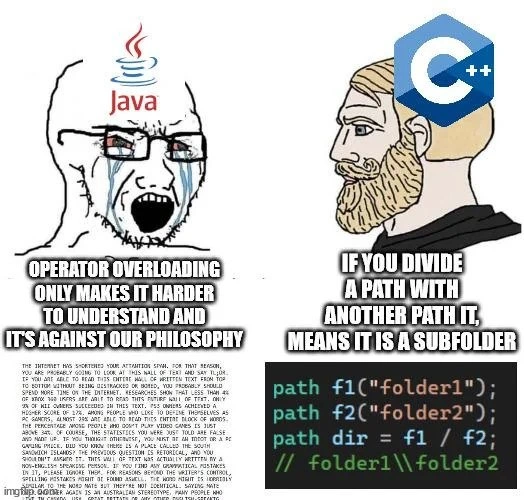
Let’s break down the joke in simpler terms. The image shows two cartoon characters often seen in memes: on the left, a crying Wojak with the Java logo, and on the right, a cool Chad with the C++ logo. They’re arguing about a programming feature called operator overloading. So, what is that? In programming, operators are symbols like +, -, *, or / that normally do math or other basic operations. Operator overloading is a feature in some languages (like C++ but not Java) that lets programmers change what these symbols do for their own custom data types. In other words, a programmer can define that for a special object, the + sign doesn’t necessarily add numbers – it could, say, concatenate (join) two objects, or that the / symbol doesn’t divide numbers, but does something else meaningful for that type. It’s a bit of language magic that can make code shorter and more intuitive if used wisely.
Now, Java decided from the beginning not to allow that kind of magic (except in one special case: Java lets you use + to concatenate strings, like "Hello " + "World"). The text under the Java Wojak basically says: “Operator overloading only makes code harder to understand and it’s against our philosophy!” This represents how Java designers and many Java developers feel — they prefer you use plain, descriptive methods instead of repurposing symbols in unfamiliar ways. Java wants code to be very explicit. For example, to join file paths in Java, you might do:
Path dir = Paths.get("folder1", "folder2");
No fancy symbols, just a clear get method that takes two folder names.
On the C++ side, the Chad character is proudly describing a feature of C++17’s std::filesystem library, where they did use operator overloading in a clever way. In C++ you have a path class (often written as std::filesystem::path) that represents a filesystem path (like a folder or file location). The library overloads the / operator for that class. That means you can use the slash between two path objects, and instead of dividing one number by another (which is what / normally does), it will join two paths into one (essentially creating a subfolder path). The Chad says, “If you divide a path with another path, it means it is a subfolder,” and there’s a little code example shown:
#include <filesystem>
using std::filesystem::path;
path f1("folder1");
path f2("folder2");
path dir = f1 / f2;
// Now dir represents "folder1\\folder2" (a path to folder2 inside folder1)
In this C++ code:
- We create a path
f1for"folder1"and a pathf2for"folder2". - Then
path dir = f1 / f2;uses the overloaded/operator. Instead of division,f1 / f2automatically produces a new path that goes into thefolder1directory then intofolder2. The comment// folder1\\folder2shows the result (in Windows the separator is\\, on Linux/Mac it would showfolder1/folder2).
So, why is this funny or interesting to developers? It’s because Java vs C++ is a classic LanguageComparison where each has different rules. Java would never allow writing f1 / f2 for paths – you’d have to call a method to join paths. C++ says, “Hey, we can make / do something convenient here!” The readability argument comes in: a Java developer might say, “If I see a / b in code, I expect division. Overloading it to mean something else (like path join) could confuse someone reading the code.” A C++ developer might reply, “But if those are clearly paths, using / actually makes the code more readable – it looks just like how we describe file paths!” It’s a bit of a friendly fight in the programming world, often done with tongue-in-cheek humor.
The meme uses the wojak vs chad format to amplify the contrast. The Wojak (with tears and rant text) represents someone complaining extensively – here it’s the Java viewpoint writing an essay about coding philosophy. The Chad (with a beard and calm demeanor) represents someone who’s confident and showing off – here the C++ viewpoint, demonstrating the feature with a one-liner. In developer communities, this is recognized as a joke about language wars: each language community sometimes mocks the other for their perceived weaknesses. Java folks tease C++ for being overly complex and allowing “too much freedom” that can lead to confusing code. C++ folks tease Java for being overly strict or verbose, requiring a lot of boilerplate for things that could be simpler. This meme specifically zooms in on the path_joining example: it humorously sides with C++ by showing a case where that freedom (operator overloading) results in nicely concise code (f1 / f2), while painting the Java side as fussy by quoting their strict philosophy. It’s a lighthearted jab – most programmers know each language’s approach has pros and cons, which is why this exaggerated portrayal gets a laugh.
Level 3: Syntactic Showdown
At a practical level, this meme highlights a long-running LanguageWars trope: Java vs C++, each smug about its own conventions. Seasoned developers will chuckle because they’ve seen this debate play out in code reviews and forums. On the left, we have the Java camp vigorously asserting that explicit code is better for CodeQuality – they argue that operator overloading can be abused, leading to code that’s hard to read and maintain. (How many of us have stumbled upon an overloaded << or ^ doing something completely unrelated to shifting bits or XOR, and thought “What on earth...?!” 🤨) The Wojak’s tearful rant (that big grey block of text) parodies those lengthy forum posts or style-guide sermons explaining why “clever operator tricks” are bad practice. Java developers often pride themselves on writing code that may be verbose but is unambiguous. In Java, joining two filesystem paths typically means calling a method like Paths.get("folder1", "folder2") or using file1.resolve(file2). You always spell out the intent with a function call, never by repurposing an arithmetic operator.
On the right, the C++ side demonstrates what an experienced C++ developer might consider a slick feature. The Chad with the C++ logo casually says, “If you divide a path with another path, it means it is a subfolder.” Short and confident. He’s showing off C++17’s std::filesystem::path where the division operator (/) is overloaded to perform path_joining. This is a built-in library feature (not some hacky user code), so it’s a sanctioned use of operator overloading for better expressiveness. In practice, path dir = f1 / f2; is much cleaner than manually concatenating or calling a join function, and it mirrors how we talk about paths (we use “/” in file paths all the time). Seasoned devs grin here because it’s a case of C++ using its powerful LanguageFeatures for good: the code is succinct and readable if you know the feature. It’s a subtle dig at Java’s philosophy – essentially saying, “See, not all operator overloading hurts readability. This one is pretty intuitive!”
The humor works on multiple levels: It’s developer humor mixing a meme format with a very specific technical in-joke. The meme format (crying Wojak vs. confident Chad) is commonly used to lampoon arguments where one side is over-the-top and emotional and the other is effortlessly cool. Here the Java developer is depicted as the frazzled Wojak, shouting that “it’s against our philosophy!” (indeed, Java’s design philosophy explicitly forbids user-defined operator overloading). The C++ developer is the bearded Chad calmly demonstrating a neat trick. It’s poking fun at how Java folks sometimes act as the code purity police, while C++ folks might do something fancy and just shrug because in their world it’s perfectly normal. Every senior dev has encountered something like this: a LanguageComparison argument where each side believes the other is either overly strict or dangerously indulgent. There’s also an undercurrent of truth that makes it too real: Java’s verbosity vs C++’s penchant for “magic” one-liners is a perpetual trade-off in real codebases. We’ve all seen Java code where joining a file path takes multiple method calls or string concatenations, versus C++ (or even Python’s pathlib.Path) where a single / operator handles it elegantly.
By contrasting these, the meme also touches on readability: ironically, the C++ code with / might be more readable once you know what it does, whereas the Java approach is readable even if you don’t know any special language tricks. Seasoned devs appreciate that both perspectives have a point. The Java rant in the meme echoes legitimate concerns about maintainability (“If any operator could mean anything, how do I quickly understand unfamiliar code?”). The C++ side exemplifies the counterpoint: a well-chosen operator overload can make code more natural to read (joining paths with a slash feels logical). This tension – between strict explicitness and syntactic sugar – is at the heart of many LanguageFeatures debates. And that’s why the meme is funny: it distills a nuanced technical disagreement into a cartoonish crying vs. smirking face-off. It’s a TechHumor cocktail of insider knowledge and exaggeration. Seasoned developers recognize the absurd accuracy of the caricatures and might respond with a knowing laugh (and perhaps an opinionated comment of their own about whether they’d want that operator/ in their code or not!).
Level 4: Philosophical Divide
Deep in the realm of language design philosophy, there's a classic schism exemplified by Java and C++. The meme captures this ideological rift: Java’s creators (like James Gosling) deliberately forbade user-defined operator overloading as a matter of principle, whereas C++ (brainchild of Bjarne Stroustrup) embraces it as a powerful feature. Why such a stark difference? It comes down to balancing clarity vs. expressiveness. Java’s philosophy, influenced by the complexities witnessed in C++ during the 90s, was keep the language simpler and more predictable. By disallowing custom operator overloads, Java ensures that a + b or x * y always mean exactly one of a few well-known things (numeric addition, string concatenation, etc.), never some developer’s overloaded whimsy. This makes the language grammar simpler and code semantics more uniform – there's less “magic” hidden behind symbols.
C++, on the other hand, comes from a tradition of giving programmers extensive control – essentially saying, “if the abstraction makes sense, the language should let you do it.” In C++, operators are just functions with symbolic names. For example, operator/ can be overloaded for a class like a Path. This is a form of ad-hoc polymorphism (overloading) baked into the language’s type system. The theoretical stance is that an operator is an abstraction just like a function: if adding two ComplexNumber objects with + improves readability, or dividing two Path objects with / models real-world composition, then why not allow it? From a compiler’s perspective, there’s no mystery – the parser resolves f1 / f2 by looking up an operator/ function for the path class. It’s all strongly typed and checked at compile-time. But from a code semantics perspective, this freedom means the meaning of an operator can vary with context (the type of objects), which is precisely what Java’s designers sought to avoid for the sake of maintainability.
Historically, these decisions were influenced by developer experiences and academic discussions from the late 20th century: C++ evolved from C with the goal of high performance and zero-cost abstractions, while Java was a reaction to C++’s complexity, aiming for a cleaner, safer subset of OO features (no manual memory management, no multiple inheritance, and indeed no custom operator overloading). Each philosophy has its merits: Java’s approach lowers the cognitive load when reading unfamiliar code (you won’t encounter a bizarre @ or / operator doing something odd), whereas C++’s approach can produce very elegant and concise code for those who understand the domain (like treating file paths almost like arithmetic expressions). This meme humorously exaggerates that divide. The crying Java Wojak embodies the purist stance: “Operator overloading only makes it harder to understand!” Meanwhile, the C++ Chad flexes a specific instance where an overloaded operator is intuitive and handy: using the division symbol to join filesystem paths. In essence, it’s poking fun at how one language’s taboo is another language’s feature to flaunt.
Description
This meme uses the 'Soyjack vs. Chad' format to compare the language philosophies of Java and C++. On the left, a crying Wojak character (Soyjack) with the Java logo on his forehead complains, 'OPERATOR OVERLOADING ONLY MAKES IT HARDER TO UNDERSTAND AND IT'S AGAINST OUR PHILOSOPHY', followed by a wall of unreadable text. This panel represents a rigid, dogmatic viewpoint. On the right, a stoic, bearded 'Chad' character with the C++ logo on his head states calmly, 'IF YOU DIVIDE A PATH WITH ANOTHER PATH IT, MEANS IT IS A SUBFOLDER'. Below this is a clear C++ code snippet demonstrating this concept: `path f1("folder1"); path f2("folder2"); path dir = f1 / f2;`, with a comment showing the result `// folder1\\folder2`. The humor arises from the stark contrast between Java's verbose, philosophical rejection of a feature and C++'s pragmatic and intuitive application of that same feature (operator overloading) to make code more readable and elegant, specifically for filesystem path manipulation

Comments
22Comment deleted
Java's philosophy is to protect developers from complexity by removing features, while C++'s philosophy is to trust developers to manage complexity, even if it means occasionally dividing a string by a string to build a path
Java will spin up three interfaces and a PathBuilderFactory to keep ‘/’ pure; C++ just writes dir = f1 / f2 - then Windows swaps the slashes and philosophy dies in CI
After 20 years in the industry, I've realized the real operator overloading was the technical debt we accumulated trying to explain to junior devs why path.resolve(path.join(basePath, subPath)) is somehow more 'readable' than path1 / path2
The real irony? Java developers will write 'Paths.get(parent).resolve(child)' and call it 'readable,' while C++ devs just type 'parent / child' and get back to solving actual problems. Both camps are technically correct, but only one needs a paragraph to justify why their coffee cup is half empty
Java's anti-overloading crusade saved us from chaos; C++ just used it to make paths finally '/' intuitive
Java: Paths.get(a, b); C++17: a / b; Enterprise: PathJoinerFactoryFactory - the only undefined behavior is the bikeshed
Java: “operator overloading hurts readability.” C++: dir = f1 / f2; elegant - until f2 is absolute and the left operand vanishes, which the standard calls “well-defined” and your pager calls “incident.”
i mean, i can understand "folder1"/"folder1" but ahhh Comment deleted
Kotlin did it too for Path lol Comment deleted
So java will do it too in some future version xd Comment deleted
JCP: no, we won't Comment deleted
> no operator overloading > looks inside > '+' for string concatenation Comment deleted
Hell naw Java is cooking something Comment deleted
*trying to write “hello world” in C++* “They bitwise shift what by what??” Comment deleted
The stream by a literal /s Comment deleted
*they push buncha characters to a file stream* *which file? what is a stream?* Comment deleted
Same in python I guess, I've seen some weird shit like BASE_DIR / 'logs' Comment deleted
if using pathlib and Path object you could do so Comment deleted
you can just implement the same functionality using methods with less confusion Comment deleted
The argument is how things look, not what they mean. Comment deleted
That's barbaric, who does that? Comment deleted
Long live path.resolve Comment deleted