The Glacial Pace of Basic Features in Java Evolution
Why is this Languages meme funny?
Level 1: New Toy for One Trick
Imagine you have a favorite toy or game, and you discover a neat little trick you want to do with it – something really basic, like making a character in a video game jump. But then you find out that your current version of the toy or game won’t let you do that trick at all. The only way to use this simple move (jumping) is to go out and get the newest version of the game or even buy a whole new console. Sounds annoying, right? You’d think jumping is a basic thing every game should allow, but nope – only the latest and greatest version lets you do it. You’d probably roll your eyes and say, “Really? I have to upgrade everything just to do that?”
That’s exactly the feeling this meme is sharing, but in the world of programming. The programmer wanted to do something very simple (handle a “nothing there” value, called null, in a new kind of checklist called a switch). But the rules of Java – the language they’re using – say you can only do that if you’re on the newest version, Java 18. It’s like being told you must get the latest toy model for one tiny feature. It’s funny in a frustrating way: everyone who plays with these “toys” (programming tools) understands that pain. The joke is basically: “Such a basic thing shouldn’t need such a big upgrade!” A child might laugh at how silly it is to need a brand new console just to make your game character jump – and that’s the same kind of silliness the programmer is laughing (and groaning) about here.
Level 2: Basic Feature, Big Upgrade
In this meme, a developer is complaining that a very basic feature in Java now forces an upgrade to Java 18. The feature in question is being able to handle null values inside a new kind of switch-case (called pattern matching switch). Let’s break that down in simpler terms:
Java 18: This refers to version 18 of the Java programming language. Java is updated regularly, and each new version can add features or change how things work. When the post says “requires Java >= 18,” it means you need Java version 18 or any later version (like Java 19, 20, etc.) for something to work. If you have Java 17 or below, that specific thing won’t function the way you want. This is akin to a version dependency – your code now depends on having at least Java 18 to run properly because of the features it uses.
Pattern matching switch: Traditionally, Java’s
switchstatement let you check a variable against a list of values (like numbers, enums, or strings) and execute code for the matching value. For example, you might switch on a number and have cases for 1, 2, 3, etc. In newer Java versions, pattern matching was introduced to the switch statement. This means you can switch on an object’s type or structure, not just fixed values. It’s a more powerful feature where you can say, for instance, “if this object is a String, do X; if it’s an Integer, do Y.” It’s like turbo-chargingswitchto recognize different types and even extract data. But because it’s new, it came with some restrictions initially.nullin a case:nullis a special value in Java that means “no object” or “nothing here.” Many Java developers are very familiar withnullbecause forgetting to handlenullcan cause the dreaded NullPointerException (an error when you try to use an object that isn’t there). In older switch statements, if you tried to switch on something that wasnull, Java would throw an error at runtime. With pattern matching switch (in Java 17’s preview), they initially did not allow acase nullbranch. In other words, you couldn’t directly write a case to catch anull– the language wouldn’t let you putnullas one of the case labels. This meant if there was a chance your variable was null, you had to handle it outside the switch or it would blow up.
Now, the meme’s complaint is that only since Java 18 did the language designers fix this oversight and allow null to be one of the cases in a switch. So “they only allow null in match case since then” translates to: the ability to write a case for null in a pattern-matching switch statement was introduced in Java 18. For someone stuck on Java 17 (or any version lower than 18), this is a bit of a sore point, because null handling feels very basic and important. The developer is essentially saying, “I consider handling null a basic thing in Java, but ridiculously, I have to use Java 18 or above to do it neatly in the new switch. Why wasn’t this basic piece always available?!”
This highlights a common language quirk: sometimes new language features aren’t fully complete in their first release. Java’s developers improved switch with pattern matching, but initially left out null handling until enough feedback (and a new version) came around. This can be frustrating to developers, as it creates a scenario where adopting a cool new feature means also accepting its limitations or waiting for the next version for it to be polished.
From a dependencies perspective, upgrading Java isn’t always trivial. Many projects use a specific Java version, and all the libraries and tools are tested for that version. Jumping to Java 18 means you need to ensure everything still works on that version. Some companies only upgrade when a version is officially Long-Term Support (LTS) to minimize risk. Java 17 is an LTS release, whereas Java 18 was an interim release. So a team might be hesitant to move to 18 just for one feature, because it might introduce compatibility issues or require lots of testing. The meme jokes about this exact conundrum: one tiny feature (matching on null in a switch) is pushing the developer towards a big upgrade (all the way to Java 18). It’s an exaggeration of a very real software development problem: “feature X needs version Y, and we’re not on Y.”
This scenario is very relatable humor for programmers:
- It mentions Java, a language many know.
- It references a language gotcha (the unexpected limitation about
null). - It touches on versioning strategy, because Java uses version numbers to indicate what features are available. The “>= 18” notation is the kind of thing you see in documentation or configuration, meaning “18 or higher”.
- It’s poking fun at the sometimes annoying process of upgrading toolchains for seemingly simple needs.
For a junior developer or someone new to Java, it’s a learning moment: always check which version introduced a feature. If your project isn’t on that version, you might run into exactly this scenario where your code won’t compile or run because you unknowingly used something that only exists in a newer Java. In summary, the meme is laughing about how something as basic as dealing with null ended up tangled in Java’s version upgrades, turning a small task into a larger version dependency headache.
Level 3: Case Null or Nothing
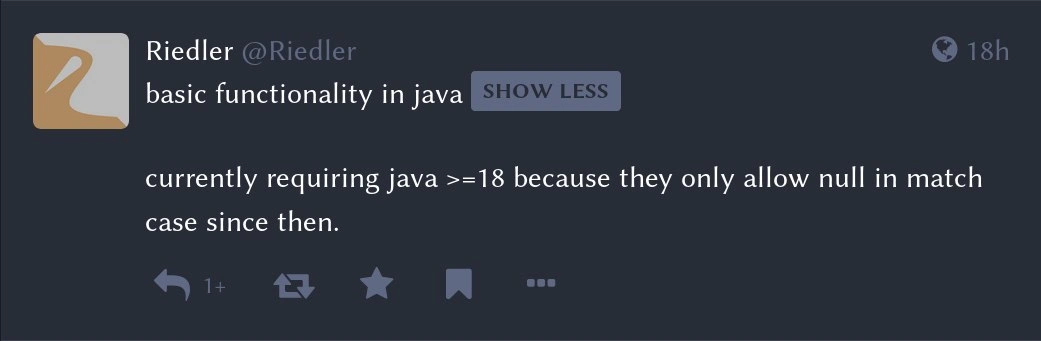
This meme hits on a frustrating language quirk in Java’s evolving language features. The poster jokes that a piece of basic functionality – specifically matching on null in a Java pattern matching switch – is only possible if you upgrade your entire environment to Java 18 or higher. In other words, if you want to use a case null in a switch expression (part of Java’s newer pattern-matching features), you must run your code on Java 18+. This feels absurd because handling null is such a fundamental thing, yet Java developers had to wait for a modern release for the language to support it directly in switch-case logic. The humor comes from a place of relatable developer pain: it’s as if Java’s semantic versioning and versioning strategy force you onto the latest version just to do something trivial. Seasoned devs have seen this pattern before, where one small needed feature or fix is locked behind a big version jump – a classic “dependency hell” scenario, but at the language level.
In this case, the feature in question is Java’s pattern matching for switch, which was a preview in Java 17 and became permanent in Java 18. Initially, the designers hadn’t allowed null to be one of the cases, likely to avoid ambiguity or errors. Before Java 18, if you tried to include null in a switch case, you’d get a compile error or unintended behavior (like a NullPointerException at runtime if a switched value was null). Starting with Java 18, the language designers finally permitted an explicit case null clause so you can gracefully handle a null input within the switch. That’s what the post means by “they only allow null in match case since then” – since Java 18, and not before.
For a senior developer, this situation is eyeroll-worthy because it highlights the churn of language updates. Every few versions, Java adds new toys (pattern matching, records, var, etc.), but each new toy might have gotchas or missing pieces until a later update. Here, the missing piece was null handling in switches. The meme exaggerates the annoyance: to get that one “basic” piece, you have to push your whole project to a newer Java version (which could be non-trivial in a large codebase). Upgrading a core platform like the JDK often means verifying all your libraries, build tools, and servers work with it – a sometimes painful ordeal. This is especially relevant in backend engineering where many projects stick to stable LTS (Long-Term Support) Java versions (like Java 11 or 17). If you’re on Java 17 (an LTS) and suddenly need a feature that only exists in Java 18 (which was not an LTS), you’re stuck in a tough spot. Do you break your stability rule and jump to 18 just for null in switch? Or implement an ugly workaround on 17? It’s a lose-lose that many devs find darkly funny.
The relatable humor lies in the shared experience of version-related headaches. It pokes fun at how a tiny language improvement can have outsized impact on your workflow. We’ve all been there: a new Java feature promises cleaner code, but adopting it triggers a cascade of upgrade tasks. It’s a sarcastic commentary on Java’s evolution and dependency management – where sometimes using modern, elegant language constructs (like pattern matching) forces an “all-or-nothing” upgrade decision. In short, every experienced Java developer reading this can chuckle (or groan) because they’ve felt that “Really? I need to update everything just for this?” moment. This tweet-style meme captures that sentiment concisely, with a dash of resignation.
// Prior to Java 18: pattern matching switch couldn't explicitly handle null
Object obj = getSomething();
switch (obj) {
case String s -> System.out.println("It's a string: " + s);
case Integer i -> System.out.println("It's an integer: " + i);
// Can't put `case null -> ...` here in Java 17, it wasn't allowed.
default -> System.out.println("Something else (or null) happened");
}
// If obj is null in Java 17, a NullPointerException is thrown before any case runs.
// Java 18 and above: you can finally match null explicitly in a switch
Object obj = getSomething();
switch (obj) {
case null -> System.out.println("It's actually null now!");
case String s -> System.out.println("String: " + s);
case Integer i -> System.out.println("Integer: " + i);
default -> System.out.println("Other type");
}
// In Java 18+, the `case null` will catch a null value and handle it, preventing NPE.
Above, we see how a basic feature (handling null) was unavailable in the new switch syntax until Java 18. The meme’s author likely encountered or learned of this limitation and is venting that frustration. The text “basic functionality in java – currently requiring java >= 18” drips with sarcasm. It’s essentially saying: “Java finally let us do something basic, but only if we’re on the absolute latest version. Great.” The languages we use often evolve like this – incrementally – and dependencies (like your required Java version) creep upwards over time. So the comedic exaggeration resonates: engineers often feel like even simple tasks end up dragging you into the version upgrade treadmill. It’s a clever jab at how progress in programming languages sometimes comes with strings attached, leaving developers to decide if that shiny new convenience is worth a big upgrade.
Description
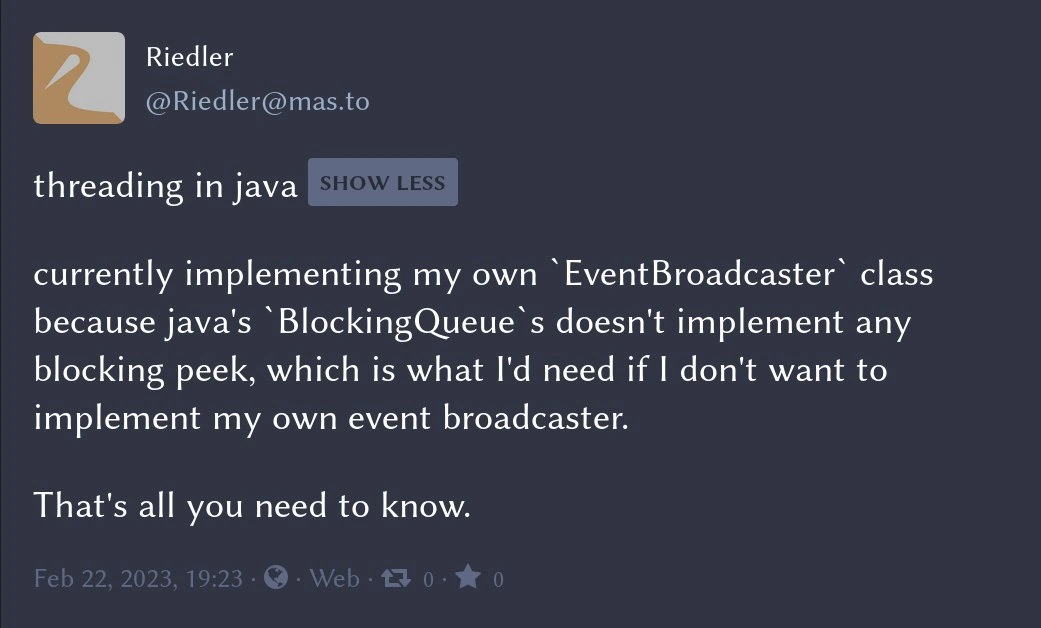
A screenshot of a social media post, likely from Mastodon or a similar platform, from a user named Riedler. The post is titled 'basic functionality in java.' The main text reads: 'currently requiring java >=18 because they only allow null in match case since then.' This is a classic developer grievance that resonates with experienced engineers. The humor lies in the irony that a seemingly fundamental and essential feature - the ability to handle a 'null' case within a modern pattern matching 'switch' (or 'match') statement - was only added in a relatively recent version of Java (version 18). This forces developers to adopt a very new version of the language, with all the associated migration and dependency challenges, just to access what they consider to be basic, common-sense functionality. It perfectly captures the frustration with the slow, committee-driven evolution of mature, enterprise-focused languages like Java
Comments
7Comment deleted
Requiring Java 18 for a null check in a switch statement is peak enterprise development. It's not about the feature; it's about ensuring the migration project is complex enough to justify a 6-month planning phase
Rolling out JDK 18 across prod just to write “case null” in a switch - turns out the billion-dollar mistake was only the down payment
Java's pattern matching roadmap: teaching a 30-year-old language what Scala knew in kindergarten, one LTS release at a time, while your enterprise is still debating the migration from Java 8
Ah yes, the classic enterprise Java dilemma: your entire microservices architecture now requires Java 18+ because someone on the team discovered they could finally handle null in a switch case without wrapping it in Optional.ofNullable().orElseThrow(). Meanwhile, your legacy monolith is still running Java 8 in production because 'if it ain't broke, don't upgrade 47 transitive dependencies and rewrite half your reflection-based framework code.' Pattern matching is great, but nothing says 'modern Java development' quite like bumping your minimum version requirement by a decade just to avoid one extra if-statement
Amazing how one ‘case null’ turned into an ADR, a toolchains rewrite, and a fleetwide JDK upgrade - apparently NPEs were the cheaper architecture
Upgrading to Java 18 for “case null” - finally the compiler acknowledges the real hot path in our system
Java switch on null since 18: because nothing screams 'enterprise stable' like NPE roulette until the next LTS