Skip to content
DevMeme
4660 of 7435
A Developer's Painful Hour-Long Discovery of Java's Reentrant Locks
Languages Post #5112, on Feb 25, 2023 in TG

A Developer's Painful Hour-Long Discovery of Java's Reentrant Locks

Why is this Languages meme funny?

Level 1: Locking Yourself Out

Imagine you have a cookie jar that only one person can use at a time – when it’s locked, everyone else has to wait their turn. Now, you take the jar to get a cookie, and you lock it so no one else can use it while you have it. So far, so good. But then you decide, “I shouldn’t eat another cookie until my friend refills the jar. I know, I’ll lock it again to stop myself!” You turn the key again… but since you’re the one who already has the jar, the extra lock doesn’t do anything to you. You still can open the jar because you never really gave up the key. Essentially, you tried to lock yourself out, but you can’t – you’re the one inside with the key! Now you’re super frustrated, yelling at the jar, “This stupid lock doesn’t work right!”

It’s funny because the jar’s lock is doing exactly what it’s supposed to: keeping other people out, not you. You expected it to work like a normal lock that would even stop you, the current user, but it won’t. In real life that scenario is silly – you’d never expect to block yourself with your own key. But in the coding world, the person in the meme did just that by mistake. They spent a long time confused why their plan wasn’t working. When they finally figured it out, they were so exasperated that they basically shouted, “I hate this jar, holy cow!” (well, actually they said a few ruder words about Java 😅). The humor comes from seeing someone get mad at a tool for doing the right thing, because they were using it the wrong way. It’s like watching a friend try to use a door lock backwards and then blame the door – you can’t help but shake your head and laugh a little, even though you feel their pain.

Level 2: Not Your Regular Lock

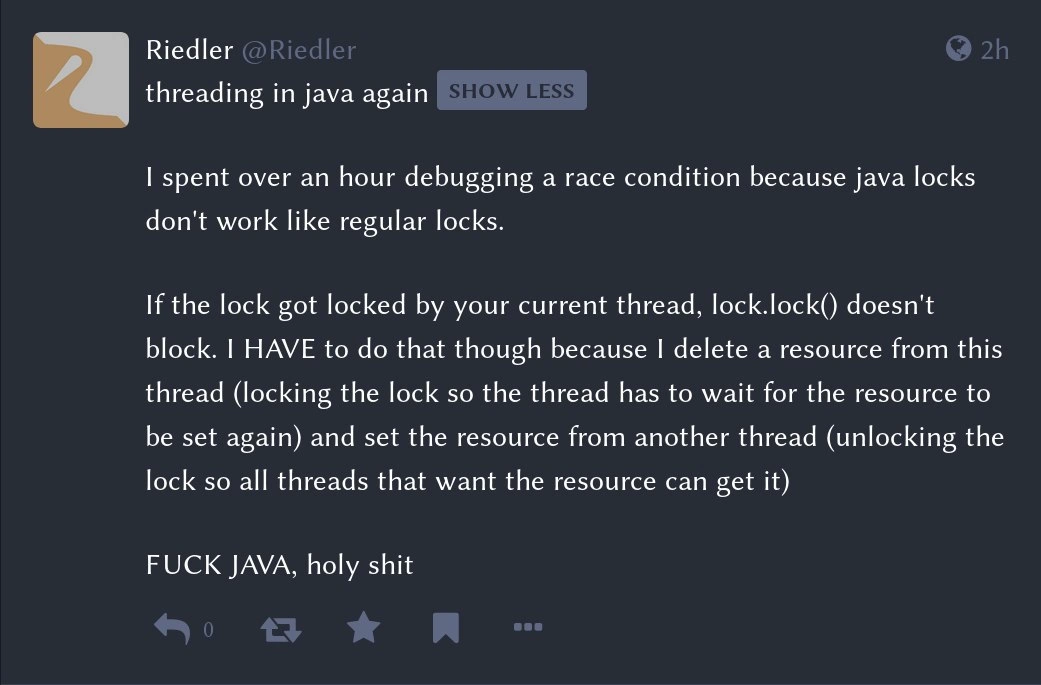
Let’s break down what’s happening in simpler terms. The meme’s text is essentially a developer saying: “I spent over an hour debugging a weird problem because Java locks don’t work like I thought they would.” This is about threads, locks, and a nasty bug called a race condition. If you’re newer to these concepts, here’s what all that means:

  • Threading in Java: A thread is like a mini-program running inside your main program. In Java (and many languages), you can have multiple threads running at the same time, truly in parallel on multiple CPU cores or virtually taking turns. This is powerful for doing things simultaneously, but it introduces complexity when threads share data.
  • Locks and why we use them: Imagine two people (threads) trying to edit the same document at once – you’d get a mess of changes. In programming, a lock is a tool to prevent that chaos. When a thread “locks” a resource (like a piece of data), it’s saying: “I’m using this now, everyone else wait your turn.” Only one thread can hold a given lock at a time, which helps avoid conflicts. In Java, you often create a lock using something like Lock lock = new ReentrantLock();, and then do lock.lock() before touching the shared data, and lock.unlock() when done. There’s also the simpler synchronized keyword which under the hood uses a lock too.
  • “Regular” vs reentrant locks: The developer expected the lock to work like a regular lock – i.e., any attempt to lock it again would make the thread wait if the lock is already held. However, Java’s locks are reentrant. Reentrant means the same thread can enter again without waiting. So if Thread A already locked lock, and Thread A (again) calls lock.lock(), it does not get stuck; it just immediately goes through because Thread A already has the “key.” Think of it like having a VIP pass to a club – if you’re already inside and you go out and come back, the bouncer knows you and lets you in immediately. A non-reentrant (“regular”) lock is more like a strict one-entry ticket – even if you somehow try to use it twice, you’d be blocked (or it’d be an error). Java’s design is that locks recognize the thread that holds them.
  • What was the bug (race condition)?: A race condition is a kind of bug where the program’s outcome depends on the unpredictable timing of threads. It’s like a race: if Thread A and Thread B “race” to do things in a certain order, and the wrong thread wins the race (or they interfere with each other), you get a bad result. They are notoriously hard to debug because adding a print or running in a debugger can change the timing and hide the bug. In this case, the developer had a plan: one thread would remove a resource and then wait (by locking) until another thread added that resource back (and then unlocked). But because of the reentrant behavior, the first thread didn’t actually wait like they expected. So the threads ended up out-of-sync – presumably the first thread kept going and hit a situation where the resource wasn’t there (since it was supposed to pause). That’s the race condition: the code didn’t pause where it should have, and the threads’ actions interleaved in a wrong order.
  • Java concurrency tools at play: The rant mentions lock.lock() and unlocking from another thread. In Java, typically the thread that locks should be the one unlocking – unlocking from a different thread is generally illegal (it throws an exception) unless that other thread somehow also acquired the lock. So something fishy was going on. Perhaps Thread A locked once (has it), then tried to lock again to simulate waiting. Because of reentrancy, that second lock call didn’t block, so Thread A never actually waited. Meanwhile, Thread B might have been expecting to do lock.unlock() to free A, but A was never stuck in the first place! Or maybe Thread B couldn’t even lock because A never released it. This miscommunication is what caused an hour of debugging chaos. The developer eventually realized: “Oh... calling lock when I already have it does nothing! So my wait logic was flawed.” Lightbulb moment 💡, followed by a facepalm.
  • The frustration is real: The all-caps shouting and swearing at the end (“F**K JAVA, holy shit”) is a classic DebuggingFrustration moment. When you finally figure out a sneaky bug, especially in threading, you often feel a mix of relief, triumph, and utter annoyance – annoyance either at yourself for not seeing it sooner, or at the technology for being counter-intuitive. Here it’s aimed at Java. Was it really Java’s fault? Not exactly – Java is doing what it’s documented to do, but when you’re in the thick of a bug hunt, logic can take a back seat to emotions. To a newer developer, it can indeed feel like “Java’s locks are broken!” until someone (or experience) points out the reentrant behavior.

Let’s illustrate the core issue with a short example in code. Imagine this snippet:

import java.util.concurrent.locks.Lock;
import java.util.concurrent.locks.ReentrantLock;

Lock lock = new ReentrantLock();

lock.lock();
System.out.println("First lock acquired");

// Now, the same thread tries to lock again
lock.lock();
System.out.println("Second lock acquired without waiting");

// ... (Later, we should unlock twice)
lock.unlock();
lock.unlock();

What happens here? The same thread acquires the lock twice. The second lock.lock() does not block the thread – it immediately succeeds because the thread already held the lock from the first call. That second System.out.println will execute right away. This is different from what one might assume if they expected a “regular” lock behavior. A new developer might think the second lock.lock() would make the thread pause until someone else unlocks. But nope – Java says, “You still have the key, go on in.”

In a scenario where you truly want a thread to wait for some event from another thread, just locking again isn’t the right approach. Common solutions in Java would be:

  • Use a Condition with the lock (via lock.newCondition()): Thread A waits on the condition (which internally releases the lock and waits), and Thread B signals the condition after doing the update.
  • Or use a synchronized block with object’s wait() and notify(): Thread A would call wait() on a shared object (releasing the lock and waiting), and Thread B calls notify() after the resource is set, to wake A.
  • Or use higher-level concurrency utilities like CountDownLatch or Semaphore that are designed for one thread to wait for another.

But if you haven’t been exposed to those yet, it’s easy to reach for the one concept you do know – locks – and try to force-fit it. The meme’s author “HAD to do that though” probably means they felt using a lock in that way was the only option given their code structure. It’s a learning moment: the tool was not meant to work that way.

To summarize in plain terms: The dev believed Java’s lock would act like a traffic light turning red even for the car that’s already in the intersection (trying to stop their own thread). Instead, Java’s lock is smart and sees it’s the same car coming through again, and leaves the light green. The result? The car zoomed through when it should have waited, nearly causing a crash (the race condition). Now the dev is upset with the traffic light (Java’s lock) for not behaving like they expected. It’s a mix of a bug in the code logic and a quirk of the language (Java) that wasn’t appreciated until things went wrong.

Level 3: Reentrant Rant

From a seasoned developer’s perspective, this meme nails a classic ConcurrencyControl gotcha. The poster’s rant about Java locks “not working like regular locks” actually translates to: “I expected a lock to always block any thread if already locked, but Java’s lock didn’t block when the same thread called it again.” This is the infamous reentrant lock behavior. Experienced Java devs will nod (and maybe chuckle) because they’ve been there: Java’s ReentrantLock (and even the built-in synchronized blocks) let a thread lock the same lock multiple times without waiting. It’s a feature, not a bug – but when you first encounter it in a real bug hunt, it can absolutely feel like the universe is broken.

So why is this combination of elements humorous (in a painful way) to us seniors?

  • The misunderstanding: The developer spent an hour chasing a “race condition” that wasn’t a mysterious hardware glitch or JVM bug – it was the documented behavior of the lock. It’s funny in hindsight because it’s a facepalm moment: the code was doing exactly what Java locks are supposed to do, but that wasn’t what the developer expected. Essentially, they were trying to use a hammer (the lock) like a clamp, and were shocked it didn’t work.
  • “Java locks don’t work like regular locks.” That line is comic gold in a niche way. What are “regular” locks? To a seasoned dev, Java’s locks are regular – they just happen to be reentrant. Perhaps the ranter came from another environment (maybe lower-level C threads or Python) where a basic lock would indeed block even the same thread (unless you explicitly use a recursive lock). They learned the Java Way the hard way. The irony is thick: cursing out Java for a well-known feature that just wasn’t obvious until it bit them.
  • Shared trauma of debugging: Any dev who’s debugged race conditions or threading issues feels this viscerally. The meme has tags like DebuggingFrustration and BugsInSoftware for a reason. A race condition bug can make you question reality – things seem to randomly fail or work depending on tiny timing differences. Spending “over an hour” debugging one? Honestly, that’s pretty mild in the grand scheme of multi-threaded bugs (some of us have lost days or weeks on such ghosts!). The subtext humor: “Only an hour? That’s a downright miracle!” 😅
  • The design intent vs. real-world use: Senior devs recognize what likely happened. The poster had a design where one thread (let’s call it Thread A) needed to wait for another thread (Thread B) to restore a resource. They attempted a DIY synchronization: Thread A locks a mutex to “hold” itself until the resource is back, and Thread B would unlock it to release A. But Thread A was already holding that lock – so when it tried lock.lock() again, Java basically said “Oh, you already have this, go on through,” and it didn’t wait at all. The result? Thread A zoomed ahead, probably accessing the missing resource or messing up the intended order, causing a race condition or inconsistent state. This miscoordination is what they debugged for an hour. It’s a bit like setting a trap for someone else but stepping into it yourself because you’re immune to your own trap!
  • Why fix is harder than it looks: One might think, “Okay, just don’t call lock twice.” But the real fix is architectural: use the right tool. In Java concurrency, if you want one thread to wait for a signal from another, you might use a Condition (with await() and signal()), or a higher-level synchronization class. The developer “HAVE to do that though” (they felt they had no choice given their design) indicates maybe their design was a bit ad-hoc. The humorous truth is that in complex multi-threaded systems, it’s easy to paint yourself into a corner where your only escape is a hack – and then the hack doesn’t work because of a detail like reentrancy. Senior engineers reading this recognize that pang: “Yep, been there, tried something crazy, and the language smiled and said ‘not today.’”
  • Historical context: Interestingly, Java has had reentrant locks from day one (synchronized is implicitly reentrant). Why? Back in the late 90s when Java was designed, they wanted it idiot-proof against simple deadlocks (like a method calling itself recursively – that shouldn’t deadlock on a lock it already holds). Older systems like POSIX threads made you explicitly ask for a recursive mutex if you wanted one. Many Java devs don’t even think about it… until it bites them when implementing a tricky wait mechanism. This rant could be happening in 2023, but it could just as well have happened in 2003 – it’s a timeless newbie mistake in the Java world.
  • The human side and the language blame game: We’ve all cursed out a programming language or API when frustrated. “F**K JAVA, holy shit” is a cathartic error message if there ever was one. The meme is relatable because the DeveloperFrustration is so real and raw. It’s amusing to others because we know that feeling and we know that, at some level, the anger is misdirected – but we also know it’s an essential phase of debugging meltdown 😜. After you cool off, you facepalm and maybe even laugh at how you went on a tirade against Lock.lock() doing its job.

In essence, the humor here is a mix of schadenfreude and empathy. We’re laughing with the ranter, not just at them. Anyone who has dealt with multithreading has war stories of “WTF, why is this not locking?!” or its cousin “Why is this deadlocked?!”. This post is one of those war stories distilled. It highlights a common gap between how we think our code should work and what it’s actually doing. And it reminds us that even a straightforward concept like a lock can hide non-obvious behaviors (reentrancy) that will sneak up and bite you. In a field where we often joke that race conditions and threading bugs only appear at 4 PM on a Friday or in production at 3 AM, seeing someone hit that wall and react with pure, unfiltered rage is both cathartic and darkly comic. It’s funny because we’ve all been that developer screaming into the void when a bug revelation finally hits.

Level 4: Monitors & Reentrancy

At the deepest technical level, this rant is about Java’s concurrency model and how it implements locks as reentrant monitors. In Java (and many modern languages), a lock is reentrant by design, meaning the same thread can acquire the same lock multiple times without waiting. This is a deliberate feature rooted in the classic concept of a monitor (as described by C.A.R. Hoare and Per Brinch Hansen in the 1970s) where a critical section is guarded by a lock that is owned by a thread. If the owning thread tries to lock again, the runtime sees it’s already the owner and simply increments an internal counter instead of blocking. This avoids a self-deadlock situation when, for example, a synchronized method calls another synchronized method on the same object – a common pattern in OO design. The trade-off is that the lock no longer acts like a simple binary semaphore in all cases; it has memory of the owner thread.

Under the hood, a ReentrantLock (the kind being vented about here) maintains state: an owner thread ID and a recursion count. Pseudocode for acquiring such a lock might look like:

if (!isLocked || owner == currentThread) {
    owner = currentThread;
    holdCount++;
    // (No blocking if currentThread already owns it)
} else {
    // Block this thread until lock becomes free
}

Only when the owner thread fully releases the lock (decrements the holdCount to zero) does it become available to others. This design solves some problems but creates others: it can mask bugs where a thread accidentally re-locks and forgets to unlock, and, as seen in the meme, it confounds developers who expect a second lock attempt to act like a wait. In low-level systems programming, “non-reentrant” locks (sometimes called mutexes or binary semaphores) do exist – if a thread tries to lock one it already holds, it either deadlocks or returns an error. By contrast, Java’s choice (and that of many high-level languages) was to favor developer convenience (avoiding accidental self-deadlocks) at the expense of this surprising “recursive” behavior.

The ranting developer’s scenario touches on a deeper concurrency primitive: condition synchronization. In classical monitor theory, a thread that needs to wait for some condition (like “resource becomes available”) should temporarily release the lock and block via a condition variable (e.g., Object.wait() in Java or a Condition with ReentrantLock). Here, the developer instead tried to use the lock itself as the waiting mechanism: lock the resource, then lock again to wait until another thread unlocks. This is a misuse of the lock abstraction because a ReentrantLock won’t block a thread that already owns it. The proper theoretical construct would be to use something like:

  • A Condition variable: The thread holding the lock calls await() (which atomically releases the lock and sleeps) and another thread calls signal() or signalAll() after setting the resource, to wake waiters.
  • Or a higher-level synchronization aid like a Semaphore or CountDownLatch that is designed to block and wake threads across events.

Race conditions are the broader bug class here – the undesirable interleaving of thread schedules. Fundamentally, a race condition arises from the non-determinism of thread execution order. The developer’s confusion over the lock’s behavior introduced a race where the thread didn’t actually wait when it should have, likely causing two threads to step on each other’s toes with the resource. In concurrency theory, this is often where one would reach for formal verification or at least a happens-before reasoning: if the code doesn’t establish a proper happens-before relationship (through locks or other synchronization), you get erratic results. The meme humorously highlights how the gap between formal concurrency concepts and a developer’s mental model can lead to a late-night expletive-laden debugging session.

In summary, at this deep level we see a clash between intended lock semantics (reentrant monitors) and a developer’s expectations of “regular” locks. It’s a textbook example of how concurrency control is both a science (with formal semantics, like monitor invariants and the Java Memory Model) and an art (getting it right in practice under pressure). The intensity of the rant (“F**K JAVA, holy shit”) underscores a fundamental truth in multi-threaded programming: when theory and practice diverge, frustration runs high. This is a case where the elegance of reentrant monitor design meets the harsh reality of debugging a race condition, leading to a visceral "WTF" moment familiar to any seasoned engineer who has wrestled with threads.

Description

A screenshot of a social media post from user Riedler, titled 'threading in java again'. The post is an exasperated rant about a difficult debugging session. The user writes, 'I spent over an hour debugging a race condition because java locks don’t work like regular locks.' They explain that if a thread already holds a lock, calling `lock.lock()` again does not block, which contradicts their expectation and is the root of their bug. They describe a scenario where they need a thread to wait for a resource to be reset by another thread, a pattern for which a reentrant lock is ill-suited. The post culminates in raw frustration: 'FUCK JAVA, holy shit'. This is a highly relatable scenario for senior developers who have encountered the nuances of concurrency primitives. The issue isn't a flaw in Java, but a classic misunderstanding of reentrant locks (like `ReentrantLock`), which are designed to be acquired multiple times by the same thread without deadlocking. The user's problem calls for a different synchronization mechanism, like a `Condition` or a `Semaphore`, to signal between threads
Comments

7
Anonymous ★ Top Pick Blaming Java's reentrant lock for not blocking the owner thread is like complaining your idempotent API endpoint isn't creating duplicate resources. It's not a bug; it's the entire point
  1. Anonymous ★ Top Pick

    Blaming Java's reentrant lock for not blocking the owner thread is like complaining your idempotent API endpoint isn't creating duplicate resources. It's not a bug; it's the entire point

  2. Anonymous

    ReentrantLock: the only mutex whose idea of fairness is “if you’re already holding it, walk right back in,” leaving me diff-ing thread dumps at 2 a.m. while Schrödinger’s null is both deleted and not

  3. Anonymous

    Discovering ReentrantLock after 15 years of Java: "Wait, you mean I've been writing CountDownLatches and Semaphores this whole time when I just needed a lock that actually... locks?"

  4. Anonymous

    Ah yes, Java's ReentrantLock - where 'reentrant' means 'we'll let you shoot yourself in the foot twice from the same thread.' Spending an hour debugging why lock.lock() doesn't block when you already own it is a rite of passage. It's like Java whispered 'I trust you to manage this complexity' while handing you a loaded footgun. The real kicker? The documentation probably mentioned this behavior in paragraph 47 of the JavaDoc, right after the part everyone stops reading. Welcome to the joys of trying to implement a resource handoff pattern with locks that have opinions about who's calling them

  5. Anonymous

    ReentrantLock isn’t a pause button; if you already own it, lock() just bumps the hold count. Cross-thread handoff needs a Condition or CountDownLatch, not an “unlock from another thread” fantasy

  6. Anonymous

    ReentrantLock's party trick: your thread skips the line it just locked everyone else behind - because reentrancy means self-service debugging hell

  7. Anonymous

    Expecting ReentrantLock.lock() to block its owner is a semaphore masquerade; if you’re coordinating state, use a Condition or CountDownLatch - holdCount only blocks your weekend

Use J and K for navigation