Skip to content
DevMeme
4663 of 7435
The Operational Nightmare of Using Java's 'Preview Features'
Languages Post #5111, on Feb 25, 2023 in TG

The Operational Nightmare of Using Java's 'Preview Features'

Why is this Languages meme funny?

Level 1: Training Wheels Forever

Imagine you got a new bicycle that came with training wheels because the bike manufacturer said, “We’re trying a new design, and it’s not officially proven safe yet.” You start riding with those extra wheels on. It’s a bit clunky to attach them, but you’re excited to try the new bike. Now, fast forward two years – you’ve been riding this bike for a long time, and it’s been working fine. But every single time you want to ride, you still have to put on those training wheels or ask for special permission, because the company hasn’t given the “all clear” for the new design. By now, you’re thinking, “This is silly – I’ve been using it forever, and it’s clearly fine. Why do I still need these training wheels?!”

That’s exactly the feeling in this meme. The programmer feels like they’ve been testing a “not-quite-finished” feature in Java for ages, and they’re tired of having to ask for permission every time they use it. It’s funny in a kinda facepalm way: you laugh because it’s a little absurd to keep needing approval long after something should be normal. But it’s also easy to understand the frustration – just like you’d be annoyed if you could never take off the training wheels, the developer is annoyed that the Java language won’t fully trust a feature that’s been around and working for two years. The humor comes from that over-the-top caution, and anyone who’s had to wait forever for something simple to be allowed can nod and laugh along.

Level 2: Flag Fatigue

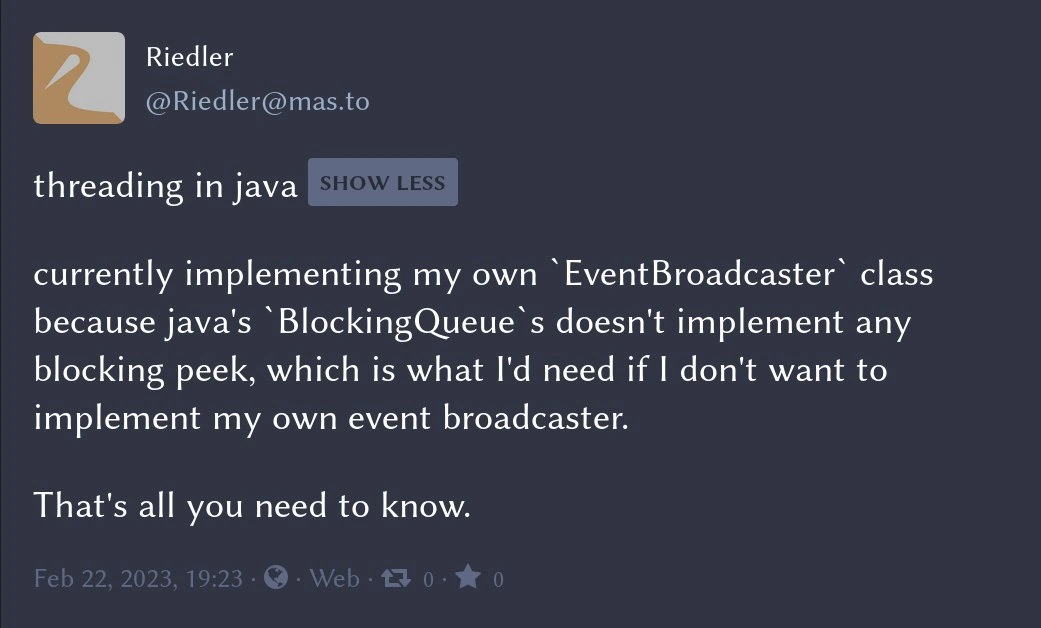
In this meme, a Java programmer vents about having to manually enable a preview feature in Java even after a couple of years. The image is styled like a social media post (dark theme, user avatar, etc.), where the user “Riedler” posts a frustrated message. The key gripe is that even though they’re using Java 17 or above (that’s what “java >=17” means: Java version 17 and later), a certain feature of the Java language is still in preview mode.

Preview mode in Java is like an “open beta” for language features. It’s a stage where a new feature (for example, a new way to write a switch-case or a new kind of class structure) is included in the JDK (Java Development Kit) release, but it’s not turned on by default. The Java team labels it preview to signal “this is nearly ready, but we’re not 100% confident or we might tweak it in the next version.” They want regular developers to try it out and give feedback, without fully committing it as a permanent part of the language yet. Other programming languages have similar ideas (for instance, Python has a “future” import for upcoming features, and C++ might require special flags for experimental features), but Java formalizes it as a preview feature mechanism.

To actually use a preview feature in your own code, Java makes you explicitly opt-in twice: once at compile time and once at runtime. This is where the compiler flag comes in. When our meme author says “I have to manually allow using preview features when compiling AND when executing,” they’re referring to the --enable-preview option.

  • Compile time: You use the Java compiler (javac) to turn your .java source file into bytecode. If your code uses any preview feature (for example, a new syntax that isn’t officially final), the compiler will normally reject it, saying “preview features are not enabled.” To override this, you run javac with --enable-preview (and usually specify --source <version> to indicate which Java version’s preview features you’re targeting, e.g. --source 17). This flag is like telling the compiler, “Yes, I know this feature is experimental, but I still want to use it – please allow it.”

  • Run time: After compilation, you run your program with the java command (the Java Virtual Machine launcher). Even if the code compiled, the JVM is also cautious. It knows that the compiled class file contains some preview feature. If you just run java MyProgram, the JVM will detect the preview feature usage and abort, complaining that “preview features are not enabled for this class.” So, you must also run it with the --enable-preview switch (e.g. java --enable-preview MyProgram). This is effectively you telling the JVM, “I understand this code uses a not-yet-official feature – it’s okay, go ahead and run it.”

Doing this once or twice is no big deal. But you can imagine the developer experience becoming irritating if you work with that preview feature frequently. Every single time, you need to remember those flags. If you forget, you either get a compiler error or possibly a runtime error. For example, if you compiled with --enable-preview but then run without it, Java will throw an error and remind you to enable preview to run that class. It’s an extra hurdle in your workflow.

The meme’s author is clearly tired of this hurdle – hence the term flag fatigue. The feature they’re using has been in preview for two years, spanning multiple Java releases (Java’s on a six-month release cadence now, so two years means maybe four versions!). That’s a long time to be dealing with a “temporary” measure. The phrase “basic functionality” suggests the developer feels this feature is something fundamental or essential for them – something that, in their opinion, should have graduated from preview to a regular feature by now. It’s possible they’re talking about something like pattern matching in switch statements or record types, which were real Java features that spent several versions in preview before becoming official. From a newcomer’s view, it’s like: “Why is this taking so long if it’s so useful? Why do I still have to flip this switch in year two?”

This highlights a common developer pain point in large, evolving languages: the balance between progress and stability. Java wants to evolve (add new language features to keep up with the times), but it also doesn’t want to break backwards compatibility or rush features out half-baked. Preview features are a compromise – you get early access, but under a warning label. In theory it’s great, but in practice, if a feature stays in preview for many releases, it starts to feel frustrating. It’s like being teased with something without ever fully getting it.

The humor here comes from relatability among Java programmers. Many of them have felt this exact annoyance and perhaps have ranted to colleagues or online about it. Seeing someone post “I still have to use --enable-preview?!” with an exasperated tone validates that feeling in a comedic way. Even the UI elements in the image (the “SHOW LESS” button) suggest the rant could go on — a playful nod that this is a developer humor moment born from genuine annoyance. Essentially, the meme is a light-hearted complaint: “Dear Java, please just let me use this feature already without all the extra steps!”

Level 3: Preview Purgatory

Java developers have a darkly comic saying: "If it’s new and useful, it’ll be stuck behind a flag for ages." This meme nails that sentiment. Here we see a programmer lamenting that even in Java 17 (and 18, 19… basically java >=17), a so-called “basic functionality” is still not officially part of the language and remains a preview feature. In practice, that means every time they want to use this shiny new language feature, they have to pass a special compiler switch --enable-preview when compiling and again when running the code. Two years have gone by, multiple Java versions have shipped, and yet the feature isn’t final – it’s stuck in a kind of developer limbo. Welcome to Preview Purgatory, where eagerly awaited features dwell for what feels like an eternity.

What makes this humorous (in a painful way) to seasoned developers is the exaggerated “Really? Still?” factor. Java is famous (notorious?) for its slow-and-steady language evolution. The platform values backward compatibility and stability so highly that new features go through lengthy trials. The meme’s author calls it “basic functionality” to express ironic disbelief: this isn’t some esoteric experimental API – it’s something that by now should be a standard part of Java. And yet, here we are in preview hell, tooling friction and all. It’s a shared developer frustration: you finally get that feature you’ve been waiting for, but you have to jump through hoops (javac flags, JVM flags) to actually use it. After a while, that manual opt-in becomes downright infuriating – a prime example of “compiler flag fatigue.”

To put it concretely, consider pattern matching for switch (a real Java feature that went into preview). Java 17 introduced it under preview, but it wasn’t finalized in that release. Then Java 18 came – still preview. Java 19 – yep, preview again. Each release, you hope the feature graduates to permanent, and each time you have to keep using --enable-preview. It starts feeling like Lucy pulling the football away from Charlie Brown. Every experienced Java dev remembers similar sagas: Project Loom’s virtual threads took several previews, Records took two rounds of preview before becoming standard, etc. Two years of having a “beta” feature in your production language is both funny and exasperating – funny as in “of course this is happening, it’s Java,” and exasperating because you still can’t use the feature naturally despite it seemingly working fine.

From a senior engineer’s perspective, the humor also comes from grim familiarity with the Java Community Process and how new features are rolled out. Java folks love stability – once a feature is officially released, they’ll support it forever. So the guardians of Java take their sweet time. They release a feature in preview to get real-world feedback and to avoid design mistakes. If something’s not quite right, they’d rather hold it in preview for another six months (or three releases!) than finalize it and regret it. It’s a sensible engineering trade-off on paper, but in practice it means writing --enable-preview so often you could tattoo it on your forearm. The DeveloperExperience_DX suffers: every build script, every IDE run configuration needs tweaking. Forget the flag just once, and you get smacked with errors or warnings reminding you this feature is “disabled by default.” It’s like the language is repeatedly saying, “Are you sure you want to use this? It’s not officially sanctioned yet!” After a couple years, that parental tone gets old.

Let’s look at the kind of message our poor Java dev is encountering constantly:

$ javac Demo.java
Demo.java:3: error: patterns in switch are a preview feature and are disabled by default
    switch(obj) {
          ^
  (use --enable-preview to enable pattern matching for switch)
1 error

$ javac --enable-preview --source 17 Demo.java    # compile with preview enabled
$ java Demo
Error: Preview features are not enabled for Demo (class compiled with preview features)
       Try running with --enable-preview.

$ java --enable-preview Demo    # run with preview enabled (now it works)
Hello from a preview feature!

Every experienced Java coder reading that can practically hear the heavy sigh that accompanies it. The extra --source 17 in the compile command is another quirk: you must specify the Java version for preview features, just to be explicit. This ceremony happens every time. Miss a flag, and either javac refuses to compile or the JVM refuses to execute the class. It’s a bit like a guarded gate that keeps asking, “Do you accept the risk? Are you really sure?” By year two of this, the annoyance turns from a mild itch to a full-on rash.

The meme’s format (a faux social media rant complete with a “SHOW LESS” button) adds to the humor. It’s as if even the timeline UI is saying, “Whoa, that’s enough ranting about Java for now.” You can sense the eye-rolling through the screen. This post condensed the collective sigh of Java developers into a relatable anecdote. It’s poking fun at Java’s slow feature rollout cycle: six-month release trains, yet some features ride that train as preview passengers for many stops. Meanwhile, developers are on the platform, tapping their feet impatiently. It’s a shared pain point turned joke – “Two years and still behind a flag, seriously?!” – the kind of thing that senior devs from the Java world chuckle at while perhaps muttering under their breath, “Classic Java.”

Description

This is a screenshot of another social media post from the user Riedler, serving as a follow-up to a previous complaint about Java. Titled 'basic functionality in java,' the post reads: 'ok so it’s actually java >=17 and I have to manually allow using preview features when compiling AND when executing. The feature has been in preview mode for 2 years…!'. The image captures a deep-seated frustration familiar to experienced Java developers. The humor arises from the cumbersome process required to use new, but essential, language features. Not only is the feature stuck in a non-production-ready 'preview' state for an extended period (two years), but using it requires adding special flags at both the compilation and execution steps. This creates significant friction in development, CI/CD pipelines, and production environments, making the adoption of modern language improvements a tedious and risky process
Comments

7
Anonymous ★ Top Pick Java's `--enable-preview` is a corporate trust fall. The compiler asks 'Do you trust me?' and the JVM follows up with 'Are you sure? Like, really sure?' for two years straight
  1. Anonymous ★ Top Pick

    Java's `--enable-preview` is a corporate trust fall. The compiler asks 'Do you trust me?' and the JVM follows up with 'Are you sure? Like, really sure?' for two years straight

  2. Anonymous

    Java’s preview flags are the GDPR pop-ups of the JVM - you click “yes, I really mean it” at compile time, click it again at runtime, and two LTS cycles later you’re still accepting cookies just to pattern-match a switch

  3. Anonymous

    Java's preview features are like that senior architect who insists on three more proof-of-concepts before approving string interpolation while your Node.js colleagues are already debating whether to deprecate their third templating engine

  4. Anonymous

    Ah yes, Java preview features - where 'preview' means 'we'll let you use it in production if you promise to add two compiler flags, accept the runtime warnings, explain it in every code review, and still get blamed when Oracle finally changes the API in Java 23.' Two years in preview is just Java's way of saying 'we're 95% sure this won't break your entire stack, but we're keeping our options open.'

  5. Anonymous

    Java DX in one sentence: add --enable-preview to javac, forget it in Surefire, watch CI implode, then learn that “preview” is a multi-year feature flag propagated across your entire toolchain

  6. Anonymous

    Java preview features: a two‑phase commit for the toolchain - --enable-preview at compile and again at runtime - and after two LTS cycles the only thing that went GA is the warning

  7. Anonymous

    Java preview features: So stable they've been previewing production readiness since the last ice age - flags required eternally

Use J and K for navigation