Eclipse IDE: The Ultimate Patience Test for Java Devs
Why is this IDEs Editors meme funny?
Level 1: The Waiting Game
Think of a time you really wanted to do something fun on a computer or console, but it made you wait. For example, you turn on your video game, all excited to play, and then a big update or loading screen pops up and you have to sit there watching a bar fill up. The game machine isn’t broken or anything – it’s working, just very slowly. How do you feel while waiting? Frustrated, right? You might even stomp or shout “Come on already!” This meme is just like that. The programmer in the picture wants to start working (which for them is the fun part), but their coding program is taking a long time to start. The words joke that it’s not checking if the computer is fast – it’s really checking if the person can stay patient. In other words, the computer is fine, but the person is getting annoyed because it’s so slow. That’s the funny part: we’ve all felt impatient waiting for something we expected to be quick. It’s like waiting for cookies to bake when you really want one now – the oven is doing its job, but your patience is what’s truly being tested. The meme makes us smile because we know exactly how that feels, and it’s always easier to laugh at a wait when you’re not the one doing the waiting right this second!
Level 2: Patience vs Performance
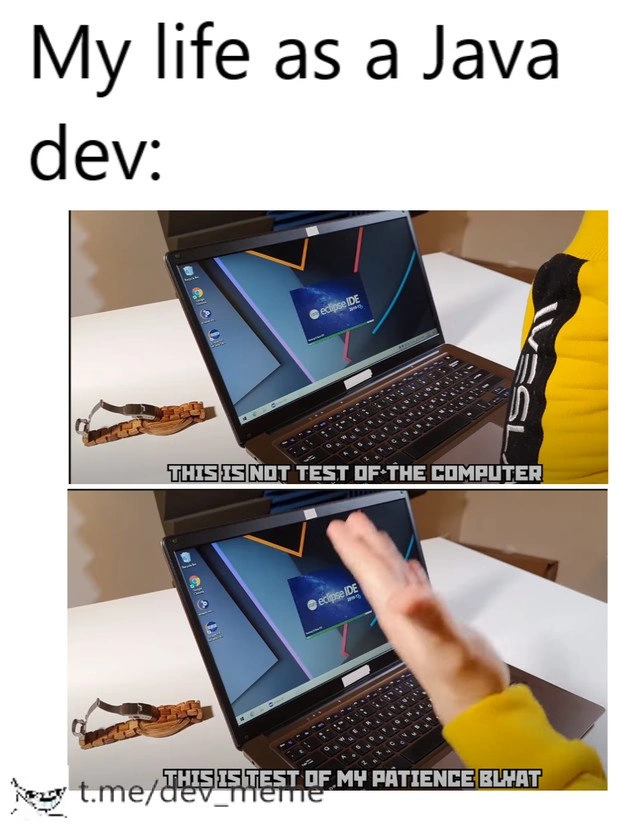
Let’s break down what’s happening in simpler terms. The meme shows a Java developer’s life, focusing on the frustratingly slow startup of the Eclipse IDE. Eclipse is an example of an IDE (Integrated Development Environment) – basically a big all-in-one program that programmers use to write and debug code. Eclipse is especially popular (or infamous) in the Java world. When you launch Eclipse, you get a splash screen (that initial image with the Eclipse logo) and usually a little progress bar indicating it’s loading. It’s during this startup that Eclipse can feel very slow. The meme’s text says “THIS IS NOT [A] TEST OF THE COMPUTER” in the first panel and “THIS IS [A] TEST OF MY PATIENCE, BLYAT” in the second. In plain English, the developer is saying: “The computer isn’t what’s being tested right now; my patience is what’s really being tested, damn it!”
Why would someone say it’s not a test of the computer? Normally, if something runs slowly, people think maybe the computer is old or struggling. Here, the joke is that the laptop is probably fine – it’s a decent machine – but Eclipse still takes forever to load. So it’s not the poor PC’s fault; it’s the software being inherently slow. The dev expected the machine to maybe be working hard (you know, fans whirring, CPU at 100%), but instead the machine is basically idle waiting on Eclipse’s long list of startup tasks. So the dev feels like they are the one under strain, not the hardware.
Now about that word “BLYAT” at the end – that’s a Russian swear word (a bit like saying “damn” or a stronger “heck” in English). It’s commonly used in internet memes to express frustration or anger in a funny way. Even if you don’t speak Russian, meme lovers recognize “blyat!” as a comedic ugh, come on! expletive, often associated with gaming or dev humor. By throwing “blyat” in there, the meme gives the line extra punch and a dash of absurdity. You can almost hear a frustrated developer half-laughing, half-crying as they say it.
The image itself has two panels (a two-panel meme format). Both panels show the same scene: a laptop on a desk with Eclipse’s launch screen open. In the first panel, things are static – the hand of the person (wearing a yellow sweatshirt) is just pointing or resting near the laptop. The caption reads “THIS IS NOT [A] TEST OF THE COMPUTER.” It’s like the setup, spoken in a flat, matter-of-fact tone. In the second panel, the person’s hand is seen mid-swipe towards the screen – you can tell they’re gesturing in frustration, possibly like they’re about to karate-chop the laptop or wave off the annoyance. The second caption says “THIS IS [A] TEST OF MY PATIENCE BLYAT.” The wording deliberately drops some articles (no “a” or “the” in spots) to mimic the blunt style of many memes and perhaps a non-native English speaker’s phrasing (which is common in meme jokes, especially with the Russian “blyat” at the end). The blocky Impact font with all-caps is that classic meme text style used to make the humor loud and clear.
Let’s talk about why Eclipse is slow and why that’s funny to Java developers. Eclipse is a powerful tool – it has tons of features and plugins (for coding, debugging, visual design, etc.). But because it’s so feature-rich, it’s also pretty heavy. When you start Eclipse, it’s not like opening a simple text editor; it’s more like launching a bunch of programs at once. It has to load the Java language support, possibly support for other languages, version control tools, UI components, and so on. Imagine if every time you went to write, you had to unpack a giant toolbox – that takes time. Many Java devs have experienced waiting and watching that Eclipse startup bar inch across the screen, especially if their project is big. The meme highlights this universal experience: you click “Open Eclipse,” and then you wait... and wait. It can feel like ages (even if it’s maybe 30 seconds or a minute or two in reality). During that time, a developer can grow pretty impatient – maybe drumming their fingers or, humorously, checking their watch (notice there’s a wooden watch on the table next to the laptop). That watch in the photo is a clever detail: it symbolizes time passing. The person might have taken off their watch to get comfortable – a sign they know it’s going to be a moment.
The categories and tags clue us in that this is about Developer Experience (DX) and Performance of tools. DeveloperFrustration and DeveloperPainPoints are literally tagged, meaning this meme is about a common annoyance developers face. For someone early in their coding journey, this is an insight: not all delay in programming is due to writing code – sometimes your tools slow you down. If you’ve ever used a school computer or an older PC that takes a long time to boot up or open Microsoft Word, you know the feeling. Eclipse (and some other big IDEs like it) can be like that: powerful but sometimes sluggish. Modern alternatives or lighter code editors (like VS Code, Sublime Text, or even IntelliJ’s lighter modes) have arisen partly because developers crave speed. Waiting for your environment to load is boring and unproductive. This meme playfully mocks Eclipse for being one of those slow-loading tools.
And why specifically “My life as a Java dev”? Because Java developers historically used Eclipse a lot (it was one of the primary IDEs for Java for many years, alongside others like NetBeans and IntelliJ). Over the past decades, countless Java devs have started their day staring at that exact Eclipse splash screen. It’s almost a rite of passage. So the meme is saying: “Yep, this is what it’s like to be a Java programmer, folks!” It suggests that an everyday part of Java development was (and sometimes still is) dealing with an IDE that tests your patience every time it starts. The humor comes from the fact that it’s a shared experience – everyone in that community has been there and can laugh (a bit bitterly) about it. Even the dramatic “THIS IS A TEST...” phrasing is like how you’d describe an extreme or important situation, which exaggerates the silliness of being so annoyed at a simple software launch.
In summary, at this level, we understand the meme as a funny commentary on a tool performance issue. The computer isn’t slow – the program (Eclipse) is. The developer is joking that waiting on Eclipse is like some sort of twisted exam to see how patient they can be. All the visual cues (the loading screen, the watch, the person’s hand waving in frustration) and the textual cues (all-caps meme font, the word “blyat” to express anger) come together to paint a picture every coder finds a bit comical. It’s basically saying: “Being a Java developer means getting used to waiting on your tools... and it drives you a bit nuts!” But we laugh because it’s true, and sometimes humor is the best way to deal with those daily tech frustrations.
Level 3: Progress Bar Purgatory
At the highest nerd altitude, this meme hits on a classic Java developer ordeal: the glacial startup of a heavyweight IDE like Eclipse. Seasoned devs know that feeling when you double-click the Eclipse icon and then... nothing really happens for a while except a splash screen and a slowly creeping progress bar. Under the hood, Eclipse is firing up a whole ecosystem: it’s launching a Java Virtual Machine, loading countless plugin modules (Eclipse’s OSGi plugin system means dozens of components initializing one-by-one), and indexing your projects. Your laptop’s CPU and disk are chugging through thousands of class files and extension points. But here’s the rub: modern hardware usually isn’t the bottleneck – the software is. Even on a monster 8-core machine with an SSD, the Eclipse startup can feel interminable because it’s doing a ton of sequential work. The meme’s top caption, “THIS IS NOT TEST OF THE COMPUTER”, dryly notes that this ordeal isn’t pushing the computer’s limits. The CPU isn’t maxed out and the memory’s not full; instead, the IDE performance is limited by its own bloat and initialization design.
For veteran developers, this scenario is painfully relatable and darkly funny. We’ve all stared at that Eclipse IDE splash screen (the launch image with the Eclipse logo and a loading bar) thinking: “Seriously, what is it doing for 30+ seconds?” All those plugins you installed, all the Java frameworks and syntax checkers – they’re fantastic once running, but they make the startup a progress bar purgatory. The meme exaggerates it as a formal “test”: not a test of the computer’s power, but a test of the developer’s patience. It riffs on the serious tone of system messages (almost like “This is a test of the emergency broadcast system”), but then twists it. Instead of testing an emergency system or the machine, it’s testing the human operator’s sanity. The punchline adds “BLYAT”, a spicy Russian expletive, for extra comic flavor – the dev is basically swearing in frustrated emphasis. In Slavic meme-speak, blyat means “dang it” (to put it politely) – a universal dev sentiment when waiting on slow tools. The two-panel format shows the escalation: first panel calm-ish statement, second panel the dev literally swiping a hand at the screen in oh-come-on exasperation. It’s a before-and-after of the poor Java dev’s mood: from deadpan observation to explosive annoyance.
There’s rich subtext here about Developer Experience (DX) and tooling performance. A tool meant to boost productivity (rich code editor, debuggers, etc.) ironically becomes a source of delay. Many senior devs have quipped that using heavy IDEs teaches Zen-like patience – or drives you to the brink. We’ve learned to anticipate this downtime: it’s the classic “go grab a coffee while the IDE boots” routine. (Fittingly, Java is also the nickname for coffee, so grabbing a cup of java while your Java IDE loads is the oldest inside joke in the book.) On large enterprise projects, you might open Eclipse and then twiddle your thumbs as it builds workspace, indexes files, and loads UIs. It’s so common that it’s practically a morning ritual for Java devs – one that this meme portrays with hyperbolic honesty. The presence of that wooden wrist-watch on the desk is a cheeky visual hint: time is literally ticking. The dev likely has time to take off their watch and set it aside, knowing the wait could be substantial. The IDEs_Editors category and tags like slow_startup and ide_performance tell us this is a commentary on software bloat. Eclipse (and other big IDEs like IntelliJ) pack immense functionality, but they’re not lightweight. A cynical veteran might recall even slower times (anyone remember Eclipse on 5400RPM drives or on 2GB RAM machines? Pure agony). The meme channels that collective memory of suffering and gives us permission to laugh at it.
From an engineering perspective, why is Eclipse so slow to start? Historically, Eclipse was built with a modular architecture where hundreds of .jar files (Java libraries) get loaded for every feature: GUI frameworks, code editors for multiple languages, version control integration, GUI designers, you name it. That means tons of I/O and class-loading at launch. The JVM (Java Virtual Machine) needs to JIT-compile a bunch of code during this process too, so initially nothing is optimized yet – it’s all “cold start.” The result: even though your computer could handle running Eclipse fine once it’s up, the startup phase is single-threaded drudgery that doesn’t fully utilize modern multi-core horsepower. In other words, the app is busy doing a long list of initialization tasks that don’t parallelize well, so even a fast computer ends up mostly waiting on a chain of not-so-fast operations. It’s like having a 12-lane superhighway that suddenly merges into a one-lane road during rush hour – your fancy car (CPU) still has to crawl along. No wonder devs feel like it’s their endurance being measured.
The humor really strikes a chord because it flips the usual script. Typically, we blame slow programs on “insufficient hardware” or “high system load.” Here, the dev pointedly says the laptop isn’t the issue. It’s almost a pride thing: “Hey, I bought a decent machine, but this IDE still makes me wait, so clearly the weak link is the software.” That resonates with experienced devs who have thrown SSDs and RAM upgrades at their systems only to watch Eclipse still load plugins at a snail’s pace. It’s a shared frustration and a bit of schadenfreude: we’ve all internally screamed at a progress bar. By shouting “This is a test of my patience, blyat,” the meme captures that universal developer moment of borderline rage when a tool wastes our time. The use of Impact font captions (the chunky all-caps text with black outline) gives it that classic meme shouting voice, as if the dev is literally yelling this for everyone in the back to hear. It’s half complaint, half battle-cry of solidarity among developers.
In sum, the meme lands so well with a tech audience because it’s too real. It highlights a persistent developer pain point: poor tooling performance. The joke works on multiple layers – technically, it alludes to Eclipse’s notorious startup slowness (a well-known PerformanceIssue), and emotionally, it dramatizes the DeveloperFrustration that builds up. This isn’t just about one IDE; it’s poking fun at any bloated software that makes us wait (looking at you, heavy enterprise apps). The Java dev in the meme has hit that moment where sarcasm is the only coping mechanism left. And every experienced coder watching that scene can’t help but smirk and think, “Yep, been there, my friend.” It’s funny because it’s true: sometimes the hardest test in programming isn’t the code – it’s waiting for your tools to catch up.
Description
A two-panel meme humorously depicting the struggles of a Java developer. The top text reads 'My life as a Java dev:'. The first panel shows a laptop with the Eclipse IDE (version 2019-12) splash screen slowly loading. A caption below reads, 'THIS IS NOT TEST OF THE COMPUTER'. The second panel shows a hand waving dismissively in front of the laptop, which is still stuck on the loading screen. The caption changes to 'THIS IS TEST OF MY PATIENCE BLYAT'. The Russian profanity 'blyat' emphasizes the extreme frustration. A watermark for 't.me/dev_meme' is in the bottom corner. The meme taps into the widely shared experience among Java developers of the Eclipse IDE being notoriously slow and resource-intensive, making the startup process an agonizing test of patience. It highlights a common pain point in developer experience (DX) with certain legacy tools

Comments
7Comment deleted
Some say if you start Eclipse on a Friday, you can finally start coding by Monday morning. They call it 'weekend-driven development'
Eclipse takes so long to reach the splash-screen progress bar’s 100% that the JDK it launched with is already two LTS releases behind - call it the IDE’s interpretation of eventual consistency
After 20 years in the industry, I've realized Eclipse's startup time isn't a bug - it's a feature that gives you just enough time to reconsider your architectural decisions, review your life choices, and maybe even write a microservice in Go before your IDE is ready
Every Java developer knows that 'Eclipse is loading workspace' isn't just a status message - it's a meditation timer. The real test isn't whether your code compiles; it's whether you can resist the urge to force-quit the IDE before it finishes indexing your 47 transitive dependencies for the third time today. At least the skeleton figure is appropriately positioned - it represents developers who started waiting for their Gradle build to finish back in 2019
Opening Eclipse: OSGi negotiates 200 plugins, Maven redownloads half the internet, the indexer re-parses 3M LOC, HotSpot warms up - and I just wanted to rename a method
Eclipse doesn’t start; it convenes a distributed ceremony - OSGi resolves 300 bundles, JDT rebuilds the world, Maven reindexes, the JIT warms up - and my patience SLO is the first thing to go red
Maven builds: Where Moore's Law meets Murphy's - cores multiply, but build times defy physics