Skip to content
DevMeme
1358 of 7435
The Perilous Journey from Prototype to 'Enhanced' Production
TechDebt Post #1530, on May 8, 2020 in TG

The Perilous Journey from Prototype to 'Enhanced' Production

Why is this TechDebt meme funny?

Level 1: Bridge Built with Band-Aids

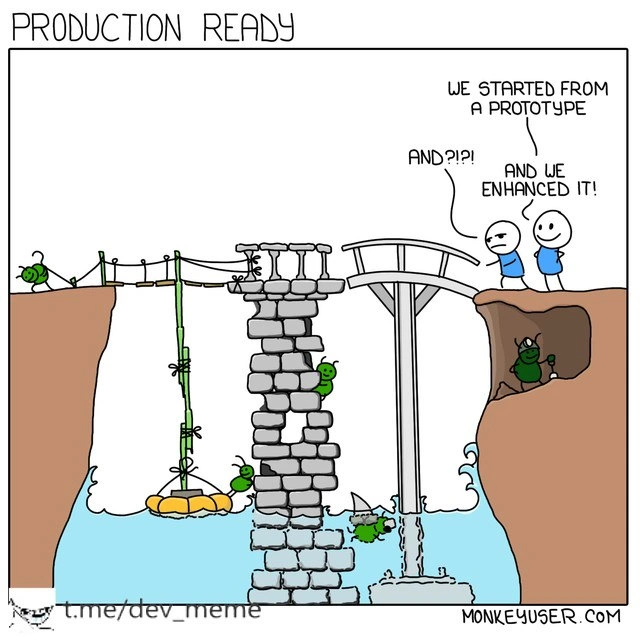
Imagine you need to cross a wide river, but you don’t have a proper bridge. So you get creative: you tie together a bunch of random things – a flimsy rope from the tree on one side, a small inflatable raft floating in the middle for you to step on, a wobbly stack of rocks piled up to reach higher, and then an old half of a concrete bridge that someone left on the other side. You connect all these bits and pieces as best as you can with vines and tape. Miraculously, it kind of works – you can gingerly find a path across. But it’s extremely shaky and could fall apart at any moment. There are even little green bugs crawling all over it, as if the structure is so messy that bugs made it their home! Now, imagine you turn around and proudly say to everyone, “Look, it’s ready for use! It’s just as good as a real bridge!” – even though anyone can see it’s held together with band-aids and glue. The reason this is funny is because the first developer is acting like this crazy, patched-together crossing is completely fine and finished. It’s like a kid gluing random broken toy parts together and calling it a brand new toy – it’s cute and a bit silly, because we can all see it’s a clunky mess even if it technically looks like the thing it’s supposed to be. In real life, we’d never feel safe on a bridge like that, just like we shouldn’t feel “safe” relying on a hastily patched-up program. The joke reminds us of the gap between calling something “done” and it actually being safe and sound.

Level 2: Prototype in Production

Let’s break down what’s happening here in simpler terms. In software development, a prototype (or proof of concept) is a quick initial version of a product. It’s often built fast and without much structure, just to prove an idea can work. Think of it like throwing together a small rope bridge across a creek to see if you could cross – it’s not meant to handle a lot of people or last very long, just to show the concept. Production code, on the other hand, is the real deal: the code that runs in the live product used by customers or end-users. Production code needs to be reliable, well-structured, and thoroughly tested because real money, data, or lives might depend on it. Using our bridge analogy, production code should be like a sturdy, professionally engineered bridge over that canyon – safe, complete, and built to last.

In the comic, the developers admit: “We started from a prototype.” This means the foundation of their system was that quick-and-dirty version. The other developer’s shocked response, “And?!?!” implies an expectation that after prototyping, they would rebuild things properly. That’s the normal Software Development Life Cycle (SDLC) advice: after you prove the concept, you design a solid architecture for production. But instead, the first developer says, “...and we enhanced it!” – meaning they just kept adding to the rough prototype and turned it into the final product without a full redesign. This scenario is all too common in the real world and is a major source of technical debt.

Technical Debt is a term we use to describe the consequences of taking shortcuts in code. Just like financial debt, you “borrow” speed or convenience by doing things the quick way (like not cleaning up the prototype), but you “pay interest” on that debt later in the form of harder maintenance, bugs, and extra work. Here, the prototype was a shortcut – it probably ignored a lot of good design practices in order to get something working quickly. The “interest” is the messy system they ended up with and the many bugs that came with it. Those little green creatures crawling all over the cartoon bridge are literal cartoon bugs, symbolizing software bugs (which are mistakes or flaws in the program that cause errors or unexpected behavior). In coding culture, we often draw or talk about bugs as actual insects for fun, because of the term “bug.” So seeing them swarming a broken bridge tells us this system is crawling with bugs.

Let’s identify the parts of this bridge architecture in relatable terms. The left side has a rickety rope bridge that just stops mid-air – that was likely the original prototype: simple, incomplete, but it got you part of the way. Below it, they’ve tied a raft with vines to cover the gap – that’s like a quick fix or patch when the prototype’s rope wasn’t enough. The stone tower piled up in the middle of the water is another makeshift addition – maybe the system needed to support more weight (more features or users), so they stacked something in the middle to hold it up. On the right, we see half of a modern concrete bridge that doesn’t connect all the way – this looks like someone started to build a proper solution later on (perhaps realizing the rope and raft were not great), but for whatever reason, they only got it halfway done and then just connected it to the old stuff. In code terms, that’s like starting a big refactor or a new module to replace the old system, but never fully switching over. So you end up running both the new half and the old half together – which can be even more complicated. The result is a single “bridge” composed of four different mini-bridges each with different styles, all tied and propped together. This is why we call it a “patches on patches” solution – each part was an ad-hoc patch rather than a cohesive design.

Now, why would anyone do this? Often, it's because of time pressure or resource constraints. For example, maybe there was a rush to deliver features to a client or users, so the team kept saying “we’ll just do this quick fix now and refactor later.” But “later” kept being pushed out. Every software engineer learns that if you don’t schedule time to rewrite or clean up a prototype, it has a sneaky way of becoming the actual product. By the time you have breathing room, the prototype-turned-product has so many users depending on it (or so many tangled parts) that doing a proper rewrite is daunting. It’s like realizing the rope bridge is now the only bridge people use daily – you can’t just close it for a month to build a new one, so you end up trying to reinforce it while people are still crossing. Each reinforcement (new code patch) might help a bit, but it also makes the structure more complex. In software, more complex often means HiddenComplexity – you don’t see the mess from the outside interface, but underneath, the code is full of special-case checks, temporary adapters, and maybe outdated components that nobody fully understands anymore.

Let’s decode some terms from the tags: Legacy Code is code that’s been around a long time and is still in use, but nobody wants to touch it if they don’t have to. Why? Because it’s typically brittle and lacks proper documentation or structure – much like this cartoon bridge, it “works” but nobody is quite sure how. Often legacy code started life as a prototype or older system exactly like in this scenario. ArchitecturalTradeoffs refers to the decisions made in software architecture – for instance, the tradeoff between quickly building something now vs. designing a system that is easy to maintain later. Here the trade-off was clearly tilted towards quick-and-dirty (speed over quality), and now the architecture is full of compromises. The tag DesignPatterns_Architecture suggests thinking about known design solutions: if this system had used good architecture or design patterns, we’d expect a single consistent bridge design (maybe all concrete, well-supported, with proper spans). Instead, we got an anti-pattern (the opposite of a good pattern) often jokingly called a “big ball of mud” in software – which basically means “just throw whatever in there, and hope it sticks together.” This comic is a textbook illustration of that worst-case architecture.

The comic format also gives us a chance to laugh at something that is usually very frustrating in real life. The two stick-figure developers on the right are basically us (developers) discussing the project. The second one yelling “AND?!?!” is the voice of reason or best practices – basically asking, “You started with a prototype... surely you rebuilt it properly afterward, right? Right??” The first developer’s response, “And we enhanced it,” is funny because it’s such an understatement. They’re using the positive word “enhanced” to describe what is obviously a jerry-rigged disaster. It’s like a mechanic saying “We started with a wrecked car frame... and we enhanced it!” when actually they just duct-taped on some new parts and painted over the rust. Developers often use humor like this to cope with the absurdity – calling a monstrous hack an “enhancement” is our form of irony. In meetings, you might actually hear someone say with a smirk, “Oh, it’s not a bug, it’s an undocumented feature,” when referring to such issues. Similarly, calling this mess “production ready” is an inside joke; we all know it’s not truly production-grade, but we’ve seen companies treat it as if it were.

For a junior developer or someone new to the field, the lesson here is: prototypes are meant to be thrown away or heavily refactored before going to production. If you skip that step, you might end up with a system that works in the immediate sense but is terribly fragile and hard to maintain. Every quick fix might solve one problem but unknowingly create two more because nothing was built on a solid foundation. This is why experienced developers emphasize refactoring, writing tests, and designing good architecture early – it’s to avoid ending up in a situation where your codebase looks like this crazy bridge. Yet, despite all the cautionary tales, situations like this still happen a lot (hence the popularity of the meme). It’s a kind of dark humor among developers: we laugh at this comic because we recognize a bit of our own past projects in that shaky bridge. It’s both a “we’ve all done it” admission and a “let’s not do that again!” warning.

Level 3: Spaghetti Bridge Code

The scene is an architectural horror story every experienced engineer recognizes. What started as a quick proof-of-concept hack has morphed into a sprawling Frankenstein architecture held together by hope and half-measures. In the MonkeyUser comic titled "PRODUCTION READY," a chaotic bridge spans a canyon, assembled from mismatched parts: a flimsy rope bridge dangles on one side, a yellow raft tied with vines floats in the middle, a wobbly stone tower props things up, and a half-finished concrete span juts out on the other side. And crawling over every piece? Little green bug-like creatures – the literal bugs in the system. It’s a perfect visual metaphor for Technical Debt run amok in a production codebase.

This image hits senior developers right in the PTSD. We've all been there: some throwaway prototype built under a crazy deadline wasn’t supposed to last. But it did. Instead of taking the time to engineer a solid foundation, each new requirement or bug fix was just patched on. The result is exactly what you see: a precarious patchwork of different solutions bolted together, just barely functional enough to claim it “works.” The humor (and horror) comes from how familiar this scenario is. The dev in the comic exclaims, “We started from a prototype,” and when pressed, adds, “...and we enhanced it!” – proudly touting enhancements to something that should have been thrown away. It’s the kind of deadpan punchline that makes veteran engineers both laugh and cringe, because they’ve heard that same justification in real architecture review meetings.

This cartoon bridge is a Big Ball of Mud – the infamous software architecture anti-pattern where a system lacks a planned structure and accumulates piecemeal design over time. One can almost identify each part: the rope bridge is the original quick hack (MVP feature), the tethered life-raft and vines are emergency fixes for unexpected gaps (“just add a quick workaround!”), the unstable stone tower is a scaling fix (“we need it to reach higher, stack something underneath!”), and the sleek half-bridge on the right is perhaps a half-hearted refactor that never got finished (“we started building a proper solution, but only got halfway before shipping”). The caption “PRODUCTION READY” drips with satire – a dig at how managers or dev teams sometimes slap the label “ready for production” on systems that are clearly anything but. In real life, ProductionReadyCode is supposed to mean code that’s robust, thoroughly tested, and maintainable. Here, it’s being used to christen a cobbled-together monstrosity teetering on collapse. The bugs crawling everywhere drive home the point: when you rush a prototype into production without proper redesign, you inherit a swarm of BugsInSoftware (each green critter likely representing a known issue or three). It’s a vivid reminder that if you don’t pay down technical debt, it’ll accumulate “interest” in the form of defects and system fragility.

Why is this so funny to those of us in the trenches? Because it’s too real. Many of us have worked on a system that started small and simple, then lived far beyond its intended lifespan. Over time, new features had to be bolted on in awkward ways (just like tying a raft to a broken rope bridge). Deadlines, budget pressures, or sheer optimism (“we’ll clean it up later, promise!”) led to shipping a prototype in production. Later, when the crackling sounds of collapsing code began, it was already too late – the system was mission-critical, and nobody had the time (or courage) to rebuild it properly from scratch. This is how LegacyCode is born: today’s quick-and-dirty ProofOfConcept turns into tomorrow’s critical system that everyone is afraid to touch. Each “enhancement” was a band-aid, each band-aid added HiddenComplexity and new failure modes. Eventually the whole contraption becomes so delicate that even small changes risk bringing the whole thing down. Seasoned devs joke about such systems being held together by duct tape and prayers. The comic’s bridge literally being held by ropes, rafts and a prayer is a chef’s-kiss perfect analogy.

There’s an old engineering adage: “Plan to throw one away; you will, anyhow.” – meaning the first version of a system (the prototype) should be treated as a learning exercise, then discarded in favor of a clean implementation. Here, that advice was ignored “enhanced.” ArchitecturalTradeoffs that favored speed upfront created a technical debt canyon that must now be crossed daily. The team could have built a proper bridge after proving the concept, but likely they faced the classic trade-off: rewrite properly later vs. ship new features now. Short-term wins won out, and the prototype was “enhanced” instead of replaced. Each short-term decision piled on more debt, just like stacking odd bridge pieces higher and higher. In the end, you get a fragile system where everything depends on bizarre, undocumented quirks – pull out one vine or stone and the whole thing might collapse. The bugs in the comic even camp out happily in the code base (one bug is literally chilling in a cave on the right, as if it’s made a permanent home there). This is a tongue-in-cheek nod to how some bugs become “features” or are so ingrained in the system that folks stop even trying to fix them.

From a high-level design perspective, the bridge is an anti-pattern exhibit. Instead of a clean, consistently designed structure, we see multiple conflicting design approaches jammed together. It’s like mixing different DesignPatterns (or lack thereof) in one solution: part of the system might follow one paradigm (monolithic rope bridge), another part is a separately over-engineered contraption (floating raft hack), and yet another part is a half-implemented shiny new microservice (the unfinished concrete span) that never fully replaced the old parts. These pieces probably don’t communicate well, have mismatched interfaces, and require bizarre adapters (in the comic, vines and ropes tying pieces together serve as makeshift connectors). Any engineer who’s tried to integrate a new module into legacy spaghetti code knows that feeling. There’s likely a jungle of if statements and conversion layers in code analogous to those vines holding disparate parts together.

And oh, the bugs. When a system is built with patches on patches, every patch can introduce new problems. Fixing one part might break another because nothing was built to fit together cleanly. This leads to the infamous game of whack-a-mole in maintenance: squash one bug, two new ones scurry out of another corner. The comic’s artist draws bugs swarming the entire bridge to illustrate that the whole structure is infested with issues. Every senior developer has fought these infestations. It’s the 3 AM emergency call: “The system is down again!” – and you know it’s some corner-case the original prototype never accounted for. You apply yet another hotfix (maybe tie another vine or place another plank) to get through the night, knowing full well you’ve only added to the absurdity. Cynical veterans see the humor because if we don’t laugh, we might cry – these war stories of patches_on_patches are practically rite-of-passage tales in software engineering teams.

In sum, this MonkeyUser production_ready_meme perfectly captures the gulf between “textbook best practice” and “real-world code in production.” It satirizes the optimistic use of the term “Production Ready” by showing a structure no sane person would trust their life with, analogous to code no sane CTO should trust their business with – yet it happens all the time. The comic is funny because it’s true: behind many polished products we use, there’s a hidden monster of a codebase that started as a quick demo. It’s the bridge_refactor_myth in cartoon form – the myth that you can lightheartedly bridge the gap from flimsy prototype to solid product with just a few enhancements. In reality, you often end up living on that shaky bridge, swatting bugs and praying it doesn’t collapse under load. The next time you hear someone say “It’s fine, we’ll just enhance the prototype and ship it,” you might remember this cartoon and shudder... then chuckle, and then urgently suggest a proper refactor before you find yourself standing on a rope-raft-stone-and-bug contraption calling it a “solution.”

Description

A single-panel cartoon by MonkeyUser.com titled 'PRODUCTION READY'. The illustration depicts a hazardous, piecemeal bridge crossing a wide chasm over water. On the right cliff, two developers are discussing their creation. One proudly states, 'WE STARTED FROM A PROTOTYPE,' and when prompted, 'AND?!?!', cheerfully adds, 'AND WE ENHANCED IT!'. The 'enhanced' bridge is a chaotic assembly of different, poorly connected technologies: a rickety rope bridge, a crumbling stone pillar, a crude raft on a pulley, and a small, modern arch bridge segment leading nowhere. Green bug-like creatures, representing users or data, are shown struggling to navigate this mess. This comic is a powerful visual metaphor for technical debt, where a proof-of-concept is iteratively patched and modified ('enhanced') into a complex, unreliable, and unmaintainable production system, rather than being properly engineered from the ground up
Comments

7
Anonymous ★ Top Pick The fastest way to create a legacy system is to add 'v2' to the end of a prototype's folder name and push it to the main branch
  1. Anonymous ★ Top Pick

    The fastest way to create a legacy system is to add 'v2' to the end of a prototype's folder name and push it to the main branch

  2. Anonymous

    Our “production” bridge is spot-on: five generations of prototypes lashed together, a raft-based message queue, two legacy monolith pylons, and a swarm of bugs we now just refer to as the observability layer

  3. Anonymous

    The scariest part isn't the bridge made of prototypes - it's that the load balancer routing production traffic across it was also a prototype, and now it's the only thing we're afraid to touch

  4. Anonymous

    Ah yes, the classic 'ship the prototype and iterate in production' strategy - where 'enhanced' means we added enough duct tape and prayer-driven development to keep the stone pillar from collapsing into the abyss. The business sees a beautiful suspension bridge; SRE sees the poor souls clinging to crumbling blocks at 3 AM during an incident. But hey, at least we made the deadline and can now spend the next five years in 'maintenance mode' (read: perpetual firefighting) while the roadmap promises a 'complete rewrite' that will definitely happen next quarter

  5. Anonymous

    When 'enhance the prototype' means bolting on feature flags to a monolith and dubbing it 'cloud-native'

  6. Anonymous

    We didn’t refactor; we just kept adding adapters until the prototype became load‑bearing

  7. Anonymous

    PoC → prod: bolt on retries and dashboards, then call the missing half of the bridge “an asynchronous boundary” with SLA: eventual arrival

Use J and K for navigation