Skip to content
DevMeme
1360 of 7435
Developers Turning a Crisis into Content
DevCommunities Post #1534, on May 8, 2020 in TG

Developers Turning a Crisis into Content

Why is this DevCommunities meme funny?

Level 1: Is This Content?

Imagine you have a Lego club where every day kids share cool new Lego builds and fun building tricks. Now picture the club leader sees everyone at school talking about a big, sad news story – say, a storm that knocked down houses – and the leader decides to bring in a newspaper clipping about that storm to the next Lego meeting. He excitedly shows the group the article and asks, “Is this what we should talk about?” The kids would probably look puzzled and think, “Um, we’re here for Lego fun… why are we talking about that sad news?” It’s a bit funny in a confused way, right? The leader is mixing up what the club is for. That’s what this meme is doing. It’s like a person in a programmer joke group suddenly sharing COVID-19 death numbers and asking, “Hey, is this good stuff to post here?” We find it funny (and a little absurd) because he’s treating something very serious and off-topic as if it’s the same as the usual fun content. It’s a silly mistake – like calling a butterfly a pigeon – and it makes us laugh because it clearly doesn’t fit.

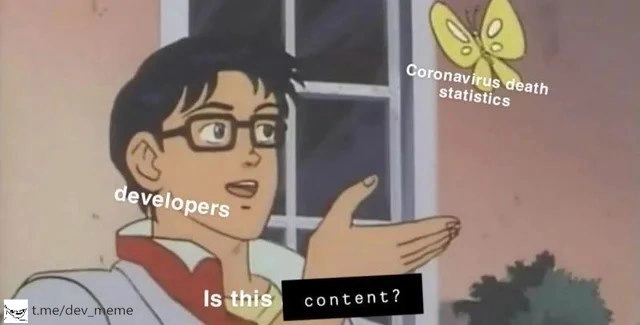
This meme uses the classic “Is this a pigeon?” template to poke fun at developer community content gone astray. In the image, a glasses-wearing cartoon character (labelled “developers”) excitedly points at a butterfly. Normally in this meme format, the character is hilariously mistaken about the butterfly’s identity. Here, the butterfly is labeled “Coronavirus death statistics” – which means the fluttering thing he’s looking at is basically a bunch of grim COVID-19 numbers. The character has a caption by his hand saying, “Is this content?”. So the scenario is: developers (or someone running a dev meme page) sees Coronavirus death statistics (daily pandemic death counts) and is asking, “Is this content?”, as if they’re not sure whether these dire statistics count as something to post in their tech meme feed.

To a junior developer or someone new to these online dev circles, let’s break that down. Developer-run meme channels are online community pages (on Telegram, Reddit, etc.) where programmers share inside jokes and funny images about coding, IT, and software life – prime examples of TechHumor and MemeCulture in action. You’d expect to see jokes about missing semicolons, production server meltdowns, maybe a sprinkle of Elon Musk or Stack Overflow gags. Essentially, content that’s relevant to developers. Now, Coronavirus death statistics are very serious real-world data: numbers of people dying from COVID-19 each day, which in May 2020 were sadly a big part of the news. Normally, that kind of information appears on news sites or public health updates – not on a programming meme channel. It’s not developer humor at all.

So when the dev character in the meme asks “Is this content?”, it’s highlighting an ironic situation: the person running a dev page is so eager to post something – anything – that they’re eyeing pandemic death data as potential “content” for their audience. They’re basically confused (or willfully ignoring context) about what content fits the community. It’s like they’re thinking, “Well, everyone is talking about COVID-19, so maybe I should post these numbers. They’re important, and they’ll get attention. That counts as content, right?” This is a form of content_creation_irony – using material that really doesn’t match the channel’s purpose, just because it’s a hot topic. The meme is calling out that thought process and saying, “Look how ridiculous this looks: a dev page treating death stats like a funny meme.”

There’s also a Communication lesson here: it shows a gap in understanding one’s audience. Good community communication means knowing what your group wants or needs. If you’re in a DevCommunities space, people expect programming-related content. By tossing in unrelated or extremely off-topic information (especially something as heavy as a death toll), the content creator might confuse or even upset the community. Some members might joke along or tolerate it because COVID-19 was on everyone’s mind, but others likely went “What does this have to do with development?” or felt it was in poor taste. That mismatch is the CommunicationBreakdown being highlighted. The admin saw a trending topic (COVID stats were the biggest news then) and assumed trending equals appropriate content. This is part of a larger hype-chasing trend (IndustryTrends_Hype) – where even tech forums or meme pages chase general world trends for engagement, sometimes forgetting their niche.

The meme uses an anime screen cap (from a 90s show, which became a popular meme format) – that’s the PopCultureReference element. Developer meme communities love using familiar meme templates like this because it connects tech jokes to the wider MemeCulture everyone knows. The tiny watermark “t.me/dev_meme” in the corner tells us exactly the kind of channel we’re dealing with: a Telegram group for developer memes. It’s almost meta, because the meme likely originated within that channel as a self-own. It’s as if the community itself realized “we might be reaching too far for content” and made a joke at their own expense.

In summary, for a junior dev: this meme is saying “Developers (or those who run dev pages) can sometimes be so hungry for new posts that they’ll meme about anything trending – even something as unrelated and sad as COVID-19 death stats. Isn’t that silly?” The humor comes from that obvious misfit: Coronavirus statistics are being mistaken for meme content, much like mistaking a butterfly for a pigeon. It’s a gentle reminder that just because something is popular to talk about (trending) doesn’t mean it fits every context. Even a tech humor page can get caught up in hype and momentarily forget what it’s actually about – and that confusion is what we’re laughing at here (with maybe a slight groan).

Level 3: Off-Topic Outbreak

In the depths of DevCommunities, even the gravest global crises can morph into meme fodder. Around early 2020, developer-run channels that normally swap jokes about NullPointerException and borked deployments suddenly started sharing grim covid19_statistics as if they were just another spicy tech anecdote. This meme nails that absurd pivot: a bewildered developer figure reaches out to a butterfly labeled “Coronavirus death statistics”, earnestly asking “Is this content?”. It’s a biting satire of IndustryTrends_Hype culture bleeding into spaces where it arguably doesn’t belong. Seasoned engineers recognize the dark irony: content creators so desperate to ride a trend that they’ll post pandemic death counts in a tech meme group — a classic CommunicationBreakdown between what’s relevant and what’s merely viral.

At its core, the humor comes from blatant miscategorization. The anime scene (a famous PopCultureReference often called the “Is this a pigeon?” meme) originally shows a character mistakenly identifying a butterfly as a pigeon. Here, that clueless character is labeled “developers” (with a half-clipped "deve" hinting at developer), and the butterfly—the thing being misidentified—is a chart of Coronavirus death statistics. By asking “Is this content?”, our hapless dev protagonist mirrors real-life community managers who confuse anything trending with quality tech content. It’s an off-topic outbreak: a lethal pandemic’s body-count graph is mistaken for appropriate dev chatter. The meme’s creator even left a self-aware watermark (t.me/dev_meme), suggesting an inside joke by the very dev meme community that experienced this. It’s a moment of collective head-shaking: even our sacred programming meme groups were not immune to the “must-post-about-COVID” contagion.

Why does this resonate with battle-hardened devs? Because we’ve seen how online communities pander to hype. In theory, a developer forum or meme channel should stick to code humor and relatable programming gaffes. In practice, when a global event dominates headlines, every content outlet feels pressure to acknowledge it. Memers, normally obsessed with Docker woes or JavaScript schadenfreude, suddenly feel compelled to post daily case numbers or lockdown jokes. It’s HumorInTech meets bleak reality. The result is often tone-deaf or jarringly out of place. Experienced developers remember other times when tech spaces chased trends: the blockchain craze that turned every discussion into crypto-hype, or AI everything, even if the audience groaned. This pandemic twist is a particularly extreme case — it’s not even tech-related news repackaged, it’s literally life-and-death statistics presented as “content.” The laugh (albeit a dark laugh) comes from that sense of “Have we really come to this?”

Deep down, this meme is a critique of content strategy gone awry. In chasing engagement, the IndustryTrends tail wags the dog. The developer in the image represents community admins or contributors who should know their audience (fellow devs looking for coding humor), yet here they are, treating a morbid data trend as fair game for a meme drop. It’s as if the only requirement for content was that it’s trending — topical relevance be damned. You can almost hear the cynical inner monologue of an old sysadmin: “We ran out of original jokes, so hey, why not repurpose the news ticker of doom? That’ll keep ’em clicking.” This undermines the Communication norms in these groups; it’s the kind of move that makes veteran members roll their eyes and newbies very confused about what this channel is even about.

To put it in code, the logic being mocked might look like:

# The "Is this content?" selection algorithm
if topic.is_trending() and not topic.is_dev_related():
    add_to_content_queue(topic)  # Because trending > relevance

The meme’s satirical brilliance is capturing that flawed algorithm in a single image. It highlights the content_creation_irony: by trying to capitalize on a headline-grabbing crisis, the content veers away from the community’s purpose. For those who’ve been around tech circles, it’s a weary reminder that even geeky sanctuaries can succumb to lowest-common-denominator TechHumor grabs. It’s funny in the same way a facepalm is funny — equal parts comedy and cringe. The CommunicationBreakdown here is palpable: the dev community’s signal-to-noise ratio gets warped when anything can be justified as “content.” In short, this meme hits home for senior devs because it lampoons a trend we know too well: when engaging the algorithm matters more than engaging the actual community. It’s a laugh so you don’t cry moment, encapsulating how an IndustryTrends_Hype can lead well-intentioned tech spaces into bizarre territory.

Description

This meme uses the popular 'Is this a pigeon?' format, featuring a screencap from the anime 'The Brave Fighter of Sun Fighbird.' In the image, an anime character with glasses, labeled 'developers,' is looking quizzically at a yellow butterfly, which is labeled 'Coronavirus death statistics.' At the bottom, the original caption 'Is this a pigeon?' has been altered to 'Is this content?'. A watermark for 't.me/dev_meme' is visible in the bottom left corner. The meme satirizes the wave of developers in early 2020 who used the COVID-19 pandemic data to create numerous dashboards, trackers, and articles. The humor critiques the perception that a serious public health crisis was being treated as a simple opportunity for 'content creation' or portfolio building, questioning the motives and the actual utility of the flood of similar projects. For senior engineers, it's a cynical take on tech solutionism and the community's occasional tone-deafness in chasing trends


Comments

7
Anonymous ★ Top Pick The fastest way to get a developer to learn D3.js is to release a tragic global event as a public JSON API
  1. Anonymous ★ Top Pick

    The fastest way to get a developer to learn D3.js is to release a tragic global event as a public JSON API

  2. Anonymous

    If your engineering blog pivoted from distributed tracing deep dives to daily COVID fatality charts, you don’t have a content strategy - you have curl | jq | publish

  3. Anonymous

    Finally found a use case for that real-time data streaming architecture we built in 2019 - watching Johns Hopkins dashboard updates instead of our own service metrics

  4. Anonymous

    When your product manager asks for 'engaging dashboard content' and you're staring at mortality statistics wondering if this counts as a valid data source for your analytics platform. Spoiler: ETL pipelines don't make ethical decisions for you - that's still a human-in-the-loop problem we haven't automated away

  5. Anonymous

    Growth finds the COVID death dataset: “Is this content?” Principal engineer: only behind a feature flag named decency with the kill switch owned by Legal

  6. Anonymous

    Outages at COVID scale? Mere log noise. Butterfly effect crashing the K8s canary? Now *that's* content worth a 3AM page

  7. Anonymous

    Product asked for “viral content”; the data team shipped a daily mortality dashboard - KPIs up, ethics down

Use J and K for navigation