The Agony of an Enterprise Java Developer
Why is this Enterprise meme funny?
Level 1: Dancing but Desperate
Imagine a clown at a carnival, dancing around with a big smile on his face, saying, “Oh yes, I love my job!” Everyone sees the bright costume and the happy dance and thinks he’s having a great time. But then you notice something odd: the glittery letters on his outfit spell out a secret message: “HELP ME, I’VE BEEN DOING THE SAME TRICK FOR 5 YEARS.” And next to this cheerful clown, there’s a little cartoon character on the ground yelling “AAAAAA!” at the top of its lungs. 🥴 It’s funny and a bit sad at the same time. The clown looks joyful on the outside (dancing hotdog style!), but he’s actually really tired and screaming for help on the inside – even the cartoon on the ground is screaming for him.
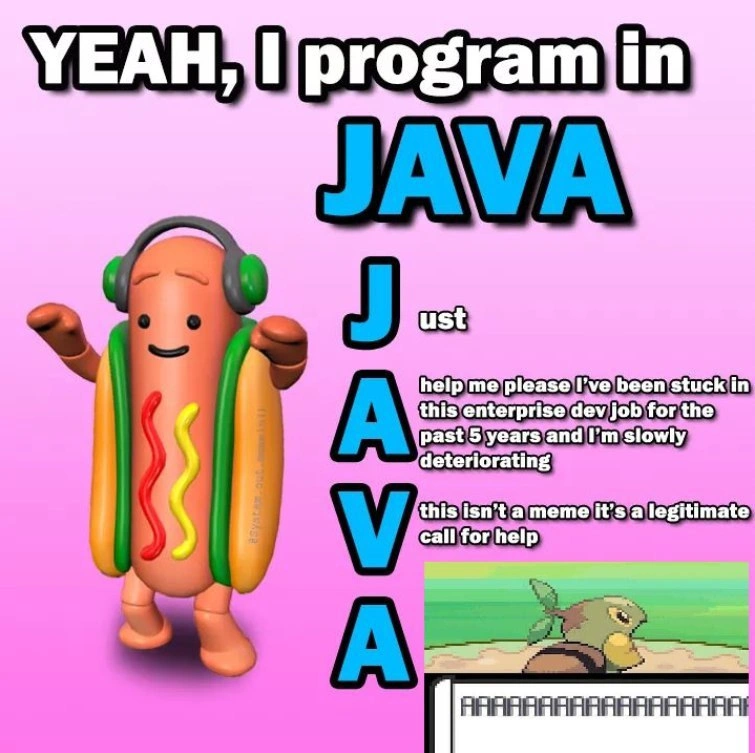
This meme is just like that. It shows a happy dancing hotdog saying, “Yeah, I program in Java!” like he’s proud and excited. But hidden beside those big letters J-A-V-A, it actually says “just help me please… this isn’t a meme, it’s a call for help.” So, the programmer is acting proud and enthusiastic, but secretly they’re begging to be saved from their boring, exhausting job. The silly hotdog and the screaming Pokémon make it extra goofy, but the idea is simple: sometimes people pretend to be happy doing something, while inside they feel really stuck and unhappy. It’s funny because the truth slips out in a sneaky way, and we don’t expect a happy dancing hotdog to be delivering an undercover SOS message. It’s like a friend laughing and saying “I’m fine, everything’s fine 😅” when you can clearly tell from the tiny print (or their face) that they’re actually not fine at all. The humor comes from that big contrast – happy on the surface, desperate underneath – which anyone can chuckle at, because we all know what it’s like to fake a smile when we’d rather yell “Aaaaah help!”
Level 2: Trapped in a Java Jar
Let’s break down the joke in simpler terms. The meme is playing with the word “Java” in a funny way and combining a few different nerdy elements to tell a story. First, Java is a very popular programming language – one that’s been around for a long time. It’s used a lot in big companies for their software (banks, insurance systems, large websites, you name it). When you hear “enterprise software,” it often means huge applications running in big organizations, and Java has been a go-to language for that. So saying “Yeah, I program in Java” is like saying “I work with this very established, corporate tech.” Some developers joke that working with Java, especially in an Enterprise setting, can be a bit dull or heavy compared to newer languages. Java is known for being reliable and scalable, but also a bit verbose (meaning you often write a lot of code to do something simple) and conservative (corporations stick with it for years, even decades). So sometimes, “Java developer at a big company” brings to mind an image of someone dealing with old code and not-so-exciting projects – hence the hint of embarrassment or distress hidden in this meme.
Now, look at how “JAVA” is written in the meme: the letters J-A-V-A are stacked vertically down the right side. Next to each letter, in very small text, there’s more of the sentence. Together, reading top to bottom, it forms a secret message: “Just help me please I’ve been stuck in this enterprise dev job for the past 5 years and I’m slowly deteriorating, this isn’t a meme it’s a legitimate call for help.” So the word “JAVA” is being used as an acrostic – a fancy term for when you use the first letters of a word to start each line of a message. It’s like if you wrote a poem where the first letters of each line spell a word vertically. Here, the word is JAVA, and the “poem” next to it is actually the programmer’s hidden plea for help. This is the big joke: the programmer is outwardly saying “I use Java,” but secretly they’re begging to be rescued from their job.
Why would they need rescuing? The text says they’ve been in an enterprise dev job for 5 years and are slowly deteriorating. In non-dramatic terms, they’ve likely been doing the same kind of work, at the same company, with the same technology (Java) for quite a while, and it’s wearing them down. Developer burnout is the idea here – that a programmer is exhausted or losing enthusiasm because of a long period of stress or boredom at work. Enterprise jobs (big corporate software developer roles) can sometimes become repetitive or bureaucratic. You might spend a lot of time maintaining old systems instead of building new cool stuff. After years, some developers feel stuck, like they’re not learning new things or their work is not exciting. Five years in tech is a significant time – technologies outside might have evolved (new frameworks, new languages), but often big companies move slowly, so that developer might still be working with an old version of Java or an outdated system. Saying “I’m slowly deteriorating” is obviously an exaggeration for comedic effect, but it reflects feeling tired or drained. And “this isn’t a meme it’s a legitimate call for help” is a tongue-in-cheek way to say: I’m joking… but also not really. It’s the kind of dark humor tech folks use to cope – like laughing about something that actually bothers them.
Now to the fun visual elements: On the left, we have that dancing hotdog character. If you’re not familiar, the dancing hotdog was a popular Snapchat filter that turned a silly cartoon hot dog with headphones into an augmented reality character dancing in your videos. It became a bit of an internet meme on its own – basically a goofy, happy-go-lucky hotdog that can dance to any music. In memes, people use the dancing hotdog to represent carefree joy or just something ridiculously upbeat. Here it’s used ironically: the hotdog is grinning and dancing as if to say “I’m so happy, I code in Java, woohoo!” It represents the external persona, like the developer trying to appear positive and chill about their Java job. The hotdog emoji wearing green headphones is super upbeat, which makes it funny when you realize the text next to it is anything but upbeat. That contrast is intentional – it’s like someone in a fun costume saying “Everything is fine!” while a tiny voice next to them says “Actually, I’m not fine.” The bright pink-to-purple gradient background adds to that cheerful, almost silly tone. It’s visually saying “This is a fun meme, nothing to see here!” even while the content is pretty dark and serious if you read it literally.
On the right bottom corner, you see what looks like a screenshot from a Pokémon game – specifically a battle scene. If you remember or know Pokémon games: when a Pokémon is knocked out (or “faints”), the game usually shows the Pokémon sprite grayed out or down with a text box indicating it fainted. Often it might say something like “Pikachu has fainted!” or show the Pokémon’s name with a dramatic line. In the image, we see a fainted creature (it appears to be a Torterra, a grass-type Pokémon, lying on its belly) and the dialogue box at the bottom just screaming “AAAAAAAAAA”. This looks like the player named the Pokémon “AAAAAAAAAA” (just a string of A’s) so that when it faints, the game literally displays “AAAAAAAAAA”. It’s a clever little trick some meme-makers use: by naming a character or object with letters like “AAAA”, the game’s message doubles as a scream. So effectively, the game is showing a Pokémon passing out with a big “AAAAA!” which is basically a big scream or panic yell. In the context of this meme, that Pokémon fainting and screaming represents the developer’s breaking point or inner collapse. It’s an exaggerated cartoon way to show “I can’t take it anymore!” The fact that it’s a Pokémon reference adds a layer of nerdy humor – many developers grew up playing Pokémon, so it’s a culturally familiar way to depict frustration. Think of it as the dev’s last bit of strength giving out, humorously illustrated by a fainted Pokémon howling in defeat.
So, putting it all together in a straightforward way: The meme starts as if it’s a proud statement – “Yeah, I code in Java” – with a smiling dancing hotdog mascot, which seems like a funny, positive vibe. But then it reveals the coder’s secret misery through the word Java turned vertically into a message, plus that Pokémon screaming in pain. It’s like a little story: a developer is outwardly happy or at least pretending to be (“dancing” because they have a steady job coding in Java), but inwardly they’re screaming for help because they feel stuck and burned out by their corporate job of 5 years. This contrast is the joke. It’s very relatable humor to other programmers, especially those who might have felt bored or burnt out in a long-term project. Even if you’re a newer developer, you might have heard people poke fun at “enterprise jobs” or “legacy code.” This meme basically puts those feelings into a colorful, absurd scene.
It also touches on corporate culture in tech. Big companies often try to keep a very upbeat atmosphere – think about all those motivational posters, team-building events, or the fun Slack emojis. There’s sometimes a pressure to be positive and grateful for your job, even if it’s grinding you down. The hotdog dancing and the “YEAH!” at the top mimic that forced positivity. Meanwhile, the tiny text stuffing a wall of despair next to that says the quiet part out loud: some developers feel like they’re dying inside but don’t openly say it, so they joke about it. It’s a coping mechanism. You’ll find a lot of developer humor like this on forums or social media where programmers share memes about their struggles – complaining about a tough project or a silly bug but in a light, joking way. It helps people bond and feel less alone in their frustration. So somebody who has been in a Java enterprise role for a while might share this meme with the caption “#relatable” or “mood” because they see themselves in it.
Let’s clarify a few terms to ensure everything’s understood. Java (the language): It’s an object-oriented programming language famous for its slogan “write once, run anywhere,” meaning Java code can run on many different devices without modification thanks to the JVM (Java Virtual Machine). It’s used for everything from Android apps to large backend systems. Over the years, Java has accumulated a huge collection of libraries and frameworks, especially for enterprise development – like JEE (Java Enterprise Edition), Spring Framework, and many others. These tools are powerful but can be complex and heavy. Working in enterprise Java often means navigating a lot of legacy code (old code that’s still in use) and following strict coding standards set by the company.
Enterprise dev job: This just means a software developer role at a large company, usually working on internal or big systems (as opposed to, say, a small startup or freelance projects). Enterprise environments tend to involve more meetings, documentation, and maintenance of existing systems. The pace can be slower, and you might be using older technology because big companies don’t always upgrade quickly – they value stability. For example, an enterprise might still use Java 8 even if newer Java versions are out, because upgrading can be risky or costly. Some developers love the stability and depth of this work, but others can find it stifling after a while, especially if they want to experiment with new things.
Burnout: This is a state of emotional, mental, and often physical exhaustion caused by prolonged stress or frustration. In developer terms, burnout might happen if someone has been working long hours under pressure, or doing tedious work without a break, or feeling unappreciated and stuck. Symptoms include feeling tired all the time, losing passion for work you used to enjoy, and sometimes even health issues. The meme exaggerates it (the person says they’re “deteriorating,” like a battery running out), but it points to a real phenomenon. After 5 years of doing something that maybe doesn’t excite them anymore, this developer character is “done,” humorously shown by them yelling for help via meme.
Meme format: Using an acrostic in a meme is a playful trick. It catches people off guard – you think you’re just reading a normal sentence, then you realize the letters spell out something more. It’s like a hidden puzzle. This format is great for internet humor because it delivers a surprise. The big bold letters J-A-V-A draw your attention, and at first you just read “JAVA”. Only on a closer look do you start reading the small text and go, “Oh… oh wow!” That delayed punchline makes it funnier. The presence of the dancing hotdog and Pokémon adds layers of pop culture so it’s not just text-on-background. It’s visually engaging and packed with references that tech folks find funny (Snapchat filters, Nintendo games, etc.).
Finally, the tone of the meme is what we’d call “dark humor” or “self-deprecating humor.” The creator is making fun of themselves (or the stereotypical Java coder) by turning their “admission” of using Java into a joke that they need saving. It’s like if someone says, “I’ve been eating only instant noodles for a month,” and then adds, “send help.” It comes off as a joke, but it hints at a real complaint (e.g., they’re tired of their situation). In professional settings, developers often use this kind of humor. For example, someone might quip “I’ve been debugging Java code for so long, I see curly braces in my dreams, please send help.” Everyone laughs, but they’re also venting a bit. This meme is essentially that vent – dressed up in bright colors and memespeak. It’s relatable to anyone who has felt stuck in their job or tired of doing the same thing for years. Even if you’re new to programming, you can imagine the feeling: it’s like doing the exact same school assignment every day for years – at some point you’d be like “please, no more!”
So, to sum up Level 2: the meme jokes that saying “I program in Java” is practically a hidden plea for rescue, because the person has been doing dreary corporate Java work for ages. It uses a funny vertical text trick, a dancing hotdog (to symbolize the forced happiness), and a screaming Pokémon (to symbolize the inner despair) to deliver this idea. It’s poking fun at the enterprise developer life and the burnout that can come with it, in a very developer humor kind of way. If you’ve ever heard a programmer jokingly say “It’s fine, I’m not trapped at all” about their job, this meme is basically that vibe in picture form.
Level 3: Enterprise Ennui
At first glance, this meme looks upbeat: a smiling dancing hotdog with headphones boogies on a cheerful pink backdrop, proudly proclaiming in bold text, “YEAH, I program in JAVA.” But look closer – the giant cyan letters JAVA down the side aren’t just for show; they form an acrostic message that’s anything but joyful. Each letter unveils a line of small white text: “Just … Ahelp me please I’ve been stuck in this enterprise dev job for the past 5 years and I’m slowly deteriorating … Vthis isn’t a meme it’s a legitimate … Acall for help.” The dev’s enthusiastic claim of using Java quickly mutates into a cry for help caption. It’s a hilarious and dark reveal: the meme itself is literally a hidden SOS, as if the programmer is encoding their despair in plain sight. This contrast – flashy positivity on the surface, utter desperation underneath – is the core of the humor. Seasoned developers recognize this pattern immediately. We’ve all seen colleagues paste on a grin about their stable “enterprise job,” while their soul withers like a fainted Pokémon screaming “AAAAAA” on the inside. In fact, the meme explicitly shows that: a pixelated Pokémon faint reference in the bottom-right, with a poor creature collapsed and the battle text “AAAAAAAAAA” echoing pure agony. That’s basically the developer’s internal scream, rendered in nostalgic 8-bit form. It’s absurd, it’s meta, and it’s painfully relatable to anyone who’s felt trapped maintaining a legacy system.
This mashup of elements is oddly perfect. Java is famously the workhorse of big corporations (the realm of Enterprise software and soul-sucking maintenance tasks). Announcing “I program in Java” at a startup meetup might get you pitying smirks, as if you just confessed to an old-fashioned lifestyle. Here, the meme plays on that stereotype: the jaunty “Yeah, I use Java!” comes off less like a boast and more like a plea. The developer is using humor as a safety valve. The phrase “I program in Java” becomes code for “I’m stuck in a boring enterprise gig”. The truth is spelled out literally alongside the letters J-A-V-A. It’s a brilliant jab at EnterpriseLife in corporate IT. The hotdog man – a goofy AR meme from Snapchat – adds to the irony. He’s the picture of carefree fun, something you might see in a corporate wellness email trying to lighten the mood. But next to him is text revealing a personal meltdown. We’ve got CorporateHumor at its finest: the kind of dark joke you whisper under your breath after deploying the billionth WAR file to an ancient JBoss server. The juxtaposition is key: a dancing_hotdog_meme mascot exuding positivity versus the dev’s actual feelings of enterprise_dev_burnout. It’s the smiling mask over the screaming face.
For veteran developers, this hits home because it satirizes real industry patterns. Many of us have done a stint in a big company where the tech stack revolves around Java, huge monolithic applications, and endless frameworks. Five years grinding on a legacy Java EE (Enterprise Edition) system can indeed feel like a sentence in a java enterprise prison. You maintain code that’s older than some interns. You wrestle with EnterpriseSoftwareChallenges daily: massive inherited codebases, mysterious 4,000-line classes, SingletonFactoryBeanFactories (yes, those exist), and XML configs that read like arcane tomes. Every “enterprise Java” dev has stories of slogging through unending JIRA tickets for feature tweaks that hardly move the needle. After enough time, you start feeling like that fainted Pokémon: out of HP, down for the count. The meme captures this with hyperbole that barely feels like an exaggeration. DeveloperBurnout is very real here – the text literally says “I’ve been stuck… and I’m slowly deteriorating.” That line isn’t exaggerating much for someone hitting year 5 on an unchanging project. Burnout in tech often manifests as this deteriorating enthusiasm. First year, you’re brimming with energy (maybe like that dancing hotdog). By the fifth year of putting out fires in a Spring 3.x application that your company refuses to upgrade, you’re mentally curled up like that fainted Pokémon crying “AAAAAAAA”. It’s RelatableHumor because so many devs have lived it: the enthusiasm of solving problems gives way to ennui when you’re solving the same problems or wrestling the same old bugs over and over.
Why is it so hard to escape this scenario? The meme hints at desperation: “this isn’t a meme, it’s a legitimate call for help.” That’s funny-sad because it rings true. Talented programmers sometimes feel stuck in cushy but stagnant enterprise jobs. Companies dangle comfortable salaries (the proverbial “free coffee” – Java is named after coffee after all) and stability, which can lead to CareerHumor situations where devs jokingly refer to themselves as lifers or say they have Stockholm syndrome with their tech stack. There’s an incentive to stay – you become the go-to person for that legacy system, you gain domain knowledge. But that very stability becomes a honey trap; you fear your skills are becoming too specialized or outdated for the outside world. It’s a systemic issue in CorporateCulture: big enterprises aren’t always quick to adopt the newest languages or frameworks. A codebase that “works” (even if held together by threads and prayers) won’t be replaced easily. So the dev keeps patching it year after year, building technical debt and personal fatigue. Modern best practices might scream “refactor or rewrite,” but reality in a bank or insurance company’s IT department says “if it ain’t broke (badly enough), don’t fix it.” Over time, that wear-and-tear accumulates on the human, not just the software. The EnterpriseLife grind is real – endless meetings about whether to upgrade the JDK, debating if moving one service to the cloud is worth it, completing mandatory security trainings instead of coding – all parts of the slow decay of passion. It’s no wonder that “Just help me please” line is plastered next to the bright letter A in JAVA.
The humor here also lies in the disconnect between appearances and reality. It’s practically an inside joke among seasoned devs that corporate teams often maintain a positive front (“Our tech stack is robust and mature”) while the developers privately groan (“...and ancient and painful”). This meme exaggerates that: an absurdly happy emoji mascot selling the idea of Java programming fun, while the subtext screams monotony and distress. Senior engineers often laugh at this because they’ve been in those sprint retrospectives where management congratulates everyone on a job well done, and you’re sitting there thinking, “I haven’t felt genuine excitement for this app since the Obama administration.” The Pokémon faint image shouting “AAAAAA” is basically the veteran dev’s spirit animal in those moments. And of course, using Pokémon is a nerdy cherry on top – many devs grew up with it, and seeing a beloved creature dramatically keel over is both funny and an apt metaphor for burnout. It’s a cross-generational nod: from the era of Game Boy screams to the era of enterprise Java apps, the pain is the same.
In a deeper sense, the meme resonates as a commentary on career stagnation. Five years in the same enterprise role working with the same technology can feel like 50 in tech-years. The industry evolves fast outside, but inside a big corp, you might still be on Java 8, praying for permission to use Java 11 features someday. It’s humorous because we recognize the absurdity: the developer in the meme has basically hidden a resignation letter in an acrostic form. It’s like those jokes about a prisoner sending a cake with a file in it – here the dev sends out a meme with a “get me out” embedded. For the Cynical Veteran crowd, it’s both funny and a touch tragic. We laugh, but we also nod knowingly. The vertical JAVA might as well stand for “Just Another Victim of Agony” in our minds. Been there, done that, got the coffee mug.
To really drive it home, consider how the meme’s text formatting itself is a clever mimicry of corporate cheer. The top says “YEAH, I program in Java” in big, bold, enthusiastic font – that could be a line from some cringey company newsletter spotlight: “Meet John, he’s proud to code in Java!” The background is a friendly pink-purple gradient; it screams marketing or social media team trying to be hip. And then the content goes off the rails into truth-land with a microscopic font rambling a genuine cry for help. It’s parodying those overly positive corporate communications where, reading between the lines, employees are miserable. This meme just literally writes out the between-the-lines part. An experienced engineer will appreciate the art of that satire – it’s almost cathartic. We’ve sat through PowerPoint decks with dancing mascots telling us how great the next release will be, even as we think “oh God, please no.” The meme cuts through that BS in one fell swoop.
It’s worth noting that Java, as a language, often gets unfairly labeled “boring” or “enterprise-y,” but there’s some truth behind the stereotype. Java has powered huge enterprise systems for decades – banks, governments, Fortune 500s – so it’s associated with large-scale, sometimes stodgy systems. A lot of DeveloperHumor around Java pokes fun at how much code you have to write (all those classes and factories), or how many years you might spend maintaining a single huge application. This meme isn’t complaining about Java’s syntax or the JVM though – it’s targeting the experience of the Java corporate developer. That experience can indeed be like running on a treadmill that never stops. You might be using robust technologies (the JVM is solid, performance is fine), but the creativity and novelty can drain away if you’re fixing the same billing system year after year. The meme’s author hyperbolically suggests they’re “slowly deteriorating” – a phrase that sounds dramatic, but any senior dev reading it might chuckle and mutter, “Mood.” We’ve seen brilliant colleagues burn out and fade in similar fashion. The call for help line, while played for laughs, hints at genuine mental health concerns that are not uncommon in our field. Burnout is sometimes called the “developer’s silent epidemic,” and here it’s not so silent – it’s plastered in bright cyan letters ironically.
In summary, the meme blends dark honesty with absurd presentation to capture a slice of Enterprise developer reality. It’s a little story: a Java coder publicly high-fives about their language (maybe to fit in or convince themselves), but can’t hold back the truth and sneaks in a plea for rescue. The veteran perspective sees layers here – the tech layer (Java’s enterprise ecosystem), the human layer (burnout and stagnation), and the cultural layer (how we use humor to cope). That mix is what makes this meme chef’s kiss to experienced devs: it’s hilariously real. We laugh because otherwise we’d cry – and this meme does both. In a way, it’s a modern office twist on the classic trope of the clown crying behind the mask. Only here the mask is a dancing hotdog and the tearful clown is a senior Java dev with 1000-yard stare.
(If this scenario were Java code, it might look ironically like:)
for (int year = 1; year <= 5; year++) {
workOnLegacyJavaCode();
}
throw new DesperateException("Help me, I'm deteriorating");
(Looping through five years of legacy maintenance, then finally throwing a desperate exception – a bit of gallows humor any overloaded enterprise dev can smirk at.)
Description
A multi-panel meme set against a pink background featuring a dancing hotdog character with green headphones. The top text boldly states, 'YEAH, I program in JAVA'. The word 'JAVA' is then spelled out vertically as an acrostic. The 'J' stands for 'Just'. The 'A' is followed by 'help me please I've been stuck in this enterprise dev job for the past 5 years and I'm slowly deteriorating'. The 'V' is for 'this isn't a meme it's a legitimate call for help'. The final 'A' is next to an inset image from a Pokémon game, showing a distressed-looking Turtwig character with a text box underneath filled with a prolonged scream: 'AAAAAAAAAAAAAAAAAAAA'. This meme uses dark, absurdist humor to comment on the stereotypes associated with enterprise Java development. It captures the feeling of being trapped in a monotonous, bureaucratic, or technically stagnant corporate job, leading to severe developer burnout. The screaming Pokémon character serves as a comedic yet poignant representation of the developer's internal despair, a sentiment that resonates with experienced engineers who have navigated similar corporate environments
Comments
17Comment deleted
Some say enterprise Java is a stable career. So is being a fossil, but you don't see many dinosaurs pushing to production on a Friday
I also “do Java” - which is senior-speak for babysitting a 700-kiloline J2EE monolith so ancient even git blames CVS, while each OKR is just another politely formatted scream for microservices
Five years in enterprise Java is just enough time to become an expert at explaining why the AbstractSingletonProxyFactoryBean you wrote in year one is now load-bearing infrastructure that nobody can touch
After five years maintaining that Spring monolith with 47 XML config files, three different ORM layers, and a build process that takes longer than your sprint - yeah, the hot dog costume and forced smile are pretty much mandatory at this point. The real enterprise pattern here isn't Singleton or Factory, it's Stockholm Syndrome
Enterprise Java: Where 'just' a simple service morphs into a 5-year XML odyssey of existential GC pauses
JAVA: Just Another Vendor Approval - five years in enterprise and I’ve tuned more GC flags than shipped features
JAVA: Just Another Voluntary Attrition - when your GC pauses are still shorter than change-control
Meirl Comment deleted
That's truly story. Same with Jenkins Comment deleted
YEAH, I program in JAVA Jenkins AWS Version 9 AAAAAAAAAAAAAAAAA Comment deleted
this one goes hard😤😤😤 Comment deleted
Version 9. Lucky you Comment deleted
I feel personally attacked Comment deleted
Now imagine being a developer in a place without stable electricity Comment deleted
Ukraine in last winter, thanks to russian attacks at energy infrastructure Comment deleted
Sorry about that. And Nigeria we've never had the luxury of stable electricity Comment deleted
Java: not even once. Comment deleted