The Programmer's Paradox: Smart People, Stupid Mistakes
Why is this DevCommunities meme funny?
Level 1: Following Directions
Imagine you have a robot friend who can build or do anything you ask, but only exactly what you ask and how you ask. This robot isn’t smart on its own – it doesn’t think about what the task means – but it’s really fast and precise at doing instructions. Now, suppose you’re a really smart kid and you give your robot friend a recipe to bake cookies. You know a lot about baking (you’re the smart person here), so you write down instructions for the robot: “Add sugar, add flour, bake for 20 minutes,” and so on. But oops! – while writing the recipe, you accidentally wrote “1 cup of salt” instead of “1 cup of sugar.” 😮
What do you think the robot will do? It will take that recipe and follow it to the letter. It doesn’t know that a cup of salt in cookies is a silly mistake. It’s just a machine following orders. So it adds a whole cup of salt, bakes the cookies perfectly for 20 minutes, and proudly presents them. The result? Salty, inedible cookies! The robot did an incredibly smart thing in one sense: it baked cookies all by itself, which is pretty cool. But because of the one bad instruction you gave, those cookies taste terrible. You, the smart human who wrote the recipe, ended up doing something incredibly silly – you put the wrong ingredient in the instructions.
This is exactly the point of the quote. The computer is like that super obedient robot: it will do amazingly complex jobs for us (like baking, or solving math problems, or running a video game) but it has no understanding of the task. It just follows steps. If there’s a mistake in the steps, it doesn’t know. The programmer (or the person giving the instructions) is like you, the smart recipe writer who goofed up by accident. You’re intelligent and know what you wanted to happen, but because you made a small mistake in the instructions, the outcome is wrong. It’s a funny situation because usually we expect smart people not to make silly mistakes. But in reality, even very smart people do make simple mistakes sometimes!
Think of another example: say you’re teaching a friend a dance move. You’re really good at dancing (smart at it), and your friend will do exactly what you say. If you accidentally say “left” when you meant “right,” your friend will move the wrong way. They’re not stupid; they’re just doing what you told them. And you’re not actually stupid either; you just slipped up and said the wrong word. But the end result is a goofy mess-up in the dance. You both might laugh about it. In the same way, programmers and computers often end up in funny (or frustrating) situations where the computer does something totally off-the-mark because the programmer inadvertently gave the wrong instructions.
The emotional core of this meme – why it’s funny and resonates – is that it reassures us of a simple truth: everyone makes mistakes. Computers will magnify those mistakes because they don’t know any better, which can lead to some absurd outcomes. The quote by Bill Bryson is basically a clever way of saying, “Computers only do what we tell them, and sometimes we tell them to do something stupid without realizing it.” It makes us chuckle because we’ve all experienced moments where we did something foolish even though we should’ve known better. It’s like writing a very important email and then accidentally sending it to the wrong person – a smart person, a simple goofy error, and now there’s a funny (or embarrassing) story to tell. In programming, those stories happen a lot!
So, in the simplest sense, this meme is funny because it shows a role reversal: the machine that we think of as not having a brain can do great things, and the human who has a brain can mess up badly. It reminds us not to get too proud and to always double-check, because even bright people can have silly moments. And when those moments happen, it’s better to laugh and learn from them.
Level 2: Literal Machines, Human Errors
In simpler terms, this meme highlights how computers and programmers operate in fundamentally different ways, and how that difference leads to bugs in software. Let’s clarify what Bill Bryson’s quote is saying:
A computer is described as a “stupid machine with the ability to do incredibly smart things.” This sounds strange at first. What it means is that a computer, by itself, isn’t smart at all – it has no feelings, no creativity, no understanding. It’s basically a collection of circuits that follow instructions (the programs we write). We call it “stupid” in the sense that it can’t think for itself or make judgments. However, when you give a computer a good set of instructions, it can do amazing things very fast and very accurately. For example, a computer can calculate large sums, draw complex graphics, or search through millions of records without getting tired. These are “incredibly smart things” in the sense that the tasks seem very intelligent or difficult – but the computer achieves them by brute-force obedience to the code, not by being clever on its own.
A programmer (or software developer) is described as a “smart person with the ability to do incredibly stupid things.” This is a playful jab at people like us who write code. Programmers are generally knowledgeable about logic and technology – we solve problems, we create algorithms, so we like to think of ourselves as pretty smart folks 😅. But the quote humorously points out that even very smart people can and do make really silly mistakes when coding. An “incredibly stupid thing” in programming usually means a really basic error or oversight that causes a bug in the software. It’s the kind of mistake where you facepalm and say, “I can’t believe I did that.” It could be as simple as forgetting to check if a user’s input is valid, or using the wrong variable name, or adding two numbers incorrectly in code. These errors might be obvious in hindsight, but in the moment, even a genius can miss them.
The key concept here is literalism of computers versus the fallibility (ability to err) of humans:
Computers follow instructions literally: They do exactly what the code tells them to do, no more and no less. There’s a popular saying in programming: “computers do what you tell them to do, not what you want them to do.” If you accidentally tell the computer to multiply two numbers when you meant to add them, it will multiply. It won’t stop and say, “Hey, maybe you meant addition?” It has no common sense. This literal obedience is why we call it a “stupid machine” in the quote – not as an insult, but to emphasize that it lacks understanding. The computer cannot detect if a step in the instructions is a mistake; it just carries it out. So, a computer will perform a smart task (like sorting a list of a million names alphabetically) flawlessly if the code is correct. But if there’s a mistake in the code, the computer will faithfully execute the wrong steps and potentially produce a very stupid outcome (like a jumbled list or a system crash).
Humans (programmers) can make mistakes: No matter how smart a programmer is, they are human. Humans get tired, humans overlook details, and humans sometimes have wrong assumptions. In programming, a tiny mistake can cause the whole program to behave incorrectly. We call these mistakes bugs. A bug is basically an error or flaw in the software’s code that leads to an incorrect or unexpected result. For example, a developer might forget to account for what happens when a user hits cancel on a form, and as a result a whole application might freeze or throw an error when that happens. That would be a bug. It’s a “stupid” thing in the sense that it’s usually not a complicated theoretical problem – it might be a simple oversight. The quote is saying that a smart person (the programmer) has an almost magical ability to do these inexplicably dumb things like create bugs. It’s tongue-in-cheek. Of course, programmers don’t try to write bad code – it just happens because programming is hard and our brains aren’t perfect.
Why is this funny to developers? It’s a form of self-deprecating humor. That means we’re making fun of ourselves in a friendly way. In the world of DeveloperCulture, people often share quotes and jokes about bugs and mistakes because it’s a way to stay humble and also to bond over shared experiences. When you’re new to coding, you might feel bad or even embarrassed the first time you create a bug that breaks something. But then an experienced programmer might comfort you with this very quote or a similar joke, essentially saying: “Don’t worry, it’s not just you. Even the best of us do that! Look, we’re supposedly smart, but we all do these stupid mistakes sometimes.” It’s a normal part of learning and working in tech.
The meme format here – a big quotation on a conference-style background – suggests this is a well-known saying, almost motivational-poster style. DevCommunities (like forums, subreddits for programmers, or chat groups at work) often share quotes like this to lighten the mood. It’s common to see posts tagged with DeveloperHumor or TechHumor that recount funny programming errors or ironic truths of coding life. This particular quote by Bill Bryson is popular because it elegantly sums up the love-hate relationship programmers have with computers (and with their own coding blunders!). It’s basically saying: “Hey, computers are super powerful but dumb, and we humans are brilliant but not as smart as we think – just look at the bugs we introduce!” Everyone who has written code for a while has experienced writing something that seemed correct at the time, only to discover later that it was a silly mistake causing a bug. We’ve all had that “oops” moment.
Let’s define a couple of the terms in the categories and tags to make sure everything’s clear:
Bugs in Software: A bug is what we call any mistake or error in a program that makes it behave in a way that wasn’t intended. The term “bug” is funny because of the anecdote with the actual moth in early computers, but it’s been used for decades to mean glitches or faults. If an app crashes when you click a button, that’s a bug. If a website shows wrong information because of a calculation error, that’s a bug. Bugs can be small annoyances or big problems, like security vulnerabilities or system outages. They all trace back to some human error in the code (or, less often, an unforeseen scenario).
Code Quality: This refers to how well code is written and organized. High code quality usually means the code is easy to read, maintain, and less prone to errors. It includes practices like clear naming, proper documentation, tests, and following good design principles. When code quality is good, it’s less likely that “stupid mistakes” slip in, because the code is structured in a way that mistakes are more noticeable or caught early. When we talk about a programmer doing stupid things, it often happens in environments of rushed or sloppy coding. Good code quality is basically an attempt to prevent the human from being too human (i.e., making mistakes) by imposing discipline and checks.
Developer Communities: This just means groups or forums where developers talk to each other – could be online communities like Stack Overflow, Reddit (with subreddits like r/ProgrammerHumor), or in-person meetups and conferences. In these communities, sharing humorous quotes and war stories is common. It helps build a sense of community. If you’ve ever been on a dev forum, you’ll notice a lot of inside jokes and memes about bugs, deployments, and coding mishaps – that’s developer culture in action.
Developer Self-Deprecation: As mentioned, developers often jokingly put themselves down in a lighthearted way. It’s not meant to actually insult anyone; it’s more about acknowledging that programming is tricky. Self-deprecation in tech might look like someone deploying a fix and then tweeting “Look at me, deploying on a Friday, what could possibly go wrong? famous last words.” They’re preemptively joking that they probably just did something dumb, because there’s a rule of thumb that deploying code right before the weekend (when nobody is around to fix issues) is asking for trouble. The Bill Bryson quote is a prime example of self-deprecating humor – it’s programmers admitting that we can be idiots sometimes, even if we’re smart on paper.
Now, think about an everyday scenario to illustrate the quote: Imagine you have a calculator (a simple computer). You’re a pretty smart person and you want to use the calculator to do a big multiplication for you. You accidentally enter the wrong number or hit the wrong operation (say you pressed multiply when you meant to press add). The calculator will give you an answer, and it will be a correct calculation for what you entered, but obviously it’s the wrong answer for what you intended. The calculator isn’t going to say, “Are you sure? That seems like a weird request.” It just does the calculation. Here, the calculator is the “stupid machine” doing a smart thing (a complex calculation) correctly, and you are the “smart person” who did a stupid thing (inputting the wrong operation). The result might be nonsense, but it’s exactly what you asked for. This is a small-scale example of how most software bugs occur: the computer isn’t misbehaving on its own – it’s doing exactly what it was told, but the instructions we gave it (the program) had an error.
For someone new to coding, the big takeaway from this meme is: don’t be discouraged by making mistakes. It happens to everyone, even veteran programmers. In fact, programming is often a cycle of making mistakes (bugs), finding them, and fixing them – that’s basically what debugging is. The quote simply captures that irony in a memorable way. And it also reminds us of another truth: the computer won’t do the thinking for you. You have to be very precise and careful with your instructions (code), because the computer can’t fill in the gaps or fix your logic; it will do dumb things very efficiently if your code has a dumb mistake. Understanding this teaches younger developers why practices like testing your code and reviewing it with others are so important. Those processes catch the “incredibly stupid things” before they cause problems.
In summary, Bill Bryson’s quote is popular in tech because it succinctly and humorously summarizes a core aspect of programming: the interplay between perfect, literal machines and imperfect, creative humans. It’s both a joke and a gentle warning: respect the machine’s power, but double-check your own work, because even a genius can create a catastrophe with a simple oversight. And when (not if) you do make one of those silly mistakes, at least you’re in good company and can laugh it off, fix it, and soldier on. 🙂
Level 3: Bright Minds, Dumb Code
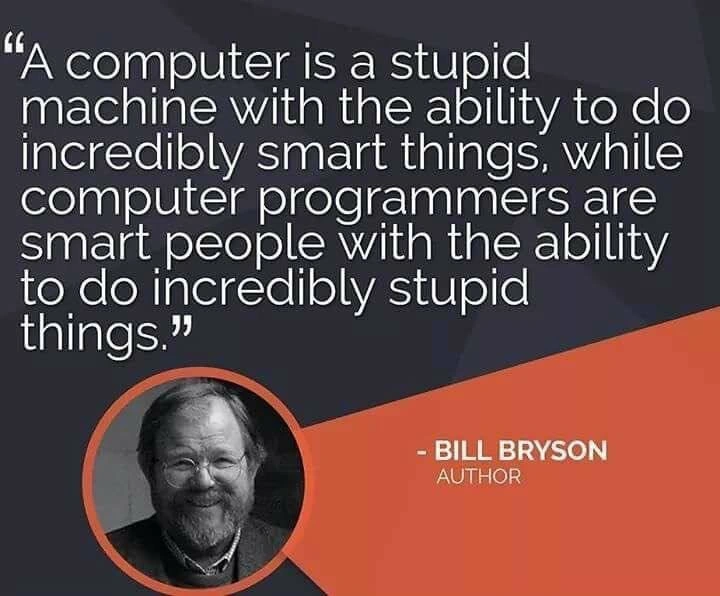
“A computer is a stupid machine with the ability to do incredibly smart things, while computer programmers are smart people with the ability to do incredibly stupid things.”
– Bill Bryson
This witty quote nails an ironic truth in software development. A computer is ultimately a very fast but very literal machine – it has no inherent intelligence or common sense, yet it can perform astonishing feats like crunching huge datasets or rendering 3D graphics flawlessly. How? Because it executes instructions with perfect obedience and speed. On the flip side, a programmer (the “smart person” in the quote) is endowed with creativity and reasoning, but we humans are undeniably fallible. We devise brilliant algorithms and then sometimes introduce a spectacularly silly bug that undermines all that brilliance. The humor comes from this reversal of expectations: the dumb machine does “incredibly smart” things by following code, while the smart developer can do “incredibly stupid” things by writing bad code. It’s a paradox every engineer eventually experiences in their career.
From an experienced developer’s perspective, the quote hits home because it’s practically a rite of passage to ship a dumb mistake in your code. The developer community loves to share these facepalm moments. It’s an open secret that even 10x engineers and genius programmers have stories like: “I missed a minus sign and crashed the server,” or “I inverted a conditional and opened a security hole.” The joke here isn’t mocking computers or programmers per se – it’s acknowledging a systemic reality of software development: complex systems amplify simple mistakes. A tiny error in logic can cause an entire application to misbehave, even if every other part of the program is crafted intelligently. As the saying goes in DeveloperHumor circles, “to err is human, but to really foul things up you need a computer.” 😅 We laugh because we’ve all been that “smart person” doing something embarrassingly dumb in code, and we’ve seen our “stupid” machines dutifully turn tiny bugs into big problems.
Let’s break down the contrast at the core of this meme:
| The “Stupid” Machine (Computer) | The “Smart” Person (Programmer) |
|---|---|
| Follows a million exact instructions per second, never questioning them. | Writes those instructions but might put one in the wrong order or syntax, causing chaos. |
| Excels at precise, repetitive tasks (e.g. calculating a billion digits of π flawlessly). | Excels at creative problem solving, but might slip on a basic math error or off-by-one mistake. |
| Never gets tired or bored – will loop forever if told to. | Can get tired or overconfident and deploy a bug at 3 AM that takes production down. |
| Has zero intuition – it will execute absurd instructions to the letter. | Has intuition and intelligence, yet sometimes trusts code that “seems right” without verifying, leading to silly bugs. |
In other words, the computer will happily do exactly what we tell it to do, even if we told it wrong. It’s a blind follower. The programmer, armed with brains and good intentions, is the one who accidentally gives those bad instructions when a lapse in judgement or a simple oversight occurs. The resulting software bug can be comically trivial in cause but severe in effect. For example, a developer might accidentally use the assignment operator = instead of a comparison == in C/C++:
// A single '=' instead of '==' is a subtle bug with big consequences
bool isAdmin = false;
// ...
if (isAdmin = true) {
// Oops: this sets isAdmin to true every time, granting admin rights to everyone!
grantAllPermissions();
}
Here a smart programmer just did an “incredibly stupid” thing – a tiny typo that makes the code do the wrong thing. The computer, of course, doesn’t know this is a mistake; it will just set isAdmin to true and keep granting permissions, because that’s what the program told it to do. This real-world example shows how a one-character bug can introduce a serious security issue. The machine isn’t intelligently deciding to open the floodgates; it’s the programmer’s logic gone awry. CodingMistakes like this are common: maybe it’s a null pointer dereference that crashes a server, or a wrong loop condition that causes an infinite loop. Seasoned developers have all caused production incidents with something that, in hindsight, was a boneheaded mistake.
So why do smart people keep making these stupid bugs? Part of it is the sheer complexity of software systems. Modern programs have thousands or millions of lines of code. Even if 99.9% of those lines are correct, one stray error in a critical check can bring the whole system down. We try to mitigate this with rigorous CodeQuality practices: code reviews, unit tests, static analysis tools, continuous integration pipelines – all designed to catch those “stupid things” before they hit production. And yet, bugs slip through. Why? Because humans write the tests and the reviews too, and humans have blind spots. A developer might be incredibly knowledgeable about algorithms but still forget a simple edge case. Or a team under deadline pressure might introduce a quick fix that has unintended side effects. DeveloperCulture actually encourages sharing these goofs because it reinforces an important lesson: no one is immune to errors. It’s both a caution and a comfort. Caution, because it reminds us to be meticulous (the computer won’t forgive a mistake). Comfort, because when you inevitably mess up, you’re in good company – even the biggest tech companies and smartest engineers have shipped absurd bugs.
Historically, this irony has been present since the dawn of computing. The term “bug” itself in a programming context famously comes from an actual bug: in 1947, computer pioneer Grace Hopper documented a moth trapped in a relay of the Harvard Mark II computer, which was causing an error. They taped the moth in the logbook with the note “First actual case of bug found.” 🤷♂️ Of course, the concept of a software bug already existed (meaning a flaw in the system), but this story became a legendary literal example. It underscores how something seemingly trivial or stupid (like a moth, or a missed character in code) can stop an incredibly complex, “smart” machine from working. Over the years, countless such incidents have occurred. For instance, a single missing hyphen in the code led to the failure of the Mariner I spacecraft launch in 1962 – a multi-million dollar rocket lost because of a typo! In 1998, the Mars Climate Orbiter was lost because one engineering team used imperial units (pounds-seconds) in calculations while the receiving code expected metric (newton-seconds) – a seemingly stupid oversight by very smart engineers that led to a catastrophic outcome. These aren’t failures of the computers – the hardware obediently did what the software told it – they’re failures of the humans who wrote the instructions wrong or misunderstood each other.
In developer communities, quotes like Bryson’s get plastered on office walls, conference slides, and GitHub READMEs as a tongue-in-cheek reminder of humility. It’s classic DeveloperSelfDeprecation. We poke fun at ourselves to cope with the frustrating reality that no matter how many programming languages we’ve mastered or how many design patterns we implement, a simple oversight can still make us look foolish (and send us on a late-night debugging goose chase). This shared acknowledgement of fallibility builds camaraderie. It’s easier to admit “I messed up” when even the gurus you respect confess to past facepalms. In fact, TechHumor like this often doubles as advice: don’t get cocky just because you’re a smart coder, because the moment you do, you’ll do something silly and the computer will mercilessly do exactly that silly thing!
So the Bill Bryson quote resonates on multiple levels. It’s funny because it’s true, and it’s ironic in a perfectly balanced way. The hardware (CPU, memory, etc.), for all its clockwork stupidity, can achieve astonishing results provided the instructions (software) are correct. Meanwhile the software developers, for all our intelligence, are the source of every bug that ever frustrates a user or causes an outage. It’s a humbling reminder that in computing, the limiting factor isn’t the machine’s intelligence – it’s ours. We’ve built compilers, interpreters, and AI systems that can do extremely clever things, yet the classic errors (typos, logic mistakes, misunderstood requirements) are eternal. This dichotomy is the computing irony Bryson encapsulated so well, and why the quote has become a mantra in DevCulture. We laugh at the quote, but we’re also nodding along, thinking of that one time we took down the database with a misconfigured script. It’s a shared joke that never stops being relevant because every new generation of programmers will eventually create their own “stupid thing” in code and learn from it.
Description
An image displaying a quote from the author Bill Bryson. The quote reads: 'A computer is a stupid machine with the ability to do incredibly smart things, while computer programmers are smart people with the ability to do incredibly stupid things.' The text is white and set against a dark gray background with an orange accent. Below the quote is a circular, black-and-white photo of a smiling Bill Bryson. This meme captures a fundamental, humorous truth of software development: the contrast between the logical, deterministic nature of computers and the fallible, often erratic, nature of the intelligent humans who program them. It resonates deeply with experienced developers who understand that a single, simple mistake can lead to catastrophic, complex failures
Comments
12Comment deleted
A senior dev's 'incredibly stupid thing' is just a junior dev's 'incredibly stupid thing' but with higher permissions, more dependencies, and an automated deployment pipeline
Spent two weeks proving our consensus algorithm in TLA+, then took prod down with one trailing comma in YAML - turns out Bryson’s theorem holds
After 20 years in tech, I've learned that the real skill isn't writing code that works - it's explaining to the board why your perfectly logical solution to deploy on Friday afternoon caused the entire Eastern seaboard to lose checkout functionality during Black Friday weekend
This perfectly captures the essence of production incidents at 3 AM: the computer executed your deployment script with flawless precision - it's just that your 'incredibly stupid thing' was setting `DROP DATABASE` as the default migration rollback strategy. The machine did exactly what you told it to do; you're the one who thought 'move fast and break things' was a database administration philosophy
Every RCA ends the same: the computer followed the spec exactly - unfortunately the spec was a bash one‑liner wrapped in three YAML defaults and a Friday emoji‑approved deploy
Legacy codebases: eternal proof that yesterday's smart programmers did tomorrow's incredibly stupid things
Computers are obedient idiots; thanks to CI/CD, our mistakes are reproducible, versioned, and deployed globally
And thus, a software is incredibly stupid thing that does incredibly stupid things Comment deleted
lol zkbridge pandras airdrop https://zkbridgenft.net/ Comment deleted
Gonna be nice LinkedIn shitpost Comment deleted
Just add some paragraphs staring with an emoji Comment deleted
ah fuck this Comment deleted