Java Date constructor trolling: when 1 means February, not January
Why is this Languages meme funny?
Level 1: Counting from Zero
Imagine you have a friend who for some weird reason starts counting things at zero instead of one. 🤔 You ask for the 1st cookie from a jar, and your friend, counting from zero, hands you what they call “number 1” – which to them is actually the second cookie! You’d be confused, right? You’d say, “Wait, I asked for the first one, why did you give me the second?” And your friend just shrugs and says, “Well, to me, 0 is the first cookie, and 1 is the second.” That’s exactly the kind of confusion this meme is joking about, but with months of the year.
Normally, January is the 1st month and February is the 2nd month. But the old Java programming way was like that odd friend: it treated January as month 0. So if you told Java “I want month 1,” Java would give you February – because Java was counting January as 0. The meme shows a character (Java) agreeing that yeah, 1 sounds like it should be January… and then pulling a switcheroo and saying “1 is February.” It’s funny in the same way a silly misunderstanding is funny – like someone following a different rule of counting that nobody else uses. The feeling behind it is a mix of surprise and “Oh no, you’ve been tricked!” – something any kid who’s played a prank or had a prank played on them can understand. In simple terms, the joke is: Java messed up the counting of months, and all the programmers yelled “Wait, that’s not how you count!”. It’s a goofy mistake that we can laugh about now.
Level 2: Off-by-One Bug
Let’s break down what’s happening here in simpler terms. Java (the programming language) had an old class called java.util.Date (and its partner in crime, Calendar). These were used to represent dates and times in Java programs way back in the day. The meme highlights a specific quirk: months were numbered from 0 instead of 1. This is what we call zero-based indexing. Zero-based means counting starts at 0. Many things in programming use zero-based counting (for example, arrays: the first element is index 0). But when it comes to months of the year, humans don’t do that – we call January month 1, February month 2, and so on.
So what happens when a developer unaware of this quirk uses the Java Date constructor or Calendar? They might write code like:
Calendar cal = Calendar.getInstance();
cal.set(2021, 1, 1); // Year 2021, Month 1, Day 1
Date date = cal.getTime();
System.out.println(date);
Intuitively, you’d think this is setting the date to January 1, 2021. But nope! In the old Java API, that month parameter “1” actually means February (because January is 0). The output would show February 1, 2021. This is a classic off-by-one error – a common programming bug where things are one step off from what you expect because of counting differences. In this case, the API itself caused the off-by-one error by design! The meme calls this out in a humorous way: the villain (representing a confused developer or just logic itself) is double-checking that Java’s Date class agrees with normal conventions (“1 is January, right?”) and Java keeps saying “Yup” – until the final reveal that Java actually treats 1 as February.
Why did this happen? Historically, the Java designers followed older conventions (like the C language’s time library) where months were 0-indexed. It’s a design decision that turned out to be a developer experience landmine. Every newcomer to Java who dealt with dates would likely stumble on this at least once. You had to remember to subtract 1 from the human month number to get the computer month number. For example:
- 0 -> January
- 1 -> February
- 2 -> March
... and so on, up to 11 -> December.
If you didn’t know this and put “1” thinking it’s January, your program would end up one month off. This is exactly the month_off_by_one_bug the tags mention. It’s a “bug” from the developer’s perspective, but really it’s the API being counter-intuitive. The meme’s Spongebob ‘Yup’ format perfectly sets up the expectation and the twist. It’s like Java is saying: “Sure, sure, that makes sense” and then does the opposite, leaving the developer screaming “Whaaat?!”.
For a junior developer (or any Java beginner), encountering this is super confusing. Imagine testing your code on January 31 and then adding one day – you’d expect February 1, but if you messed up the month index, you might get March 1 instead! These kinds of surprises are why Java’s old date API was infamous. It was relatable dev experience in the worst way: everyone could relate to being tripped up by it. It’s also a lesson in API design best practices: nowadays, new APIs avoid this kind of design. In Java 8+, there’s a new date/time API (java.time.LocalDate and friends) which uses normal 1-12 month numbers or enums for months, so it’s clear and type-safe. They basically said, “let’s not repeat that mistake.”
So, in summary, the meme is funny to developers because it’s highlighting a real gotcha in Java coding. The Java Date class was essentially trolling developers – doing something that logically makes no sense in everyday terms. By using the cartoon with the Java mascot just innocently agreeing until the final punchline, it shows how a programmer feels when they discover this: “Java, you betrayed me! You said 1 was January… and now you say 1 is February?!” It’s a mix of frustration and humor – laughing at a silly design after you’ve survived the confusion it caused. And trust me, anyone who’s dealt with dates in Java has a few gray hairs or war stories about it – whether it’s this month indexing problem or the nightmare of time zones (yes, those are hard too!). This one meme panel encapsulates that whole experience in a quick, relatable exchange.
Level 3: Zero-Based January
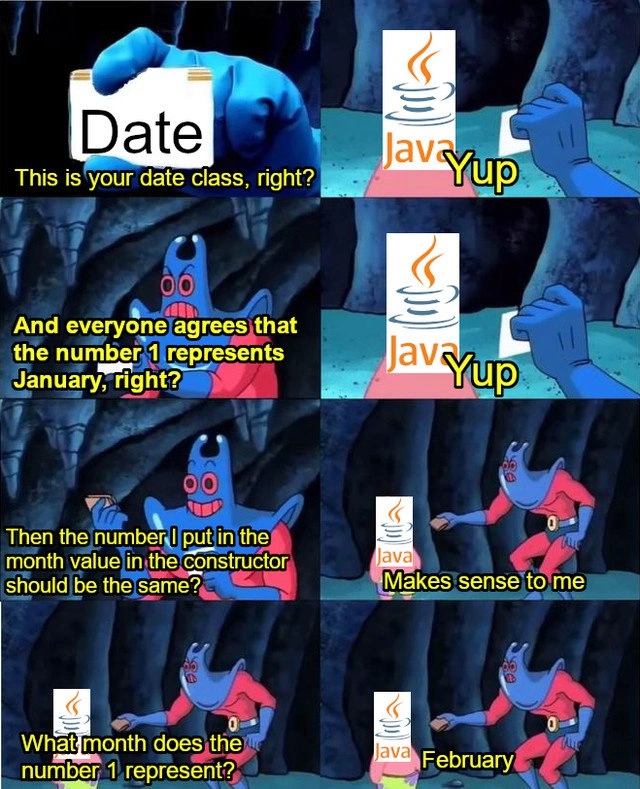
Ah, java.util.Date – the gift that kept on giving off-by-one bugs to generations of Java developers. In this meme’s cave scene, the Java superhero (with the Java coffee-cup logo for a face) cheerfully answers “Yup” to a villain’s logically consistent questions, only to deliver a punchline that breaks all expectations. The villain’s blue-gloved hand labeled “Date” represents the notorious Java Date API, grilling Java about its design:
- “This is your date class, right?” – Java: Yup.
- “And everyone agrees that the number 1 represents January, right?” – Java: Yup.
- “Then the number I put in the month value in the constructor should be the same?” – Java: Makes sense to me.
In the final panel, reality hits: “What month does the number 1 represent?” – Java: February. 🤦♂️ The humor here is a senior-engineer inside joke: the Java Date constructor trolls everyone by using zero-based month indexing. In other words, January is 0 and December is 11 internally. So if a poor unsuspecting dev uses 1 for the month, they get February (month index 1) instead of January (month index 0). It’s a classic API design blunder that has caused untold confusion and bugs. Every experienced Java hand either learned this the hard way or heard horror stories of production dates slipping by one month because someone forgot Java counts from zero.
This meme nails the absurdity with the Spongebob “Yup” format – Java (the language) just cheerfully agrees with each reasonable assumption, leading you right into a trap. Seasoned devs find it painfully funny because we’ve been there: logging into a server at 3 AM, wondering why schedules are off or why February is showing up when we meant January. It’s so relatably dumb that you can’t help but laugh. The DeveloperExperience_DX here was clearly an afterthought in early Java. The Date API was introduced in Java 1.0 (mid-90s), and frankly, it shows its age. Back then, Java’s creators probably followed C’s struct tm convention (where tm_mon runs 0–11 for months). Maybe it made internal arithmetic easier or was meant to save a few bytes. Regardless, it became a language quirk etched in stone – one does not simply “fix” it after millions of programs have come to expect that behavior. Changing it would have broken backward compatibility on a massive scale, so Java just slapped a big “deprecated” label on Date and Calendar later, and eventually gave us a new API altogether.
From a senior perspective, this is a perfect example of how API design best practices evolve. A well-designed API should match developers’ mental model: if everyone thinks January = 1, your API should too. The old Java Date API violated the Principle of Least Astonishment in a big way – it astonished everyone at least once! The industry learned from this mistake: modern date libraries (like Joda-Time and Java 8’s java.time package) use more sensible approaches (e.g., months as 1–12 or using enums like Month.JANUARY). But the meme’s point is that for years Java programmers suffered from this relatable dev experience: you’d create a date with new Date(2021, 1, 1) expecting January 1, 2021, and Java would smugly hand you February 1, 2021. Surprise! 🎉 “It’s not a bug, it’s a feature,” one might joke, but really it was just a design wart.
In practice, this off-by-one month issue led to countless minor bugs: mis-scheduled events, wrong birthdates, off-by-one errors in financial reports – the works. Teams eventually learned to subtract 1 from the month or use constants like Calendar.JANUARY (which equals 0) to avoid mistakes. But every so often, a new developer (or an old one with a memory lapse) would fall into the trap, and cue the facepalm 🙄. The meme resonates with experienced devs because it encapsulates that “You’ve got to be kidding me!” moment we all had when first discovering this. Java agreeing “Yup” to “1 is January, right?” only to call 1 “February” is exactly how it felt using that API: it lures you in with sanity and then says “Gotcha!”.
So this meme stands as both comedy and caution. It’s poking fun at Java for one of its most famous WTFs: a date/time API confusion so prevalent that “TimeZonesAreHard” became only one part of the joke – in Java, even months were hard if you didn’t read the fine print. The image of Java as a superhero confidently giving the wrong answer is perfect symbolism: Java is powerful and trustworthy… until it isn’t. At least not when it came to dates. Developer pain points like this tend to stick in memory, creating a shared folklore among programmers. We laugh now because Java’s moved on (the new java.time API got it right, finally). But the scars of debugging why our January dates showed up in February? Those we remember, and that’s why this meme hits a nerve. It’s a senior dev’s dark humor: “Welcome to programming, where even the calendar can betray you.”
Description
Spongebob’s ‘Yup’ meme is recreated in a cave setting. In each panel, a blue-gloved hand labeled “Date” and a superhero figure with the Java logo on his face have a dialogue in bright yellow caption text. Panel 1 shows the hand holding a card that says “Date” while the villain asks, “This is your date class, right?”; Java replies, “Yup.” Panel 2: “And everyone agrees that the number 1 represents January, right?” - Java: “Yup.” Panel 3: “Then the number I put in the month value in the constructor should be the same?” - Java: “Makes sense to me.” Panel 4: “What month does the number 1 represent?” - Java answers, “February.” The joke highlights the historic java.util.Date/Calendar API quirk where months are zero-indexed, causing off-by-one bugs and developer frustration. Visually, the Java logo is superimposed on the superhero in every response frame, emphasizing that the language’s standard library design is the culprit

Comments
12Comment deleted
java.util.Date: where 0 is January, 1 is February, and every project plan is off-by-one sprint because someone trusted the constructor
After 20 years in the industry, I've seen teams spend millions migrating from java.util.Date, only to discover their offshore contractors are still using Calendar.getInstance() because 'it worked in the tutorial from 2003' - and somehow that's still more reliable than the junior who tried to fix it with SimpleDateFormat in a multithreaded environment
Ah yes, java.util.Date - the API that taught an entire generation of developers that January is the loneliest number (zero). Nothing says 'enterprise-grade design' quite like requiring a PhD in off-by-one arithmetic just to wish someone Happy New Year. At least when we migrated to java.time, we got to experience the joy of explaining to stakeholders why we needed three sprints to fix 'just changing how we store dates.' The real kicker? Somewhere in a Fortune 500 codebase, there's still a comment that says '// month is 0-indexed, don't forget!' right above code that forgets
Senior dev wisdom: Subtract one from the month before new Date() - legacy tax even stdlib can't escape
Nothing screams enterprise legacy like an API where January is 0, years start at 1900, and off-by-one is a feature - aka java.util.Date
Legacy Java Date: where 1 means February - off-by-one shipped as a feature and the official fix is spelled JSR‑310
Isn’t it deprecated tho? Comment deleted
This is stupid. Any reasonable person thinking about how months would be represented should know that the first month should be 0. Comment deleted
I think it's hard to switch from computer array to real-life array and it can cause mistakes. But in programmer way you're right, why we need in array first null cell, that only use allocated memory, when we can only think from 0 Comment deleted
Because Java is written in C. He-he. https://www.cplusplus.com/reference/ctime/tm/ Comment deleted
its just 0 indexing them Comment deleted
Same in JavaScript Comment deleted