Skip to content
DevMeme
262 of 7435
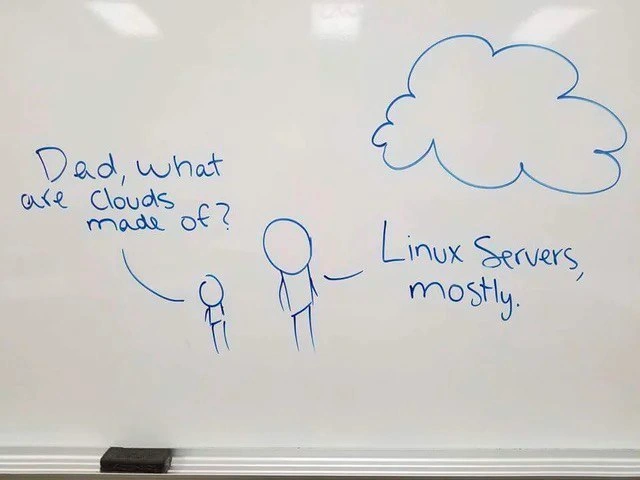
Explaining cloud computing to kids: it's mostly Linux servers up there
Cloud Post #318, on Apr 15, 2019 in TG

Explaining cloud computing to kids: it's mostly Linux servers up there

Why is this Cloud meme funny?

Level 1: Grandma’s Toy Box

Imagine you ask your dad what clouds are made of, thinking he’ll talk about fluff or rain. Instead, he says, “They’re made of Linux servers.” Huh?! It’s silly because he took a simple kid question and gave a super nerdy answer. Here’s a way to understand it: When grown-ups say something is in “the cloud,” it doesn’t mean it’s floating up in the sky. It’s more like keeping your toys at Grandma’s house. You can play with them whenever you visit (just like you can get your photos or games from the internet cloud anytime), but the toys aren’t actually magic or in the sky – they’re in Grandma’s toy box in a real house. In the same way, when we save files “to the cloud,” those files are actually stored on real computers in a building somewhere, not on a fluffy cloud.

So in the meme, the dad is joking that clouds (the computer kind) are made of “Linux servers.” Linux is just the name of the operating system, which is like the brain of those computers. His answer is funny because the little child was asking about actual sky clouds, but the dad answered about the internet “cloud.” It’s as if you asked, “What are stars made of?” and someone answered, “Mostly giant nuclear reactors in space.” Technically that’s true — stars are huge burning reactors — but it’s not the playful answer you expected! Here, the truth behind the tech term “cloud” comes out in a simple way: it’s all computers underneath. The kid in the drawing might be confused hearing that answer, but for people who work with technology, it’s a cheeky reminder that the “cloud” isn’t mystical. It just means someone else’s computers doing all the work. We find it funny and cute because the dad turned a normal question into a nerdy truth. Even a child can get the basic idea with a good analogy: the cloud is basically a bunch of computers in a remote toy box, not actual sky fluff. That’s the heart of this joke — revealing a complicated idea in a way so simple it’s giggle-worthy.

Level 2: Someone Else’s Computer

Now let’s break down the joke in more straightforward terms. Cloud computing means using computing resources (like servers, storage, or databases) over the Internet instead of on your own computer. When people say “my data is in the cloud,” they really mean it’s stored on someone else’s computers in a data center somewhere. Those computers are often just regular servers running the Linux operating system. Linux is a popular open-source OS (kind of like Windows or macOS, but free and very customizable) that powers most of the servers on the internet. A server is simply a powerful computer that provides services or data to other computers. So a “Linux server” is a computer running Linux that is typically sitting in a big server room, waiting to handle requests like showing you a website or storing your files.

In the meme’s doodle, a kid asks “Dad, what are clouds made of?” The funny twist is that the dad answers as if the question was about the internet “cloud” instead of sky clouds. He says, “Linux Servers, mostly.” Normally, the answer about sky clouds would be “water droplets” or “cotton candy” if the dad was being playful. But this dad gives a tech answer. It’s both a cloud_computing_joke and a classic geeky dad joke rolled into one. The drawing even uses a basic cloud shape on a whiteboard, just like the cloud symbol we see in app icons or tech diagrams. Engineers often draw a cloud shape in diagrams to represent “the internet” or “somebody else’s computer infrastructure.” Here, the dad basically writes inside that drawn cloud what it’s actually made of: a bunch of Linux servers. So the caption “explaining cloud computing to kids: it’s mostly Linux servers up there” is tongue-in-cheek. It’s taking a complex idea (cloud infrastructure) and simplifying it in a goofy literal way.

For a new developer or someone just learning IT, here’s what it means:

  • The cloud is not a mythical place – it’s a term for services running on remote servers accessible via the internet. When you save a photo to the cloud, it’s stored on a hard drive in some distant server rack.
  • These servers live in buildings called data centers, which are basically giant warehouses full of computers. Think of rows and rows of machines with blinking lights, all connected by networks.
  • Most of those servers run Linux because it’s very stable, secure, and can be tweaked to do just what companies need. (Linux is free and community-maintained, which helped it become the favorite for servers.)
  • So, saying the cloud is made of Linux servers is a cheeky way to reveal what “the cloud” really is: somebody else’s Linux computers doing the work for you. In other words, the cloud = someone else’s machine.

This insight often clicks during a developer’s first experience deploying an app. The first time you host a website or app on a cloud service like AWS, Azure, or Google Cloud, you quickly encounter the reality that you’re just interacting with another computer remotely. For example, if you launch a virtual server on AWS (an EC2 instance), you typically connect to it and see a terminal (text console). If you run a quick command to check the system, you’ll likely find out it’s Linux under the hood:

$ uname -s    # Check the OS name of the cloud instance
Linux

That simple output “Linux” drives home the point: even though you used a cutting-edge cloud platform, at the end of the day you’re logging into a Linux machine sitting in a data center. As a junior developer, realizing that “the cloud” is just other people’s computers can be an eye-opener. It demystifies the buzzword. This meme plays on that exact realization in a funny way. The kid asks a normal question about the sky, and the dad answers with tech truth about the cloud we talk about in computing. It’s the kind of humor you start to appreciate as you learn what things like Cloud, OperatingSystems, and DevOps really involve. Behind every friendly cloud icon or slick app, there’s still a physical machine running software. In most cases, that machine runs Linux.

In short, the meme is saying that the high-tech “cloud” isn’t magic at all – it’s lots of ordinary servers (basically powerful PCs) running an OS (mostly Linux) in big buildings around the world. When you understand that, the dad’s answer becomes both informative and humorous. It’s informative because it’s true (the internet cloud is built from Linux servers), and it’s humorous because it’s an absurd answer to a child who probably just wanted to know about sky clouds. For new developers, it’s a lighthearted reminder: when you deploy code to the cloud, you’re really just putting it on another computer that someone else is maintaining.

Level 3: The Linux Lining

From a senior developer’s perspective, the charm of this meme is how it pulls back the curtain on cloud computing hype. We often quip, “There is no cloud, it’s just someone else’s computer,” and here the dad’s punchline nails that truth. The question, “Dad, what are clouds made of?” sets up an expectation of a fluffy answer (maybe “water vapor” or a fairy-tale explanation). Instead, we get the deadpan reply: “Linux servers, mostly.” It’s essentially a dad joke for the tech crowd — a perfect blend of literal truth and context switch. The stick-figure father isn’t wrong: the vast majority of cloud services really do run on Linux machines in data centers. But his answer treats a child’s query about sky clouds as if it were about cloud infrastructure. That disconnect is exactly why developers smirk at this comic. We’ve all either been the curious kid or the over-technical dad in real life. Tech folks often can’t resist dropping a nugget of sysadmin wisdom, even in a silly scenario.

The humor also taps into the shared experience of explaining tech to non-techies. For example:

Friend: “Where does my data go when it’s in the cloud? Is it up in the sky somewhere?”
Engineer: “Nope — it ends up on a Linux server in Virginia.”

This kind of blunt clarity is typical in DevOps circles. Cloud computing is really just a fancy way of saying “your code runs on somebody else’s machine.” Seasoned devs remember the era before “the cloud” became a buzzword — we simply called it hosted servers or colocation. The meme’s simple whiteboard style (stick figures and a puffy cloud doodle) is exactly how we diagram architectures: we draw a cloud to represent the Internet or an external provider, because the internal details are somebody else’s problem. Here that convention gets turned on its head: the cloud icon in the drawing is explicitly filled in with what’s inside — Linux servers! It’s a literal truth that breaks the usual cartoon symbolism, and that’s funny to anyone who’s done system design on a whiteboard.

This comic is also a nod to the dominance of Linux in back-end systems. Folks in DevOps or SRE roles know that if you peek behind services like AWS, Azure, or Google Cloud, you’ll find fleets of Linux boxes (yes, there are Windows servers too, but Linux is the workhorse of Cloud). In fact, it’s a running gag in ops that when something in “the cloud” breaks, the final fix usually involves SSH-ing into a Linux machine and checking logs or restarting a process. The dad’s answer “mostly Linux servers” highlights that operating systems still matter, even in our age of ultra-high-level cloud platforms. No matter how glossy the web console or how abstracted the service, at some level a Linux process is chugging away to make it all work. It pokes fun at the tendency to forget the basics: deploying code “to the cloud” still means there’s an OS allocating memory, managing files, and scheduling tasks underneath. The cloud doesn’t run on magical ether; it runs on good old Linux.

By phrasing the answer so plainly, the meme gives that satisfying “it’s funny because it’s true” punch. The dad in the comic basically blurts out what every experienced engineer knows but marketing glosses over. If you’ve ever spent a late night debugging why your cloud instance isn’t responding, only to discover it was a hung Linux process or a misconfigured /etc/fstab, you appreciate the truth in this joke. Every mysterious cloud outage has a very down-to-earth root cause — often found in a Linux log file. The stick-figure art and innocent kid’s question amplify the contrast. It’s drawn so simply you could imagine an engineer doodling it during a lunch break. That childlike setup combined with a sysadmin reality check encapsulates classic developer humor. It gently ribs the industry’s habit of giving grand, fluffy names to what are essentially just racks of computers. In the end, no matter how high we build our tech castles in “the cloud,” it all runs on the ground, on real Linux servers. Remembering that is both humbling and hilarious to those of us in the field.

Level 4: Hypervisors in the Sky

At the most advanced level, this meme touches on the underlying cloud infrastructure that seasoned engineers deal with daily. The joke “Linux Servers, mostly” alludes to the fact that cloud computing is fundamentally built on virtualization and operating system internals. Modern cloud data centers are essentially massive clusters of physical machines running specialized software called hypervisors. A hypervisor (like Xen, KVM, or VMware ESXi) is a low-level layer that lets multiple virtual machines share a single physical host by emulating hardware for each “guest.” Each virtual machine (VM) runs its own operating system, and more often than not that OS is Linux. So when you spin up an AWS EC2 instance or a Google Cloud VM, there’s an extremely high chance you’re booting up a Linux kernel under the hood.

This layering of virtualization is what puts the “cloud” in cloud computing: it’s all about abstraction. Just as network diagrams traditionally depict the Internet as a fluffy cloud to hide complex details, cloud platforms hide the messy reality of hardware behind neat APIs. The illusion of an infinite cloud is created by pooling resources and dynamically scheduling them across many machines. But peel away that abstraction layer and you find the robust machinery enabling it. For example, Amazon’s cloud uses custom lightweight hypervisors and a tuned Linux (Amazon Linux) to host thousands of isolated customer instances on each physical server. Google’s infrastructure similarly relies on a bespoke Linux-based OS for their servers. Even modern “cloud-native” tech like containers is powered by Linux features. Technologies like cgroups (control groups) and namespaces in the Linux kernel allow containers to isolate processes and limit resources, creating secure mini-environments. Orchestrators like Kubernetes then deploy these containers across clusters, essentially treating many Linux servers as one giant computer. In short, behind that cloud icon is a vast network of real machines using very clever software to act as one.

The meme’s humor comes from exposing this technical reality in an absurd context. By answering the child’s question with “Linux servers,” the dad in the drawing is succinctly summing up cloud architecture. It hints at deep truths of OperatingSystems and distributed computing: that our high-level cloud services ultimately boil down to processes running on Linux kernels, handling threads, storage, and network packets. The high-level applications we use every day — from streaming video to online gaming — all reduce to binary instructions executed on a processor in some data center. There’s an almost poetic contrast: we call it “the cloud” to suggest something floating and abstract, yet its foundation is physical servers and CPUs, whirring away in racks. Seasoned developers appreciate this joke because it cuts through the mystique. It’s a nod to the fact that even the fanciest serverless app or scalable microservice still relies on a Linux process on a machine somewhere. In other words, the cloud’s silver lining is literally millions of lines of Linux code. The dad’s reply cleverly flips a child’s innocent question into a lesson on tech infrastructure, and for those of us in the industry, it’s both illuminating and darkly funny — a reminder that our lofty digital “cloud” is firmly grounded by penguin-powered servers.

Description

On a whiteboard, a simple blue-marker doodle shows two stick figures: a small child on the left asking, “Dad, what are clouds made of?” and a taller adult responding, “Linux Servers, mostly.” A fluffy cloud outline hovers in the upper right corner, visually linking the conversation to modern ‘cloud’ iconography. The humor plays on the double meaning of ‘clouds,’ revealing that today’s internet ‘cloud’ is fundamentally clusters of Linux machines running in data centers. For engineers, it’s a lighthearted reminder that behind abstract cloud-native architectures and DevOps tooling lie very real operating systems - predominantly Linux - quietly powering the infrastructure

Comments

7
Anonymous ★ Top Pick Cumulus are Ubuntu, cirrus are RHEL, and when it rains that’s just the AWS bill precipitating out of the abstraction layer
  1. Anonymous ★ Top Pick

    Cumulus are Ubuntu, cirrus are RHEL, and when it rains that’s just the AWS bill precipitating out of the abstraction layer

  2. Anonymous

    "Linux servers, mostly. And the tears of engineers who thought 'lift and shift' meant their legacy monolith would magically scale horizontally."

  3. Anonymous

    Accurate, though the kid should follow up: 'And what holds them together?' - 'Bash scripts nobody dares to touch, son.'

  4. Anonymous

    The real cloud computing explanation: it's just someone else's Linux servers, but with better marketing and a 99.9% SLA that somehow still allows for that one Friday afternoon when everything goes down because someone fat-fingered a Terraform config in us-east-1

  5. Anonymous

    Cumulus? More like 'cumu-Linux' - explains why every autoscaling group begs for more apt repos

  6. Anonymous

    The cloud is just Linux with an SLA and an egress line item

  7. Anonymous

    Clouds are mostly Linux servers - the rest is a billing layer that translates “kernel panic” into “elevated error rates” and an egress fee

Use J and K for navigation