Developer Culture vs. The World: A Thesis on Criticism
Why is this DevCommunities meme funny?
Level 1: Just Trying to Help
Imagine two kids, Alice and Bob, each doing a project. Alice is writing a story for class, and Bob is building a tall Lego tower.
First, Alice’s story: she’s worked hard on it and is proud of it. Her friend looks at her paper and says, “Oops, you spelled a word wrong here.” Alice suddenly gets very upset and shouts, “I was already going to fix that!” 😠 She’s basically yelling because she feels embarrassed and hurt – like the friend’s small critique means she did a bad job.
Now, Bob’s tower: he’s stacking Lego bricks to make a big castle. His friend comes by and says, “Hey, this wall is really weak. It might fall down.” Bob just shrugs and says, “Oh, I see it. Let’s rebuild that part.” 🙂 He doesn’t get mad at all. He knows his friend is just trying to help make the tower stronger. Together they fix the wobbly wall, and the tower ends up better.
This meme is joking that coding students behave more like Bob with the Lego tower. When someone says “Your code sucks” (which is a harsh way of saying “there’s something wrong with your code”), the coding student reacts calmly like, “Yeah, I know.” They don’t take it as an insult. They treat it like friendly advice to fix the “wobbly” part of their code. Alice, on the other hand, is like the non-coding student who gets super defensive about her story when someone points out a tiny mistake. She felt attacked, even though the friend was only trying to help.
So in really simple terms: one person sees a correction as helpful and doesn’t get upset, the other person sees a correction as hurtful and gets angry. The meme finds humor in how extremely different those reactions are. It’s funny because usually if someone said “your work sucks,” you’d expect a big argument or hurt feelings. But here we see the IT student just agreeing calmly, which is the opposite of what you’d expect. The picture exaggerates it, but it’s showing that people who are used to constant feedback (like coding students) can take even rough criticism in stride, while others might cry or yell over even gentle feedback. In the end, the message is: when someone points out a mistake, sometimes they’re truly just trying to help you improve – and it helps if we can be more like the easy-going IT student, and not take it to heart.
Level 2: No Hard Feelings
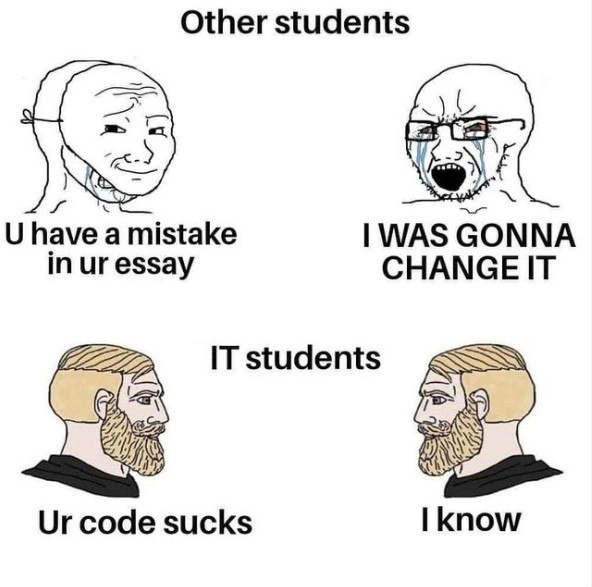
Think of it this way: the meme shows two different worlds reacting to feedback. In the top half, under "Other students," a student gets a tiny bit of critique on an essay and reacts very emotionally. One person says, "U have a mistake in ur essay," and the other student freaks out, yelling "I WAS GONNA CHANGE IT!" That student is clearly hurt and defensive about the feedback. Now in the bottom half, under "IT students," one tech student says "Ur code sucks" and the other just casually replies "I know." No anger, no tears – just acceptance. The contrast is huge and meant to be funny. It highlights how IT students (students in programming or computer science) often handle feedback very differently from other students. The IT folks act almost unfazed by harsh words, whereas the non-IT folks get upset even at mild criticism.
So what's going on here? In the programming world, people do something called code review all the time. A code review is when someone else looks at your code (the program or script you wrote) and checks it for mistakes or ways to improve it. It's like having a friend double-check your math homework or proofread your essay, but for code. In software classes and companies, this is completely normal – in fact, it's expected. Because it's so common, everyone gets used to receiving comments about their code regularly. And these comments can be very direct. A friend or teammate might say something like "this function is too slow" or "your code here is pretty messy." At first, feedback like that can feel harsh (after all, "your code sucks" is not exactly polite!). But in coding, people understand it's helpful criticism, not a personal insult. The main goal is to catch bugs or bad practices early, so being blunt actually saves time. Developers often prefer someone plainly telling them "this code is wrong" so they can fix it, rather than hinting at the issue vaguely.
For example, imagine you wrote a program that works but the code is kind of sloppy and hard to read. When you show it to a more experienced friend during a peer review, they might bluntly say, "This code is really hard to follow, it's pretty bad." At first, you might feel a sting — "ouch, that was honest!" But then they sit with you and help you reorganize it. You realize they weren't trying to be mean; they were just trying to help make your code better. Over time, you actually start expecting this kind of feedback whenever you write code. You might even joke about it yourself. It's common to hear a programmer say something like, "Haha, I know my code is a dumpster fire, I'm going to clean it up soon." This kind of joking shows they already accept the code has problems. In other words, programmers often acknowledge their mistakes upfront. So if someone else says "Your code sucks," it's easy for them to shrug and go, "I know, I'll fix it." It’s not that they don’t care – it’s that they agree and want to improve it. This meme shows exactly that: the IT guy outright admits the flaw ("I know"), which is a form of self-deprecating humor and a sign of being used to constant code critiques.
Now, compare that to someone writing an essay or a paper. Outside of tech, students don’t usually review each other’s work in such a blunt way. If a classmate points out an error in your essay, it’s hard not to feel a bit embarrassed or attacked. Writing feels personal – it's your ideas and words. So when someone says "there's a mistake in your essay," some people take it as "you're not good at this." That’s why the student in the top half reacts with "I was gonna change it!" They’re basically saying, "I’m not dumb, I knew it was wrong, I was already on it!" – trying to save face. They got defensive because they felt their ability was being questioned in front of others. In many non-IT classes, the only feedback you get might be a grade or a few red marks from the teacher, usually given privately. It's not common for peers to critique each other's essays line by line in real time. So when it does happen, it can be a shock and feel very personal.
To summarize the contrast, here's a quick comparison drawn from the meme:
| Situation | Feedback given | Reaction |
|---|---|---|
| Other students (essay) | "U have a mistake in ur essay." | Defensive: "I WAS GONNA CHANGE IT!" 😭 (upset and offended) |
| IT students (code) | "Ur code sucks." | Calm: "I know." 🙂 (acknowledging and unfazed) |
As you can see, the exact same kind of comment (pointing out a mistake) leads to completely opposite reactions in these two scenarios. The IT student isn’t getting angry at all, because in coding culture, being told your work has issues is normal and expected. They have no hard feelings about it; they know it's about the code, not them. On the other hand, the essay-writing student hears about a mistake and immediately takes it personally, as if they’ve been attacked. This meme exaggerates things to make us laugh, but there’s a ring of truth: programming students often joke around and say "your code is trash" / "yeah, I know," and it's no big deal, whereas many others would find that exchange unbelievable or rude. The bottom line is that IT folks learn to accept feedback without feeling insulted, while people in other fields may not be used to that kind of blunt peer critique. The result? The coders come off looking oddly zen and humble, and everyone else... a bit oversensitive. And that contrast is exactly what makes the meme humorous and relatable to those of us in tech.
Level 3: Egoless Programming
In this meme, we see a stark contrast between how peer review feedback is handled by general students versus by programming students. The top panels (captioned "Other students") depict two Wojak characters – an internet meme figure often used to show someone being emotional or sensitive. One says "U have a mistake in ur essay" and the other Wojak immediately flies off the handle, crying out "I WAS GONNA CHANGE IT". It's a trivial critique met with an over-the-top defensive reaction. Now compare that to the bottom panels labeled "IT students." Here we have two bearded Chad characters (a meme archetype of a confident, unfazed person) calmly facing each other. The left Chad flatly states "Ur code sucks" and the right Chad just nods with "I know". This four-panel format uses the classic Wojak vs Chad meme structure to highlight opposites: one side is overly sensitive, the other is supremely chill. The humor comes from how, in the coding world, calling a friend's code "awful" is oddly normal, whereas in other fields even mild feedback can trigger meltdowns. The meme’s title nails it: when code review banter is gentler than essay feedback, you know there's a cultural difference. In programming teams, the culture of code review normalizes that kind of bluntness – everyone knows not to take it personally.
For experienced developers (and even IT students who have been through a few coding classes), this situation reflects something we call egoless programming. Egoless programming is the idea that you shouldn't tie your ego or self-worth to the code you write. In other words, when someone says "this code is bad", they're not saying you're bad – they're just pointing out an issue in the code. Programmers train themselves to take comments on their code as constructive, not as personal attacks. Over time, developers actually get comfortable with critique. They might even preempt it: it's common to see a programmer openly admit "my code probably sucks" before anyone else can. This is a form of self-deprecating humor we use to cope with the fact that no code is perfect. By the time a teammate bluntly comments "Ur code sucks" on your commit, you've likely already said something similar under your breath. So the reply "I know" isn't sarcasm – it's often honest agreement. The meme exaggerates it, but there’s truth here: among IT peers, acknowledging flaws quickly is how we move on to fixing them.
In the software development world, code reviews are an everyday practice. Whenever you want to merge your code changes (say via a pull request on GitHub or GitLab), at least one person will inspect the diff and give feedback. This is done to maintain quality and catch mistakes early. As a result, developers experience a lot of critique. Some feedback is gentle, but often it's very direct. For example, a reviewer might write a comment like // this logic is too convoluted, please simplify it right in your code. Or they might point out style issues by saying things like, "Naming this variable 'data' is too vague." On a bad day, you could even get a remark as blunt as "What is this? This makes no sense." Hearing comments like that is a relatable developer experience for anyone who's worked on a software team. At first it can sting, but you soon realize every developer gets those comments. We've all had our share of code review pain points – like the time you opened a pull request and got a 50-line review full of nitpicks from a senior dev. But experiences like that, plus the occasional 3 AM production bug wake-up call, quickly teach you that it's better to have peers catch mistakes early than to have those mistakes blow up later. (Better a colleague says your code has issues than having the app itself scream in error at 3 AM!) It puts things in perspective. Even a harsh code review comment at noon is a lot better than a system crash at midnight because nobody pointed out a flaw. Crucially, everyone follows the unspoken rule: "criticize the code, not the coder." The meme's Chad programmers embody that rule; they don't get defensive because they know the review isn't about them being bad, it's about the code needing work. In healthy dev teams, no one takes such comments personally. In fact, many devs prefer brutal honesty. It's more efficient to hear "this implementation is wrong" than a sugar-coated "hmm, this might need some improvement".
Now compare this with the world outside of tech. When it comes to essays or creative writing, people aren't used to such blunt peer criticism. Telling someone "there's a mistake in your essay" can feel like telling them they're not good at writing. Many students pour a lot of personal pride into their essays, so even minor critiques can bruise egos and provoke defensiveness. They might think, "You don't understand my work," or feel embarrassed that they missed an error. Culturally, in non-IT fields, feedback is often given more gently or it comes only from teachers in red ink on a final draft. It's rarer for peers to look over each other’s work in real-time and say something direct like "this paragraph is unclear" or "your argument here is weak." So when the Wojak character in the meme hears a classmate point out a mistake, he takes it personally and overreacts. This perfectly sets up the essay vs. code contrast: in essay-land, feedback is infrequent and often sugar-coated, so any direct critique feels like an attack; in coding-land, feedback is continuous and expected, so even a blunt comment is just business as usual. Programmers actually joke that if your code doesn't have any bugs or review comments, that's surprising – something must be wrong! We expect to find issues in each other's code the same way we expect to find typos in a first draft. There's less ego involved when someone else points one out, because finding and fixing mistakes is just part of the process.
As funny as this meme is, it also highlights a truth about learning in IT. Being able to say "my work isn't perfect" is actually considered a strength. The IT students in the meme treat critique as a chance to improve. The banter "Your code sucks" – "I know" shows a kind of mutual understanding and trust. Both sides know they're on the same team, trying to make the code better. Instead of fighting the feedback, they embrace it. This attitude leads to faster learning and better results in coding projects (and a lot less stress once you get used to it). The humor comes from exaggeration, of course – not every code review literally goes "Your code sucks" followed by "I know." But the core insight rings true to developers. We laugh because we've all had that emotionally detached conversation where you acknowledge your code's faults with a grin. It's a lighthearted reminder that accepting feedback is practically a survival skill in the developer community. In the end, the meme is celebrating the programmer culture of taking feedback in stride: one group treats a correction as an attack on their identity, the other group sees it simply as help with the work.
Description
This is a two-panel 'Wojak' meme comparing the reactions to criticism between 'Other students' and 'IT students'. In the top panel, a student represented by a Wojak hiding a crying face behind a smiling mask is told, 'U have a mistake in ur essay'. Their response, from a separate, openly weeping Wojak, is a defensive 'I WAS GONNA CHANGE IT'. This portrays a sensitive and ego-driven reaction. In contrast, the bottom panel features two stoic, bearded 'Chad' Wojaks under the label 'IT students'. One states bluntly, 'Ur code sucks', and the other calmly replies, 'I know'. The meme humorously captures the culture of blunt honesty and emotional detachment in the tech world. Experienced developers understand that code is constantly critiqued and improved, and direct, impersonal feedback is essential for growth, unlike in many other fields where criticism is often taken personally
Comments
7Comment deleted
The fastest way to tell a senior from a junior developer is their reaction to 'this code sucks.' The junior explains why it doesn't, while the senior replies, 'Yeah, I know. I wrote it at 4 PM on a Friday. What's the ticket number?'
“Humanities: fix one comma and egos implode; engineering: ‘your microservice violates every SOLID principle and still ships nulls over gRPC’ is just how we say good morning.”
After 15 years in the industry, you realize 'your code sucks' is just shorthand for 'welcome to the club - we're all maintaining someone's technical debt from 2019 that seemed like a good idea after three energy drinks and a deadline.'
After 15 years in the industry, you realize 'your code sucks' is actually a compliment - it means someone bothered to read it. The real horror is when they say nothing at all, merge it without comment, and you find it running in production three years later, accruing interest on that technical debt like a subprime mortgage in 2008
Essays: one mistake triggers tears. Code: 'sucks' is the baseline assumption before review
Senior translation: “Your code sucks.” “Yep - hit the SLO, missed SOLID.”
In code review, 'your code sucks' just means: non‑blocking nit - LGTM after you squash the commit that deletes it