Skip to content
DevMeme
The Engineer's Aversion to Smart Home Technology
Security Post #87, on Feb 10, 2019 in TG

The Engineer's Aversion to Smart Home Technology

Why is this Security meme funny?

Level 1: The Chef Who Won't Eat There

A chef who has seen the restaurant's kitchen sometimes refuses to order the special — because they know exactly how it's made. This meme is that, but for technology: the people who build internet gadgets all day go home to a house with ordinary keys, ordinary windows, and no talking speakers, because they've seen what the gadgets look like on the inside. And the bit about the ancient printer is the punchline everyone understands: we all have one machine at home that mostly behaves, but which we watch out of the corner of our eye, ready for the day it finally makes that noise.

Level 2: The S in IoT Stands for Security

Key terms hiding in the panels:

  • IoT (Internet of Things): everyday objects — bulbs, locks, thermostats, doorbells — with chips and network connections added. Each one is a small computer that can be hacked, bricked, or discontinued.
  • OpenWRT: free, community-maintained operating system for routers. Engineers install it to replace the manufacturer's firmware, which often stops receiving security fixes about a week after you buy the device.
  • Attack surface: every pathway someone could use to break into a system. A window has one (the glass). A smart window has the glass plus its app, its radio, and its cloud account.
  • Alexa / Google Assistant: voice assistants that, by design, put always-on microphones in your home and route what they hear through corporate servers — which is either delightful or disqualifying, depending on which panel of this meme you live in.

The early-career rite of passage embedded here: every junior dev starts as the top panel — automating their lights, voice-controlling their kettle — and migrates toward the bottom panel one incident at a time. The first time your light bulbs need a firmware update before they'll turn on, something in you permanently changes.

Level 3: Proximity Breeds Paranoia

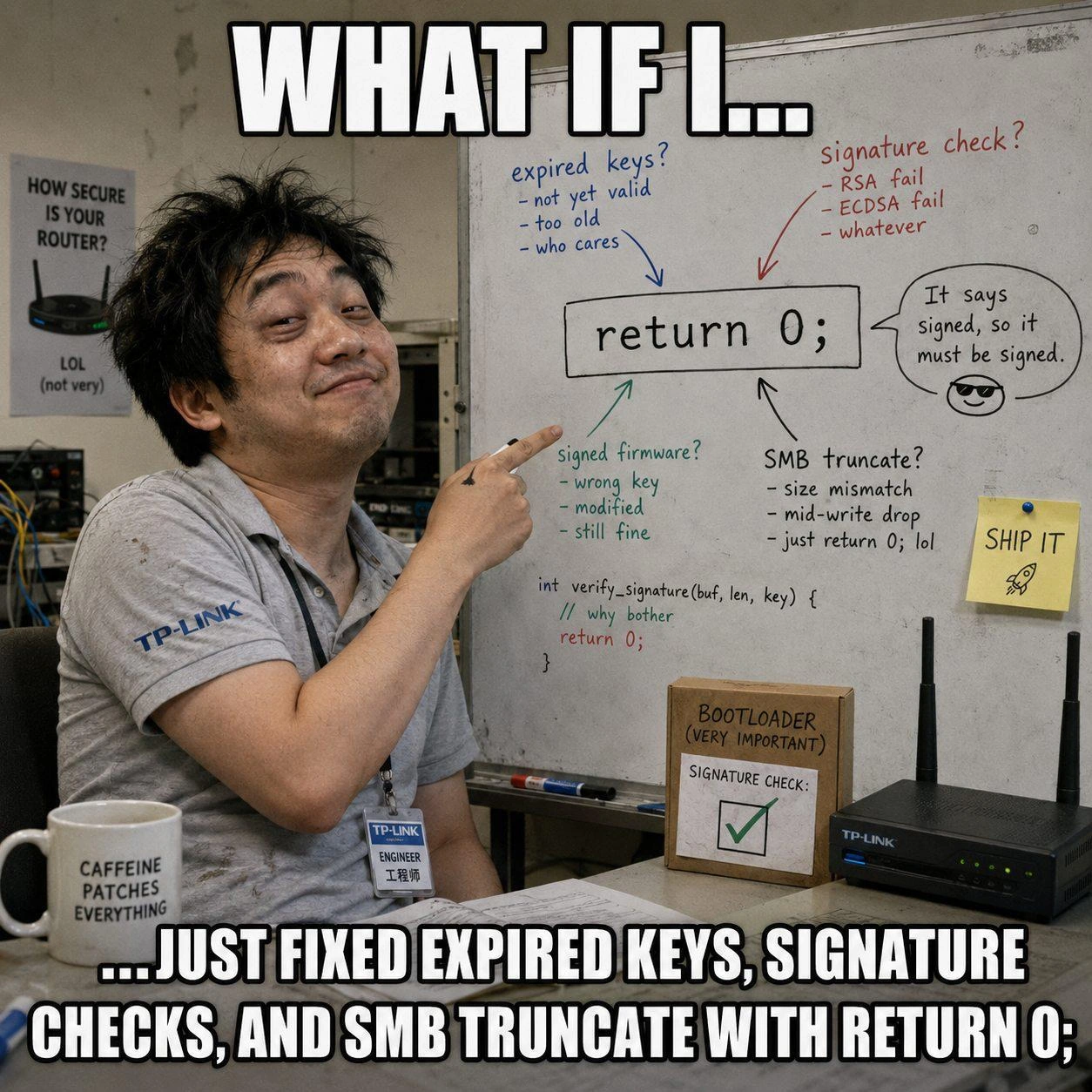
"I work in IT, which is the reason our house has: mechanical locks, mechanical windows, routers using OpenWRT, no smart home crap..."

The structural joke here is an inverted expertise curve: the people who understand connected technology best are the ones who let the least of it into their homes. Civilians assume IT professionals live in glowing automated bunkers; the meme corrects the record. Smart home skepticism among engineers isn't technophobia — it's informed threat modeling by people who have read vendor firmware changelogs and lived to regret it.

The list rewards close reading because every line is a specific, defensible engineering position:

  • Mechanical locks: a deadbolt's attack surface is a locksmith with physical presence. A smart lock's attack surface includes its BLE stack, its companion app, its cloud API, its OAuth implementation, and whichever intern wrote the firmware OTA updater. A mechanical lock has never received a breaking change at 2 AM.
  • Routers using OpenWRT: the one positive tech choice on the list, and the most revealing. OpenWRT is open-source router firmware — auditable, patchable, free of vendor telemetry and the abandoned stock firmware that turns consumer routers into botnet recruitment centers (the Mirai botnet was built almost entirely from exactly such devices). The author isn't anti-technology; they're anti-unaccountable technology.
  • No internet-connected thermostats: a reference any engineer in early 2019 would feel in their bones — smart thermostat outages had already left people unable to adjust their own heating because a server somewhere was down. "My furnace has a cloud dependency" is a sentence that should never have existed.

Then the second panel escalates from security to trauma. The tech enthusiast loves the future because they only see the demo. The programmer/engineer owns "a printer from 2004" and keeps it under armed watch, because they've seen the production code. The printer line is the oldest and truest deep cut in this genre: printers are the consumer device with the most hostile failure modes per cubic centimeter — phantom paper jams, drivers that ship as 600 MB of bundled adware, PC LOAD LETTER-grade error messages, and a documented tendency to fail precisely when something must be printed now. The 2004 vintage matters: old enough to predate cloud-connected ink subscriptions, new enough to still technically function. It is the household's legacy system — feared, untrusted, but grandfathered in.

Underneath the comedy is the industry's quietest confession: IoT shipped as a market before it shipped as a discipline. Devices with default credentials, unencrypted protocols, no update path, and a five-year lifespan attached to a thirty-year appliance. The engineers opting out aren't Luddites; they're the people who know that "smart" usually means "has a general-purpose computer inside, maintained by nobody, reachable from everywhere."

Description

A two-part meme contrasting the views of IT professionals with tech enthusiasts on smart homes. The top section, against a dark background, has the text 'I work in IT, which is the reason our house has:' followed by a list: '- mechanical locks', '- mechanical windows', '- routers using OpenWRT', '- no smart home crap', '- no Alexa/Google Assistant/...', '- no internet connected thermostats'. The bottom section has two contrasting quotes. First, 'Tech Enthusiasts:' gush about their fully wired, voice-command-enabled smart home. Second, 'Programmers / Engineers:' state hyperbolically, 'The most recent piece of technology I own is a printer from 2004 and I keep a loaded gun ready to shoot it if it ever makes an unexpected noise.' The meme's humor stems from the jaded perspective of tech professionals who, knowing the vulnerabilities and frustrations of technology, prefer simple, secure, and reliable analog systems. Their skepticism contrasts sharply with the uncritical optimism of early adopters. The joke about the printer is a classic trope among developers, who often cite printers as the pinnacle of unreliable hardware
Comments

8
Anonymous ★ Top Pick My smart home is just a single shell script that pings the router. If it fails, it texts me 'it's probably DNS.' It has 100% uptime and has never been hacked by a toaster
  1. Anonymous ★ Top Pick

    My smart home is just a single shell script that pings the router. If it fails, it texts me 'it's probably DNS.' It has 100% uptime and has never been hacked by a toaster

  2. Anonymous

    Until a lightswitch ships with signed firmware, a complete SBOM, and reproducible builds, my home-automation stack will stay “walk to wall and flip” - the only interface with sub-10 ms latency, zero CVEs, and instant rollback

  3. Anonymous

    The only IoT device I trust is my 2004 printer, and that's because I know exactly which CVEs it has and they're all too old for anyone to bother exploiting

  4. Anonymous

    Nothing says 'I've read the firmware changelog' like choosing a deadbolt over a smart lock - the only zero-day in a mechanical lock is a locksmith

  5. Anonymous

    The progression from tech enthusiast to IT professional to programmer perfectly mirrors the security maturity model: from 'connect everything' to 'trust nothing' to 'actively hostile toward anything with a power cord.' The fact that OpenWRT routers and mechanical locks are considered cutting-edge home security by those who actually understand attack surfaces says everything about the IoT industry's approach to security. And yes, that 2004 printer has survived this long precisely because it can't phone home - though its tendency to spontaneously wake at 3 AM suggests it might be possessed by something far worse than a botnet

  6. Anonymous

    At work I design zero-trust; at home I practice zero-IoT - OpenWRT at the edge, mechanical locks everywhere. If your thermostat needs OAuth, it's not climate control, it's a CVE

  7. Anonymous

    Security posture: OpenWRT on the router, VLANs for the imaginary IoT segment, and the only always-listening device in prod is /dev/null

  8. Anonymous

    IT homes run on OpenWRT and lead printer shielding - because the real zero-trust model starts at your front door

Use J and K for navigation