Skip to content
DevMeme
Deploying Directly to Production: A Thrill Ride Nobody Wants
Deployment Post #86, on Feb 10, 2019 in TG

Deploying Directly to Production: A Thrill Ride Nobody Wants

Why is this Deployment meme funny?

Level 1: No Rehearsal, Live Audience

It's like a school play where, instead of practicing even once, the lead actor puts on sunglasses, walks straight onto the stage on opening night, and tells the audience to buckle up. Maybe he nails every line and looks like a legend. Maybe the set collapses on the front row. The funny part is his total confidence either way — and the fact that the audience, not the actor, are the ones who need the seatbelts. Everyone who has ever skipped the practice run and gone straight to "the real thing" knows both this grin and the disaster that sometimes follows it.

Level 2: The Vocabulary of the Tightrope

Terms worth knowing before you're the one in the sunglasses:

  • Production (prod): the live system real users touch. Breaking it has real consequences — lost money, lost data, lost trust.
  • Staging environment: a near-copy of production where changes are rehearsed first. Like a dress rehearsal before opening night.
  • CI/CD pipeline (Continuous Integration / Continuous Delivery): automation that builds your code, runs the tests, and deploys in controlled steps. It exists so a typo gets caught by a machine instead of by customers.
  • Hotfix: an urgent patch pushed quickly to fix a live problem — the most common legitimate-sounding excuse for skipping the pipeline.
  • Rollback: undoing a bad deploy by restoring the previous version. If you don't know how you'd roll back, you're not deploying, you're gambling.

The classic junior-developer arc this meme foreshadows: one day a senior says "just push it straight to prod, it's a one-line change." It works, and you feel like the man in the picture. The fifth time, the one-line change has a missing WHERE clause, and you discover why the pipeline, the review checklist, and the phrase "it's never just a one-line change" all exist. Both experiences are part of the curriculum.

Level 3: The Stuntman Theory of Deployment

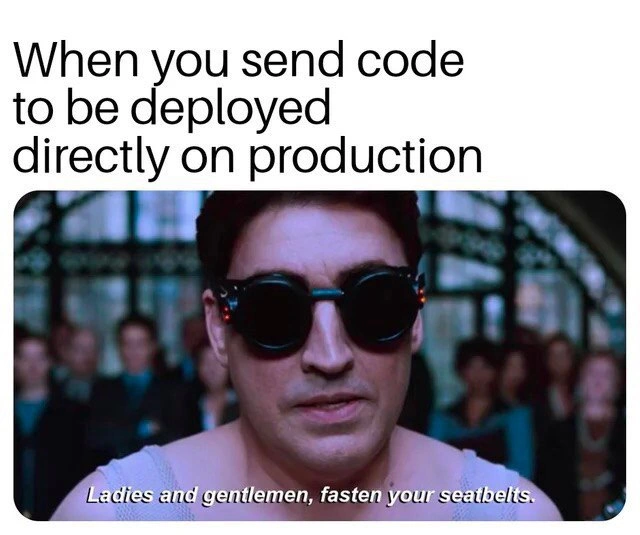
When you send code to be deployed directly on production "Ladies and gentlemen, fasten your seatbelts."

The sunglasses are the tell. A daredevil performer addressing his audience before the trick — that's exactly the energy of the cowboy deployment, and the meme is honest about something the industry usually isn't: shipping straight to production feels fantastic. It's the closest a developer gets to walking a tightrope in front of a crowd. The crowd, in this case, being your entire user base, who did not buy tickets and would very much like to get off the ride.

The satire lands because everyone in the audience knows what's being skipped. The modern CI/CD liturgy exists precisely so that no single person ever gets to feel this cool: code review, automated test suites, a staging environment that imperfectly mirrors prod, canary releases, feature flags, automated rollback. Every one of those layers is scar tissue — each was invented after someone, somewhere, did exactly what this meme depicts and took down billing for six hours. The pipeline isn't bureaucracy; it's a graveyard with good marketing.

And yet direct-to-prod deploys keep happening, for reasons that are systemic rather than stupid:

  • The hotfix paradox: the more broken production is, the more justified it feels to bypass the safeguards — which is precisely when you're most likely to ship a second, worse bug on top of the first. Outages compound under pressure.
  • Staging drift: when staging is missing, underfunded, or "basically prod except different data, different config, different load, and it's been broken since March," it stops catching anything, and developers rationally stop trusting it. no_staging_environment isn't a tag, it's a budget decision.
  • Incentive asymmetry: the dev who YOLO-ships a fix in four minutes is a hero tonight. The cost — the incident review, the on-call engineer paged at 3 AM by the side effect — lands on someone else's calendar. Heroism is a lagging indicator of process failure.
  • Survivorship bias: every cowboy deploy that works tightens the habit. "We did it last quarter and nothing broke" is the deployment equivalent of "I've never needed a seatbelt before."

The subtitle is doing the best work: fasten your seatbelts concedes, up front, that something may go very wrong — and proceeds anyway. That's the entire genre of the YOLO deploy in one sentence. Mature shops do ship to production constantly, but they do it with guardrails so each change is boring. The meme celebrates the opposite: maximum blast radius, maximum showmanship, zero rollback plan. The grin of a man whose monitoring strategy is "users will tell us."

Description

A two-part meme about the risks of reckless deployment practices. The top section features the white-background text: 'When you send code to be deployed directly on production'. The bottom image is a cinematic still of Dr. Otto Octavius from the movie Spider-Man 2, wearing his dark, heavy-duty goggles just before his fusion power experiment. The subtitle captures his dialogue: 'Ladies and gentlemen, fasten your seatbelts.' The meme humorously equates deploying code straight to the live production environment with a dangerous, unpredictable, and potentially catastrophic event. For senior developers, this resonates deeply, as it represents a cardinal sin of software development - skipping crucial testing, staging, and validation steps, which almost guarantees a turbulent experience for the on-call team and users alike
Comments

8
Anonymous ★ Top Pick Some developers test in staging. The truly bold prefer to performance-test their SRE team's incident response SLAs
  1. Anonymous ★ Top Pick

    Some developers test in staging. The truly bold prefer to performance-test their SRE team's incident response SLAs

  2. Anonymous

    Direct-to-prod deploys: where the integration test is live traffic, the rollback script is a dusty Perl one-liner from the Subversion days, and “fasten your seatbelts” passes for a change-management checklist

  3. Anonymous

    The same confidence that made you skip staging is now calculating how many PagerDuty alerts you can ignore before it becomes a resume-generating event

  4. Anonymous

    We do have a staging environment - it's called production, and the test suite is whoever's on call tonight

  5. Anonymous

    Ah yes, the classic 'test in production' strategy - where your staging environment is production, your QA team is your users, and your rollback plan is updating your LinkedIn profile. Nothing says 'we have mature DevOps practices' quite like treating your deployment pipeline as a suggestion rather than a requirement. At least when the pager goes off at 3 AM, you'll have that brief moment of clarity wondering if maybe, just maybe, that staging environment the team kept requesting wasn't such a bad idea after all

  6. Anonymous

    Direct-to-prod: the only canary is the on-call rotation, and the error budget is the runway length

  7. Anonymous

    Direct-to-prod deploy? Fasten your seatbelts - we’re A/B testing our incident response with 100% of users

  8. Anonymous

    Direct-to-prod: artisanal incident crafting, one unpiped commit at a time - until the SLOs demand a feature-flagged mea culpa

Use J and K for navigation