When your regex fails and you’re left SED instead of satisfied
Why is this CLI meme funny?
Level 1: Sad Husky, Silly Tech Pun
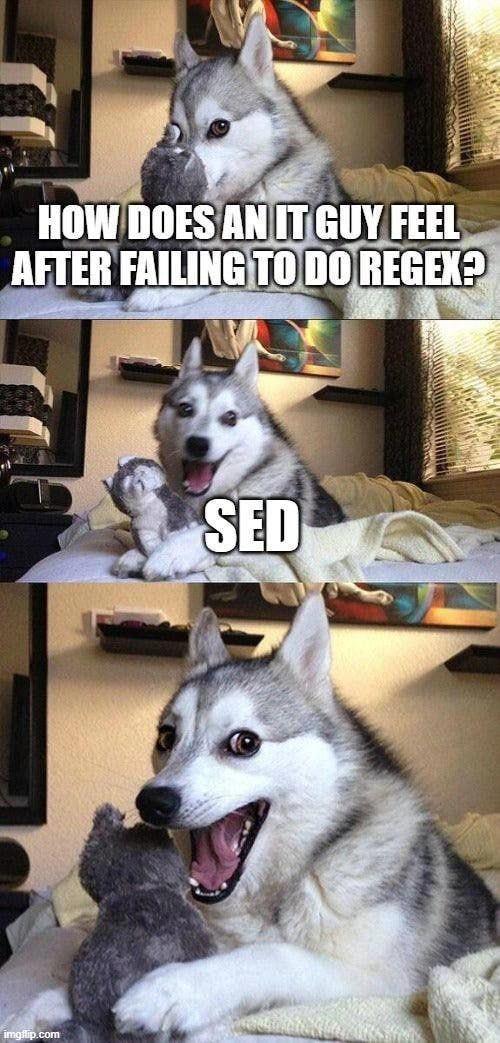
This picture is a simple joke that uses a play on words. The dog (looking very proud of itself) asks how an IT person feels after messing up something tricky, and then it answers with the word “SED.” That’s meant to sound just like “sad.” So basically, it’s saying the IT person feels sad because they failed. The twist is that Sed is also the name of a computer tool used in coding, but you don’t even need to know that to get why it’s funny at a basic level. It’s like if someone failed at a magic trick and said “I’m abracadab-ra upset” – using a magic word in place of “very” or something, just being playful with language. Here the dog is using a tech word that sounds like an emotion. The reason people laugh (or groan!) is that it’s a pun – a goofy joke where a word with double meaning is used unexpectedly. In plain terms: the person is unhappy that their computer thing didn’t work, and the dog jokes that they’re “sed” (which sounds like “sad”). The dog’s big grin in the last panel shows it’s proudly teasing us with this cheesy joke. Even if you don’t know anything about computers, you can understand that the dog basically made a silly word joke about being sad. It’s the kind of humor where you go “oh no, that’s so bad it’s good!” and maybe chuckle because the dog is just so pleased with itself. In short, the person is sad, the dog says “sed” instead – and that’s the whole joke!
Level 2: Pattern Matching Pains
Let’s break this down in simpler terms. The meme is asking about a very specific scenario: failing to do a regex. A regular expression (regex) is basically a pattern you write to match text. Think of it like a supercharged find-and-replace or a complex search query. For example, a regex ^Hello.*world$ would match any string that starts with "Hello" and ends with "world". Developers use regexes to do things like validate input (e.g. checking if an email address is in the right format) or to find pieces of text in a file. They are incredibly useful, but they have a reputation for being hard to get right. The syntax is full of symbols with special meanings (^, $, \d, (), |, *, +, etc.), so it’s easy to make a small mistake that causes your pattern to fail. If you’ve ever tried to craft a regex and it didn’t match what you wanted – or matched way more than you expected – you know it can be frustrating. In fact, for newcomers, writing a correct regex can feel like solving a riddle or a puzzle. Missing one backslash can completely break it! So, “failing to do regex” just means the regex didn’t work – the IT person couldn’t get the pattern to do what they needed, and likely they’re feeling defeated or annoyed by that.
Now, the answer in the meme is “SED.” What does that mean? sed (all lowercase in actual usage) is the name of a classic command-line tool on Unix-like systems. It literally stands for Stream EDitor. People run sed in a terminal (shell) to process text, usually to find and replace things in a stream of text or a file. It’s part of the standard arsenal of CLI tools along with others like grep (for searching text) and awk (for more advanced text processing). The key connection is: sed uses regex patterns for its search-and-replace operations. In fact, one of the most common ways to use sed is with the substitute command, which looks like s/old_text/new_text/g. This means "replace every occurrence of old_text with new_text globally in the input." For example, if you wanted to change all occurrences of "foo" to "bar" in a file, you might run:
sed -i 's/foo/bar/g' filename.txt
This would find "foo" anywhere in the file and replace it with "bar". The -i flag means it will edit the file in place. The part between quotes, s/foo/bar/g, is the sed command to do substitution with a regex pattern "foo".
So how does this tie into the meme? The joke answer "SED" is a play on words. It sounds like “sad” (especially when read quickly), but it’s actually referring to the sed command. The humor is: the IT guy feels sad because their regex failed, but since we’re all techies here, we say "sed" instead, hinting at the tool meant for regex-based editing. It’s a bit of wordplay that assumes you know sed is a thing. To a non-developer, "sed" doesn’t mean anything, but to a developer, it immediately brings to mind the command-line and regex replace operations. The meme even spells it in all caps in panel 2 (“SED”) to make it stand out as a reference to the command.
Let’s illustrate what sed does, to make it clearer. Imagine we have a simple text: "I feel sad". If we use sed to replace "sad" with "SED", it would look like this:
$ echo "I feel sad" | sed 's/sad/SED/'
I feel SED
In this example, we echoed the string "I feel sad" and piped (|) it into sed. The sed 's/sad/SED/' part tells sed: find the text "sad" and substitute it with "SED". The output, as you see, becomes "I feel SED". We basically used the sed tool to perform the exact word swap that the meme joke is doing! This is why the meme is funny to developers – it’s referencing exactly this kind of text substitution. The poor IT guy in the joke “failed to do regex”, implying perhaps he couldn’t craft the right pattern or get his search-and-replace working in code. The result? He’s left feeling sed (sad), and maybe he’s going to go use the sed command as an alternative to finish the job. It’s a pun that only works because sed is both a tool and sounds like an English word.
We should also note the meme’s format: it’s using that bad pun husky image. In panel 1, the husky looks a bit coy while the question text is posed. In panel 2, it blurts out the punchline ("SED") with a more eager expression. By panel 3, the husky has this huge goofy grin, as if proud of the terrible joke just made. This format is well-known: whenever you see that husky, you expect a corny pun. In a programming meme context, the puns often involve programming terms or CLI tools, exactly like we see here. Tags like DeveloperHumor or CodingHumor fit because this kind of joke is something only people in the coding world tend to make. The context tags such as regex_fail and shell_tool_joke literally describe what’s happening: it’s a joke about a shell (command-line) tool in the context of a regex failure. And text_processing is relevant since both regex and sed are tools for processing text.
For a newer developer (or someone not yet familiar with these tools), here’s the takeaway: Regular expressions are a powerful but tricky way to search text patterns, and sed is a command-line utility that uses regex to edit text streams. Failing at regex is a common woe – it can make you feel upset. The meme then makes a pun by saying “sed” instead of “sad.” It’s the kind of joke you might only hear in programmer communities. If you didn’t know what sed was, you might be pretty puzzled by this meme. But now you know: the joke lives at the intersection of tech jargon and wordplay. The husky is basically saying, “I’m sad about my regex fail – get it? Sed?” 🙃 Even if you groan, you’ve learned a bit about a shell tool in the process!
Level 3: s/regex/sed/g
For seasoned developers, this meme triggers an instant mix of facepalm and laughter. It’s playing on the classic frustration of regular expressions (regex) and giving it a command-line twist. The setup asks, “How does an IT guy feel after failing to do regex?” The punchline answer is SED, which is hilarious (and groan-worthy) because sed is a Unix CLI tool for text substitution using regex. In other words, the meme swaps "sad" (the emotion of failure) with "sed" (the tool) – a homophone pun that only makes sense to tech insiders. The husky in the image (known as the “bad pun dog”) turns toward the camera in panel 2 and proudly delivers this one-word zinger, and by panel 3 it’s grinning because it knows it dropped a nerdy joke. The humor here comes from layering a developer’s pain point (regex messing up) with a bit of shell tool trivia. It’s the kind of joke where if you get it, you might grog– grin and groan at the same time.
This meme lands well with experienced engineers because it captures a shared reality: regexes are hard. We’ve all spent far too long debugging a seemingly simple pattern like ^.+@.+\..+$ (supposed to match an email) only to find edge cases or escaping issues that make it fail. When your carefully crafted grep or application regex doesn’t do what you expect, you feel defeated. As a kind of coping mechanism, developers often joke about these things. Here, the punchline being the sed command is perfect because sed itself is a classic text-processing power tool. It stands for “stream editor” and is often used in shell scripts or one-liners to do substitutions on text streams or files. The irony is rich: if you fail at regex, turning to sed wouldn’t really save you – since sed uses regex under the hood for its find-and-replace! It’s like saying, “My regex didn’t work in my code, so I feel sed,” implying you might resort to opening a terminal and using the sed command (thus being both “sad” emotionally and “sed” tool-wise). This self-referential loop is what makes tech folks smirk. It’s humor by way of insider knowledge: only someone who knows what regex and sed are will fully appreciate why replacing one with the other is a joke.
Beyond the wordplay, there’s a nod to real developer experiences. RegularExpressions are powerful but can be bewildering, especially under pressure. The meme’s question (“failing to do regex”) evokes that scenario where you just cannot get your pattern to match or replace correctly. Maybe you’ve run into unpredictable results due to greedy vs. lazy quantifiers, or you’ve been stumped by how to escape special characters (. or \ nightmares, anyone?). At 2 AM, eyes blurred, you might’ve even considered abandoning your code’s regex logic and using a quick sed command on the data file instead. It’s a bit of a running joke in programming: “I had a problem, so I tried to use regex. Now I have two problems.” The meme capitalizes on that famous quip by Jamie Zawinski:
“Some people, when confronted with a problem, think ‘I know, I’ll use regular expressions.’ Now they have two problems.”
Here, the developer’s first problem was whatever text processing task they had. The second problem is the sadness from the regex failure – which the meme whimsically labels with the tool sed. It’s a tongue-in-cheek way of saying “Yep, been there, felt that.” Seasoned devs recognize this pattern (pun intended): the more convoluted your regex, the more likely you’ll feel sed when it doesn’t immediately work.
The choice of a husky delivering the line adds to the comedic effect. The bad_pun_dog_meme format is well-known on the internet: the dog tells an absurd dad-joke with a triumphant grin. In this context, the dog is effectively a fellow developer who can’t resist a shell tool joke. By using sed, the meme also pays homage to old-school Unix tooling. It reminds us that even in the age of fancy IDEs and AI code assistants, we’re still leaning on 1970s-era command-line utilities – and joking about them. There’s almost a historical Easter egg: sed has been around since the early Unix days (a descendant of the ed editor, created in 1974), and it uses the same regex syntax that has frustrated programmers for decades. The meme slyly hints that this is an age-old story: text processing is tricky, and when it goes wrong, we feel low. But leave it to developers to turn that into a pun with the tools of the trade. The categories listed (CLI, Tooling) and tags like sed_command and shell_tool_joke show that this is a very geeky, command-line-centric piece of humor. It’s the kind of joke you’d see in a GitHub issue comment or a DevOps team chat after someone spends too long wrestling with a deployment script’s regex. In short, the meme is funny because it wraps a common tech frustration in a clever homophonic pun – one that only makes sense if you speak the language of the command line. And for those who do, it’s sed-ifyingly satisfying. 😅
Description
A three-panel “bad pun husky” meme shows a grey-and-white husky on a bed holding a plush toy. Panel 1: the dog looks sideways while white block-cap text overlaid reads, “HOW DOES AN IT GUY FEEL AFTER FAILING TO DO REGEX?” Panel 2: the husky turns toward the camera, mouth slightly open, with the single word “SED” in bold white capitals centred across the frame. Panel 3: the husky grins widely with teeth showing, clearly pleased with its own joke. The gag is a Unix command-line pun: ‘sed’ is a classic stream-editing tool that uses regular expressions, while the homophone “sad” conveys the emotion of failing at regex. Developers familiar with shell tooling, regex frustration, and groan-worthy puns will recognise the CLI humour immediately
Comments
11Comment deleted
Running sed -i in a one-liner on prod is that senior rite of passage where you discover both your regex and your rollback strategy were non-greedy
The real tragedy is when you finally get your sed regex working perfectly, only to realize you forgot the -i flag and all your changes went to stdout instead of the file - now THAT'S when the existential 'sed'ness truly hits
After spending three hours debugging a catastrophic regex that somehow matched everything except what you needed, discovering sed's simple 's/problem/solution/' syntax feels less like settling and more like finally understanding why the Unix philosophy exists - sometimes the tool that does one thing well beats the Swiss Army chainsaw every time
Regex “didn’t work,” so someone reached for sed -i - congrats, you just shipped a write-only DSL to prod
Regex lookahead hell in code: 3 hours of despair. Sed one-liner: instant victory. CLI elders know the real regex power lies in streams, not libraries
Regex failed? Classic - next step is `sed -i` against live configs, because nothing calms catastrophic backtracking like irreversible text surgery in production
that happens too regular Comment deleted
-i "s/know/knew/g" Comment deleted
didnt get it, explain plz Comment deleted
https://www.gnu.org/software/sed/manual/sed.html Comment deleted
Ahh, sed. Helped me a lot Comment deleted