Drake chooses Ponzi scheme over leverage staking in blockchain meme
Why is this Blockchain meme funny?
Level 1: Too Good to Be True
Imagine you have two friends giving you advice on how to grow your savings. One friend says, “Hey, put your money in a safe place and maybe do a bit of extra work; it’s slow, but over time you’ll earn a little more. You could even borrow a tiny bit to invest, but be careful.” This is like a careful, honest plan: it takes effort and there is some risk, but it’s a real way to get some profit over time (kind of like doing chores to earn allowance and maybe doing extra chores to earn bonus money). Now your second friend comes along with a big grin and says, “I’ve got a magic idea: give me $10 right now, and by next week I’ll give you $20 back! I found a secret trick to double your money. And if you get more friends to join in, you’ll earn even more!” That sounds exciting, right? Double your money without much work! But deep down, you might feel something isn’t right — like, where is that extra $10 coming from? (Hint: in schemes like this, it’s usually coming from the next unsuspecting person who hands over their money.) Now picture someone completely ignoring the first friend’s sensible plan and eagerly trusting the second friend’s sketchy offer. It’s a goofy scenario, isn’t it?
That’s exactly what this meme is joking about. In the pictures, Drake (the guy in the meme) is acting out that silly choice: he rejects the slow-and-steady idea (“leverage staking,” which is the complicated but reasonable approach) and he loves the too-good-to-be-true idea (“Ponzi scheme,” which is basically a scam). It’s funny because it’s so obviously the wrong choice. We all know the saying: if something sounds too good to be true, it probably is. The meme makes us laugh by showing someone doing the opposite of what common sense advises — all because the bad option is dangled like a shiny object with big promises. It’s a cartoonish reminder of how people can be tempted by easy money, even when they kind of know it’s a bad idea. Drake’s happy face for the “Ponzi” option is the punchline: it captures that moment of temptation in a lighthearted, exaggerated way, and it makes us smirk because, hey, humans can be pretty silly when money is on the line.
Level 2: High Stakes & Schemes
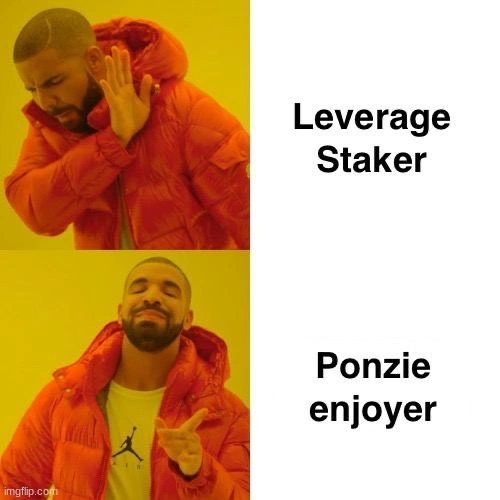
Let’s break down the joke in this meme in simpler terms. We have the famous two-panel Drake meme format here (Drake is a musician, and images from his “Hotline Bling” music video are often used for memes). In the top panel, Drake is shown turning away with his hand up, as if saying “no thanks” – the text next to him says “Leverage Staker.” In the bottom panel, Drake is smiling and pointing as if he’s found something he likes – the text there says “Ponzie enjoyer.” So, basically, the meme shows Drake disliking leverage staking and instead loving a Ponzi scheme (spelled “Ponzie” in the image as a playful twist on the word Ponzi).
Now, what do those terms mean?
Leverage Staker: This refers to someone who does leverage staking. Staking means locking up your cryptocurrency (like coins or tokens) to earn some rewards or interest, often to support the network’s operations. It’s common in blockchain and DeFi (decentralized finance) platforms. For example, you might stake Ether (Ethereum’s coin) and get, say, 5% annual interest paid in Ether. Now, add “leverage” to that – leverage means borrowing money to invest more. So a leverage staker is an investor who not only stakes their crypto to earn interest, but also borrows extra funds to increase the amount they have staked. It’s like if you had $100 earning interest, and the bank let you borrow another $50 to also put to work earning interest; now you have $150 earning money for you instead of just $100. The idea is to amplify returns: if you’re earning 10% interest, doing it with $150 instead of $100 makes more profit. However, it also amplifies risk: if things go wrong, you could end up losing money and still owe that $50 loan back. In crypto, leverage staking often involves using one platform to lend you money against your staked coins, then using that money to stake even more on another platform (sometimes people loop this multiple times). It’s complex and risky, but it’s a real (if advanced) strategy in the crypto FinTech world. People do this to chase higher returns, but they must manage it carefully. If the market for your coin drops too much or the interest rates change, the platform might force-sell your staked assets to recover the loan (this is called being liquidated). So, it’s a high-risk, high-reward tactic for experienced users.
Ponzi enjoyer: First, what’s a Ponzi scheme? It’s basically a fraudulent “investment” scheme where no real profit is being made; instead, any returns you’re getting are just money from new people who join after you. In a Ponzi, the organizers take money from new investors to pay earlier investors, making it look like a profitable investment. But there’s no actual business or earnings behind it, so if new people stop joining, the whole thing collapses (because there’s no real money to pay out anymore). It’s called “Ponzi” after Charles Ponzi, who ran a famous scam like this in the 1920s, but the idea is similar to a pyramid scheme. Eventually, a Ponzi scheme runs out of new suckers and the last people in line lose their money (often the scheme runners vanish with a big chunk of it too). Now, the meme says “Ponzie enjoyer” — using “enjoyer” as a joking term to mean someone who enjoys or is a fan of Ponzi schemes. It’s tongue-in-cheek because obviously being a “Ponzi enjoyer” is not a good thing in reality! The meme is making fun of the fact that some crypto investors behave as if they prefer a Ponzi. Why would they? Well, a Ponzi scheme often advertises ridiculously high returns (“Get rich quick!”) which can be tempting if you don’t think about the long-term trap. In crypto, there have been coins or projects that were basically Ponzi schemes offering huge daily or weekly returns, and unfortunately, a lot of people did jump in hoping to make a quick buck before it crashed.
So, the meme is contrasting two approaches in the crypto world:
- Leverage staking – a complicated, somewhat legitimate method to earn higher yield (but with a lot of effort and plenty of risk), and
- Ponzi schemes – an obviously shady, ultimately doomed method that promises absurd rewards (and is basically a scam).
Drake turning away from “Leverage Staker” and pointing happily to “Ponzie enjoyer” is a humorous way to say: “Some people would rather go for the easy, sketchy high-return scheme than bother with the hard, sensible strategy.” It’s funny (and a bit sarcastic) because it’s true that during crypto hype periods, many folks do exactly that! They ignore the motto “If it’s too good to be true, it probably is,” and pour money into things that claim you can double your money overnight. Meanwhile, more realistic strategies that might yield decent returns with proper work get ignored because they seem boring by comparison.
In other words, the meme is poking fun at that greedy or naive part of human nature. We have one option that’s like doing your homework and slowly earning real rewards, and another option that’s like chasing a flashy promise of instant riches (which is a trap). And the meme shows Drake — a stand-in for those investors — literally choosing the trap with a grin. It’s a lighthearted warning: be careful of anything that promises guaranteed high returns with no risk, and don’t be the person who actually becomes a “Ponzi enjoyer.”
For clarity, here's a quick comparison between leverage staking and a Ponzi scheme in the crypto context:
| Approach | How returns are generated | Likely Outcome | Difficulty for Investor |
|---|---|---|---|
| Leverage Staking | From real sources: network rewards (staking interest), trading fees, or lending interest. The returns are real, but you borrow extra funds to amplify them. | Not guaranteed to fail, but very risky. If the market moves against you (price drops or interest goes up), you could lose your money and get liquidated. If things go well, you earn more than normal staking, but if things go poorly, losses are amplified. | High complexity – involves multiple steps (stake, borrow, re-stake) and constant monitoring. You need good knowledge of DeFi platforms and risk management to do this safely. |
| Ponzi Scheme | From new investors’ money only. There’s no actual profit being generated by a business or investment; it’s just shuffling money from newcomers to pay earlier people. | Guaranteed to collapse eventually. It can pay out for a while, but once new people stop joining (or the creators decide to run off), it fails and most people lose their money. Only a few early ones or the scammers win; majority get burned. | Very easy – usually just send money in and watch “your balance” go up… until it doesn’t. No special knowledge needed to start; the simplicity is part of the appeal. (Also, no amount of “skill” can save you when it collapses.) |
As you can see, leverage staking at least has a legitimate basis (earning actual crypto rewards), though it’s complicated and has lots of risk, while a Ponzi scheme is basically a house of cards that will inevitably fall apart. The meme is funny (and a bit biting) because it points out a truth in the crypto community: some people are more attracted to the simple, shiny promise of a Ponzi-style ROI than to a sensible strategy that takes work. It’s highlighting the irony that, in the pursuit of quick gains, folks can make choices that in hindsight look pretty foolish. Drake’s choice in the meme is obviously the wrong one, and that’s the joke — it’s a goofy way to remind us how ridiculous it is to go for a “get-rich-quick” scam over a sound investment plan.
Level 3: Stake It or Fake It
Anyone who’s been around the cryptocurrency block a few times will smirk at this meme, because it captures a scenario we’ve seen play out repeatedly. On the “Leverage Staker” side, we have a supposedly savvy strategy: using decentralized finance tools to stake coins and then leverage them for extra yield. This means doing things like depositing your crypto as collateral in a lending protocol, borrowing stablecoins or other assets against it, then staking those again elsewhere, perhaps even repeating the loop. It’s complex, a bit like juggling chainsaws financially – you're stacking yields, but also stacking risk. Seasoned devs have written multi-step smart contracts or scripts to automate these loops, carefully calculating collateral ratios and interest rates. It’s the kind of thing a DeFi power-user or developer might brag about: “I’ve got a yield farming strategy that nets 30% APY by looping through three protocols!” But it’s also the kind of strategy that can go wrong in a flash – a sudden price dip, and your collateral gets liquidated across the board at 3 AM. DeFi risks are real: even “sophisticated” leverage staking can turn into an expensive lesson if the market moves against you.
Now, on the other side, we have the “Ponzi enjoyer.” This is the investor who says, “Forget all that complicated yield juggling – this Ponzi scheme over here promises me 10% per day just for depositing, and I don’t have to understand anything!” It’s laughably unsustainable (and probably literally called something like MagicMoney or UltraYieldDAO), but in the crypto hype cycle, you’ll find plenty of takers. The meme portrays Drake happily pointing at the Ponzi option, which satirizes those moments in crypto culture where absurd scams actually attract more money than legitimate projects. It’s painfully relatable. Imagine being a developer who spent weeks crafting a careful smart contract system to earn, say, a 15% annual yield for users, only to watch a sketchy “double your money” scheme rake in millions of dollars overnight because it dangled a 1000% APY carrot. That contrast – the diligent strategist vs. the reckless yield-chaser – is exactly what’s being lampooned here. In blockchain circles, we sometimes joke about “APY so high, it’s basically a pyramid.” This meme takes that joke and runs with it.
The humor also comes from shared community awareness. Terms like “degen” (short for degenerate) get thrown around – affectionately! – for those who ape into (i.e. throw money at) questionable projects purely for the adrenaline rush of high returns. A “Ponzi enjoyer” is the ultimate degen: someone who fully embraces a pyramid scheme on the blockchain for that chance of a big score. There’s an ironic, self-aware subculture in crypto where people will meme about being “rug pulled” (when a project creator suddenly absconds with the funds) and wear it as a badge of honor if they managed to flip a profit before the collapse. It’s the Wild West ethos of FinTech meets internet humor. So Drake grinning at “Ponzi enjoyer” isn’t just calling some investors foolish – it’s acknowledging a very real pattern where folks know something is fishy but jump in anyway. Maybe they’re thinking, “I’ll be out before it crashes,” or maybe they just can’t resist the allure of those sweet, sweet yields that put conventional investments to shame. It’s greed, FOMO (Fear of Missing Out), and a bit of nihilistic humor all wrapped in one image.
From a developer’s perspective, there’s a mix of horror and dark comedy in this. Horror, because we’ve seen people lose fortunes chasing scams (and perhaps had to console friends or users who got burned). Comedy, because after you’ve seen the tenth variant of “Ethereum Yield Doubler 2.0” pop up on Reddit, it’s either laugh or cry. We know the script by heart now. The project’s Telegram chat will be full of rocket emojis and “we’re all gonna make it” chants… until suddenly it isn’t. The meme basically says: given the choice between a complicated but legitimate hustle (leverage staking) and an obviously sketchy get-rich-quick scheme (Ponzi), a lot of crypto players literally shrug and choose the latter. And as absurd as that sounds, it rings true enough to make us laugh. It’s funny because it shouldn’t be true, but it kind of is. In a boom cycle, rationality often goes out the window. People don’t want to hear about 5% yearly returns with careful risk management – they want 5% daily and they want it now. And if that means believing in a financial fairy tale, so be it.
The timing of this meme (late 2022) is notable too. We had just witnessed some high-profile crypto catastrophes: projects that promised stable high yields imploding spectacularly. The Terra/Luna yield farming fiasco is a prime example: a whole ecosystem offering ~20% annual on a “stable” coin — it turned out to be unsustainable, and it collapsed in dramatic fashion. It was emblematic of broader cryptocurrency trends at the time: during phases of extreme blockchain hype, if something offered juicy returns, hordes of people would pile in first and ask questions later. Only after the crash did everyone sober up and admit, “yeah, that was basically a pyramid scheme.” Meanwhile, legit blockchain projects focusing on real use-cases sometimes struggled to get attention. It’s a bit demoralizing for serious developers to see meme-worthy Ponzi games outshining genuine innovation. But what can you do except shake your head and maybe make a meme about it? In tech circles, humor is often how we cope with absurdity. This Drake meme is exactly that: a coping mechanism and an eye-roll rolled into one.
To an experienced eye, this meme is like a knowing nod and wink. It says “We’ve all seen this, right? The carefully engineered DeFi protocol vs. the flashy scam, and guess which one people flock to…” It highlights an ongoing challenge in the crypto space: education vs. temptation. As a community, we know we should be telling newcomers why a guaranteed 8,000% APY is a big red flag. But the temptation of quick gains is powerful. The meme uses Drake’s exaggerated gestures to sum up that struggle in one glance. Every crypto old-timer chuckles because they’ve lived it — either personally or by watching the insanity unfold from the sidelines. It’s developer humor and fintech satire boiled down into one bright, memetic image.
Level 4: Perpetual Ponzi Motion
In the realm of DeFi (decentralized finance), any promise of high, consistent returns with no external source of value is as impossible as a perpetual motion machine in physics. This meme humorously spotlights that violation of financial thermodynamics. Leverage staking might sound like a clever exploitation of yield opportunities, but even it bows to mathematical realities: you can’t create money from nothing without someone eventually paying the price. A seasoned blockchain engineer recognizes that no amount of smart-contract wizardry or cryptographic brilliance can override basic economics. It's akin to the conservation of energy: you can't get out more value than you put in, at least not indefinitely. The meme juxtaposes two options—complex leverage loops versus blatant Ponzi yields—and at a deep level it’s highlighting a fundamental paradox of decentralized finance: exponential returns inevitably collide with real-world limits.
Consider the mathematics behind a Ponzi scheme. If a platform promises a fixed 10% return every month with no real profit-generating activity, it must use new investors’ funds to pay earlier investors. This creates a classic geometric series of debt. For example, if $N_0$ is the initial investment pool, after one month it owes $N_0 \times (1 + 0.10)$ to investors; after two months, $(1 + 0.10)^2$; after k months, $N_0 \times (1.10)^k$. Meanwhile, the influx of new investment must accelerate to cover that expanding payout obligation. Mathematically, the required new funds grow exponentially. Very soon the number outpaces the available pool of new investors or money in the system — a direct analogy to an engine running out of fuel. In other words, the growth needed to sustain a Ponzi scheme will inevitably outrun reality, just as a machine claiming to run forever runs out of energy. This is financial entropy at work: the scheme must collapse when the chain of new contributors breaks. No distributed consensus algorithm or cryptographic trick can escape that fate.
Even so, the allure of those sky-high returns often blinds people to this inevitability. There's a concept in economics and game theory called the “Greater Fool Theory”: one might knowingly buy into an overvalued or unsustainable deal hoping to sell it to someone else (a “greater fool”) before the crash. This meme’s Drake character embracing “Ponzi enjoyer” is a tongue-in-cheek nod to that mentality. It’s a wry acknowledgment that, at a certain speculative frenzy, investors stop asking “Is this project fundamentally sound?” and start asking “Can I ride this rocket just long enough to jump off profitably?” We see parallels in formal financial theory too: economist Hyman Minsky described a late market stage where Ponzi finance takes hold—new debt (or investment) is needed just to service existing commitments. In DeFi’s chaotic playground, this dynamic played out starkly during the 2020–2022 yield farming boom, where protocols sometimes simply printed new tokens as rewards (diluting value, akin to paying with funny money) or recycled funds in loops to sustain payouts. No matter how blockchain-savvy the implementation, if a scheme’s payout depends solely on influx of new funds, it’s fundamentally a pyramid mechanism with a fresh coat of techno-paint.
On the flip side, “leverage staking” tries to use legitimate mechanics—earning interest or rewards from blockchain networks—amplified by borrowing. From a theoretical standpoint, it’s leveraging the system’s built-in reward (like Ethereum’s staking yield or lending interest) by recursively investing borrowed assets. If you model this mathematically, you find that the expected return can increase, but so does the risk of ruin non-linearly. It’s reminiscent of the gambler’s ruin problem in probability theory: the more you bet (or leverage), the higher the chance of going bust after a run of bad outcomes. In crypto terms, a sudden drop in the token price or a spike in borrowing rates can trigger liquidations that wipe out the leveraged staker’s position. So while leverage staking obeys the letter of economic laws (it’s not inherently fraudulent; it’s using real yields), it pushes the envelope of risk-taking. The meme humor is that one path is esoteric and complex (but at least tangentially grounded in “real” returns), and the other path throws all caution to the wind for outright make-believe returns. Drake siding with the Ponzi option underscores the absurdity: it’s poking fun at how even highly engineered financial strategies can’t compete with the raw seductive power of an “easy money” scam.
At a code level, this contrast is intriguing as well. A smart contract implementing leverage staking might be an elaborate piece of code interacting with multiple protocols (lending platforms, staking modules, yield optimizers) – a complex choreography that's difficult to get right (and secure). In contrast, a Ponzi scheme smart contract can be surprisingly simple: it’s basically a ledger that says “new deposits pay off the old ones.” Developers have even written analysis tools to detect Ponzi patterns on Ethereum by finding contracts where payouts to users come predominantly from subsequent users’ contributions with no other revenue source. No matter how clever the implementation, a Ponzi contract is fundamentally just shuffling funds forward until the music stops. It’s almost elegant in its simplicity, if it weren't so destructive. And that’s why the meme resonates on this deep level: it’s highlighting, with a dash of dark humor, that in the world of cryptocurrency and high-yield finance, complexity and even technological brilliance are sometimes cast aside by participants in favor of something that blatantly shouldn’t work, because for a short, intoxicating time, it does. The underlying laws of mathematics and economics will catch up, of course – and every veteran in the industry knows how that story ends – but until then, the mirage of effortless riches is a powerful draw.
Description
Classic two-panel “Drake Hotline Bling” meme on a yellow background. Top panel: Drake in a red puffer jacket turns away with one hand held up in rejection; to the right, bold black text reads “Leverage Staker.” Bottom panel: Drake smiles, points approvingly toward the viewer; to the right, bold black text reads “Ponzie enjoyer.” The joke contrasts two approaches in the crypto world - complex leveraged staking versus blatantly unsustainable Ponzi-style yields - highlighting how some investors favor risky, dubious schemes. The meme satirizes decentralized-finance culture, leverage loops, and the allure of impossibly high returns that often resemble pyramid structures
Comments
7Comment deleted
Architecture review takeaway: scrap the 12-layer leverage-staking loop and deploy a single `payYieldToEarlierDepositors()` function - same inevitable liquidation event, 90 % fewer gas fees, and marketing can brand it “Ponzi-as-a-Service.”
The only difference between a leverage staker and a Ponzi enjoyer is that one uses smart contracts to automate the inevitable liquidation cascade, while the other at least gets to meet the person running off with their money
The real alpha move is understanding that 'Ponzie enjoyer' isn't a typo - it's a feature flag for detecting who actually read the smart contract audit. Spoiler: the audit was also a Ponzi scheme, and the auditor's token just rugged last Tuesday. But hey, at least staking only gives you 4% APY instead of the promised 40,000%, which in crypto terms makes you the boring one at the DAO governance call
Leverage staking: architecting liquidations at scale. Ponzis: simpler consensus, guaranteed rug without the MEV bots
If your DeFi APR depends on collateral-looping of LSTs, you didn’t build a protocol - you implemented a strongly connected component where throughput equals new wallets; graph theory calls that a Ponzi
If your leverage-staking flowchart is a self-referencing loop with rising APY, congratulations - you’ve implemented circular dependencies as a business model
And they copypaste memes from Ivan Bevuch and many more So what? Comment deleted