Skip to content
DevMeme
2606 of 7435
C++ Committee's 'Fixes' that Just Add Complexity
Languages Post #2885, on Apr 3, 2021 in TG

C++ Committee's 'Fixes' that Just Add Complexity

Why is this Languages meme funny?

Level 1: Kitchen Sink Chaos

Imagine you have a big toy toolbox that started with just a hammer and a screwdriver. Over time, instead of fixing the worn-out hammer or the bent screwdriver, the toy makers just keep adding new shiny tools into the toolbox – a wrench, then a drill, then 30 more tools, one after another. They never remove the old broken tools, and they don’t really fix the hammer that sometimes hits your thumb by mistake. Now your toolbox is overflowing with gadgets. Every time you open it, it’s harder to find the right tool because there’s just so much stuff. And whenever the toy makers check on the toolbox, they scratch their heads and say, “Huh, why is this toolbox such a mess after we added all those tools to ‘improve’ it?” Sounds silly, right?

That’s basically what’s happening in this meme, but with the C++ programming language. The people in charge of C++ keep adding new features (like adding new tools) every few years. They think they’re fixing or improving the language by giving programmers more options. But they rarely take the time to clean up old problems (like the broken or awkward parts of the language). So C++ just keeps getting more complicated and heavy, kind of like that overstuffed toolbox. The funny picture from the cartoon shows a character (Fix-It Felix) who fixes everything he touches, looking frustrated and asking, “Why do I fix everything I touch?” In our toolbox story, it’s like the toy maker saying, “Why does everything get ‘fixed’ (filled with new stuff) when I work on it?” It’s ironic and funny because fixing in this case is actually making things more confusing. The joke is simply pointing out in a lighthearted way that sometimes trying to improve something over and over without ever simplifying it can just make it crazier – and everyone who has seen C++ grow over the years can’t help but laugh at how true that feels.

Level 2: Feature Bloat in Plain Sight

Let’s break down what’s going on in this meme for those newer to C++ or programming. C++ is a very popular programming language that’s been around a long time (since the 1980s) and is maintained by an international committee (the ISO C++ committee). This committee meets and publishes a new version of the C++ standard roughly every three years. Each new version of the standard adds a bunch of new features – think of features as new tools or new syntax that programmers can use to make their programs better or easier to write. For instance, C++11 added lambda functions (a way to write tiny functions inline), C++14 and C++17 kept refining things with convenience features (like auto and structured binding which let you declare variables more easily), and C++20 introduced big things like modules (to help organize code and hopefully replace the old header file system) and coroutines (for writing asynchronous code more easily).

The meme points out a funny problem: every time they add these dozens of features, they often don’t fix longstanding bugs or issues. What kind of issues? Well, C++ has some rough edges inherited from its past (it was built on the C language). For example, C++ doesn’t automatically prevent certain errors like accessing memory that you shouldn’t (which can cause crashes or security problems). There are also quirks like the complicated rules about how and when objects are created and destroyed, or how the C++ compiler can sometimes give very confusing error messages especially with templates (templates are a feature that lets you write code that works with any data type, but if you make a mistake, the error output can be insanely long and hard to understand). These are the “bugs” or flaws people often gripe about – not literal software bugs, but design problems or things the language could handle better. Instead of fixing or simplifying those, the committee usually just adds more on top. This accumulation of more and more stuff is what we call feature bloat or sometimes "over-engineering" when it feels like an overly complicated solution.

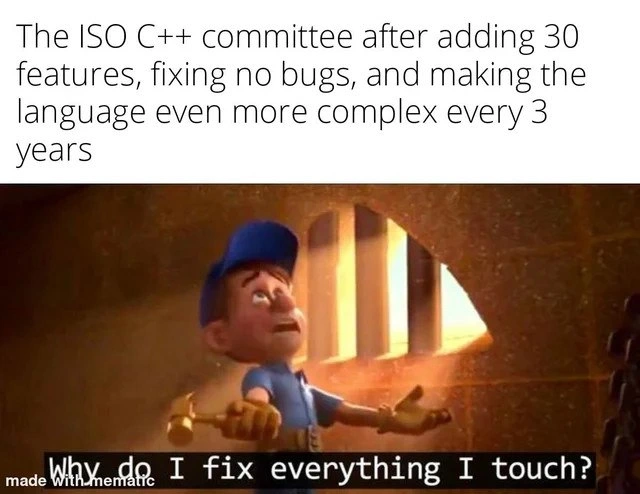
Now, look at the images in the meme. The top panel text directly calls out the ISO committee: “after adding 30 features, fixing no bugs, and making the language even more complex every 3 years.” This is the setup. It’s clearly exaggerating (30 features is a humorous hyperbole, though modern C++ updates do have dozens of changes if you count everything). It captures that feeling that every time you turn around, there’s a new C++ standard with a laundry list of new goodies, but some of the annoying parts of C++ are still there.

The bottom panel image is a scene from the animated movie “Wreck-It Ralph.” The character shown is Fix-It Felix, who in the movie is a handyman with a magic hammer that fixes anything he hits – even if he wants to break something, his hammer’s powers cause it to be repaired instantly. In the screenshot, Felix is frustrated and says, “Why do I fix everything I touch?” In the context of the meme, the C++ committee is being compared to Felix. The irony is that the committee believes it is “fixing” or improving C++ with each new standard (like Felix trying to be helpful with his hammer), but developers feel that actually everything they touch gets fixed (read: changed or complicated), leading to unintended results. Felix’s exasperated pose — arms spread, looking defeated — matches how C++ programmers imagine the committee feeling when they see the outcome: Oops, we tried to help, and now it’s even more complex! It’s a playful jab: the committee can’t help itself from “fixing” (adding to) the language, even if those fixes end up making C++ tougher to learn and use.

In simpler terms: the meme is saying “Every time the C++ committee updates the language, they cram in a bunch of new stuff and rarely clean up old problems, so C++ just keeps getting more and more complicated. Then they act surprised that it’s so complicated – just like a character who fixes everything and then wonders why everything he touches gets ‘fixed’ (changed).” It’s highlighting the contrast between code quality (which would mean sometimes you should clean up or simplify things) and what’s actually happening (just adding more, making the language heavier). This resonates with many programmers, especially those who have tried to keep up with all the modern C++ changes and felt overwhelmed by its ever-expanding feature set.

Level 3: Swiss Army Language Syndrome

For seasoned C++ developers, this meme elicits a knowing chuckle of exasperation. It highlights an ongoing reality in the C++ community: the ISO committee’s feature bloat vs. long-standing “bugs” or flaws that never get truly fixed. C++ has often been jokingly called a “Swiss Army chainsaw” – it has a tool for everything (and then some), but using it can be dangerous and unwieldy. Every 3 years, the committee releases a new C++ standard (like clockwork: C++11, C++14, C++17, C++20, etc.), each packed with fancy new capabilities. For example, C++11 gave us smart pointers, lambdas, and auto type deduction; C++17 added structured bindings and std::optional; C++20 introduced modules, coroutines, and concepts; C++23 (on the horizon at the time of this meme) promises even more. These features are often impressive and powerful – move semantics solved some performance issues, constexpr enables compile-time computation, and concepts improve template code clarity. But here’s the rub: while adding all these, the language rarely sheds legacy quirks or genuinely resolves its rough edges. Seasoned devs remember or deal with things like undefined behavior (e.g., accessing memory out of bounds is still not prevented by the language), the nightmare of template error messages that span pages, the complexity of the build process (linkers, headers and the preprocessor haven’t gone away), and old C++ pitfalls (like the dangling std::string_view or the still-weird syntax of declaring function pointers). Many of these “bugs” or design warts remain because fixing them would break older code or require rewriting the language from scratch. So instead, the committee’s typical approach is to introduce yet another feature to mitigate the old problem. This leads to over-engineering: solving problems by layering new abstractions rather than simplifying the foundation. The meme text mocks the committee as if saying: “Look, we’ve added 30 new features and made the language even more convoluted – how could this possibly have happened!?” The bottom image from Wreck-It Ralph shows Fix-It Felix (the handyman character with a magical fixing hammer) throwing up his arms in despair and asking, “Why do I fix everything I touch?”. It’s ironic because Felix’s fixes sometimes backfire – akin to the committee’s “fixes” making C++ heavier. Experienced programmers relate to this deeply: they’ve sat through C++ committee proposals, read endless upgrade notes, and felt the pain of codebases strained by each new standard’s complexities. There’s also a sly nod to language wars: developers in other language communities (like Rust, Python, or Java) often tease C++ for exactly this – adding complexity to solve issues C++ itself created. The senior perspective here recognizes the pattern of feature creep: an organization (the ISO committee) keeps cramming in new things (often to satisfy different interest groups, from game developers wanting better low-level control to large enterprise users wanting higher-level conveniences) without refactoring or simplifying. The humor has an element of weary sarcasm: Of course the language is exploding in complexity – what did they expect after continuously bolting on more parts without cleaning up the engine? It’s like watching someone “improve” a car by attaching extra engines and wheels instead of fixing the one flat tire – then being surprised when the car becomes absurdly complex. In real development terms, many C++ veterans have resigned themselves to the fact that each new standard may solve one problem but introduces two new concepts to learn, and they joke that C++ is its own biggest parody at this point. The meme encapsulates that collective frustration and amusement at how the C++ standard, intended to fix things, often feels like it’s breaking our sanity with complexity.

Level 4: Combinatorial Explosion

At the most advanced level, this meme hints at language design theory and the combinatorial complexity that arises when a programming language accumulates feature after feature over decades. C++ is a multi-paradigm language (supporting procedural, object-oriented, generic, and even functional programming styles), and each new ISO C++ standard introduces numerous additions. In theory, every feature interacts with existing ones, creating a combinatorial explosion of language behaviors and corner cases. The C++ committee operates under constraints like backward compatibility – they almost never remove old features (even flawed ones) because billions of lines of existing code rely on them. This means every new addition must coexist with everything from the past 40+ years of C/C++ history. The result? An increasingly complex specification and a compiler that has to handle an ever-growing grammar with special cases. Parsing and type-checking C++ has become notoriously difficult – certain template metaprogramming techniques make the compiler work as hard as running an algorithm, since templates are Turing-complete (you can literally perform arbitrary computations at compile time). The language’s grammar is so large and context-sensitive that some parts of C++ cannot be parsed with a simple context-free parser; compilers instead contain many ad-hoc rules to resolve ambiguities (e.g. the infamous “most vexing parse” where code could be parsed as a function declaration when you meant an object). Each standard (C++11, C++14, C++17, C++20, C++23, ...) piles on new keywords, library utilities, and rules – from constexpr to concepts to modules – increasing the power of the language but also the ways those features can interact in unexpected ways. This is reminiscent of a combinatorial state space explosion in formal systems: as you add more components, the number of possible combinations grows exponentially. In C++, every combination of features (say, templates + inheritance + exceptions + move semantics + ... you name it) might expose new edge cases or undefined behaviors. The dark humor here is rooted in the theory of complexity: with so many moving parts, accidental complexity (difficulties not inherent to the problem being solved, but created by the solution domain itself) becomes enormous. The meme’s punchline frames the ISO committee as Fix-It Felix accidentally “fixing” things: every time they touch the language to improve it, they inadvertently create an even more over-engineered beast. In essence, the meme is a tongue-in-cheek nod to the second-order effects of language evolution – a cautionary tale from a theoretical perspective about how adding power adds complexity in non-linear ways.

Description

A meme featuring the character Fix-It Felix from Disney's 'Wreck-It Ralph.' The top text reads, 'The ISO C++ committee after adding 30 features, fixing no bugs, and making the language even more complex every 3 years'. The image below shows Fix-It Felix, looking bewildered and holding his golden hammer, with the subtitle, 'Why do I fix everything I touch?'. The joke is a sarcastic critique of the C++ standards committee, suggesting that their attempts to 'improve' the language by adding numerous new features (like concepts, modules, and ranges in C++20) paradoxically make it more convoluted and unwieldy, without addressing long-standing core issues or bugs. The irony lies in the character's catchphrase, which is repurposed to highlight the committee's perceived lack of self-awareness about the consequences of their additions


Comments

13
Anonymous ★ Top Pick The C++ committee's motto: 'Why deprecate when you can just add another, slightly different way to do the same thing and call it modern?'
  1. Anonymous ★ Top Pick

    The C++ committee's motto: 'Why deprecate when you can just add another, slightly different way to do the same thing and call it modern?'

  2. Anonymous

    C++26 roadmap: replace nullptr with an optional<expected<shared_ptr<monostate>>> so we can finally say we “fixed” nulls - then wonder why hello-world needs a minute of template instantiation time

  3. Anonymous

    C++ is the only language where "we've deprecated auto_ptr" and "we've added 7 new pointer types" can happen in the same meeting, and everyone just nods because they're still debugging template errors from C++98

  4. Anonymous

    The ISO C++ committee operates on the principle that if you can't fix the footguns, just add enough features that developers are too busy learning concepts, ranges, and coroutines to notice the undefined behavior lurking in their legacy code. Every three years, they deliver a new standard that makes your existing codebase feel simultaneously outdated and impossible to modernize - because who has time to refactor when you're still trying to understand why `std::move` doesn't actually move anything?

  5. Anonymous

    Every three years WG21 “fixes” C++ by not breaking ABI and shipping consteval/concepts/ranges - zero-cost at runtime, compounding interest on your build farm

  6. Anonymous

    WG21’s cleanup plan: add a new sublanguage (concepts/ranges/coroutines/modules) so we don’t have to touch the old one - UB remains the only stable ABI

  7. Anonymous

    C++ committee: Adding coroutines and concepts to 'fix' templates, because nothing simplifies like nesting 30 new keywords in your includes

  8. @ANTICHRISTUS_REX 5y

    For us (Antediluvian Programmers), our era was so sweet, no complicated languages, no colored screens, even no mice (we was watching them on TV). If we come back, we will eradicate you, or will force you to hide your noses. Why ? You (moderne developers) are seeing us like dinosaurs, and we're seing you like.. Mice 🤣.

    1. Deleted Account 5y

      need thay world

    2. @Supuhstar 5y

      Lol

      1. @ANTICHRISTUS_REX 5y

        Memories 😢.

  9. @Supuhstar 5y

    Cute donkey baby 🥰

  10. @Supuhstar 5y

    The cute donkey!

Use J and K for navigation