Skip to content
DevMeme
2607 of 7435
User Ingenuity vs. Developer Deprecation Strategy
Stakeholders Clients Post #2886, on Apr 5, 2021 in TG

User Ingenuity vs. Developer Deprecation Strategy

Why is this Stakeholders Clients meme funny?

Level 1: Stubborn as a Mule

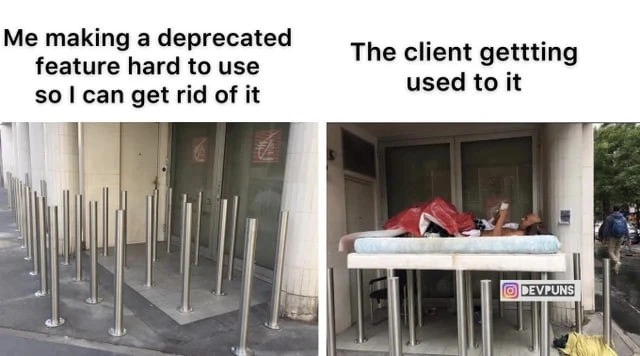
Imagine you have a favorite old toy that you think your little brother shouldn’t play with anymore because it’s worn out. You decide to make it hard for him to reach: you stack a bunch of chairs and boxes around it, creating a little maze so he’ll give up. That’s like the left picture – you blocking the door with poles. But your little brother really loves that toy. So, instead of giving up, he drags over a big pillow (like the mattress in the right picture), throws it on top of the messy pile of chairs, climbs over comfortably, and grabs the toy anyway. He even lies down on the pillow and plays there, completely unbothered by your obstacle course. In the end, your plan to discourage him doesn’t work at all – he found a silly, clever way to keep doing exactly what he was doing. It’s funny because you went through all that trouble to set up barriers, and he just said, “No problem!” and made himself at home on them. This is just like the developer and client in the meme: one tries to block the old thing, but the other finds a way and keeps using it, easy-peasy. The joke shows how people can be very stubborn and creative when they want to stick with something they like!

Level 2: Old Habits Die Hard

Let’s break down the meme’s scenario in simpler terms. On the left, we have a developer (or a development team) dealing with a deprecated feature – a part of the software that they officially want to phase out. In software, deprecating something means “we intend to remove this in the future; please avoid using it.” It’s like putting up a sign that says “this road will be closed soon, find another route.” The developer, unable to remove the feature immediately (maybe because some users still rely on it), instead tries to make it harder to use. Those shiny metal poles in front of the door (called bollards) are a visual metaphor for the obstacles a developer might introduce. For example, they might hide the old feature deep in a menu, require extra confirmation pop-ups (“Are you REALLY sure you want to use this old thing?”), or deliberately not improve its user experience. It’s essentially adding friction – making the feature inconvenient, hoping users will get frustrated and move to the new and improved option. This tactic is a bit like saying, “We aren’t banning you from using it, but we’ll make it so annoying that you’ll choose to stop.” It’s a form of UX (User Experience) sabotage albeit for seemingly good reasons (encouraging progress).

Now, look at the right panel. The client (the user or the stakeholder who uses that software) has done something ingenious: they placed a mattress over the bollards and are lying on it comfortably. In plain terms, the client found a workaround. Instead of giving up on the deprecated feature, they got used to the inconvenience or bypassed it in a clever way. Maybe they wrote a script to automate all those extra confirmation dialogs the devs added, so they don’t even see the warnings anymore. Or perhaps they dug through documentation to find the hidden setting that re-enables the old UI that was supposed to be buried. The caption even jokes that the client is “gettting used to it” (with an extra “t” for emphasis or humor), implying the client has made themselves at home with the new hurdles. This is highlighting how stakeholders/clients often behave: if a certain feature is crucial to their work or comfort, they will adapt to almost any change as long as they can keep using it. Old habits die hard – if someone has used a feature for years, they won’t abandon it just because it’s labeled “old” or “bad.”

In the world of software development, this dynamic is very relatable. Legacy systems (older software or features that have been around a long time) tend to stick around because people build business processes or daily routines around them. A junior developer might wonder, “If this code is marked DeprecatedCode, why don’t we just delete it?” The answer is usually: “We have a client (or many) who still depend on it, and we can’t break their workflow.” So developers try a gentle approach first — they mark the code as deprecated, which might show a warning in the console or documentation. They might announce, “Feature X will be removed in version 3.0, please migrate to Feature Y.” This meme depicts what sometimes happens next: some users don’t migrate. Instead, they find ways to live with the increasingly awkward technical debt. (Technical debt is basically the cost of keeping outdated or quick-and-dirty code around; here the deprecated feature is technical debt the devs are trying to pay off.) The company might even intentionally make the old feature worse – for example, not fixing minor bugs in it or not updating its interface – thinking users will naturally move to the shiny new feature. But to the surprise of the devs, certain clients just say, “It’s fine, we’ve adapted.” They might respond to complaints with “Oh, we don’t mind clicking through 3 warnings and waiting 10 seconds. We built our own little tool to handle that. No big deal.”

This can be frustrating for developers because it prolongs the life of the legacy code they wanted to sunset (remove). It’s a bit of a running joke in development circles that no matter how clearly you signal an old feature’s demise, some user will treat your warnings as optional. Clients often have expectations of long-term support – “we paid for it, so it should keep working!” – and so they persist. The company might be hesitant to upset paying customers, so the deprecated feature stays alive far beyond its intended expiration date. The meme’s humor comes from this tug-of-war: the devs essentially booby-trapped the entrance (the feature) with a maze of bollards, and the users said, “Challenge accepted,” casually throwing a mattress on top to stroll in anyway. In real projects, this might translate to a customer running an outdated version of an app on an old operating system, and instead of upgrading as the devs hoped, they run the app in a special compatibility mode or use an emulator – anything to avoid change. Workaround resilience is the term – users can be remarkably resilient, finding creative solutions to keep their old ways. In summary, the left image is the developer’s deprecation strategy (make the old thing hard to get to), and the right image is the client’s adaptation strategy (make that hard path routine or comfortable). It’s a comical illustration of how client expectations and love for the status quo can outlast a developer’s attempts to clean up and move on.

Level 3: Kill It with Friction

At the highest technical level, this meme highlights a passive-aggressive deprecation strategy – an anti-pattern where developers try to retire a legacy feature not by removing it outright (perhaps due to political or client constraints), but by making it extremely inconvenient to use. In the left panel, the tightly packed bollards (metal posts) represent all the hurdles a developer can conjure in software: extra confirmation dialogs, buried settings, performance throttling, ugly warnings – basically UX sabotage intended to frustrate users off an old path. It’s the “let’s add just one more AreYouReallySure() prompt” approach to feature retirement. This often stems from technical debt desperation: the feature is outdated or legacy code that the team is dying to purge, but some stubborn stakeholder won’t let it die peacefully. So, the devs resort to turning the feature into a maze, hoping users will give up in exasperation.

However, the right panel punchline reveals the familiar outcome: the client adapts with absurd ease. The person lounging on a mattress laid over the bollards symbolizes the user (or client) who simply finds a workaround and keeps on using the deprecated feature as if nothing happened. It’s a darkly funny commentary on stubborn stakeholders and entrenched user habits. We’ve all seen mission-critical “zombie” features that should’ve been dead years ago, but remain in production because someone refuses to part with them. The humor here comes from the mismatch between the dev’s intent and the user’s response: you create an obstacle course to drive them away, and they treat it like a mild inconvenience – even an opportunity to get comfortable (hence the mattress).

From a seasoned developer’s perspective, this scenario is painfully relatable. It satirizes the “soft deprecation” tactics often used in real projects: marking APIs as @Deprecated and flooding logs with warnings, hiding old UI pages behind multiple clicks, or requiring obscure config flags to enable outdated behavior. In theory, these obstacles should encourage migration to newer, better solutions. In practice, determined users treat them as mere speed bumps. They’ll script away the warnings, click “Don’t remind me again,” and teach their team how to unlock the hidden settings. It becomes a cat-and-mouse game: every barrier you erect triggers an equal and opposite crafty maneuver from the user. The table below captures this back-and-forth:

Dev’s Friction Tactic Client’s Countermove
Bury the feature behind 5 nested menus Bookmark the feature’s direct URL for one-click access
Add a scary “Are you sure?” warning dialog Click “Yes, and don’t ask again” every time without flinching
Throttle performance or add artificial delays Run the process overnight or script around the slowness
Flood logs/UI with deprecation warnings Filter out or ignore all those warnings (business as usual)
Set a removal date and announce end-of-life Call your manager to postpone the removal indefinitely

Every seasoned engineer can recall a “deprecated” function that kept creeping back into use because one critical client had built their entire workflow around it. You might try to starve it of support or make it ugly, but external client expectations and internal politics give it unholy resilience. The codebase ends up like that barricaded storefront: cluttered with awkward safeguards and hacky shims (those shiny bollards in code form), yet still obligated to serve the legacy need. This is the essence of technical debt – you incur complexity and contortions in your code trying to support something that really should be gone. The joke cuts deep because instead of solving the root problem (removing the obsolete feature), the team’s “solution” multiplies the complexity and fails to actually solve the human problem of user attachment.

Historically, the industry has many examples of this dance. Think of the long, drawn-out death of Internet Explorer: Microsoft put up literal pop-ups and ended support, but enterprises threw down a “mattress” of internal workarounds (compatibility modes, captive old VMs) to keep IE alive well past its time. Or recall how the Python community declared Python 2 “deprecated” and EOL (End of Life) – plastering warnings everywhere – yet some environments kept Python 2 running via third-party patches because certain applications weren’t ported to Python 3. Each obstacle met with an equal measure of resistance or adaptation. The meme perfectly captures this relatable humor: the developer’s exhausting crusade to eliminate a legacy feature, and the client’s almost zen-like ability to persist with it. It’s funny in a gallows-humor way: the best laid plans of engineers often turn into elaborate inconveniences that users just… navigate around. In the end, the deprecated feature isn’t gone – it’s now a weird, limping part of the system that everyone acknowledges as “awful, but still somehow in use,” much like a building entrance you tried to block off, only to find a customer literally sleeping comfortably on the blockade.

Description

A two-panel meme contrasting a developer's intention with a client's reality. The left panel is captioned, 'Me making a deprecated feature hard to use so I can get rid of it,' and shows a building entrance blocked by a dense grid of upright metal poles, a form of hostile architecture designed to prevent loitering. The right panel, captioned 'The client gettting used to it,' shows a person who has placed a mattress atop these poles and is comfortably lying on it, using their phone. This meme humorously illustrates the futility of trying to force users away from a feature they like. Developers may try to 'sunset' a feature by making it inconvenient, but resourceful users will often find a way to adapt to the changes rather than migrate, creating unexpected workarounds and dependencies on the very 'hostile' environment created for them
Comments

10
Anonymous ★ Top Pick The fastest way to make a feature 'critical infrastructure' is to deprecate it. Users will build entire workflows on top of the 'do not use' warnings
  1. Anonymous ★ Top Pick

    The fastest way to make a feature 'critical infrastructure' is to deprecate it. Users will build entire workflows on top of the 'do not use' warnings

  2. Anonymous

    Deprecated v1 behind captchas, 429s, and a scheduled 410; the client wrote a Jenkins job that OCRs the captchas, retries on 429, and still demands a 24×7 SLA - legacy APIs are cockroaches with a budget

  3. Anonymous

    We spent three sprints implementing rate limiting, removing documentation, and adding deprecation warnings, only to discover the client wrote a wrapper that polls harder when throttled and filters out our warnings

  4. Anonymous

    The eternal optimism of deprecation warnings: you add friction, remove documentation, and mark it @Deprecated(since='2019', forRemoval=true), yet somehow production traffic to that endpoint keeps growing. Users don't migrate - they evolve. They'll build entire CI/CD pipelines around your intentionally broken API before they'll read the migration guide. It's the software equivalent of finding out your 'temporary' Kubernetes workaround from 2018 is now load-bearing infrastructure supporting $10M ARR

  5. Anonymous

    Soft-deprecation strategy: rate-limit, scary warnings, awkward OAuth. Enterprise client: built a proxy, wrote a runbook, got it blessed by change control - congrats, the obstacles are now part of the SLA

  6. Anonymous

    I tried to kill the legacy endpoint with nag banners, 429s, and awkward OAuth; the client shipped a ‘compat’ sidecar with a policy exception - now my workaround has an SLO

  7. Anonymous

    Classic deprecation ploy: lace legacy API with 429s and cryptic schemas; clients spawn a Kubernetes namespace just to curl it comfortably

  8. @ANeufeld 5y

    That actually seems to be nicer than lying on the ground. Less animals and bugs, better heat isolation, no trash.

    1. @RiedleroD 5y

      when the side effects are actually benefits for the client

      1. @feskow 5y

        you make a good product @ complete failure @ try to make product hard to use @ success that was unseen before

Use J and K for navigation