Skip to content
DevMeme
4261 of 7435
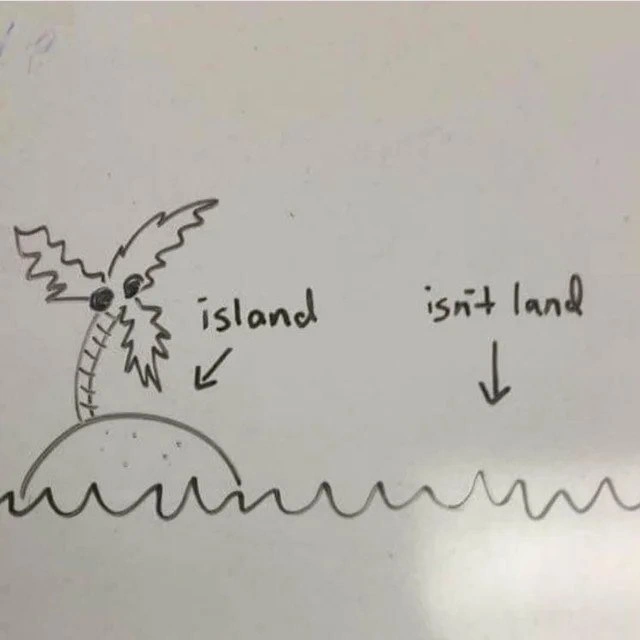
Developer illustrates 'is land' predicate pun with literal island whiteboard sketch
CodeQuality Post #4660, on Jul 7, 2022 in TG

Developer illustrates 'is land' predicate pun with literal island whiteboard sketch

Why is this CodeQuality meme funny?

Level 1: Land or Not Land

In plain language, this picture is making a simple joke about what is land and what isn’t. The person drew a tiny island with a palm tree and wrote “is land” next to it (because an island is a piece of land). Then they pointed to all the surrounding water and wrote “isn't land” (because water is not land). The joke is that the word “island” sounds like “is land.” They took that word and split it up to label the drawing in a goofy way. Basically, the drawing is saying, “this part is land, and that part isn’t land,” very matter-of-factly.

It’s funny because it’s so literal and obvious. Imagine labeling your pet cat as “cat” and your pet dog as “not cat.” Of course one is a cat and the other isn’t, but phrasing it like that makes us smile. In the same way, here they labeled the land and the water as "land" and "not land." It’s a simple little word joke that anyone can understand. We laugh because it's a very straightforward truth presented in an unexpected, playful format. It turns the word "island" into a cheeky puzzle: part of the word means land, and the rest is water, and that literal labeling is what makes it cute and funny.

Level 2: Is vs Isn't Land

Boolean – this is a basic data type in programming that can only have two values: true or false. Booleans answer yes/no questions in code. By convention, many languages (Java, C#, JavaScript, etc.) name boolean variables or functions with an is prefix. For example, isEmpty might be a function that returns true if something is empty. Similarly, isLand would be a variable or method that's true if something is land. So if we had a tile in a game map, tile.isLand being true means “this tile is land.” If tile.isLand is false, that means “this tile isn’t land” (in other words, it must be water).

The whiteboard drawing takes this concept and makes it literal (and funny). It shows an island in an ocean. The island is labeled “island”, and the water next to it is labeled “isn't land.” Basically, the person split the word “island” into “is land” (for the part that is land) and “is not land” for the water. It's a pun because the word “island” already sounds like “is land.” Here they're using that fact to point out what's land and what isn't. In coding terms, imagine we have a boolean variable called is_land in Python (using an underscore for clarity) or isLand in Java (using a capital L). If is_land is True, that indicates is land; if it’s False, that means isn’t land.

Here's a little code example to illustrate the idea:

is_land = True   # True means it is land
if is_land:
    print("This is land")
else:
    print("This isn't land")  # This runs if is_land is False

In this snippet, when is_land is True, it will print "This is land." If is_land were False, the else branch would print "This isn't land." The whiteboard meme is doing exactly that check, but with a sketch and labels instead of actual printouts!

Now, why do developers find this funny? Because it highlights how a tiny naming detail can cause confusion or amusement. In programming, you can't use spaces in variable names, so we use techniques to make compound names readable. For instance, CamelCase means sticking words together and capitalizing the start of each word after the first (e.g. isLand for is + Land), and snake_case means using underscores to separate words (e.g. is_land). These styles help avoid mix-ups. If someone forgets to use them, two words can blur into one. For example, writing isLand (with a capital L) or is_land is clear, but writing island all as one word could be misread as the noun "island" instead of the phrase "is land." The joke exaggerates this mix-up by explicitly writing out the opposite case as “isn't land” – something we normally don’t do in code (we’d just use a ! or name a variable isWater for the water case).

Ultimately, this meme is a lighthearted lesson about naming things. It’s a straightforward wordplay pun: taking the word "island" and splitting it into "is land" versus "isn't land" to get a laugh. Programmers enjoy this kind of joke because it’s nerdy yet simple to understand. Even if you're new to coding, you can see how adding or removing a tiny space (or underscore) completely changes the meaning of a name. And yes, it definitely qualifies as a classic “dad joke” in the programming world — a cheesy pun that makes you groan and smile. This silly sketch reminds us that choosing good names in code is important, but it’s okay to laugh at the quirks along the way.

Level 3: Naming is Hard

As every seasoned developer knows, naming things in code can be deceptively difficult. There's a famous saying:

“There are only two hard things in Computer Science: cache invalidation and naming things.”

This meme humorously highlights that challenge by turning a simple boolean naming convention into a visual pun. It’s a clever mash-up of CodeQuality wisdom and playful WordplayPuns.

In the doodle, a tiny tropical island (complete with a cartoon palm tree and coconuts) rises above wavy water. An arrow labels the island “island”, and another arrow points to the open water labeled “isn’t land.” At first glance it’s just a goofy sketch, but for developers it's a direct play on how we name boolean values. We often prefix boolean variables or methods with is to pose a yes/no question (like isLand). Here, the word “island” slyly splits into “is land,” implying this piece is land, while the surrounding water is clearly not land. Essentially, the arrow to the island says isLand == true and the arrow to the ocean says isLand == false. The pun exploits a tiny detail: a missing space (or a capitalization). In code, you can't have spaces in names, so isLand is how you'd normally write "is land" in CamelCase. But without proper casing or an underscore, isLand collapses into island – a completely different word! This is a perfect example of predicate naming confusion: a convention intended to make booleans clear (isSomething) instead forms an actual English word that obscures its meaning.

The humor works on multiple levels. For one, it’s the classic is vs isn't boolean logic presented in plain English. In real code, you wouldn’t literally name a variable isntLand – you’d use !isLand to negate it, or perhaps name a separate flag isWater – but spelling it out as “isn't land” on a whiteboard makes the true/false contrast absurdly literal. It’s like the doodle is a snippet of pseudo-code that anyone can understand: “This is land, this isn’t land.” Senior developers chuckle because they've seen how a tiny naming slip can lead to confusion. We remember those code reviews where someone flags a variable name for being ambiguous or too cute. (Ever encountered a boolean that was named in the negative or had a double negative? It's a recipe for head-scratching on a Friday afternoon.) This whiteboard joke is a gentle reminder: be careful with those names, or you might accidentally create an is vs isn't situation that leaves everyone scratching their heads.

Another reason this resonates is that it’s an inside joke about readability. Clean, clear naming is a cornerstone of good code. A well-named boolean like isLand immediately tells you what it means: true if something is land, false if it isn't. But when mushed together without visual cues, island might make a junior dev think of a geographic island rather than a logical condition. This is why many languages and style guides encourage clarity in naming (and discourage smooshing words together). For example, Python uses is_land with snake_case, and Java or C# would use isLand with CamelCase. One stray character can maroon the meaning – much like a castaway getting lost at sea because their map had unclear labels. Naming things is hard, indeed, but this cartoon shows we can at least find some humor in the struggle. The artist even added those goofy coconut palm details, a sign of a true coding dad joke: it over-explains the pun visually, just enough to make you groan and laugh at the same time.

This meme tickles developers because it transforms a dry coding concern (clear boolean naming) into a visual gag. It reminds us that even something as small as a space or underscore can be the difference between clarity and confusion. And if you ever forget that, just picture this doodle: one tiny island showing how a well-placed space can rescue you from an ocean of ambiguity!

Description

Black-marker whiteboard doodle shows a small half-circle island rising above wavy water, topped by a cartoon palm tree with coconuts. An arrow points to the island with handwritten text "island". A second arrow points to open water to the right with the caption "isn't land". The joke is a phonetic play on typical boolean naming conventions (e.g., isLand) versus the negated case, highlighting how a tiny spacing error or mispronunciation can change meaning entirely. It pokes fun at variable naming clarity and the readability quirks senior developers constantly debate
Comments

6
Anonymous ★ Top Pick A boolean named `isLand` inevitably gains a third state: the bikeshed discussion over whether `!isLand` should be called `isn’tLand`, `isSea`, or just another ticket for next sprint
  1. Anonymous ★ Top Pick

    A boolean named `isLand` inevitably gains a third state: the bikeshed discussion over whether `!isLand` should be called `isn’tLand`, `isSea`, or just another ticket for next sprint

  2. Anonymous

    This is exactly why our GIS library returns null for water polygons instead of false - someone took this diagram literally and now we have 47 production incidents where boats are classified as "temporarily land."

  3. Anonymous

    This is the kind of diagram you draw during a code review when someone asks 'what's the difference between null and undefined?' - except you realize halfway through that you're explaining boolean negation with tropical geography, and somehow everyone in the room nods in understanding because we've all been debugging for 6 hours straight

  4. Anonymous

    Naming flags isLand and isntLand is how you invent tri-state booleans - ship an enum before the coastline becomes “eventually consistent.”

  5. Anonymous

    Null Island at 0,0: the 'isn't land' we all map as an island anyway

  6. Anonymous

    This is why we ban negated booleans: “island” parses as “is land,” so “!island” reads ocean - model Terrain as an enum and spare the code reviews

Use J and K for navigation