Known threat meme: when SIEM alerts don’t stop real incidents
Why is this Security meme funny?
Level 1: You Had One Job
Imagine you have a smoke detector in your house that beeps really often – sometimes because you cooked bacon, sometimes because it’s a bit faulty. After a while, your family gets so used to it that when it beeps, everyone just sighs and says, “It’s probably nothing again.” Now picture one day it’s beeping because there’s an actual small fire starting in the kitchen. If everyone ignores the alarm and the fire spreads, afterwards your parents would say, “We knew the alarm was going off.” And you’d probably think, “If you knew, why didn’t you do something? You had one job!” It’s funny in a sad way, because the whole point of having the alarm was to catch the fire early. But if people don’t act on the warning, the alarm by itself can’t stop anything.
This meme is like that. The FBI had information about a bad guy (they had an “alarm” in a sense), but the bad event happened anyway. It’s as if a teacher knows one student always starts food fights, yet she doesn’t keep an eye on him during lunch – and then a food fight breaks out. Afterward she says, “Yeah, I knew he might do that.” All the other kids would be like, “Then why didn’t you prevent it?” The joke here is pointing out the obvious: just knowing about a problem isn’t the same as preventing it. It makes us laugh a little because it’s so silly and frustrating – the person responsible had all the info they needed, and still the bad thing happened. It’s a reminder that information is useful only if you actually use it.
Level 2: Alert Fatigue
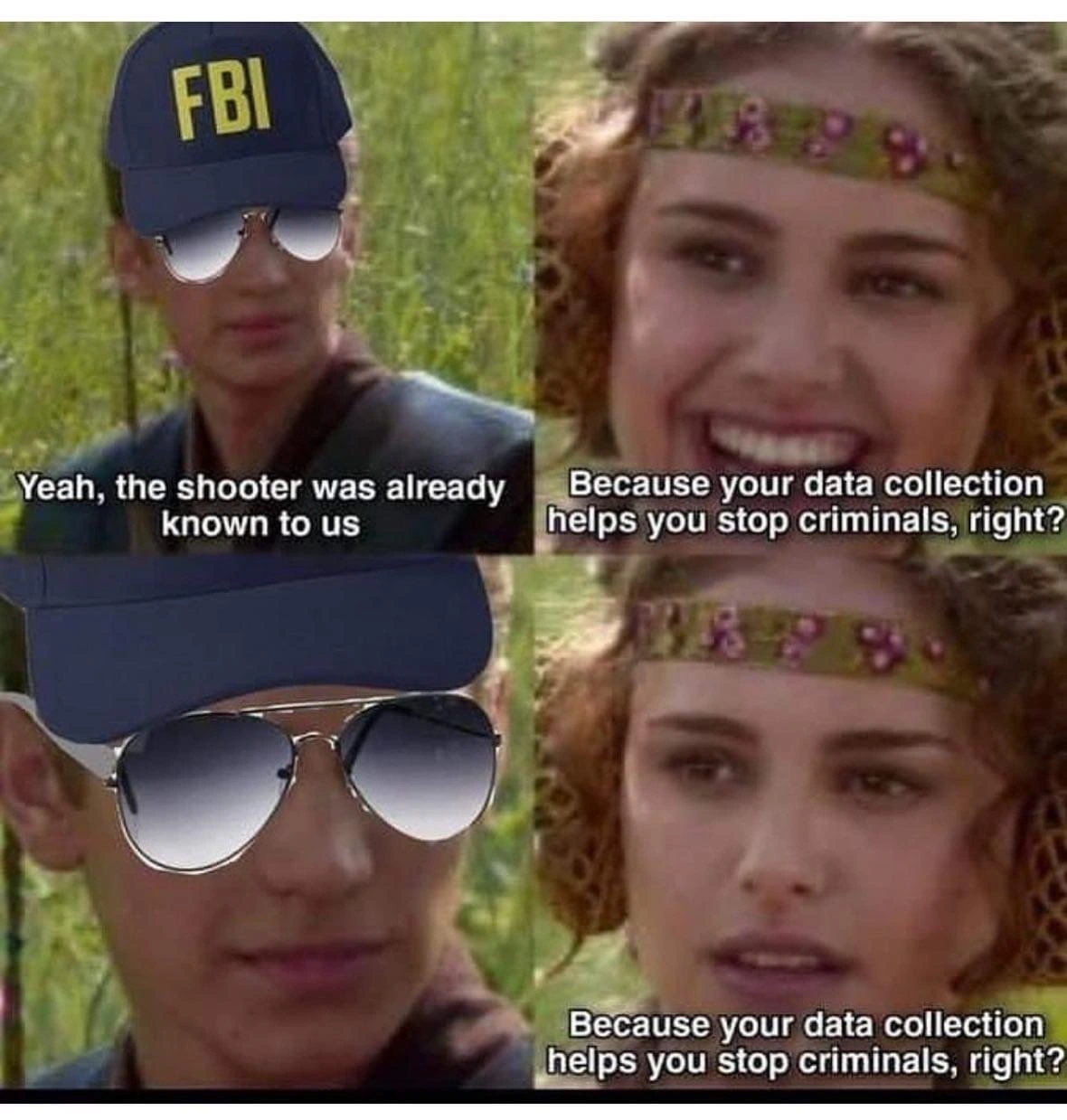
In this Star Wars meme, Anakin Skywalker (the guy in the meadow) is shown wearing an FBI cap and sunglasses, and Padmé Amidala (the woman) is asking him a question. The text in the panels goes like this:
- Panel 1 (Anakin/FBI): “Yeah, the shooter was already known to us.”
- Panel 2 (Padmé): “Because your information helps you stop criminals, right?”
- Panel 3 (Anakin/FBI): (silent, looking awkward)
- Panel 4 (Padmé): “...right?” (repeating the question with a concerned look)
Padmé expects that if the FBI knew about a dangerous person in advance, of course they would do something to stop them. Anakin’s silence tells us the embarrassing truth: having information didn’t stop the bad guy this time. This format is a popular meme where Padmé asks a question twice, highlighting a flawed assumption. Here, the flawed assumption is: “If you know about a threat, you will prevent the harm.”
Now, let’s connect this to tech and security operations. In cybersecurity, teams use tools like SIEM (Security Information and Event Management) systems to collect tons of data (logs, alerts, events) about what’s happening in their networks and computers. They also gather threat intelligence – information about known bad guys on the internet (for example, a list of hacker IP addresses, malware file signatures, or tactics that attackers use). The idea is that if a company knows about a malicious IP or a certain virus ahead of time, their security tools can spot it and raise a flag when it appears. So theoretically, the security team is like the FBI having a watchlist of “known threats.”
However, just like in the meme, knowing is not the same as doing. Security teams often suffer from alert fatigue – a term that means they get so many warning alerts every day that it becomes overwhelming. Imagine a smoke alarm that goes off hundreds of times a day; after a while, you’d probably stop jumping up every time it beeps, right? You might start to assume it’s always a false alarm or just hush it without looking. In a Security Operations Center, analysts see alert after alert scrolling by: maybe one alert says “possible malware file detected,” another says “unusual login from China,” another “known malicious IP tried to connect.” There can literally be thousands per day in a big organization. The team has to triage (sort out) which ones are real threats and which are just noise (false alarms or minor issues). Known threats (like a bad IP address that’s on a watchlist) might trigger alerts frequently if that IP pokes around a lot. If 99 out of 100 times those probes turn out harmless or are automatically blocked at a firewall, the 100th alert – the real attack – might not get the urgent attention it deserves. This is the core of the threat_intel_gap: having intelligence about threats doesn’t automatically bridge the gap to action and prevention.
Let’s break down some terms:
- Security Information and Event Management (SIEM): This is a centralized system that collects log data from many sources: servers, firewalls, antivirus programs, etc. It looks for signs of malicious activity. Think of it as a big security dashboard that lights up when something suspicious happens. For example, if a user tries 5 wrong passwords then logs in from an unusual country, a SIEM might create an alert for the analysts to check.
- Threat Intelligence: This is info about threats gathered from outside and inside. It can include lists of known hacker IPs, known phishing email addresses, signatures (digital fingerprints) of malware, or profiles of hacker groups. Security teams subscribe to threat intel feeds (like the FBI’s crime watchlist, but for cyber threats) so their systems can recognize when one of these known baddies shows up at their doorstep.
- Security Operations (SecOps): This refers to the team and processes that monitor and respond to security events. If you imagine IT security as a war, SecOps are the soldiers on watch and the first responders when alarms go off. They sit in front of that SIEM dashboard, 24/7 in many companies, and their job is to investigate alerts and take action (like blocking an IP, or shutting down a compromised server) before things get worse.
- Incident (or security incident): This is what we call it when something actually goes wrong – for example, a data breach, a malware outbreak, or any security breach. An incident means the bad thing happened (the network got attacked successfully, data was stolen, etc.).
- Incident Response: When an incident happens, the security team jumps into investigation and damage control mode – finding what happened, containing the damage, and recovering. During incident response, it’s very common to discover clues that were in the logs before the incident started. For instance, they might find that an alert had triggered a week prior showing the attacker’s first probing attempt, but no one acted on it at the time.
So why didn’t the team act on those clues? Often it’s because they have too many clues and not enough people or hours in the day to investigate each one. Prioritization is hard – the truly dangerous events are mixed in with a lot of innocuous or low-level noise. No team wants to ignore an alert about a known threat, but if you get dozens of “known threat IP scanned us” alerts every day, it’s hard to tell which one is the prelude to a major breach. There’s also the issue of false positives: sometimes an alert makes something look bad but it’s not. (Maybe the “known bad” IP was spoofed or it did a benign scan that didn’t lead to anything.) Chasing every single alert can burn out the team and distract from real issues. So security folks have to make judgment calls, and occasionally they guess wrong. It’s a tough job: if they ignore alerts, they might miss a real attack; if they chase every alert, they’d never get any sleep and might cry wolf too often.
The meme’s joke highlights this frustrating situation. The FBI (or the security team) isn’t evil or stupid – they did gather information (like a good security practice for SecurityAwareness). But collecting data isn’t enough. Preventive action requires sorting out which info matters right now and doing something about it in time. The painful irony is that after an incident, people will say, “you knew this was a risk, so why didn’t you stop it?” There’s no good retort except admitting the truth: knowing is easy, acting at the right moment is hard. Padmé’s repeated question “...right?” reflects that outside perspective – of course if you have info, you should’ve used it. Inside the security team, Anakin’s blank face is the internal cringe, because they know exactly how it happened despite the info. It’s a humbling reminder for junior developers and analysts that in security operations, having tools and data is just the start – the real challenge is making those tools actually protect you when it counts.
Level 3: If a Log Falls in a SIEM
This meme lands hard with anyone who’s worked in Security Operations (SecOps) or a Security Operations Center (SOC). We’ve all seen the scenario: after a breach or major incident, the team begrudgingly admits, “Oh yeah, we actually saw indicators of this attack in our logs last week.” It’s equal parts tragic and darkly funny – a textbook case of preventive_failure. The meme’s dialogue nails it: Anakin (wearing the FBI hat) says, “Yeah, the shooter was already known to us.” Padmé responds, “Because your information helps you stop criminals, right?” followed by Anakin’s awkward silence and Padmé’s increasingly concerned, “…right?” This mirrors the uncomfortable conversations after a security incident: “We knew this IP was malicious” – “So that helped you stop the breach, right?” – [crickets]. The humor comes from that painful gap between knowing about threats and actually preventing them – a gap so common it has its own tag here: threat_intel_gap.
In practice, this happens all the time. A company’s SIEM might dutifully flag a hacker’s IP address or a known malware signature weeks before the damage is done. But maybe the alert was buried among thousands of others or dismissed as a false positive. Security teams drown in data: endless firewall logs, intrusion detection alerts, user behavior anomalies – an alert avalanche hitting the dashboards 24/7. Eventually analysts become desensitized. This is known as alert fatigue, and it’s the bane of Security Operations. When every other hour the SIEM yells about some port scan or failed login, it’s easy for a real attack pattern to hide in plain sight. It’s the classic “Boy Who Cried Wolf” situation: after too many false alarms, the shepherds (analysts) don’t rush out for every howl, and one day a wolf slips in for real.
There’s also the organizational dysfunction aspect. Often, companies invest heavily in data collection and threat intel – they’ll have subscriptions to multiple threat feeds, fancy machine-learning anomaly detectors, and logs aggregated from every system (cloud, on-prem, you name it). The SecurityInformationAndEventManagement system dutifully correlates and produces a blizzard of alerts. But what about response? Many times, the missing piece is a streamlined process or enough trained responders to triage and act on those alerts. It’s not uncommon for a critical alert to trigger at 3 AM on a Saturday and sit untouched until Monday when someone checks the queue – by which time the “known” attacker has already exfiltrated sensitive data. The preventive_failure here isn’t that the system didn’t know; it’s that the organization couldn’t translate knowledge into action fast enough. In the FBI analogy, they knew the person was a risk but didn’t have (or use) the means to intervene in time – maybe due to legal constraints, or simply because there are far more “known risks” than they can monitor actively. In tech security, it’s often due to limited manpower or fear of blowing the whistle on every suspicious event and causing constant panic or disruptions.
The meme’s Star Wars format (Anakin and Padmé in the meadow) is itself famously used to expose uncomfortable truths behind assumptions. Padmé’s optimistic question – “Because your data collection helps you stop criminals, right?” – is something every security engineer has heard in some form. Upper management might ask after a breach, “We had all this threat intelligence, why didn’t it prevent this?” The only honest answer is Anakin’s pained silence. Having piles of SecurityAwareness data, or an expensive SIEM, doesn’t automatically equate to SecurityBreachResponse capability. It’s a bitter pill: we can know about a threat actor (be it a criminal or a hacker) long beforehand, yet still fail to stop them when it counts. That disconnect is exactly what makes this meme hit home and simultaneously smirk-worthy. It’s the kind of grim laughter you get in a post-mortem meeting when someone says, “Well, technically, the attacker was in our known threats list…” and everyone groans because knowing was useless without doing. In short, the meme hilariously encapsulates a key security lesson: Collecting data is easy; acting on it is hard.
Level 4: Signal-to-Noise Dilemma
In an ideal world, every Security Information and Event Management (SIEM) alert screaming “known bad actor detected!” would result in instant preventive action. In reality, defenders face the signal-to-noise dilemma: truly malicious events are needles in a massive haystack of benign logs and false alarms. There’s a fundamental trade-off between catching all threats (high sensitivity) and avoiding constant false positives (high specificity). Tune your detection to be very sensitive and alert fatigue sets in as it flags everything under the sun; tune it too strictly and subtle breaches slip through unnoticed. This is essentially the base rate problem in cybersecurity – when actual attacks are rare, even a 99% accurate detection algorithm can still produce so many false alerts that genuine threats get lost in the noise. It’s like a twisted application of Bayes’ Theorem: if only 0.1% of events are attacks, an alert’s probability of indicating a real incident can be vanishingly small despite a high detection rate. In such an environment, security teams struggle to distinguish signal from noise in real-time. They might have threat intelligence feeds flagging an IP or a user as risky (the “known threats”), but if that intel triggers alerts every other hour, it becomes background noise.
On a theoretical level, this highlights why simply knowing about a threat doesn’t guarantee prevention. Effective prevention would require near-perfect precision in identifying bad actors before they do harm – a feat that borders on science fiction. (We’re not quite in Minority Report territory; we don’t arrest people or block IPs for potential badness without solid evidence.) Automated Intrusion Prevention Systems (IPS) that act on every alert often remain in monitoring-mode only, because flipping them to “block everything suspicious” can wreak havoc by stopping legitimate activity. The result? Many organizations intentionally sacrifice proactive blocking to avoid disrupting normal operations, accepting that some known threats will only be addressed after they actually do something bad. It’s a classic known threat paradox: the limitations of detection algorithms and the cost of false alarms make it practically impossible to act on every early warning. So logs dutifully record the danger in advance, yet the incident still unfolds – not because engineers are clueless, but because mathematical constraints and operational realities tie their hands. The meme hits on this deep truth: having information is one thing, acting on it effectively at scale is an entirely different challenge. Until we crack that, even the best SIEMs and threat intel systems will sometimes end up saying, “Yeah, we knew… but we couldn’t stop it in time.”
Description
Four-panel Star Wars meadow meme. Panel 1 shows Anakin wearing a dark blue cap with large yellow letters 'FBI' saying, “Yeah, the shooter was already known to us.” Panel 2 shows Padmé, against the same grassy background, asking, “Because your information helps you stop criminals, right?” Panel 3 zooms on a silent, awkward-looking Anakin in the FBI cap. Panel 4 returns to Padmé, repeating, “Because your information helps you stop criminals, right?” The humor mirrors many security teams’ pain: threat intelligence and SIEM logs may flag malicious actors long before an incident, yet operational gaps still allow breaches - highlighting the difference between knowing about risks and actually mitigating them
Comments
8Comment deleted
“Great news - the attacker’s IP was in our threat feed two months ago.” “Perfect, so the feed automatically blocked it?” “…No, it automatically created a Jira ticket we closed as ‘won’t fix’ during sprint grooming.”
It's like having a distributed logging system with petabytes of data indexed in Elasticsearch, but your alerting rules are just 'if (threat.severity > 9 && Math.random() > 0.99) { maybe_investigate(); }' - the classic problem of collecting everything but analyzing nothing until the post-mortem
When your threat detection model has 100% recall on identifying suspects but 0% precision on preventing incidents - classic case of collecting all the training data but never deploying the model to production. It's like having perfect observability with Prometheus scraping every metric at millisecond intervals, yet still getting paged at 3 AM because nobody configured the alerting rules to actually *do* something actionable
In enterprise security, “already known to us” means the detection SLO is green, there’s a Grafana panel and a risk register entry - and prevention ships next quarter
FBI surveillance: 100% recall on every citizen, 0% precision on actual threats
In SOC-speak, “known to us” means the SIEM rule fired, got globally suppressed during tuning, was filed as a low‑sev Jira with no owner, but still made the QBR slide as “coverage.”
FBI: Nah we saw him on a video tape 8 years ago shoot and 3 months ago too Comment deleted
Don't forget weekly team catch-up Comment deleted