The Siren Song of New Technology
Why is this IndustryTrends Hype meme funny?
Level 1: Left the Door Open
Imagine a kid bragging to everyone, “I’ve kept my house safe and locked every night since the day we moved in!” Now, you happen to know that on the very first night in that house, they actually left the front door wide open by mistake. 😅 A stray dog wandered in and made a mess of the kitchen before they shooed it out! Now years later, the kid pretends that they were super careful from the start, but you remember the truth. It’s pretty funny, right? You’d probably giggle because the kid’s claim doesn’t match what really happened.
This meme is just like that. Apple (the company that makes the iPhone) is like that kid bragging about always being secure. They say, “Our iPhones were designed to be super safe from the very beginning!” But people who remember the first iPhone know that back then, one of the important doors (the Safari internet app) was essentially wide open. In fact, that door was like the front door of the phone’s security, and it wasn’t locked at all in the first version. So when Apple boasts about always being safe, those people who know the real story can’t help but laugh. It’s as silly as someone saying they always lock their doors, even though we saw that friendly dinosaur stroll in on day one. The joke here is simply that what Apple is saying now doesn’t match what really happened in the past, and pointing that out in a funny way makes us laugh.
Level 2: Safari Unleashed
Let’s break this down in simpler terms. Back in 2007, when the first iPhone came out (running what we now call iOS 1), there was a big security oversight: the built-in web browser app, Safari, was running with administrator-level access on the device. In Unix-like systems (which iPhones are built on), the administrator account is called “root.” Running as root means having full control over everything, like being the king of the device. Normally, apps are supposed to run as a regular user with limited permissions, or inside a sandbox (a protected zone where the app can only reach its own toys, so to speak). A sandbox in computing is a security mechanism that keeps apps from touching stuff they shouldn’t – imagine a playpen that keeps a toddler (the app) safely contained in one area of the house. But in early iOS architecture, Safari wasn’t in a sandbox at all. It was more like a toddler set loose in the whole house with the master keys! This is what we call a least privilege violation: the app had way more privilege than it needed. Least privilege is just a philosophy saying “give each program only the access it absolutely requires.” Safari only needed to display web content, it didn’t need authority to, say, alter system files or install things – yet iOS 1 gave it the highest level of access by default. That’s why developers laugh at Apple’s claim of security from the very beginning. It’s a bit like a bank claiming “we’ve had top-notch security forever” when you know their first vault door was made of cardboard.
To a newer developer or someone not familiar with Apple’s history, here’s the context: Today, Apple’s ecosystem is famously strict about security. Modern iOS Development involves giving apps specific permissions (like access to camera or contacts) and every app is stuck in its own sandbox. If you download an app from the App Store now, it can’t just read another app’s data or modify the system willy-nilly. Apple’s marketing and documentation often brag about these strong security measures – things like sandboxing, code signing, and the Apple Security model that keeps malware out. So reading Apple’s official Security Guide introduction, you might find a proud statement such as “we designed iOS with security in mind from the very start.” That sounds believable if you look at iOS today. But the meme is pointing out that this wasn’t 100% true at the start. In the TechHistory of iOS, one of the early security flaws was exactly this: the Safari browser app had the run of the land as the root user. For perspective, on a normal computer, running your web browser as an admin would be considered a huge security no-no, because any security hole in the browser could then affect the whole system. And indeed, what happened? Early iPhone hackers (the jailbreak community) discovered tricks to exploit Safari’s freedom. For example, simply visiting a specially crafted website could jailbreak an iPhone back in those days – meaning the website could execute code to push apps onto your phone or unlock features, because Safari had the power of root. These were not just theoretical concerns; they were real SecurityFlaws exploited in the wild. Apple quickly learned from these mistakes. By the time iOS 2 and the App Store came around (2008), Apple had introduced a non-root user account (“mobile”) for running apps and started sandboxing processes like Safari. In short, Apple closed that open door in subsequent versions.
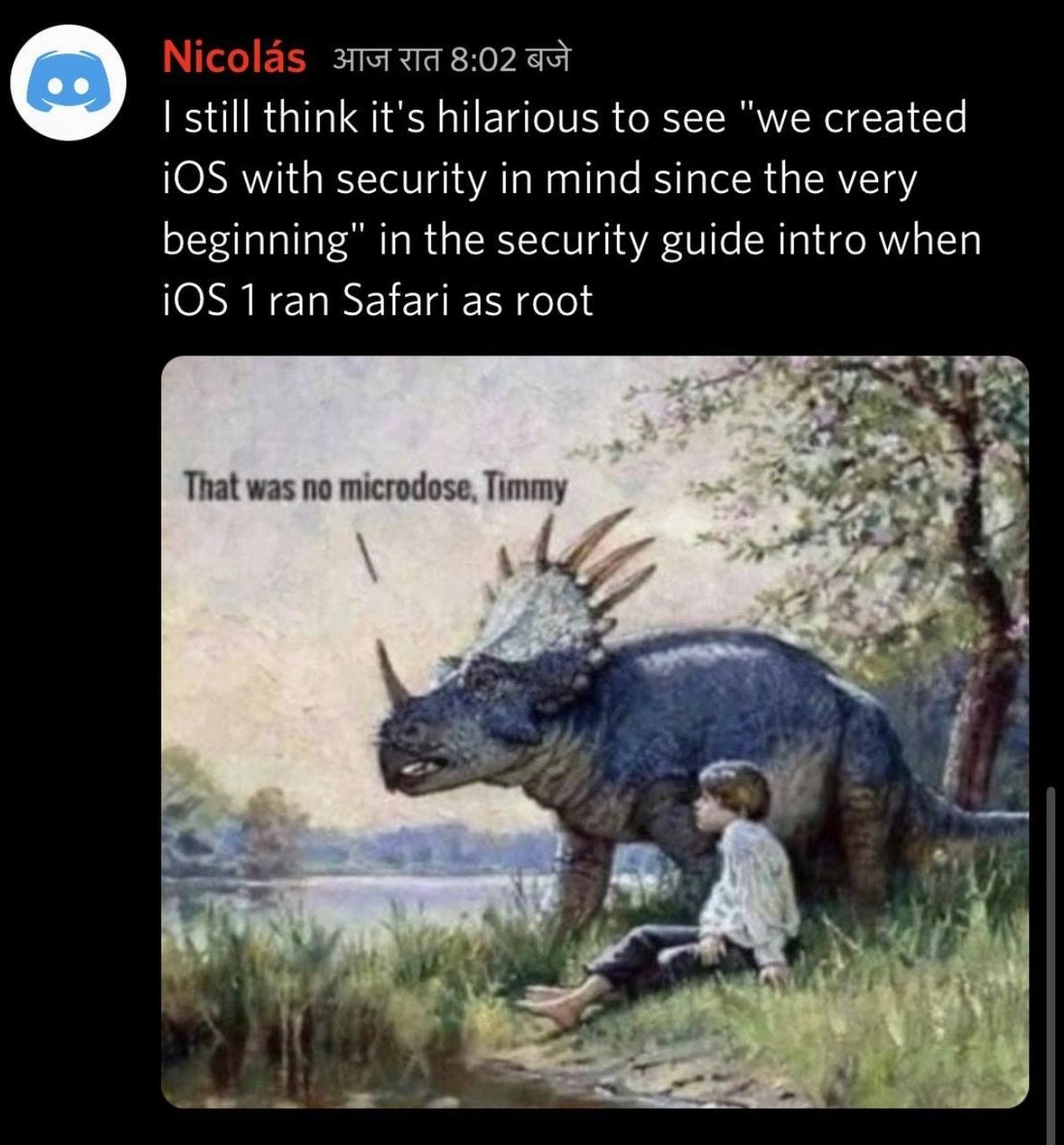
Now, the image with the boy and the dinosaur: what’s that about? It’s a separate meme image used here to react humorously. In the picture, a young boy (Timmy) is lounging casually next to a massive dinosaur by a lakeside, as if it’s nothing unusual. The overlaid text says, “That was no microdose, Timmy.” A “microdose” refers to taking a very small amount of a psychedelic substance (like a tiny dose of LSD) that supposedly wouldn’t cause full-blown hallucinations. So if Timmy is seeing a friendly dinosaur in a tranquil field, clearly he must have taken more than a microdose – he’s tripping pretty hard! In the context of the meme, Apple’s statement about always prioritizing security is so far-fetched that you’d think the person saying it is hallucinating. In plainer terms, the meme jokes that believing iOS was super secure from day one is as crazy as a kid seeing dinosaurs after claiming he barely took any hallucinogenic. It’s an exaggerated, humorous way to say “Apple, you must be imagining things if you think that was true.” The dinosaur stands in for the obvious truth that doesn’t fit the claimed narrative (a dinosaur in a modern scene is obviously out of place, just like a claim of perfect security is out of place with Safari running as root). For developers, especially those interested in Security or who have studied OperatingSystems design, it’s a funny wake-up call: even big tech companies have embarrassing early designs. And it teaches an important point: don’t blindly accept marketing claims. Always remember to check the real history and architecture. Just because a platform is super secure now doesn’t mean it started that way. In Apple’s case, they learned and improved – but it’s okay to chuckle at how they gloss over the dinosaur in the room.
Level 3: Rooted in Myth
This meme lands squarely in the sweet spot of tech insider humor by calling out the disconnect between Apple’s marketing claims and the recollections of veteran developers. The Discord message from Nicolás points out the irony: Apple’s security guide intro boasts about having security in mind "since the very beginning," yet back in 2007 the original iPhone’s Mobile Safari browser was literally running with root privileges. For experienced folks in MobileDevelopment or Security, that claim is uproariously absurd. It’s the kind of revisionist history that prompts knowing groans and chuckles. Apple is effectively patting itself on the back for being Security-conscious from day zero, but those of us who remember iOS 1.0 (or iPhone OS 1 as it was known) recall that early iOS architecture had some gaping holes by today’s standards. In the world of TechHistory, this is a classic example of a company applying a bit of retroactive polish to its narrative. The meme’s humor comes from highlighting that discrepancy: the AppleEcosystem may now be famed for strict sandboxing and a locked-down approach, but in its infancy it had a browser roaming free with god-like powers.
Why is this combination of elements so funny to developers? It’s because it’s so on the nose. We have a giant corporation confidently proclaiming a foundational myth (“security from day one!”) juxtaposed with a blatantly contradictory fact that many in the community know: Safari ran as root in iOS 1. The phrase “we created iOS with security in mind since the very beginning” reads like Apple’s self-congratulatory lore. The immediate mental image for an old-school iOS dev is a bit different: they remember the first jailbreaks emerging almost as soon as the iPhone hit shelves. In fact, the first iPhone was jailbroken via exploits in services or Safari— the very door Apple had left wide open. Root privilege browser meant that if you could trick Safari (for example, through a malformed webpage, like the famous TIFF image exploit in early jailbreak days), you essentially already had the run of the system. No further escalation needed! So when Apple implies “from day one, we were super secure,” insiders respond with a sarcastic laugh: Sure, Jan. It’s as if Apple expects us all to collectively forget that awkward phase of the platform’s youth. This is a shared industry joke about least_privilege_violation: running a web app as root is exactly what not to do if security was truly priority number one.
The meme doubles down on the absurdity with the reaction image: a serene pastoral scene of a boy resting against a horned dinosaur, captioned “That was no microdose, Timmy.” This phrase is internet-slang for “you’re not just imagining lightly – you’re totally delusional.” It implies that believing Apple’s rosy statement requires an almost hallucinogenic level of denial. In other words, Apple must be high on its own reality distortion field to claim nothing but pure security vision right from the start. The dinosaur in the painting is anachronistic – a prehistoric creature plopped into an idyllic human scene – just like Apple’s claim is an anachronism in light of real history. The boy named Timmy thinking he only took a “microdose” (a tiny bit of psychedelics) when he’s clearly seeing dinosaurs is a tongue-in-cheek way to say, “Apple, your memory of the past is way off – you’re seeing things that weren’t there.” For senior developers, this resonates because we’ve seen it before: companies often rewrite their history once they’ve improved a product, glossing over early missteps. It’s comforting (and comical) to remember that even a tech giant like Apple had to learn the hard way. This shared recollection of “how things really were” creates a bond among those who lived through the early days of iOSDevelopment. We nod knowingly because we remember that initial OperatingSystems design quirk, and we appreciate the meme’s clever way of shredding the myth. The humor has a cathartic edge: it pokes fun at corporate PR speak while reminding us that even legendary products have embarrassing v1.0 stories. In essence, the meme says, “Nice try, Apple, but we remember when Safari was running wild with root powers – your security-first fairy tale is busted.”
Level 4: Darwin’s Security Evolution
At the deepest technical level, this meme highlights an ironic quirk in Apple’s early mobile OS architecture. The original iPhone OS (later named iOS) was built on Apple’s Darwin core – a Unix-like foundation derived from Mac OS X. Under the hood, Darwin is a hybrid of the Mach kernel and BSD Unix, meaning it inherited the classic Unix concept of user accounts and privileges. In theory, even a mobile device OperatingSystem should enforce the Principle of Least Privilege, a cornerstone of computer security outlined by Saltzer and Schroeder in 1975. This principle dictates that software should run with only the minimum permissions necessary. Running Safari as root, however, flagrantly violated that idea. On a Unix system, the root user (a.k.a. superuser) can do anything: modify files, install apps, access any device resource. When Safari (the iPhone’s web browser) was launched with root privileges on iOS 1.0, it effectively had unrestricted access to the entire device. That’s like giving a web-facing app the keys to the kingdom. In academic terms, it’s a textbook example of privilege escalation risk baked right into the system’s initial design – there was no escalation needed if the app started at the highest privilege! This oversight wasn’t just a theoretical musing; it had real consequences. Early security researchers and jailbreakers quickly discovered that any vulnerability in Safari (say, a malicious webpage exploiting a memory flaw) could compromise the whole phone.
Why would Apple do such a thing? The decision can be understood in the context of 2007’s tech landscape and engineering trade-offs. The first iPhone was a revolutionary device on a tight launch schedule, essentially a scaled-down Mac with a touch interface. Apple may have initially run core apps with elevated privileges due to a simplified single-user model — the iPhone wasn’t designed for multiple user accounts like a Mac, so processes defaulted to running as one user. Unfortunately, that one user was root in early builds. In fairness, Apple had other security measures: the original iPhone had no App Store and disallowed third-party native apps, relying on code signing to prevent unknown code execution. The attack surface was intentionally limited. But even so, giving Safari full system rights was a massive SecurityFlaw. This was corrected in later releases: Apple introduced a dedicated non-privileged user (often called “mobile”) for apps and implemented sandboxing (using a macOS technology called “Seatbelt”) to confine apps’ access to data and hardware. Over time, iOS’s security evolution included ASLR (address space layout randomization), DEP (data execution prevention), stronger sandbox rules, and entitlement checks — a far cry from that original all-powerful Safari. So, when Apple’s official Security Guide in 2022 confidently proclaims “we created iOS with security in mind since the very beginning,” a seasoned engineer can’t help but smirk. It’s a bit like a paleontologist hearing someone say dinosaurs never existed while leaning against a Triceratops fossil; the historical evidence (TechHistory in this case) flatly contradicts the rewritten narrative.
Description
This image uses the 'Distracted Boyfriend' meme format to illustrate a common dilemma in software development. A man, labeled 'Me,' is walking with his girlfriend, labeled 'The perfectly fine monolith that gets the job done.' He is looking back admiringly at another woman who is walking by, labeled 'Doing everything in microservices because it's new and cool.' The meme humorously captures the tendency of developers to be seduced by trendy new technologies and architectural patterns, like microservices, even when their existing, stable systems (monoliths) are working perfectly well. For senior engineers, this is a relatable commentary on 'hype-driven development' and the constant need to weigh the genuine benefits of a new approach against the significant, and often underestimated, costs of complexity, maintenance, and migration
Comments
9Comment deleted
A monolith is like a marriage: it's not perfect, but you know how to deal with its issues. Microservices are like dating: it seems exciting until you're managing 50 different conversations and they all start failing at 3 AM
Apple’s “security since day one” checks out - day one starts right after the `git filter-branch --force` that removed the commit where Safari had UID 0
Apple's 'security-first' iOS running Safari with root privileges is like implementing defense-in-depth by giving your web browser sudo access - the kind of architectural decision that makes you wonder if the security team was consulted after the marketing slides were already printed
Ah yes, iOS 1's 'security-first' approach: running Safari as root because apparently the principle of least privilege was just a suggestion. Nothing says 'we thought about security from day one' quite like giving your web browser the keys to the entire kingdom. It's the mobile equivalent of running production databases as sa/root and wondering why your threat model includes 'literally everything.' At least they eventually discovered that maybe, just maybe, a browser parsing untrusted HTML shouldn't have unrestricted access to the entire filesystem. Who knew?
Nothing says 'security‑first' like your primary attack surface running as UID 0; apparently the original sandbox lived only in the whitepaper
“Security from day one” hits different when day one shipped Safari as UID 0 - the mobile equivalent of docker run --privileged and calling it a sandbox
iOS 1 security: So 'secure from the start,' Safari got root keys - because sandboxes were for kids, not browsers
They blamed the fappening on users, right, hundreds of celebs all got phishing attack at the same time 🤦♂ Comment deleted
Looool Comment deleted