The Duality of a Developer's Mind
Why is this MentalHealth meme funny?
Level 1: Playground Justice
Imagine two kids playing a game with their friends’ lunch money on the line. The first kid is playing a money game with rules (like a school fair game) and he cheats everyone, taking $60 from the group unfairly. The school has clear rules against cheating. When the teacher finds out, that kid is in big trouble – he’s punished and given a huge timeout, maybe suspended for a long time. Basically, he broke a well-known rule and the grown-ups made sure he faced the consequences.
Now the second kid invents a new game that no one really understands on the playground. He gets friends to play and they all end up losing a huge pile of lunch money, say another $60, because the game was badly designed (maybe the rules of this new game just don’t work, and everyone’s money vanishes). Now, here’s the crazy part: since this game was so new, the school didn’t have any specific rules for it. There was no teacher watching who even knew what the kid was doing. So the kid doesn’t get punished at all. In fact, the next day, he shows up and says, “Hey, I’ve made Game 2.0 – a new version of that game. Want to play again?”
It sounds ridiculous, right? All the other kids are like, “How is that fair? We lost our money and he just gets to start a new game?” The first kid got a massive timeout for cheating in the traditional game. The second kid, who caused the same harm, kind of got away with it because the grown-ups didn’t have a rule for his new kind of game yet. That’s exactly what this meme is saying about the real world: if you use the old system to trick people out of money, you go to jail for a long time. But if you do something very similar with a brand-new made-up system (like a new kind of digital money game) that adults haven’t made rules for, you might not get punished immediately and could even try the whole thing again. It’s pointing out how that feels really unfair – like the rules haven’t caught up, and one person got justice while the other did not, just because his game was too new for the rulebook.
Level 2: Fork Privilege
Let’s break down what this meme is saying in simpler terms. It’s comparing two people and events:
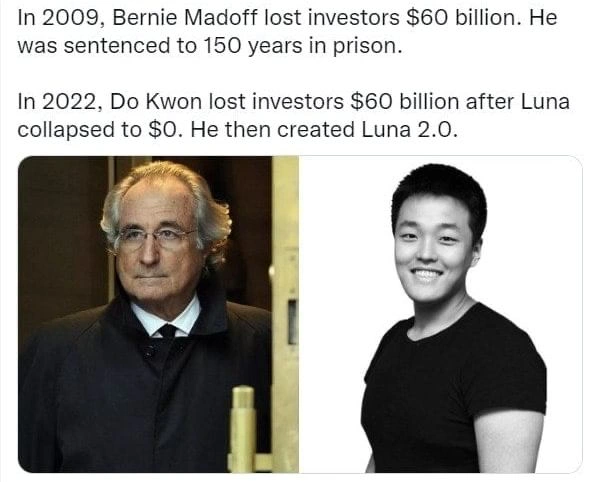
Bernie Madoff (TradFi) – He was an investment manager on Wall Street who ran what’s called a Ponzi scheme. A Ponzi scheme is basically a scam where someone promises big profits, but instead of actually investing the money, they secretly use money from new investors to pay earlier investors. It’s like robbing Peter to pay Paul, all while claiming magical consistent returns. Bernie Madoff did this for years, and people trusted him until the scheme collapsed. When it fell apart in 2008, about $60 billion of investor money had evaporated. Because this is clearly illegal (fraud, theft, you name it), he was caught and sent to prison. In 2009 a judge gave him a 150-year sentence – essentially he’ll be in jail for the rest of his life. That’s the left side of the meme: a notorious financial criminal behind bars. It’s the ultimate punishment in traditional finance for losing a huge amount of other people’s money through deception.
Do Kwon (Crypto) – He is a co-founder of a cryptocurrency project known as Terra. Terra had a cryptocurrency token called LUNA and a paired “stable” coin called UST (TerraUSD). UST was supposed to always be worth $1 (hence “stablecoin”), but unlike a traditional stablecoin that’s backed by real dollars in a bank, UST was backed by code and an algorithm involving LUNA. In May 2022, this setup failed catastrophically: UST lost its $1 value (it “de-pegged”), and LUNA’s price imploded to almost $0. Together, about $60 billion in value was wiped out – roughly the same scale of loss as Madoff caused. People who had savings in UST or investments in LUNA saw those become almost worthless in days. Here’s the twist: after this collapse, Do Kwon did not face immediate arrest or punishment. Instead, he rather boldly launched Luna 2.0, essentially a new version of the cryptocurrency. In blockchain terms, he “forked” the project – which means he created a new blockchain that split off from the original, kind of like copying the blueprint of the old system and starting fresh (with some adjustments and a new token, often to try to compensate those who lost money or to keep the community alive).
The meme’s text sets these two scenarios side by side to highlight the absurd contrast: Bernie causes $60B loss → goes to prison for life; Do Kwon causes $60B loss → makes a new coin. The phrase “fork privilege” jokingly implies that in the crypto world, if your project collapses, you might have the privilege of just forking (restarting) the code and carrying on, rather than facing jail. It’s pointing out a perceived loophole: major failures in crypto might not be punished the way major frauds in traditional finance are.
Why is that the case? One big reason is regulation (or the lack of it). Traditional finance (often called TradFi) is heavily regulated by government agencies. There are clear laws: if you lie to investors and run a Ponzi scheme, you have committed crimes. Crypto, on the other hand, has been a new frontier. In 2022, crypto projects weren’t clearly covered by existing financial laws in many countries. Cryptocurrency projects often operate internationally, on the internet, and sometimes anonymously or in jurisdictions known for light regulation. It’s not that authorities approve of what Do Kwon did – it’s that it wasn’t immediately clear what law applies or who has authority to step in. It’s a bit like a new kind of game that doesn’t yet have a full rulebook or referee. Regulators were still trying to figure out “Was this securities fraud? Was it illegal, or just a terribly failed business model?”
That’s where the term “regulatory arbitrage” fits in – it means taking advantage of gaps in the rules. Crypto has been full of gaps for people to exploit, sometimes unintentionally, sometimes on purpose. Do Kwon’s Terra project promised something very ambitious (a stablecoin with ~20% yearly yield on deposits via a service called Anchor). In a bank, offering 20% interest with no risk would be instantly flagged by regulators as dangerous or as a scam. But in crypto, such promises flew under the radar for a while because crypto wasn’t under bank or securities laws (or was operating offshore).
So, the meme also implicitly references the Terra Luna crash (often tagged as #terra_luna_crash in discussions). This event was huge in the crypto community. And Luna 2.0 refers to the new blockchain Do Kwon launched after the original Luna went to nearly zero. Many found this audacious: imagine a company going bankrupt and instead of facing investigation, the founder just says “I’ll start a new company with the same name 2.0!” In the crypto world, this kind of “reset” via a fork is technically and legally easier. A fork in blockchain is literally copying the open-source code, or splitting the network’s history at a point before the crash, and then continuing as a separate chain as if the disaster hadn’t happened. In Terra’s case, Luna 2.0 was a new token distributed to some of the people affected, trying to make up for losses or keep the community engaged, but it didn’t restore anywhere near $60B.
For a newcomer or junior dev, it’s useful to clarify: nothing physically prevented Do Kwon from creating a new cryptocurrency because blockchain networks are decentralized – there’s no single authority to say “No, you’re banned.” It’s as if after a big collapse, the crypto founder still had the keys to the factory and just spun up a new product. In contrast, if a finance guy like Madoff bankrupts thousands of people through fraud, authorities will lock him out (literally, in jail) from ever doing that again.
The meme taps into the frustration and shock many felt: How can two $60 billion debacles have such different consequences? It’s hinting that the crypto industry in 2022 was a bit like a wild carnival – huge sums gained and lost with few immediate repercussions for the ringleaders – whereas the traditional finance world, for all its flaws, has established punishments for such enormous wrongdoing. It also suggests a double standard in privilege: one person’s innovation hub (crypto) became a way to escape punishment that the other person in the old system couldn’t escape. In short, Bernie Madoff went to prison for essentially running a financial scam, and Do Kwon (at least at that time) was able to avoid prison and just create a new cryptocurrency. The meme is both darkly funny and a commentary on the state of crypto regulation. It’s like saying: “In 2009, do that and go to jail; in 2022, do that in crypto and you might just hit the restart button.”
Level 3: Chain Gang vs Blockchain
Stepping back, the meme draws a sharp contrast between how traditional finance (TradFi) treats massive fraud versus how the crypto world often handles massive failure. In 2009, Bernie Madoff – architect of a decades-long Ponzi scheme – was subjected to the full force of financial regulation. He misled investors with fake profits and monthly statements in a highly regulated environment (Wall Street), so when it unraveled, the SEC and the justice system came crashing down. Bernie ended up behind bars with a 150-year prison sentence (essentially a life sentence, a punishment meant to be as grandiose as the $60B theft itself). This is the classic “chain gang” outcome – the perpetrator is literally in chains (prison) for breaking the law and wrecking lives.
Fast-forward to 2022: Do Kwon, co-founder of Terraform Labs and figurehead of the Terra/Luna project, oversaw an epic collapse that also obliterated around $60B of investor value when LUNA and its stablecoin UST imploded. But instead of orange jumpsuits and handcuffs, the immediate aftermath saw him rather casually launching Luna 2.0 (a fork of the original blockchain, basically a restarted version of the project). No jail cell photo-op, just a new press release. The meme’s side-by-side images capture this absurd gap: on the left, Bernie stands literally behind bars (the photo even frames him with a prison-like bar), and on the right, Do Kwon stands free, smiling in a t-shirt, seemingly unrestrained. It’s a side-by-side indictment of how two worlds handle accountability. Bernie’s fate is “chain gang” justice, while Do Kwon’s fate was rebooting on the blockchain – hence, Chain Gang vs Blockchain.
Why such different outcomes? A lot comes down to regulation and jurisdiction. Traditional finance operates under a web of laws (securities law, banking regulations, etc.) that define crimes like fraud clearly. Bernie Madoff’s operation checked all the boxes of outright fraud: falsified reports, no real investments, explicit lies. Regulators had clear authority to shut him down and courts had statutes to put him away. In contrast, the crypto realm in 2022 was like the Wild West of FinTech – full of innovation, hype, and sadly, regulatory grey areas. Terra’s collapse caused real losses, but was it technically illegal? That’s murky. Terra wasn’t a registered security or a bank; it was a decentralized project offering a token and a stablecoin governed by code. Do Kwon didn’t send fake account statements à la Madoff; instead, he created a system that failed spectacularly. There’s a concept called regulatory arbitrage, where businesses exploit gaps between laws – in crypto, entrepreneurs operate in global, often poorly regulated waters, effectively sidestepping the strict rules that exist in stock markets or banking. Do Kwon’s Terra was headquartered in jurisdictions with less stringent enforcement, and global agencies were (and still are) playing catch-up on defining what to do with cross-border crypto collapses.
The industry perspective is that this wasn’t an isolated case of “founder fails, walks free, tries again” – it’s almost an archetype in crypto history. We’ve seen multiple high-profile crypto scandals where founders faced few immediate consequences. From the Mt. Gox exchange hack in 2014 (where the CEO evaded jail for years) to the ICO boom of 2017 (many projects raised millions on promises and vaporware with little oversight), accountability has lagged. The meme invokes Do Kwon specifically because the Terra/Luna crash was among the largest destructions of wealth in crypto, yet the response felt surreal: rather than being perp-walked by authorities the next day, Do Kwon proposed a do-over. This “fork privilege” is essentially the ability to say “Oops, that didn’t work – let’s roll out a new token and hope for the best,” a luxury you never have in TradFi after a catastrophe. In the startup world we call it a pivot (shifting to a new product or model), but rarely does one pivot immediately after vaporizing tens of billions belonging to others.
It’s important to note that eventually regulators did take interest – by late 2022, South Korean authorities issued an arrest warrant for Do Kwon, and Interpol even got involved. But at the meme’s timing, the absurdity was stark: the traditional fraudster is already in jail, while the crypto founder is still on Twitter, explaining Luna 2.0 plans to his community. It captures a zeitgeist issue: laws have teeth in traditional markets, whereas crypto was (and in many ways still is) a step ahead of law enforcement. The BlockchainTechnology moved fast; the law moved slow.
Technically minded folks also see a deeper irony: crypto rhetoric often proclaims “code is law”, meaning the rules of the system are enforced by software, not governments. Well, Terra’s code allowed Do Kwon to create a new blockchain fork – the blockchain doesn’t have a concept of jailing a creator for a bad monetary design. Meanwhile, in the eyes of actual law (law is law), Bernie’s misdeeds equaled crimes. The meme cleverly exposes this clash of worlds. It’s equal parts a commentary on IndustryTrends_Hype (how hype can let founders get away with wild experiments) and a sardonic look at the gap in Cryptocurrency oversight. Anyone who’s been around tech or finance long enough has seen this pattern: during a gold-rush (be it dot-com stocks or crypto coins), the usual rules often lapse until a reckoning happens. As a senior dev or investor, you chuckle at the meme but also wince – because it’s too real. It underscores why many technologists have been calling crypto the “Wild West”: in the Wild West, some sheriffs (regulators) haven’t yet come to town, meaning folks like Do Kwon can, at least for a while, ride off into the sunset (or rather, fork off into a new chain) after a calamity that would put others in a concrete cell. The side-by-side comparison is a bit like a mirror held up to the finance world, reflecting how two different systems respond to the same $60 billion disaster: one with a prison jumpsuit, the other with a restart button.
Level 4: Ponzinomics by Code
At the most technical level, this meme highlights how algorithmic stablecoins can mirror the mechanics of a Ponzi scheme under the hood. In traditional Ponzi "investments", payouts to earlier investors come from the cash of new investors – an unsustainable loop requiring endless growth. The crypto project Terra attempted a high-tech twist on this formula: it created an algorithmic stablecoin called UST that was meant to stay pegged at $1 via a sister token called LUNA. The code essentially allowed anyone to swap 1 UST for $1 worth of LUNA at any time. This was supposed to stabilize UST’s price through automated arbitrage. However, this design assumed LUNA would reliably hold value – a circular dependence much like a pyramid needing a steady stream of new entrants.
In theory, Terra’s smart contract logic balanced supply and demand between UST and LUNA. When UST was above $1, the code would burn (destroy) LUNA in exchange for new UST, increasing UST supply to push the price down to $1. When UST fell below $1, the system would mint (create) new LUNA to trade for cheap UST, reducing UST supply and trying to lift its price back to the peg. Mathematically, this resembled a self-correcting feedback loop — or at least that was the idea. In reality, once confidence faltered, this loop spiraled out of control. Printing more LUNA to save UST led to hyperinflation of LUNA’s supply, which tanked LUNA’s price, which then made UST even less credible. The algorithm was basically eating its own tail. We can illustrate the core of the death spiral with pseudo-code:
while UST_price < 1.0:
# Minting more LUNA to prop up UST
new_luna = mint_luna(amount="$1 of LUNA per UST")
sell(new_luna for UST)
# LUNA's value drops further each loop iteration...
This is reminiscent of a Ponzi collapse in code form – when UST started slipping, the only “solution” was to dilute LUNA holders massively (akin to taking from new token buyers to pay for the stablecoin exits). In the end, both tokens approached worthlessness, erasing roughly $60 billion in combined market value. There was no external collateral, no central bank, just an algorithm chasing its own tail. The elegant mathematics of the peg mechanism met the harsh reality of market psychology: once trust vanished, no algorithm could magically create sufficient value.
What’s darkly humorous (and tragic) is how the Terra ecosystem enticed investors with Anchor Protocol, which offered ~20% APY on UST deposits – a sky-high yield with no clear revenue source. Many in crypto dubbed this “Ponzinomics”: the project used incentives that only make sense if ever more people buy in. It’s an old scheme wearing new BlockchainTechnology clothes. In academic terms, Terra’s mechanism was a variant of a seigniorage shares model (as described in some 2014 crypto research papers), essentially an algorithmic central bank. But unlike a real central bank, Terra had no regulators or lenders of last resort – just code and hype. This level of analysis shows that beneath the jargon (decentralized finance, algorithmic stablecoin) lay a fragile system doomed by the mathematical inevitability that you can’t safely back a stable asset with an unstable one at scale. The meme’s technical punchline is that Bernie Madoff’s scheme and Do Kwon’s Terra smart contract both vaporized $60B, one via fraudulent account statements and the other via flawed code economics – but only one of those architects faced legal thermodynamics (i.e., the law of conservation of jail time).
Description
This meme uses the 'Two Guys on a Bus' format to illustrate the contrasting internal states of a developer. On the left, a man sits in the dark, gloomy side of the bus, looking out the window with a forlorn expression. The caption above him reads, 'My last project has 100% test coverage and is running smoothly in production.' On the right, another man sits in the bright, sunny side of the bus, smiling and enjoying the view. The caption above him reads, 'My last project has 100% test coverage and is running smoothly in production... What if I introduced a bug?' This meme humorously captures the self-sabotaging, and often restless, nature of developers who, even in moments of success and stability, are tempted to create new challenges or experiment with their own creations. It speaks to the constant desire to learn, tinker, and sometimes, to simply watch the world burn (in a controlled, sandboxed environment, of course)
Comments
16Comment deleted
A stable production environment is a developer's greatest achievement and their biggest source of boredom. It's like building a perfect sandcastle and then resisting the urge to see how it handles a tsunami
TradFi keeps its transaction log with 150-year write-ahead sentencing, but in Web3 you just `git push --force` a new chain and call it version 2.0
The real innovation in Web3 isn't decentralization or smart contracts - it's discovering you can lose $60 billion of other people's money and instead of prison, you just increment the version number and ask for more funding
The difference between traditional finance and crypto? In TradFi, catastrophic failure gets you 150 years. In crypto, it gets you a 2.0 release and a fresh round of funding. Turns out 'move fast and break things' hits differently when the things you break are $60 billion in investor capital - but at least Do Kwon understood semantic versioning for his comeback
Only in crypto does a $60B failure become ‘git tag v2.0’ - when your “stability” mechanism is a reflexive mint/burn loop masquerading as finance
Madoff's $60B rug pull: 150 years in prison. Kwon's: hard fork to Luna 2.0. Crypto's git reset --hard for investor losses
Only in crypto does a $60B production incident get closed as 'v2.0' - in regulated fintech you'd ship a consent decree, not airdrops
token Comment deleted
MMM Comment deleted
Minnesota Mining and Manufacturing ? Comment deleted
Financial Pyramid Comment deleted
one of the TOP-10 scams in the human history Comment deleted
Bitcoin but called luna /s Comment deleted
a cryptocurrency Comment deleted
That went to hell Comment deleted
yup Comment deleted