Intern Pitches Uber But No Car Walking Buddy Feature for $7.50
Why is this Startup meme funny?
Level 1: Paying for a Friend
Imagine you and your friend always walk home from school together for free – it’s just a normal thing, right? Now imagine someone says, “Hey, I have a great new idea: I’ll find you a person to walk with you, but you have to pay them money!” 🤨 It sounds pretty silly because you can just walk or find a friend on your own without paying. This meme is funny for the same reason. It’s as if an intern (a very new employee) suggested turning the simple act of walking with someone into a business, kind of like a taxi service but with no car at all. People laugh because it’s like trying to sell something that we already do ourselves every day. It’s a joke about calling something ordinary a new “invention” just to make money. In other words, the idea of paying for a walking buddy is as goofy as it sounds – and that’s why it makes us smile.
Level 2: Uber for Everything
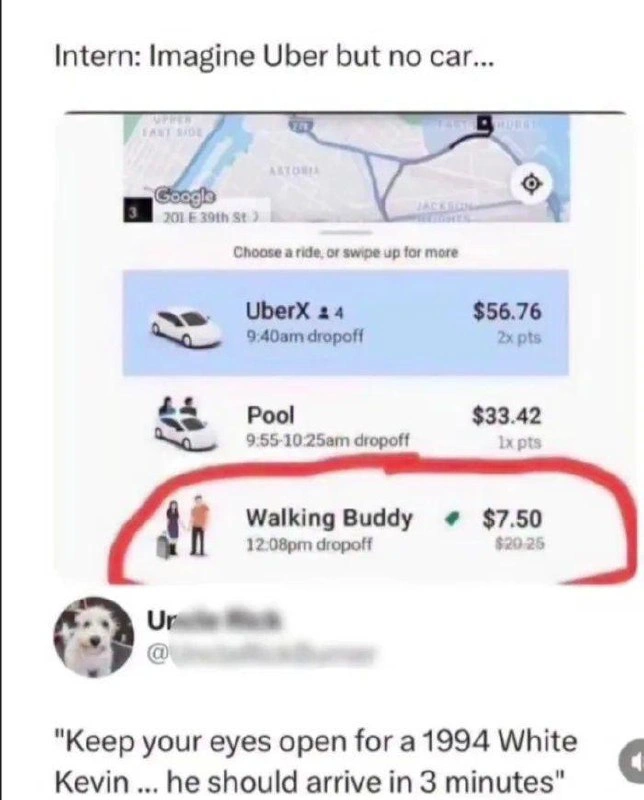
This meme revolves around an intern suggesting a crazy new feature: “Imagine Uber but no car.” In the image, we see what looks like the Uber app’s ride selection screen. Normally, when you use Uber, you choose a ride type – for example, UberX (a standard private car ride) or Uber Pool (a car ride you share with other passengers to save money, which might take a bit longer). Those are real options in the Uber app. The intern in the meme, however, has proposed a new option called “Walking Buddy.” It’s presented just like a ride option, but instead of a car picking you up, you’d simply get a person to walk alongside you to your destination. The meme-maker even edited the screenshot to show the Walking Buddy option circled in red, with details: an arrival time of 12:08 pm (much later than the car rides) and a price of $7.50 (crossed down from $20.25, suggesting a big discount for this “service”). There’s also a Twitter-style caption below jokingly saying: “Keep your eyes open for a 1994 White Kevin … he should arrive in 3 minutes.” This line mimics how the Uber app usually tells you about your driver and car – e.g. “Look for a white Toyota from 2014, driver Kevin, arriving in 3 minutes.” But since Kevin is on foot, they jokingly describe Kevin himself like he’s the vehicle (1994 might be Kevin’s birth year, “White” likely describes Kevin or his clothing). It’s an absurd detail that highlights how odd the concept of a “walking Uber” is.
The phrase “Uber for everything” is key to understanding this humor. In tech and startup circles, calling something “Uber for X” means you’re trying to replicate Uber’s business model in a new area. Uber’s model is basically: use a smartphone app to instantly get a service (in Uber’s case, a car ride) from someone in the gig economy. So, over the years, many startups pitched themselves as “Uber for [something else]”. For instance, DoorDash and UberEats are kind of an “Uber for food delivery” (you tap an app and someone brings you food), and there have been things like “Uber for dog-walking” or “Uber for laundry” where you can request those services via an app. It became a bit of a cliché around Silicon Valley that people would say “It’s Uber, but for __” about every new startup. That’s why this intern_feature_pitch sounds so silly: “Uber but no car” is basically “Uber for walking”. Walking is so simple and normal that turning it into an Uber-like service is funny. It’s like a parody of all those ambitious startup ideas – the meme is showing how StartupHumor can stem from pushing the “Uber for X” concept to ridiculous extremes.
Let’s break down some terms and why developers find this scenario comical. FeatureCreep is a term for when a product keeps getting more and more features tacked on, often unnecessarily. It usually leads to the product becoming overly complex or unfocused. In this case, Uber’s core feature is getting you from point A to B with a car. A Walking Buddy has nothing to do with cars at all – it’s a completely different service (literally using your feet). Adding something so off-beat to the Uber app would be a classic case of feature creep. Developers and designers often warn against this because adding too many unrelated features can confuse users and dilute the main purpose of your application. Here, the meme exaggerates feature creep to a silly level: the intern wants to cram in a feature that basically re-invents walking as an Uber service.
Another term that comes up is MVP, which stands for Minimum Viable Product. An MVP is the simplest version of a product that you can release to test if people actually want to use it. It has just the core features needed to work. In startup culture, interns and new product managers are taught to think about making an MVP to prove an idea’s value quickly. The meme hints at this being a minimum_viable_product_parody. Essentially, the intern might be thinking: “Hey, what’s the smallest, easiest way to expand Uber? We don’t even need cars or drivers – just pair up walkers! That’s a viable product we could test cheaply.” In theory, as an MVP, a Walking Buddy service is extremely minimal – all you need is a way to match a customer with a “buddy” and a method to charge for it. But it’s a parody because it’s clear that even if you can build it easily, nobody really needs it. A good MVP addresses a real user problem or demand; here the “problem” being solved is nonexistent (people can simply walk by themselves or with a friend without an app!). So the meme jabs at how sometimes tech ideas focus on what can be built cheaply rather than what makes sense to build.
Now, consider corporate and management culture. StakeholderExpectations refers to what important people at the company (like bosses, investors, or project owners) expect from a project or team. Interns often feel pressure to come up with something bold or “innovative” to stand out. They hear buzzwords like “disrupt” (which means to radically change or revolutionize an industry) and think they should present a big visionary idea. In this case, the intern’s big idea is to “disrupt sidewalks” — basically taking the concept of ride-sharing and applying it to walking. It’s an attempt to impress stakeholders with creativity: “Look, we can expand our platform in a whole new direction!” However, to more experienced folks, this comes off as naive and amusing. It’s ProductManagementHumor: product managers are known for sometimes suggesting wild new features to capture more market or improve metrics, and developers often react with a mix of frustration and laughter, especially if the idea is far-fetched. The meme reflects that common workplace scenario where a non-technical person suggests something that makes the engineers scratch their heads.
Technically speaking, the idea of a “Walking Buddy” would introduce a lot of complications. For example, Uber’s app and backend systems are built around vehicles and drivers. Having a no-car option means things like estimated time and routing would need walking directions instead of driving directions. The app might need to handle showing a person icon instead of a car on the map, and safety/trust issues become different when it’s just someone walking with you. A junior developer or someone early in their career might not immediately see those complexities; they might think “No car means less work, right?” Meanwhile, a senior developer knows this would require special-casing all over the code. (In programming, a special case is an exception to the normal rules – too many of those and the code gets messy.) The line “1994 White Kevin arriving” exemplifies that: the system clearly expected to show car details, and now it’s awkwardly showing human details in that format. It’s funny, but it also subtly points out how clunky the implementation of such a feature would be unless you overhaul a lot of systems. That’s why developers find it humorous on another level – we can imagine the janky workaround an intern might use to jury-rig this feature into an existing app.
Finally, the broader StartupHumor aspect: In startup culture, there’s often a tongue-in-cheek reference to “X as a Service” for everything. Originally, “as a Service” is a serious term from cloud computing (e.g. Software as a Service (SaaS) means delivering software over the internet for subscription). But people joke about it to poke fun at businesses that try to commodify everyday things. Here, “Walking as a Service” (sometimes jokingly called WaaS) is exactly that kind of tongue-in-cheek phrase. It implies you’d pay a subscription or fee to basically get something as trivial as a walking partner. It’s ironic and funny because walking with someone isn’t a service anyone thought needed a tech platform. The meme’s tags like walking_as_a_service capture that irony. The surge_pricing_irony tag also hints: Uber is known for “surge pricing” (charging higher rates during high demand). You can imagine the absurdity of surge pricing for walking buddies – like charging extra on a rainy day or during the morning rush when many people want a companion to walk to work. It’s a sarcastic way to highlight how far these app-based business models might go in pursuit of profit.
In summary, to a newcomer or junior developer, this meme is pointing out the silliness of turning something very simple (walking with a friend) into a high-tech, monetized service. It touches on concepts like feature creep (adding unnecessary features can be ridiculous), the “Uber for everything” trend in startups, and the pressure in corporate/startup environments to come up with flashy new ideas (stakeholder expectations for constant “disruption”). Developers, even those early in their careers, often find this relatable because they quickly learn that not every “innovative idea” is actually practical or needed. Sometimes, the best response is to laugh and shake your head, which is exactly what this meme invites us to do.
Level 3: Walking as a Service
At first glance, this meme looks like an absurd case of feature creep in a rideshare app: an intern suggesting “Uber without cars” – essentially trying to monetize the act of walking. It parodies the classic uber_for_everything startup trope, where every imaginable activity gets turned into an on-demand service. The screenshot mock-up shows Uber’s ride selection UI with a new option called Walking Buddy, listed alongside normal rides like UberX and Pool. The intern’s idea is to “disrupt sidewalks” by offering a paid walking companion on-demand. The humor here is that a simple everyday activity (walking with someone) is being treated like a revolutionary product. It’s the kind of overzealous ideation seasoned developers have seen in countless hackathons and pitch meetings — an intern trying to impress stakeholders by reinventing the wheel (or rather, reinventing walking without wheels).
From an experienced developer’s perspective, several things make this hilarious and painfully relatable. First, there’s the “Uber for X” mania: ever since Uber’s success, every new MBA or junior PM at a startup wanted to proclaim “It’s like Uber, but for [insert basic human activity]!”. We’ve seen pitches for Uber for laundry, Uber for groceries, Uber for dog-walking – some ideas worked out, many crashed and burned. By 2025, that formula is so overused it’s basically a punchline. So when the intern proudly proposes “Uber… but no car,” you can practically hear a room full of engineers groan. It’s a textbook example of chasing StakeholderExpectations with buzzwords: the intern is clearly aiming to sound innovative and disruptive for its own sake. The veteran engineers in the room, however, immediately recognize this as a solution in search of a problem – a minimum_viable_product_parody that nobody asked for.
The screenshot details amplify the joke with true-to-life specifics. The Walking Buddy option is circled in red, emphasizing its ridiculousness. It promises a 12:08 pm dropoff for only $7.50 (discounted from a ludicrous $20.25). Compare that to the normal UberX car showing 9:40 am dropoff for $56 – the walking option is cheaper but comically slow. This highlights how impractical the idea is: sure, you save money, but you’ll be hoofing it for hours. It’s a sly nod to corporate cost-cutting ideas that ignore real-world convenience. The meme even mimics Uber’s marketing style: “2x pts” for UberX, “1x pts” for Pool, and presumably some reward for Walking Buddy too. That’s a joke about how ProductManagementHumor plays out in real life – companies dangle loyalty points and promos to make even a bad idea seem enticing. The intern’s imaginary UI tries so hard to sell this feature (“crossed-out $20.25 now just $7.50!”) exactly the way a real app would roll out a questionable new tier with a discount. It’s a brilliant little detail that senior devs and PMs chuckle at, because they’ve sat through meetings where someone suggests gamifying and incentivizing the most trivial feature to drive adoption.
Perhaps the funniest touch is the tweet-style text at the bottom: “Keep your eyes open for a 1994 White Kevin … he should arrive in 3 minutes.” This line satirizes the standard Uber driver notification (e.g. “Look for a white 2014 Toyota; your driver Kevin arrives in 3 minutes”). In the Walking Buddy scenario, there’s no car, so they’ve cheekily treated the person as the vehicle – Kevin is a 1994 model in white! 😂. A battle-scarred dev reads that and imagines the poor intern kludging the app’s code: the system was built to describe cars, so the easiest hack was to repurpose the fields. Year of the car? That’s Kevin’s birth year, 1994. Car color? Kevin is a white guy, so… “White Kevin.” It’s absurd and borderline offensive, which is exactly the point – this feature is a total shoehorn. The veteran engineer in me can just see the code diff where vehicle.make is set to "Kevin" and we pray nothing breaks. In real development, adding a ride type with no actual vehicle would wreak havoc on systems expecting a car object. It’s a recipe for spaghetti code with special-case if (rideType == WALKING_BUDDY) { ... } checks scattered everywhere. The meme exposes how such an intern_feature_pitch might sound “simple” in a meeting, but would create gnarly edge cases in the codebase (and plenty of grim laughter in the engineering bullpen).
Beyond the technical silliness, this meme lands because it skewers CorporateCulture and the Startup mindset. The Walking Buddy idea is a caricature of that “move fast and break things” attitude where no idea is too crazy – often encouraged by management and product folks chasing the next big thing. It’s RelatableDeveloperExperience for anyone who’s been in a planning session that went off the rails. Imagine a wide-eyed intern actually pitching this in a conference room:
Intern (excited): “What if we disrupt pedestrian travel by offering a platform for on-demand walking partners? Think Walking as a Service! Users could order a buddy to walk with them for a fee. It’s Uber, but for sidewalks!”
Senior Dev (muttering): “Great, next we’ll monetize breathing as a service…”
The intern’s enthusiasm is adorably misguided: they’re trying to apply the successful Uber template to literally anything, because that’s what they’ve been told innovation is. The cynical veteran in the back knows this isn’t innovation, it’s FeatureCreep meets buzzword bingo. But in some companies, you can bet at least one manager’s eyes would light up at phrases like “on-demand pedestrian mobility solution.” Upper management and some PMs have a weakness for grandiose ideas that sound cutting-edge, even if they border on self-parody. The meme captures that dynamic perfectly – it’s funny because it’s true. We’ve all seen decision-makers entertain outlandish concepts for a moment, especially if an eager intern or PM sells it with enough flair. The truth is, a service for “walking buddies” would be a nightmare in practice (liability issues, anyone?), but on a PowerPoint slide it could look like the next big growth vertical. The humor has a bit of a bite: it’s poking fun at the stakeholder expectations in tech that everything must be disrupted and monetized, even something as simple and human as taking a walk.
In essence, this meme is a witty critique of startup overreach and impractical product ideas. It resonates with senior tech folks because it exaggerates a scenario we find all too familiar. The intern_pitch is well-intentioned but clueless, the feature is half-baked, and the CorporateHumor of it all is that somewhere in Silicon Valley, someone probably tried something similar in earnest. “Uber without cars” to disrupt walking innovate the pedestrian experience? It’s hilariously emblematic of an industry that sometimes loses the plot chasing the next Uber. And as a grizzled developer who’s survived a few FeatureCreep fiascos, I appreciate that this meme lets us laugh at the madness before we trudge back to our legacy code (which, thank goodness, does not have a WalkingBuddyService… yet).
Description
A meme showing an Uber-like ride selection screen with the caption 'Intern: Imagine Uber but no car...' The screen shows three options: 'UberX' at $56.76 (9:40am dropoff, 2x pts), 'Pool' at $33.42 (9:55-10:25am dropoff, 1x pts), and 'Walking Buddy' at $7.50 (12:08pm dropoff, crossed-out $20.25) which is circled in red. Below is a reply: '"Keep your eyes open for a 1994 White Kevin... he should arrive in 3 minutes"'. The map shows a Google Maps route to 201 E 39th St. The joke mocks absurd startup pitches that are essentially existing services minus the core value proposition
Comments
49Comment deleted
It's like Uber but we removed the car, the safety, and the speed -- investors, we're calling it 'disrupting the walking space' and our Series A deck is ready. Valuation: $2B pre-revenue
The service is codenamed 'person-as-a-service' (PaaS), but the architecture review revealed a critical flaw: the 'Kevin' instances aren't idempotent and have unpredictable downtime for 'bio breaks'
Great, now the roadmap includes WaaS - Walking-as-a-Service - because apparently the best way to hit profitability is to delete the CAPEX layer entirely and just ship pedestrians
After 15 years of building distributed systems, I've learned the hardest problem isn't CAP theorem or consensus algorithms - it's explaining to VCs why your B2B SaaS doesn't need blockchain, AI, or apparently now, why walking doesn't need surge pricing and a two-sided marketplace
When your intern takes 'move fast and break things' literally and pitches a peer-to-peer walking service - because why optimize algorithms when you can just optimize步数?
Interns: like Walk Buddy for code reviews - they'll show up eventually, but expect a sweaty merge conflict and zero context switches
Engineering swapped vehicle_id for person_id, toggled vehicle_required=false, and branded it WAAS - Walking as a Service; the ETA model immediately went out-of-distribution
Why would I pay for a walking buddy? I also don't talk to my Uber or Taxi driver, am I too German to get the point behind this? Comment deleted
To help carry your luggage for you and chat with you 😄 Comment deleted
But why would I want to chat to a random stranger? My issue is, it is not like a random conversation but more like a forced one, the person is getting paid to talk to me. This is weird to me. Carrying luggage tho sounds nice, but I would still have headphones on :D Comment deleted
you are doing so right now 🥹😛 Comment deleted
But that is because I and you guys want to. I doubt any of you are paid to do that :D Comment deleted
I'm actually paid to do that, but I'm not very good at my job. Comment deleted
It's like a walk buddy and paid psychologist at the same time. Like Doctor Pal. Comment deleted
so I can dump all the issues on that poor Kevin and hope he won't kill himself after the walk? Comment deleted
Imagine you’re in Neuköln at 01:00 and you need to get home alive but don’t have the money for a car Comment deleted
But how says, that a random Kevin, maybe even an Alphakevin, can help with that? In Neukölln I would rather have someone who can actually protect me, not a Fittibro Comment deleted
Maybe that costs extra Comment deleted
Dang, but then at least I get someone who can actually protect me? Comment deleted
People, especially women, are often uncomfortable walking in certain areas at night. Not saying the walking buddy is a body guard, but you're less likely to be assaulted if you're not walking alone Comment deleted
armed robber: Comment deleted
lmao Comment deleted
that's why you carry a gun Comment deleted
Aren't there statistics that show your gun is most liked used against you? And by the way, if you have gun, the robber HAS to carry a gun too. Comment deleted
I mean, if you don't train with your gun, then you're fucked regardless. Comment deleted
That doesn't make that much of a difference. In countries where people commonly carry guns, the count of people dying from robberies is way higher. Comment deleted
That is a very good point. The part about not being assaulted is very true, but weren't there several reports that Uber drivers commonly assault women? So that wouldn't help that much. Comment deleted
what are those prices, wtf, did he order 200km ride or sth? Comment deleted
If I wanted to take a walk for fun and have a buddy, I would ask my dad. Otherwise it is just about getting somewhere. Comment deleted
White Kevin sounds like an SCP name Comment deleted
I’d assume Comment deleted
can I offer you a bowl of soup? Comment deleted
What soup? Comment deleted
chicken Comment deleted
and what type of chicken soup? Comment deleted
the kind that contains chicken Comment deleted
here u go ✨ Comment deleted
I see a classic chicken soup, always a good take Comment deleted
Whatever that means, but still if you have a gun, the chance you get killed is higher. Comment deleted
Yes, but real life shows clearly that you are getting killed way more likely in a robbery where both carry a gun. Comment deleted
So you would prefer to be defenseless? Typical european Comment deleted
Ah defenseless, no I would just like to live in a society, where there are no mass shootings every other day. Comment deleted
I prefer to live. But honestly, wouldn't it be nice to live in a country where children don't need to get shot when going to school, where school shooting drills are not a thing, since you don't need to worry about that? Comment deleted
Lockdowns were a thing my entire childhood, just recently did the name change Comment deleted
Do you get the point though? It is proven that a drill causes the same trauma like a real shooting. Comment deleted
this is certainly bullshit and I don't even need proof Comment deleted
https://www.nbcnews.com/news/us-news/active-shooter-drills-are-meant-prepare-students-research-finds-severe-n1239103 there you go Comment deleted
I prefer free healthcare, proper sick pay for about 3 years of being sick and yeah, like not living in a dictatorship in the making. And don't forget that we have at least 25 paid vacation days and every sick day is paid off by default and not counted against PTO. Comment deleted
oh you are jobless, then you would get money here too Comment deleted