Skip to content
DevMeme
6660 of 7435
Stand-Up That Turned Into 3-Hour Live Debugging Session What Year Is It
Meetings Post #7297, on Oct 19, 2025 in TG

Stand-Up That Turned Into 3-Hour Live Debugging Session What Year Is It

Why is this Meetings meme funny?

Level 1: Lost Track of Time

Imagine your teacher calls a quick 15-minute class meeting, but it ends up lasting three hours. You were only supposed to discuss one small thing, but instead the whole class spent the entire morning trying to solve a big puzzle on the board. When you finally step out for lunch, you’re all confused and jokingly ask, “Wait, what year is it?” because it felt like you were stuck in that classroom forever. The meme is funny because something that should’ve been short and simple turned into a long, draining adventure, leaving everyone feeling disoriented – just like waking up from a really long sleep and not knowing what day it is. It’s poking fun at how easy it is to lose track of time when a small chat suddenly becomes a huge problem-solving session.

Level 2: Stand-Up Scope Creep

Let’s break down the scenario for those newer to Agile and debugging. In Scrum (a popular Agile methodology), a stand-up (also called the Daily Scrum) is a short team meeting, ideally around 15 minutes. Each team member usually answers three questions: What did I do yesterday? What will I do today? Am I blocked by anything? The idea is to keep it brief – it’s even called a “stand-up” because some teams literally stand during it to discourage going on too long. It’s one of the key AgileCeremonies meant to improve communication without wasting time. A 15-minute timebox is set so the meeting doesn’t drag.

Now, what happened in this meme is an example of scope creep and MeetingOverload. Scope creep means something goes beyond its intended scope. Here the stand-up’s scope was just daily status updates, but it “crept” into a full-blown debugging session. A debugging session is when developers dig into code and systems to find and fix a bug (an error or problem in the software). Live debugging means doing it in real-time, often with multiple people involved, possibly screen-sharing code or console outputs so everyone can see what’s happening. It’s like a team huddle where you try different things to identify the cause of a problem and solve it on the spot.

In a healthy process, if someone mentions a serious bug during the stand-up, the team should note it and then certain members would “take it offline” – meaning handle it after the stand-up, involving only those necessary. For example, “Alice and Bob, you’re on this bug, sync up right after this call.” That way, the rest of the team can go on with their planned work. But in this meme’s scenario, nobody pressed pause. Instead, the entire team stayed and dove right into debugging together, effectively turning a quick morning check-in into a prolonged war room session. A war room in tech is a situation room where everyone gathers (physically or virtually) to solve a high-priority issue, often a production outage or critical bug, as fast as possible. It’s called that because it’s intense and all-hands-on-deck, much like strategizing in a war. War rooms can be effective for critical problems, but they are exhausting (hence tags like DebuggingFatigue and DeveloperExhaustion). They’re also focused events that ideally should be scheduled, not sprung on the team out of nowhere, especially not by hijacking another meeting.

For a junior developer, witnessing this can be confusing and draining. One minute you’re giving your daily update (“Yesterday I finished module A, today working on module B…”), and the next minute the whole team is knee-deep in debugging a complex issue on the spot. If you’ve just started in the industry, you might wonder, “Is this normal? Are stand-ups supposed to turn into three-hour meetings?” The short answer: no, not in theory. Stand-ups are meant to prevent long meetings, not become them. But it does happen sometimes in practice – especially in environments where urgent issues pop up or the team hasn’t enforced the discipline of keeping stand-ups short. Maybe a critical bug came up that morning or some piece of code broke the build, and someone mentions it during stand-up. The team decides it’s too urgent to wait, and before you know it, everyone’s sharing ideas or running code to figure out the problem. The stand-up meeting link stays open, or everyone physically remains, and it morphs into an unplanned debugging marathon.

This is exhausting for a few reasons. Context switching is one: you switch from “stand-up mode” (broad focus on tasks & blockers) to “debugging mode” (deep focus on a specific problem) without warning. It’s like your brain had to suddenly change gears. Just like a computer, rapid context switching can overload your mental “CPU”. If you were a newbie expecting the usual quick meeting and then time to code, now you’re pulled into a group problem-solving session – possibly out of your depth if you’re not familiar with the part of the system that broke. That can be intimidating. Also, a 3-hour intense debugging session can burn anyone out, let alone someone new who’s still getting used to the codebase and tools.

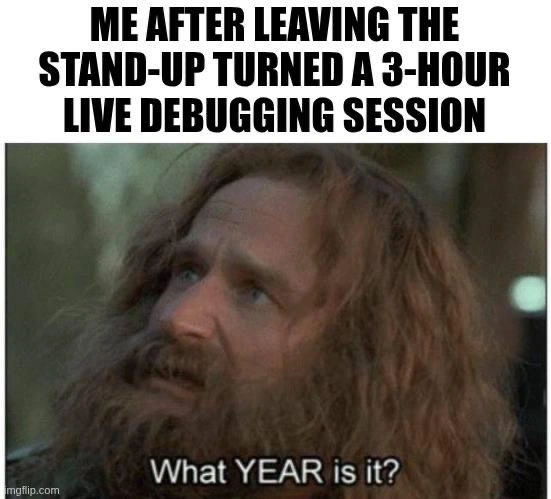
The meme uses a still from the 1995 movie Jumanji to illustrate how one feels after such a marathon. In the movie, the character Alan (played by Robin Williams) gets trapped in a magical board game jungle for decades. When he finally escapes, he’s bewildered, with a wild beard and hair, and famously asks, “What year is it?” because he’s been gone so long. In the context of this meme, the joke is that the developer went into what was supposed to be a brief stand-up and emerged hours later feeling so disoriented it’s as if years passed. It humorously exaggerates the feeling of “losing track of time”. After being in a heated debugging session, developers often do come out of the zone a bit dazed – you might squint at the clock, surprised that it’s already lunchtime or later. If it was emotionally intense (say production was down and everyone was stressed), you also feel a bit like you’ve been through a battle, hence the disheveled “just fought a lion” look from the Jumanji scene.

For junior devs, the take-away lesson hidden in this humor is: keep stand-ups focused. If you ever find a daily stand-up going off the rails into problem-solving territory, it’s okay (and often appreciated) to suggest, “This sounds important – maybe we should take this discussion offline with the folks directly involved, and let others get back to their tasks.” It might feel hard to say as a newbie, but teams thrive when they follow good meeting practices. The meme is a lighthearted way of saying “we’ve all been there, and it’s not fun.” It underscores the importance of timeboxing meetings and respecting everyone’s schedules. And if you do get pulled into one of these marathon sessions early in your career, don’t worry – it’s a common experience, and you’ll definitely bond with your teammates over the shared DebuggingMarathon misery (maybe over some coffee after!).

Level 3: Scrum Black Hole

When a daily Scrum stand-up collapses into a marathon debugging war-room, it feels like a timeboxed meeting turned into a black hole sucking in hours. This meme nails that AgileCeremonies anti-pattern: a supposed 15-minute stand-up expanding into a 3-hour live debugging saga. In theory, stand-ups are strictly timed to prevent exactly this. In practice, one urgent blocker or juicy bug report during the meeting can trigger standup_scope_creep – the agenda spirals out of control, and suddenly everyone’s screen-sharing logs and stack traces. Seasoned developers laugh (and cry) at the relatability: they’ve survived those “quick” daily syncs that devolve into impromptu war_room_session marathons. It’s a perfect storm of MeetingOverload and DebuggingHell rolled into one.

Why is this so humorous (in a dark way) to experienced engineers? For one, it satirizes how often teams violate Agile’s sacred rituals. The Scrum Guide prescribes a 15-minute limit for stand-ups – a timebox meant to keep things efficient. But here we have a time dilation phenomenon where 15 minutes turn into 180 minutes. It’s like the meeting hit an event horizon: once the deep debugging starts, there’s no escaping until the bug is cornered and vanquished. Everyone emerges bleary-eyed as if they’ve aged in a rabbit hole of logs and breakpoints. The top text encapsulates the developer’s state: “ME AFTER LEAVING THE STAND-UP TURNED A 3-HOUR LIVE DEBUGGING SESSION”. Then we see Robin Williams from Jumanji – wild hair, totally disoriented – asking “What YEAR is it?”. This image punches up the joke: that dazed post-meeting feeling when you realize half your day vanished in what was meant to be a trivial ritual. DebuggingFatigue and DeveloperExhaustion are real – after hours of intense problem-solving under time pressure, your brain feels scrambled and you’ve lost track of time (and possibly your will to live, caffeine please).

From a senior dev perspective, the meme also pokes fun at organizational dysfunction. A proper stand-up should surface blockers and then “take it offline” – meaning any detailed discussion or debugging happens after the stand-up with only relevant people. But here nobody said “Let’s discuss this right after”. Instead, the whole team got pulled into a massive DebuggingMarathon then and there. It’s a shared trauma: maybe the Product Owner or boss was present, panicking about a production bug and insisting “let’s fix it now.” Cue three hours of screen sharing, log diving, and people suggesting wild theories – basically an unplanned joint debugging session hijacking everyone’s morning. This scenario is painfully common in teams with shaky processes or fragile systems: one critical issue turns the daily stand-up (meant for quick status updates) into an all-hands-on-deck firefight. It highlights how scope creep isn’t just for projects – even meetings can balloon beyond their intended scope when panic sets in.

Notice the satirical exaggeration: coming out of a stand-up asking “What year is it?” as if you spent decades inside. It’s a play on how disorienting these overlong sessions can be. You went in at 9 AM, blinked, debugged a gnarly issue, and when you finally walk out, lunch is cold, your backlog for the day is untouched, and you have that caveman look of “I have seen things…”. The Jumanji reference amplifies the absurdity – in the movie, the character Alan Parish (Robin Williams) was literally trapped away from civilization for 26 years. In the meme, the dev wasn’t literally stuck for years, but it feels like it. That’s the punchline: a 15-minute Scrum turned into a jungle adventure long enough to lose track of the year. It’s an extreme send-up of MeetingOverload culture and broken Agile practices, where everyone involved knows this is wrong but goes along anyway because “we have to solve this now.” Senior engineers chuckle because they’ve been that disheveled person stumbling out of a conference room or Zoom call, wondering how a simple stand-up turned into an epic debugging quest. The meme resonates as gallows humor about the gap between textbook Agile and the messy reality of software development emergencies.

Description

A meme using the classic Robin Williams 'What YEAR is it?' scene from the movie Jumanji, where his character emerges looking wild and disheveled with long hair and a massive beard. The top text reads 'ME AFTER LEAVING THE STAND-UP TURNED A 3-HOUR LIVE DEBUGGING SESSION'. The bottom text reads 'What YEAR is it?'. The imgflip.com watermark is visible. The joke captures the disorientation of a daily standup meeting (meant to be 15 minutes) spiraling into a marathon debugging session that leaves you feeling like you've aged years

Comments

14
Anonymous ★ Top Pick The standup was supposed to answer three questions: what did you do, what will you do, and any blockers. Three hours later, you've answered a fourth: what is the meaning of existence when your CI pipeline has 47 flaky tests
  1. Anonymous ★ Top Pick

    The standup was supposed to answer three questions: what did you do, what will you do, and any blockers. Three hours later, you've answered a fourth: what is the meaning of existence when your CI pipeline has 47 flaky tests

  2. Anonymous

    The purpose of a stand-up is to identify blockers, not to hold the entire team hostage and become a three-hour blocker on the calendar itself

  3. Anonymous

    If your daily sync lasts long enough to need a fresh sprint, congrats - you just shipped real-time Waterfall

  4. Anonymous

    The only thing more disorienting than emerging from a 3-hour 'quick sync' is realizing the bug was in production the whole time, your coffee is now geological sediment, and the junior who asked 'can we just debug this together real quick?' has somehow been promoted to tech lead while you were screen-sharing

  5. Anonymous

    When your 15-minute standup morphs into a 3-hour live debugging session, you emerge like you've been trapped in production for decades - disoriented, aged beyond your years, and genuinely unsure if that critical bug fix was yesterday or in a previous sprint cycle

  6. Anonymous

    Standups: Scaling meeting time complexity from O(1) to O(n³) faster than any leaky abstraction

  7. Anonymous

    If your stand-up needs an MTTR and a postmortem, you’ve accidentally run incident response

  8. @RiedleroD 8mo

    it's a valid english sentence. english is just weird like that

    1. @diman4ous 8mo

      my bad lol

    2. @Algoinde 8mo

      is it? i thought it would be either "standup turned session" or "standup turned into a session"

      1. @RiedleroD 8mo

        …I'm not entirely sure on that

        1. _ 8mo

          Also, shouldn't it be "leaving the stand-up *that* turned …" ?

          1. @Algoinde 8mo

            that can be safely dropped

        2. dev_meme 8mo

          Don’t even stat on regional specific English variations that ARE deemed valid

Use J and K for navigation