Skip to content
DevMeme
847 of 7435
Intel's Unending Advent Calendar of Flaws
Security Post #957, on Jan 5, 2020 in TG

Intel's Unending Advent Calendar of Flaws

Why is this Security meme funny?

Level 1: A Bug in Every Box

Imagine you have a special year-long chocolate calendar, where you’re supposed to get a yummy treat each day. 🎄 But instead of candy, every time you open a little door you find a slip of paper that says something like, “Oops, something’s broken in your computer!” Day after day, a new problem shows up. At first, you might think, “Wow, what a weird surprise,” and maybe you even laugh because it’s so strange. But as it keeps happening, you start to expect that each “gift” is just another trouble. This meme is joking that owning an Intel computer chip in 2019 was like getting one of those prank calendars. Each day brought news of a new “surprise” weakness in the chip that hackers could use – definitely not the kind of surprise anyone wanted! It’s funny in the same way a really over-the-top cartoon is funny: it takes a frustrating reality (lots of computer bugs) and exaggerates it to the point of silliness. The feeling behind the joke is a mix of “Oh no, not again!” and “If it’s going to be this ridiculous, we might as well laugh.” In simple terms: instead of chocolates, Intel owners kept getting new bugs, and after a while you just have to smile at how crazy that is.

Level 2: Side-Channel Surprise

This meme is referring to a period when a lot of security vulnerabilities were found in Intel’s CPU hardware. A CPU (Central Processing Unit) is basically the brain of your computer. Intel is a leading company that designs these brains (the Intel Inside™ sticker on laptops is a brag about having an Intel chip inside). Normally, when we think of computer bugs or security holes, we think of software bugs – mistakes in programs or apps that hackers can exploit. But in this case, the bugs were deep in the computer’s hardware, inside the CPU’s very design. That’s unusual and alarming, because you can’t just rewrite hardware like you do software. These flaws were nicknamed after spooky things like “Spectre” and “ZombieLoad,” which tells you the vibe: even the researchers were a bit shocked and having fun naming them. The meme specifically talks about side-channel vulnerabilities. A side-channel attack means instead of attacking a system head-on (for example, directly guessing a password), an attacker finds an indirect way to get information. It’s like trying to figure out what’s on a sealed letter by noticing the imprint on the envelope. In computers, a common side channel is timing or cache behavior. For instance, a malicious program might not be allowed to read secret data directly, but it can measure how long certain operations take and infer the secret from that.

The big Intel vulnerabilities of 2018–2019 (such as Meltdown and Spectre) took advantage of a CPU performance feature called speculative execution. Essentially, the CPU guesses what work might be needed next and pre-executes it to save time. If the guess was wrong or not allowed, the CPU is supposed to throw those results away. The scary discovery was that even if the CPU throws the results away, the act of doing them left tiny traces — for example, a particular piece of data might get pulled into the CPU’s cache (a small, fast memory) and stay there. A hacker could then check the cache and figure out what that piece of data was, even though officially they were never supposed to see it. Meltdown was one such flaw where a normal program could trick the CPU into speculatively accessing protected memory (like data belonging to the operating system or another program). The CPU would later halt the operation, but not before the secret data was momentarily loaded into cache. The attacker could then do a clever timing check to deduce that secret. Spectre was a broader technique: it showed you could mislead the CPU’s branch predictor (the part that guesses which way an if will go) and make a program leak its own secrets from protected areas. These were hardware bugs, meaning they weren’t mistakes in any particular app’s code, but rather weaknesses in the fundamental design of the CPU.

When the meme says “open a fun new vulnerability every day,” it’s joking that there were so many of these disclosures that it felt daily. In reality, over those two years, there were perhaps dozens of major ones — still an avalanche by historical standards! Each time one came out, it was a big deal in cybersecurity news. Companies running thousands of servers (like cloud providers, banks, etc.) had to rush to mitigate the issue to keep data safe. Mitigating a hardware flaw often meant updating the system’s firmware with a microcode patch or changing the operating system to work around the problem. A microcode patch is like a tiny software update that Intel releases to adjust the behavior of the CPU at a low level. Think of it as teaching the CPU new rules on the fly, like “hey, don’t do that risky speed-up trick in this particular case.” These patches and OS updates fixed or reduced the risk of the exploits, but they usually made the computer run a bit slower. That’s because many of the vulnerabilities were tied to those very speed-up tricks (speculative execution, caching optimizations). So fixing the security issue often meant turning off or dialing back the optimization. It’s a classic trade-off: you lose some performance to gain safety. For example, after applying patches for Meltdown, some programs (especially ones that frequently ask the OS for something) slowed down noticeably, because the fix (called KPTI, Kernel Page Table Isolation) made the CPU do extra work to isolate memory. People weren’t exactly happy to see their systems slow down, but it was the price of security.

Now, an Advent calendar is a festive box or book with 24 small compartments, one for each day of December leading up to Christmas. You open one per day and usually get a treat or a toy – it’s meant to be joyful and fun. The tweet twists this idea: imagine an “Intel CPU vulnerability” Advent calendar where each day you open the little door and instead of a candy, you discover a new security flaw in your processor. It’s a nerdy joke obviously – nobody literally sells such a calendar. It’s a metaphor for how frequent these revelations felt. By saying “every day of the year,” the joke exaggerates that 2019 had so many vulnerabilities that even the 24 days of Advent weren’t enough to cover them; you’d need one for each of the 365 days! For a junior developer or someone new to this topic, the takeaway is: Intel CPUs had an embarrassing number of security issues revealed in a short time span, so the tech community started joking about it to cope. It’s tech humor born from frustration – when you spend a year applying patch after patch and reading about “yet another side-channel attack,” the absurdity of the situation lends itself to a Christmas joke: Santa’s not giving out chocolates this year, he’s giving out CVEs. 🎁🔐

Level 3: The Gift That Keeps On Giving

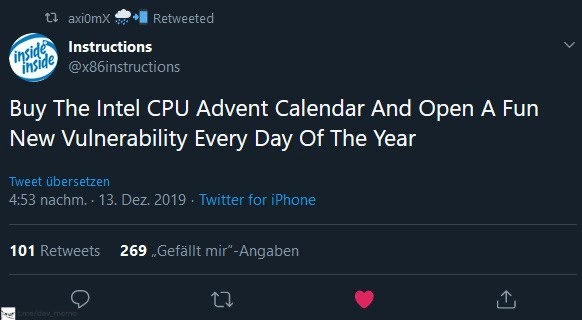
“Buy The Intel CPU Advent Calendar And Open A Fun New Vulnerability Every Day Of The Year.”

This tongue-in-cheek tweet perfectly captures the exhausting comedy of being a tech professional in 2018–2019. It felt like every time you turned around, someone had discovered yet another Intel CPU security vulnerability. The joke frames these disclosures as an Advent calendar, a holiday tradition where you open one small treat each day leading up to Christmas. Normally, that means 24 delightful surprises – chocolates or toys behind each door. But here the punchline is that Intel’s CPUs had so many “surprises” (read: security bugs) that you’d need a calendar with 365 doors, one for every single day of the year. It’s a sardonic way to say: “last year was overflowing with CPU crises.”

The humor lands because it’s painfully true for those in the industry. Throughout 2018 and 2019, a parade of ominous-sounding vulnerabilities kept dropping, especially affecting Intel’s dominant x86 processors. The tweet’s author, an account named @x86instructions with a profile picture parodying the “Intel Inside” logo (their version says “inside inside”), is clearly poking fun at Intel’s insides in more ways than one. Every few weeks it seemed we learned about a new speculative execution hole or side-channel leak. Each vulnerability got its own catchy name and sometimes even a logo, almost like a perverse collection of Pokémon cards for hackers. By late 2019, engineers joked darkly that Intel must have a “vulnerability-of-the-month club.” The “Advent calendar” quip exaggerates it to every day, but some weeks it really did feel that way.

To put the onslaught in perspective, here are just a few of the greatest hits from that era of Intel CPU flaws:

  • Meltdown – A bug that melted the normal security boundaries, letting user programs peek into protected kernel memory. It forced emergency OS patches (KPTI) and microcode updates, slowing down many systems.
  • Spectre – Aptly named like a ghost, it haunted numerous CPUs (Intel, AMD, others) by tricking victim code into speculatively revealing its secrets. Spectre was not one single bug but a whole class of issues, spawning variants that kept researchers busy like a never-ending horror sequel.
  • Foreshadow (L1TF) – As the name implies, it prefigured more trouble by targeting Intel’s secure enclaves (SGX) and leaking data from the L1 cache. Even the trusted parts of the CPU weren’t safe from scrutiny.
  • ZombieLoad – Just when you thought it was safe, this came lurching along. It allowed attackers to read data that was “left for dead” in the CPU’s buffers. The moniker “Zombie” was fitting: data you thought was gone could rise again and bite.

And that list is not even exhaustive – there were others with names like RIDL, Fallout, and more. Each time one was announced, hardware and security teams had to scramble. Picture a frazzled engineer’s year: every new CVE (Common Vulnerability and Exposure ID) felt like opening a tiny advent calendar door to reveal… yet another chore. Instead of a sweet chocolate, you got a sour dose of on-call firefighting. Apply a patch, update the firmware, coordinate with cloud providers, reassure customers, test for performance hits – rinse and repeat. It’s tech humor coping with real stress: rather than crying that our fancy CPUs had so many holes, we laugh and say, “Ho ho ho, what’s behind today’s door? Another bug!”

The tweet’s format mimics an advertisement (“Buy The Intel CPU Advent Calendar...”) as if this barrage of side-channel disclosures were an actual product feature. That’s a sly jab at how Intel and the industry were in reactive mode all year. Imagine Intel trying to spin it positively: “Look, we’re so innovative, we even deliver fresh content (er, vulnerabilities) daily!” In reality, of course, these hardware bugs were unintentional and quite embarrassing for Intel’s reputation. But the community found solace in humor. The retweet by prominent security folks (like axi0mX, known for jailbreak exploits, who added the rainy cloud and blue book emoji) shows how this resonated: it was a collective eye-roll. Everyone from low-level firmware engineers to cybersecurity teams felt the fatigue of constant patching, and this meme let them chuckle at the absurdity.

Importantly, the meme also hints at the performance trade-offs that plagued that period. Each “fun new vulnerability” came with its not-so-fun mitigation, which often meant slowing down the CPU or disabling features. People joked that by the end of the year, their blazing-fast Intel chip was running at the speed of a much older one because so many performance features had to be muzzled for security. It’s like getting a new present (a fix) that slightly breaks your favorite toy (your server’s throughput). The phrase “Advent Calendar” also subtly implies countdown – except instead of counting down to Christmas, we were counting down the days until the next disclosure or the next urgent patch Tuesday. Security teams started to feel like kids eagerly (or not so eagerly) opening each day, except instead of candy it was a CVE notice.

The insider nature of the joke is strong. It riffs on the titles of these flaws and the sheer ridiculous abundance of them. To someone who lived through that wave, the line “open a fun new vulnerability every day” drips with irony – none of it was fun by the usual definition. But calling it fun points to how security researchers would sometimes seem almost giddy to unveil the next big flaw at conferences, while sysadmins dreaded it. The discrepancy is funny: one person’s exciting discovery is another’s late-night deployment nightmare. The meme captures a shared feeling across the tech world: exasperation masked as humor. By framing the year of vulnerabilities as a cheery holiday calendar, it highlights the only sane response to such an insane situation: laugh it off. After all, when you’re on your tenth emergency patch cycle of the year, sometimes gallows humor is the gift that keeps on giving.

Level 4: Speculative Execution’s Naughty List

At the cutting edge of CPU architecture, speed and security are often at odds. Modern Intel CPUs perform speculative execution – they guess what instructions might be needed next and execute them out-of-order before it’s confirmed, to gain a performance edge. This means the processor will speculate on both branch prediction (guessing which way an if or jump will go) and preloading data into fast cache memory. Normally, if a guess was wrong or not allowed (say, reading data it shouldn’t), the CPU aborts those speculative operations and no harm is done – at least, in theory. The spectacular surprise of vulnerabilities like Meltdown and Spectre was that even rolled-back operations could leak information through side effects. Data from a forbidden memory read might get loaded into the cache for a few fleeting moments. The CPU will later discard the results and pretend those instructions never ran architecturally, but micro-observables like cache state are still changed. An attacker can measure those changes (for example, by timing how fast certain memory accesses are after speculation) and infer the secret data that was temporarily accessed. This class of weakness is called a side-channel attack – rather than directly breaking the system’s rules, it listens to subtle “side” signals (like timing, cache hits, or power draw) to smuggle out secrets.

These speculative execution flaws revealed fundamental cracks in the assumption that different processes (or privilege levels) are truly isolated inside the CPU. The isolation boundary between, say, user applications and the operating system’s kernel, relied on the rule that a program couldn’t read memory it didn’t own. But with speculative execution, the CPU temporarily violates that rule under the hood (to keep pipelines full and avoid stalling). The designers assumed any misstep would be safely undone with no external evidence. The research community proved that assumption wrong: there is evidence left behind – tiny timing differences and cache leftovers – and they’re enough to reconstruct supposedly protected data. It’s as if the CPU had a “naughty list” of performance tricks that suddenly got it in trouble: each trick (like aggressive caching, branch prediction buffers, or sharing microarchitectural state across security domains) became a new crack through which data could slip.

From a microarchitectural standpoint, each new vulnerability targeted a different hardware buffer or predictor deep inside the chip. One day it’s the branch predictor’s BTB (Branch Target Buffer), next it’s the L1 cache lines, then the store buffer or fill queue – all the little transient holding areas inside a complex out-of-order core. Hardware engineers had to scramble to plug one leak after another, often by issuing microcode updates or advising OS vendors on software patches. A microcode patch is essentially a firmware update for the CPU itself – it can tweak instruction behaviors or insert extra checks (for example, making sure speculative loads that fault don’t reveal data). However, these fixes usually come at a cost. To stop bad speculation, CPUs had to throttle or insert guards in their good speculation features. Suddenly, code ran slower because the chip couldn’t be as carefree in guessing ahead. In technical terms, mitigating side-channel vulnerabilities often means adding pipeline barriers, extra flushing of caches or TLBs, and disabling some sharing of resources between threads. No surprise, those measures drag down performance. We saw trade-offs like fast secure vs. fast-but-vulnerable manifest overnight. It’s a classic case of “no free lunch” in computer architecture: every clever speed optimization might carry a latent cost in security. The Meltdown paper and subsequent ones showed that speculative memory access violates fundamental safety boundaries, essentially rewriting textbooks on how memory isolation and privilege levels are enforced under the hood. Academic models of out-of-order execution had to consider these transient execution effects. The theoretical takeaway is almost philosophical: performance optimizations created a parallel shadow world of transient states, and those shadows were not as harmless as assumed. What was once a purely academic curiosity (timing attacks on caches have been discussed since the 1990s) exploded into real-world exploits that could dump memory contents across security boundaries. Each new CPU vulnerability disclosure in 2018–2019 reinforced a bitter truth: many modern microarchitectural techniques, from branch prediction to caching, inadvertently opened Pandora’s box, scattering a year’s worth of side-channel surprises and landing Intel’s proud optimizations squarely on the security naughty list.

Description

A screenshot of a tweet from the user 'Instructions' (@x86instructions), which has been retweeted. The tweet, dated December 13, 2019, reads: 'Buy The Intel CPU Advent Calendar And Open A Fun New Vulnerability Every Day Of The Year'. The profile picture for @x86instructions has the words 'inside inside' in a circular logo, parodying the 'Intel Inside' branding. This meme is a satirical commentary on the string of severe hardware-level vulnerabilities discovered in Intel CPUs, such as Meltdown, Spectre, and their many variants, which were prominent in the news from 2018 onwards. The joke likens the seemingly constant discovery of new security flaws to an Advent calendar, but instead of daily treats, the user gets a new vulnerability, humorously extended to last the entire year rather than just the holiday season. It resonates with senior engineers who dealt with the extensive patching and performance implications of these fundamental hardware security issues


Comments

7
Anonymous ★ Top Pick Intel's idea of a subscription model: you don't pay for new features, you just receive a steady stream of microcode updates that slowly degrade performance to patch the hardware you already bought
  1. Anonymous ★ Top Pick

    Intel's idea of a subscription model: you don't pay for new features, you just receive a steady stream of microcode updates that slowly degrade performance to patch the hardware you already bought

  2. Anonymous

    Nothing like a daily side-channel to remind ops that "continuous delivery" now includes microcode updates that shave more performance than your quarterly capacity plan

  3. Anonymous

    Remember when we thought branch prediction was just a performance optimization? Now it's a security consultant's retirement fund. At least Intel's vulnerability disclosure schedule is more reliable than their 10nm roadmap was

  4. Anonymous

    The Intel CPU vulnerability advent calendar: where every day brings a new CVE instead of chocolate, and the real gift is the performance penalty from all those microcode patches you'll need to apply. At least with 365 days of vulnerabilities, you'll never run out of reasons to justify that AMD migration budget request

  5. Anonymous

    We skipped the Intel Advent Calendar - every kernel update already unwraps a new mitigation and another 5% of our perf budget

  6. Anonymous

    Intel's advent calendar: 365 speculative execution exploits to ensure your mitigations never retire

  7. Anonymous

    Our holiday risk posture: every Intel CVE we unwrap means KPTI, retpoline, a microcode patch - and gifting ops another 15% throughput tithe

Use J and K for navigation