Integer Overflow IQ: So Smart It's a Bug
Why is this CS Fundamentals meme funny?
Level 1: Off the Charts
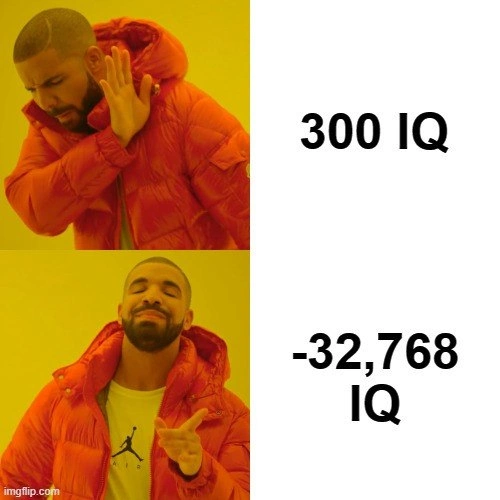
Imagine you have a simple counter that can only go up so high before it resets. Think of those old-fashioned car odometers that show all 9’s when maxed out and then flip back to 0 when you add one more mile. Now, pretend that counter was measuring something like “smartness points.” If you keep increasing the smartness and the counter hits its limit, it might suddenly jump to a really low number because it can’t display anything higher – like going from the highest score back around to a super low score. That’s what’s happening in this joke. In the picture, the famous rapper Drake is used as a meme. In the first part, he’s saying “no thanks” to a 300 IQ – which is a joking way to say someone is really, really smart. In the second part, he’s giving a thumbs-up to –32,768 IQ – an insanely low (and actually impossible) IQ. Why would anyone choose a negative IQ? They wouldn’t in real life! But the joke is comparing a computer glitch to a person’s IQ. It’s showing how a computer, when it runs out of room to count a high number, can loop back around to a weird negative number. Drake “liking” that is just a funny way to point out this silly behavior. So basically, the meme is laughing at how computers sometimes do crazy things with numbers – like being so smart that it wraps around to looking dumb – and that little inside joke makes programmers chuckle.
Level 2: Numbers Gone Loopy
Let’s break down the joke in simpler terms. Computers store numbers in a fixed size most of the time. An int16 is a common way to say a 16-bit integer – basically a whole number that’s stored in 16 binary digits. For a signed 16-bit number, the values it can hold go from –32,768 up to +32,767. Why those weird numbers? It’s because of how two’s complement works, which is the method computers use to handle negative numbers. You can imagine it like a circular number line for that variable: if you try to go past the top, you end up at the bottom (and vice versa). So if you count up one more than 32,767, the number doesn’t magically become 32,768 – it loops around to –32,768. That lowest value, –32,768, is the int16_min_value – essentially the floor beyond which the int16 just can’t go. It’s like an odometer in a car flipping from 99999 to 00000, except here when it flips, the computer reads it as a negative.
Now, the meme itself uses the popular Drake meme template. In the first panel, Drake is waving his hand “no” at something; here that something is “300 IQ”. In internet lingo, saying someone has “300 IQ” means they did something really smart or galaxy-brain level clever (far above the average IQ of 100 – it’s a humorous exaggeration). So, Drake rejecting “300 IQ” suggests we’re saying “nah, we don’t want the straightforward super-smart solution.” In the second panel, Drake is smiling and pointing at “-32,768 IQ”, indicating “this is the good stuff!” That “–32,768 IQ” is not a normal phrase at all – it’s referencing the exact numeric value –32,768. In context, this would be an IQ so low it’s impossible; you can’t have negative IQ points in real life. But that’s the joke: –32,768 is a very specific number a programmer would recognize. It’s the outcome of an integer overflow error on a 16-bit number. Essentially, the meme is saying: instead of doing something in a normal intelligent way (300 IQ logic), a programmer might accidentally or hilariously do something that makes a number hit its lowest possible value – the proverbial “−32,768 IQ move.”
So why is that funny to developers? Because many of us have seen this exact bug or studied it in school. It’s a classic bug in software: you expect a value to maybe go up to some high positive number, but due to a mistake, it “wraps around” and becomes a huge negative number. It’s the same kind of error that leads to high scores in old video games turning into negative numbers after you pass a certain point. For a newer developer, imagine you wrote code to track a player’s score or an IQ value and you used a 16-bit integer by habit. If the score or IQ went above 32767 (maybe you didn’t expect it to, but it did), that variable would suddenly roll over to –32768. The program might then freak out: “Negative IQ? That makes no sense!” Exactly – it’s a nonsensical situation caused by a simple oversight.
The meme takes that scenario and makes it relatable and funny. Drake preferring “–32,768 IQ” over “300 IQ” is a tongue-in-cheek way to celebrate this little quirk of computer arithmetic. It’s poking fun at ourselves as programmers: sometimes we create 300 IQ (super smart) solutions, but one little missed detail – like the limit of an int16 – and we end up with a result so wrong (–32768) that it’s comical. This kind of developer humor works because it’s based on a fundamental concept you learn early on, and it reminds us that even basic things like how numbers are stored can’t be ignored. In short, the meme is highlighting an “oops” moment with integer limits, using the Drake format to say: messing up your number range is somehow more entertaining than a genius plan that avoids it. It’s a lighthearted way to remember a lesson in CS fundamentals: always know your data type limits!
Level 3: Bug Beats Brains
For experienced developers, this meme hits on a painfully familiar scenario: the clever solution vs. the unforgiving edge case. The top panel (Drake rejecting “300 IQ”) represents a 300 IQ logic – a super-smart plan or an expected high-functioning behavior in code. In theory, a 300 IQ solution is brilliant. But then reality (and computer architecture) intervenes. The bottom panel (Drake happily pointing at “–32,768 IQ”) shows that sometimes a simple bug in software – here an integer overflow causing a value to hit –32,768 – will triumph over even the 300 IQ approach. In other words, your galaxy-brain idea was no match for a basic arithmetic overflow bug. It’s a sly commentary on how even the brightest developers can be humbled by forgetting a simple CS fundamental: the limits of data types.
We’ve all been there. Maybe you were optimizing memory and chose a 16-bit int type for a value, thinking “it’ll never exceed a few hundred.” Sounds reasonable... until that one day it does. Suddenly that value that should logically be around 300 jumps to –32,768, and your program starts behaving as if it had a lobotomy. This kind of IntegerOverflow bug is the stuff of legend in programming circles – and exactly the kind of thing we joke about in developer humor. It’s the classic tale of the twos_complement snafu: you increment one beyond the max or decrement one below the min, and the number wraps around. The result is often absurd, like a calculated IQ or score going negative when it obviously shouldn’t. Seeing –32,768 appear in logs or on a dashboard is a moment that makes seasoned devs both laugh and cringe, because it screams “whoops, we hit the limit!”
The Drake meme format nails the sentiment: In real life, having a 300 IQ would be amazing, and a –32,768 IQ is nonsensical (you’d be phenomenally brain-dead by that measure!). But in coding, a –32,768 showing up is too real – it means our code’s “intelligence” (or rather, our oversight) went so high it actually broke the scale. Drake giving a thumbs-up to –32,768 IQ is like a senior dev smirking at a bug that they’ve seen a dozen times. It’s dark irony: we know 300 IQ (the smart approach) is what we intended, yet here we are preferring the ridiculous outcome because it ironically validates our shared experience with overflow errors. The humor comes from recognizing this pattern instantly. It’s a gentle poke at our profession: brilliant logic is great, but don’t forget to check your data types, or you’ll get a face-full of –32768 when you least expect it. Remember the Y2K and Year 2038 problems? Those are larger-scale examples of the same concept – counters hitting their max and rolling over. This meme distills that epic facepalm into one number and a Drake reaction. BugsInSoftware like these are a rite of passage. Seasoned devs have a saying: “If you haven’t seen an overflow bug yet, just wait – it’s a matter of time (or a matter of an extra bit).” Drake’s just here giving that bug a cheeky high-five.
Level 4: The Two’s Complement Trap
At the deepest level, this meme dives into binary number representation and how computers handle negative values. A signed 16-bit integer (often called int16) uses two’s complement encoding, which has an intriguing quirk: its range isn’t symmetric. It goes from –32,768 up to +32,767. That –32,768 isn’t a random figure; it’s –2^15, the exact int16_min_value. Why not a matching +32,768 on the positive end? Because two’s complement dedicates one combination of 16 bits to represent zero and then assigns 32,767 positive numbers and 32,768 negative numbers. In other words, a 16-bit value can encode 65,536 distinct states, and using two’s complement those map to –32,768 through +32,767. This asymmetry means –32,768 is a kind of “extra” negative number with no positive counterpart.
Now, here’s where the IntegerOverflow humor kicks in. Two’s complement arithmetic is essentially modulo arithmetic under the hood – overflow causes values to wrap around like a clock. If you take the maximum 16-bit number (0x7FFF in hex, which is 32767 in decimal) and add 1, all the bits flip and you land on 0x8000, which the computer interprets as –32,768. Boom – you’ve hit the int-16 lower bound. This phenomenon is sometimes called underflow when moving past the negative end. It’s a fundamental quirk of low-level CS fundamentals: when a calculation exceeds the allowed range, the result “wraps around” within the fixed bit-width.
The meme’s punchline is rooted in this deep technical reality. It humorously prefers “–32,768 IQ” to “300 IQ,” alluding to the exact lower bound of a 16-bit signed integer. It’s referencing that special two’s complement trap value, the one you get when an algorithm unintentionally rolls over. Seasoned developers know this number by heart – it’s the hallmark of a value that went so far out of bounds that it popped back in on the opposite side. In fact, –32,768 is a notorious edge case: try to negate it or take its absolute value in a 16-bit context, and you’re in for a surprise (you can’t represent +32,768 in 16 bits, so the result stays –32,768!). This is why in some programming languages abs(INT_MIN) can cause an overflow. The meme playfully elevates this obscure bit-level hiccup to meme status. Essentially, it’s saying: here’s a situation so 300 IQ (brilliant) that it actually triggers a low-level overflow, producing a result that’s off the scale (literally underflowing to the most negative number). For those of us who love computer architecture trivia, it’s a cheeky nod to how the elegant design of two’s complement arithmetic can lead to bizarre outcomes like an “IQ” of –32,768. And we can’t help but grin at how clever that is in a roundabout way.
Description
A classic two-panel 'Drake Hotline Bling' meme. In the top panel, the rapper Drake, wearing an orange puffer jacket, looks displeased and holds up a hand in rejection towards the text '300 IQ'. In the bottom panel, Drake is smiling and pointing in approval at the text '-32,768 IQ'. A small watermark for 'imgflip.com' is visible in the bottom left corner. The humor is a deep-cut joke for programmers. The number -32,768 is the minimum value for a signed 16-bit integer (a 'short int' in many languages). The meme humorously suggests a level of intelligence so high that it causes an integer overflow, wrapping around from the maximum positive value to the minimum negative value. It's a clever way of expressing 'galaxy brain' thinking in a way that only people familiar with data type limitations and low-level programming concepts would understand
Comments
14Comment deleted
That's not a low IQ, that's a senior architect whose brilliance has finally overflowed the `short int` allocated for it
Give me -32,768 IQ any day - two’s-complement underflow is deterministic; the 300-IQ “smart” logic will still race itself in prod at 2 a.m
The only developers who truly understand integer overflow are those who've spent three days debugging why their perfectly reasonable user count suddenly showed -2,147,483,648 active sessions after a successful marketing campaign
Ah yes, the classic signed 16-bit integer overflow - where being too smart (32,767 + 1) instantly makes you the dumbest person in the room at -32,768. It's like when your carefully optimized counter hits MAX_INT and suddenly your high-score leaderboard thinks Gandhi just launched all the nukes. Every senior engineer has debugged this at 3 AM, staring at production logs wondering why their perfectly logical increment operation just made their system think time traveled backwards 65,536 units. The real 300 IQ move? Using unsigned integers and watching your values wrap to zero instead - because apparently, becoming nothing is more dignified than becoming maximally negative
300 IQ? Nah, -32768 IQ means your brain's mastered two's complement wraparound to true genius
Real 10x move: store IQ in SMALLINT and set it to −32,768 - the canonical int16_t min that passes legacy schemas, doubles as a sentinel, and detonates analytics the moment someone calls abs(iq)
Forget 300 IQ; real senior energy is picking -32,768 as a sentinel in a two’s complement int16 and praying nobody calls abs()
What is it? Comment deleted
It's (int16_t)(32767+1); Comment deleted
Overflow I guess Comment deleted
python, javascript, rust: 🗿 Comment deleted
but they have same Comment deleted
python definitely not, ints are infinite and limited only by memory (int can be int, long and so on) Comment deleted
урыл Comment deleted