A Technically Perfect Insult for a Real-World UX Failure
Why is this Apple meme funny?
Level 1: Hurry Up, Gadget!
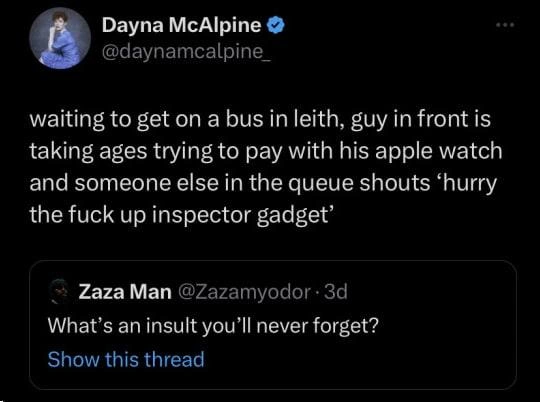
Imagine you’re waiting in line with a bunch of people to get on a bus, and the person at the front of the line is trying to pay using a special watch that can do payments. It’s a really cool, high-tech watch (kind of like a toy that can do magic tricks), and it’s supposed to let him pay just by holding his wrist up to the ticket machine. But for some reason, it’s taking a long time for the machine to accept the payment from his watch. He keeps trying, and it’s slow. Now everyone behind him in line is waiting…and waiting. You know how if someone in front of you is taking forever, you start to get impatient? That’s what’s happening – people are sighing and looking at each other like, “What’s the holdup?”
Finally, one person in the line gets so frustrated that they yell out to the guy, “Hurry up, Inspector Gadget!” It’s a rude but funny comment. Inspector Gadget is a cartoon character who has all sorts of gadgets and gizmos, kind of like a goofy robot detective. By calling the guy with the watch “Inspector Gadget,” the person is teasing him for relying on this fancy gadget when it’s not working right. It’s like saying, “Hey, gadget-man, your super watch isn’t so super right now – hurry up!” Everyone in line can relate to that annoyance, and using a silly cartoon reference makes it a bit humorous instead of just angry.
So, in simple terms: a man tried to use a fancy gadget (his Apple Watch) to do something quick, but it ended up being slow. The people waiting behind him got irritated, and one of them made a joke, comparing him to a clumsy cartoon gadget guy, to tell him to speed it up. It’s funny because it’s a real-world example of cool technology backfiring a little and how people react when they just want to get on with their day. Even if you don’t know the cartoon, you can understand someone saying “Hurry up with your gadgets!” The joke takes a frustrating moment and turns it into a shared laugh (well, for everyone except maybe the guy with the watch). It’s a way of venting impatience with a bit of humor — and that’s why this story makes people chuckle.
Level 2: Wearable Payment Woes
Let’s break down the situation in simpler terms. The story takes place at a bus stop where people are lined up (that line of people is a queue). The person at the front is trying to pay for the bus fare with an Apple Watch. Now, an Apple Watch isn’t just a regular watch – it’s a small smart device on your wrist made by Apple. It’s part of the Apple family of products (often called the Apple ecosystem because they all connect and work together). One cool thing an Apple Watch can do is Apple Pay, which means it can act like a wallet. With Apple Pay, you can store your credit or bus card on the watch and pay wirelessly. You’ve probably seen someone tap a credit card or phone to a reader to pay – that’s a contactless payment. This watch is doing the same thing, just on the person’s wrist.
Usually, using Apple Pay is really fast: you tap your watch, it buzzes or beeps, and boom, paid. But in this case it’s not working fast. Maybe the watch isn’t connecting to the bus’s reader right away, or the guy didn’t double-click the side button in time, or the watch asked for a passcode. Whatever it is, there’s a little holdup. In tech terms, we’d call that a bit of latency – a delay between the action (tapping the watch) and the result (the payment going through). It’s like when you click a link and it takes a few seconds longer than usual to load; that delay is latency. Here, each extra second the watch doesn’t beep is a second everyone in line has to wait.
Now, whenever there’s a delay like that, it causes UX friction. UX stands for User Experience, which is basically how easy and pleasant (or irritating) it is to use a product. Friction means something in the experience is rough or dragging. Imagine a slide that isn’t slippery – you’re supposed to zip right down, but instead you get stuck halfway. That’s friction. In this scenario, the payment process has friction because it’s not smooth and instant like people expect. So folks in the queue start feeling annoyed – this is queue frustration, the frustration of waiting when you shouldn’t have to.
Finally, someone in the line loses their patience. They shout, “hurry up, Inspector Gadget!” Now, this is both an insult and a joke. Inspector Gadget is a funny old cartoon character (from the 1980s, with movies and memes since then) who is a detective loaded with absurd gadgets. He’s got a gadget for everything in his coat: a hand that extends, a helicopter hat, you name it. But here’s the thing: despite all his high-tech tools, Inspector Gadget often bumbles around and things go wrong in a comical way. So, when the person in line calls our Apple Watch user “Inspector Gadget,” they’re poking fun at him for relying on a fancy gadget when it’s not even working right. In other words, “Hey gadget man, your high-tech toy is holding us up!” It’s a pretty creative diss for someone who’s frustrated – basically saying the tech is overkill or being used wrong, with a big side of sarcasm.
For someone newer to the tech world, there’s a lesson here about “production” vs. testing. You might have heard the phrase “works on my machine”. It’s what developers joke about when something they built works in their own environment but then breaks or slows down in the real world (which we call production). This bus scene is like a real-life “works on my machine” moment. The Apple Watch payment (fancy technology) is something that likely works fine most of the time (maybe when the person tried it at home or in a less hurried setting). But in the wild – out in a real, unpredictable environment – it’s choking at the worst time. And just like users on a live app, the people around aren’t going to be patient or understanding about it. They just want it to work, now.
In tech lingo, you might label what happened here as an apple_pay_delay causing a contactless_bottleneck. All that waiting built up queue_frustration, which finally erupted as an inspector_gadget_heckle — a fancy way of saying someone made a sharp joke at the gadget-user’s expense. In plain terms: a high-tech watch was supposed to make paying effortless, but it ended up creating a holdup, and an annoyed fellow traveler snapped with a clever insult.
So, this meme is funny to developers and tech-savvy folks because it shows how even cool technology can backfire in everyday life. It’s a reminder that technology is only as good as its real-world performance. If it slows you or others down, people are going to get upset (and maybe even mock it). The humor comes from the contrast: futuristic gadget vs. ordinary impatience, with a dash of nostalgia from the Inspector Gadget reference. It’s the kind of real-life comedy that makes tech people both laugh and wince, because we know that feeling: when your shiny new solution suddenly makes you look a bit silly in front of a crowd.
Level 3: Latency Gets Loud
For a seasoned developer or ops engineer, this scene is immediately recognizable as a production performance issue happening in real life. The Apple Watch payment flow that worked so slickly in the lab (or during demos) has hit unexpected latency under real-world conditions. And the end-user feedback isn’t coming through a bug report or an APM dashboard — it’s coming from a person in line, yelling in frustration. It’s prod latency, IRL in the most literal sense.
Think of the guy with the Apple Watch as a new app feature that just got deployed. Everything seemed fine in QA, but now it’s taking too long at the exact moment it needs to be fast. In software, if your service starts lagging, users might start hammering refresh or venting on Twitter. Here, the people behind him in the queue are effectively load testing his payment method — and he’s failing the throughput test. One slow transaction created a contactless bottleneck, and the “users” (the fellow passengers) immediately registered their dissatisfaction in a very human way.
The twist is the brutally direct feedback mechanism. In tech, we strive for good UX (User Experience); we add loading spinners, we optimize database queries, we do caching — all to hide latency and keep things smooth. But when your UX has friction — like a clunky wearable payment taking too long — users won’t politely file a Jira ticket. They’ll call you out on the spot. In this case, a bystander in the queue dropped a legendary one-liner:
"hurry the fuck up inspector gadget"
That’s production monitoring by way of public humiliation. The reference to Inspector Gadget is the perfect pop-culture burn. Inspector Gadget, for anyone who hasn’t heard of him, is a retro cartoon detective loaded with goofy gizmos that often misfire. Calling someone “Inspector Gadget” in this context means “you and your fancy gadget are over-complicating things and slowing everyone down.” It’s the tech equivalent of saying “forget the gizmos, just get it done!” The frustrated passenger basically wrote a scathing usability bug report in one sarcastic sentence.
Folks in the Apple and FinTech industry will smirk at this because it underscores a core issue: no matter how slick the technology, the real test is human patience. Apple’s whole ecosystem is about convenience and speed — tapping your watch to pay is supposed to be faster than digging for coins. When that promise breaks, it feels like over-engineering in the worst way. Maybe the watch needed the iPhone nearby, or the card wasn’t set to the quick-pay mode, or maybe the system was momentarily offline. Regardless, a seamless wearable technology experience turned into a public stall. It’s a classic case of tech optimism meeting the reality of Murphy’s Law: if something can go wrong (at the worst time), it will.
For veteran engineers, there’s also a sense of “there but for the grace of God go I.” We’ve all seen our projects behave perfectly in testing and then choke in production with real users. It’s both terrifying and comic to see that dynamic play out with a person at a bus stop. The humor works because it’s relatable on multiple levels: technologically (we know even simple tasks have complex backends that can fail), and socially (we’ve all been stuck behind the slow person, or been the slow person). And let’s be honest, we’ve all secretly wanted to yell something in moments like this. The difference here is someone actually did, and they chose a punchy, nerdy insult that made everyone who read the tweet laugh out loud.
In essence, this meme captures a perfect little drama of modern life: high-tech convenience meets everyday impatience. The wearable payment was supposed to be futuristic and cool, but when it faltered, all the high-tech gloss fell away to a very old-school human experience — people in a hurry, and one of them heckling the other to hurry up. For engineers, it’s a cheeky reminder that even when we push code (or gadgets) that we think are ready for prime time, the real world can find their breaking points instantly. And when it does, users might not give polite feedback; sometimes they give you a one-star review in the form of a loud public one-liner. Ouch, but also… pretty hilarious.
Level 4: NFC Handshake Hiccups
In the depths of an Apple Pay transaction on an Apple Watch, an invisible ballet of cryptography and wireless protocols is unfolding. This isn't just a watch beaming magic to a turnstile — it’s a mini computer engaging in a secure NFC handshake with the bus’s payment reader. The watch’s secure chip (a Secure Element) holds a token representing your credit card. When you tap, it generates a one-time cryptographic code (a dynamic verification value). The reader and watch perform an elaborate dance akin to a challenge-response protocol: “Are you legit?” → “Yes, here’s a unique proof.” All this is designed to happen in a split second, but if any step goes even slightly off-script, you get a noticeable delay.
There are a few reasons this high-tech tap might experience a hiccup:
- Authentication delays: If the watch wasn’t in Express Transit mode (a special setting for Apple Pay that skips extra ID checks for transit), the user might have to double-click a button or enter a passcode to authorize the payment. Each extra second fumbling with the watch’s UI is like an eternity in real-time computing terms.
- NFC alignment issues: The watch’s NFC antenna is tiny. If it’s not aligned perfectly or held at the sweet spot on the card reader, the devices might have to retry the handshake. It’s like two radios saying, “Can you hear me now?” multiple times before succeeding.
- Network round-trip: Some contactless transactions need to phone home to the bank for approval. If the bus’s card reader attempts an online authorization, that’s a round-trip across the network (cellular or Wi-Fi) to a payment server. A few hundred extra milliseconds of network latency can stall the whole flow.
- Hardware/software lag: Occasionally, the watch’s operating system or the payment terminal might just be having a slow moment. Think of it like a server pause or a garbage collection hiccup at the worst possible time — the device hesitates, and those milliseconds stack up.
(A quick side note: modern transit systems try to avoid these delays — often they allow offline verification or use a pre-auth for speed. Apple even introduced that Express Mode to make sure buses and trains aren’t held up by payment checks. But in this case, it seems our gadget guy wasn’t so lucky.)
Each of these factors can turn a quick “Go!” into a prolonged “Wait...”. In systems design, we know that a single slow microservice can become a bottleneck for the entire pipeline. Here, the wearable payment pipeline (pun intended) is the culprit. The effect is comparable to a distributed transaction where one sluggish node drags everything down: the overall throughput of boarding the bus decreases. If a bus can normally board, say, 20 people per minute, and Gadget Guy’s transaction takes 15 seconds instead of 2, you’ve effectively rate-limited the whole system. Queueing theory kicks in: when service time (W) increases but arrival rate (λ) stays constant, the queue length (L) balloons (Little’s Law: L = λ·W). In plain terms, frustration ≈ latency * people_waiting. A few seconds of tech trouble, multiplied by a dozen people in line, yields a big spike in collective annoyance.
From a security and FinTech perspective, we appreciate that all this complexity (tokenization, encryption, the NFC handshakes) is what keeps our money safe during a contactless payment. It’s actually amazing that a watch can securely perform an EMV payment transaction in a blink. But this meme highlights the flip side: put that marvel in a high-pressure, real-world context (a crowded bus queue in Leith), and those normally trivial 500ms delays become painfully obvious. The end-user — or in this case, the bystander behind you — ends up being the most unfiltered monitoring system imaginable. If your latency is too high, you won’t just see it on a performance dashboard – you’ll hear about it in unvarnished terms. Here that feedback loop manifested as a perfectly aimed pop-culture jab, dubbing the slow-paying tech user “Inspector Gadget.” It’s a reminder that even the coolest, most advanced wearable tech can run headlong into the unforgiving constraints of the real world, where a few extra seconds can turn a slick feature into a public punchline.
Description
This image is a screenshot of a tweet from user Dayna McAlpine (@daynamcalpine_), presented in a dark mode interface. The tweet is a reply to another user, Zaza Man, who asked, 'What's an insult you'll never forget?'. Dayna's tweet tells a short, humorous story: 'waiting to get on a bus in leith, guy in front is taking ages trying to pay with his apple watch and someone else in the queue shouts ‘hurry the fuck up inspector gadget’'. The humor is rooted in the contrast between the promise of high-tech convenience (paying with an Apple Watch) and the clumsy reality of its failure in a public setting. The insult 'Inspector Gadget' is particularly clever, referencing the famous cartoon character known for his array of often malfunctioning gadgets. For a technical audience, this is a highly relatable scenario that touches upon user experience (UX) failures, the awkwardness of early adoption, and the public's low tolerance for technology that doesn't work seamlessly
Comments
26Comment deleted
The difference between a product demo and reality is the error handling. In the demo, it's a seamless NFC transaction; in reality, it's a synchronous call to a public shaming API with a boomer as the load balancer
Proof that in the real world your critical path latency isn’t measured by p99 - it's measured by how fast a stranger can shout a cartoon reference
The real bug here isn't in the Apple Watch NFC stack - it's the race condition between early adopter enthusiasm and the timeout on British politeness. Should've implemented exponential backoff on the queue's patience buffer
The real technical debt here is the 3-5 second NFC handshake timeout combined with the user's inability to find the correct wrist angle for optimal antenna coupling - a perfect storm of UX friction that turns contactless payment into a blocking I/O operation for everyone in the queue. At least with a card you can blame the chip reader; with a smartwatch, you're just the person who chose the wrong API for public transit
Go-Go-Gadget retry: EMV tokenization, watch unlock, card selection, and NFC alignment - four network hops to buy a $2 fare while the queue's SLO is passengers per second
Apple Pay stalling at the turnstile is a postmortem waiting to happen: NFC handshake times out, issuer auth retries exceed dwell time, and the queue installs observability on the spot - ‘hurry up, Inspector Gadget’ is the alert
Apple Watch payments: slower than Xcode indexing a monorepo, but with worse haptic feedback on failure
Inspector gadget 🤣🤣 Comment deleted
Blue text version 2 Comment deleted
Inspector gadget 🤣🤣 Comment deleted
There's some reddit in this Telegram Comment deleted
Inspector gadget 🤣🤣 Comment deleted