Skip to content
DevMeme
6316 of 7435
The Dungeons & Dragons Alignment Chart for DC Power Connectors
Hardware Post #6926, on Jun 27, 2025 in TG

The Dungeons & Dragons Alignment Chart for DC Power Connectors

Why is this Hardware meme funny?

Level 1: Plugging In – Safe vs. Silly

Imagine you have a bunch of toys that each need a battery or a charger. Now, some people are very careful – they use the right battery, in the right direction, exactly as the picture shows (that’s our super orderly lawful good person). The toy works perfectly and everyone is happy. Others are a bit more creative – like if a toy’s battery slot doesn’t fit, they might tape a different battery with wires to make it work. It’s not the usual way, but hey, the toy car is running and they meant well (that’s the chaotic good tinkerer). Then there are the troublemakers – like someone who puts the batteries in backwards on purpose or uses the wrong charger just to see what happens. That usually makes the toy smoke or break (definitely the evil approach!). This meme shows a funny chart of nine such people plugging in devices: from the perfectly correct method to the totally crazy ones that might set something on fire. It’s poking fun at how even a simple thing like giving power to your gadget can be done in really different ways – careful or careless, right or wrong – and how engineers have seen it all. The joke is basically: “there’s a right way to power stuff, a wrong but inventive way, and a really wrong way… and we’ve encountered each one!” It’s funny and a bit like a cautionary tale, reminding us that how you plug things in really matters if you don’t want to break them.

Level 2: Polarity and Power for Newcomers

Let’s break down the technical jargon and scenarios in simpler terms. This meme is all about DC barrel connectors – those round power plugs you see on many devices (like the plug that powers your router or Arduino). They typically have a metal outer barrel and a metal inner pin. Polarity describes which part of that connector is positive (+) and which is negative (−, usually ground). Most modern electronics use center-positive polarity, meaning the inner pin of the connector should get the positive voltage and the outer barrel connects to the negative side (ground). Some older or special devices use center-negative, which flips that (inner pin is negative, outer barrel is positive). Plugging the wrong polarity into a device is a big misconfiguration error – it’s like putting batteries in backwards – it can prevent the device from working or even fry the electronics if there’s no protection. That’s why you often see a little symbol near the power jack or on the power adapter: a diagram with + and − signs pointing to the center and outer parts of a circle. That symbol is basically a tiny map telling you how the adapter is wired, so you match the right kind.

Now, the meme uses a D&D alignment chart format (from the game Dungeons & Dragons) just for fun – it places nine examples of using these connectors on a grid from “lawful good” (very proper and good) to “chaotic evil” (totally reckless and harmful). This is a popular internet meme style to categorize anything into a 3x3 grid of seriousness vs. craziness. Here it’s applied to the seemingly simple act of powering devices, showing there’s a surprising spectrum of how that can go.

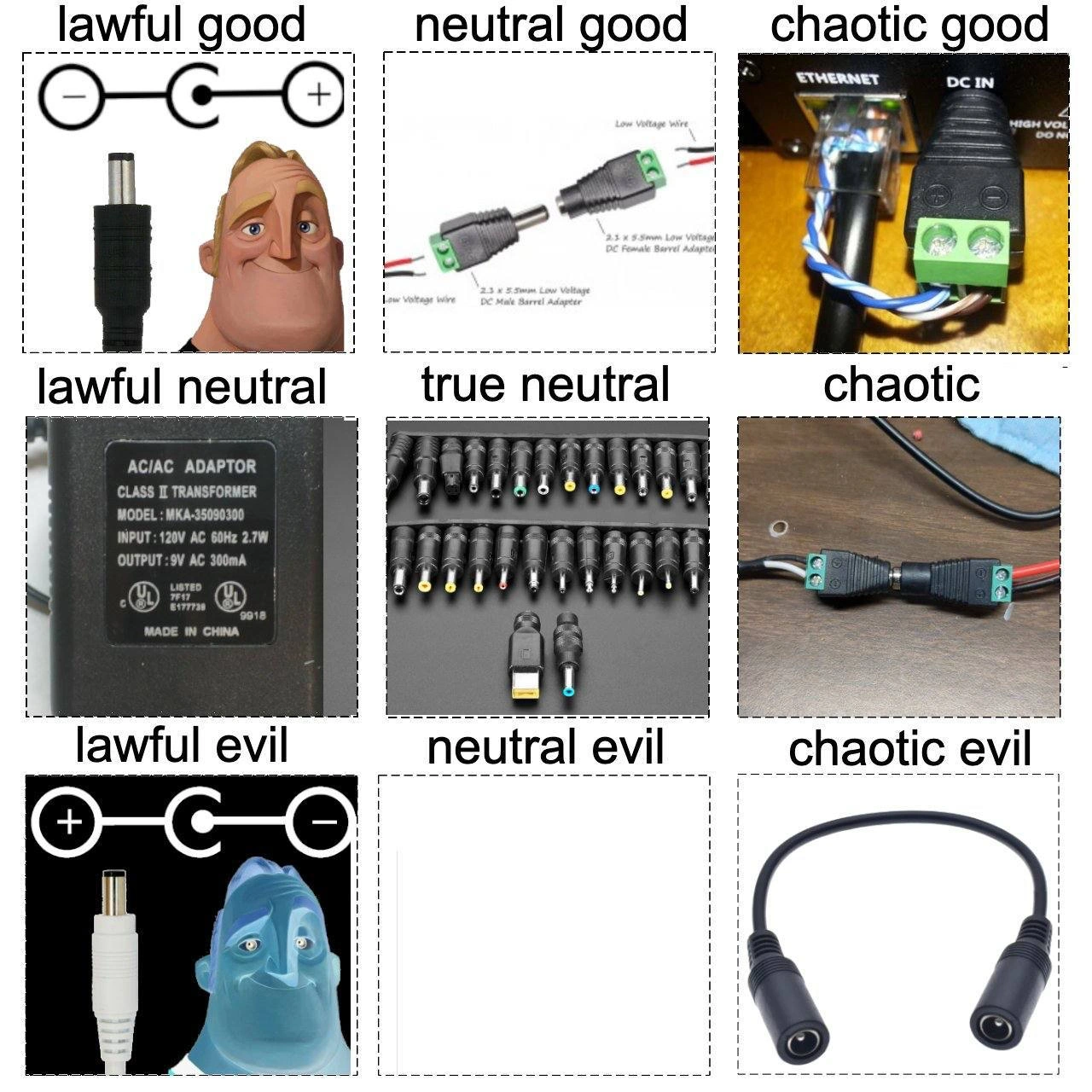
  • Lawful Good: This is the ideal scenario. The picture shows a clear center-positive diagram and a neatly attached proper plug. In practice, this means someone used the correct adapter, with the correct polarity, and probably made a nice solid connection (like soldering or using a proper jack). It’s like following the manual exactly – result: device powers on happily, no drama. Imagine plugging your phone’s charger into your phone – it’s correct and safe, that’s lawful good in a nutshell (except phones use USB now, but same idea of correct polarity and connector).

  • Neutral Good: Here we see screw-terminal pigtails used correctly. A screw-terminal pigtail is a small adapter gadget: on one side it has a DC barrel plug (male or female), and on the other side it has two little screw clamps where you can insert bare wires. These are super useful for prototyping – say you have a raw power supply with just wires coming out, and you want to connect it to a device’s barrel jack; you can attach the wires to this adapter instead of cutting any cables. In the meme, neutral good shows two of these (one female, one male) correctly wired together, red wire to red wire (+ to +) and black to black (− to −). It’s “good” because the wiring is correct and everything is working; it’s “neutral” because it’s not the official cable that came in the box, but it’s not breaking any rules either. It’s a handy and correct solution. Think of it like using a generic replacement charger that you’ve set to the right voltage and polarity – not the original, but it does the job safely.

  • Chaotic Good: This one is a bit wild. The image shows a screw-terminal adapter actually plugged into an Ethernet port labeled “ETHERNET” next to “DC IN”. It appears someone didn’t have the right power jack or maybe the device was meant to get power through the Ethernet (like via PoE – Power over Ethernet, which normally requires proper adapters). Instead, they MacGyvered it by physically sticking the power wires into the Ethernet jack! In real life, this is definitely not a standard method – Ethernet ports carry network data and, only in special setups, power (and even then, it’s done with specific circuits, not by wedging a DC plug in). Here, though, they decided to deliver power through the Ethernet connection manually. It’s “chaotic” because it’s an unconventional, kinda messy hack – imagine sticking wires where they don’t normally go. But it’s “good” in the sense that the person’s goal is to power the device and presumably it worked without breaking stuff. It’s like using a paperclip to connect a battery to a toy when you lost the battery holder – unorthodox, maybe a bit risky, but done with good intentions to get things working.

  • Lawful Neutral: This quadrant shows an actual wall wart (the nickname for those brick-like power adapters that plug into the wall) with its label. The label in the image says it’s an AC/AC adapter: that means it takes AC from the wall and outputs AC (which is less common; usually they output DC). If something outputs 9V AC, it means the device you plug it into expects AC and likely has its own rectifier inside to make DC. Lawful neutral in the meme means this is a very by-the-book approach: use a power adapter that exactly matches what the device expects, per the official specs. It’s “lawful” because it’s exactly what the manufacturer prescribes (voltage, current, type all correct). It’s “neutral” because it’s not especially “good” or “evil” – it’s just correct and standard. There’s no creativity here, just matching numbers and polarity symbols. This is essentially plugging the right charger into the right gadget – no less, no more. It’s the baseline of proper behavior in powering electronics.

  • True Neutral: The center of the chart has a whole kit of DC barrel connectors of various sizes. This represents the person who isn’t taking any single approach – they’re ready for anything. There are many sizes of these barrel plugs (common ones: 5.5 x 2.1 mm, 5.5 x 2.5 mm, 3.5 x 1.3 mm, etc.), and if you work with hardware long enough, you accumulate or buy a kit with all types because different devices use different sizes. The photo shows maybe dozens of adapter tips, possibly from a universal adapter kit or just a collection. True neutral is the even-handed approach: neither enforcing a strict standard (lawful) nor engaging in wacky methods (chaotic), but being adaptable to whatever standard is needed. In a way, it’s not committing to either side – just have every possible connector and you’ll always be neutral and fine. If you’re new to hardware, picture this: you have a big box with every kind of phone charger and laptop charger tip, so no matter what device someone brings, you have something that fits. That’s the vibe here – very practical, very neutral.

  • Chaotic (Neutral): The meme calls it just “chaotic” (implying chaotic neutral), and it shows something really messy: two female DC barrel jack adapters connected to each other by twisted wires. So imagine you have two pieces, each of which normally would let you attach wires to a male plug or a female jack. Instead of using them in the usual way, someone took two of these and joined them together: the exposed wires from each are literally twisted around each other or maybe poorly soldered. This creates effectively a female-to-female connector assembly. Normally, you’d buy a proper female-to-female coupler if you needed one, but here someone apparently made one out of two other adapters. It’s pretty chaotic because the wires are just hanging and twisted—very unstable, could easily come loose or short out if the twist is not insulated. It’s neutral in morality because it’s not like they’re trying to break anything; they just needed a solution and went for a quick-and-dirty approach. This is the kind of thing a beginner might do not realizing the dangers, or an expert might do in desperation during a test (“I know this is bad, but I just need it to work for 5 minutes…”). It highlights how not following best practices (like secure connections, proper adapters) can lead to precarious setups. If you saw this in real life, you’d probably go, “Whoa, is this safe?” It might work temporarily, but it’s one tug away from sparking or disconnecting.

  • Lawful Evil: Here we see the symbol for center-negative polarity along with a villainous-looking cartoon character. Center-negative, as mentioned, is when the inner pin is negative and the outer barrel is positive – the opposite of the common convention. Lawful evil in this meme means a deliberately standard-compliant but harmful setup. Center-negative is an official way to do things (some standards exist, especially older ones), so it’s “lawful” in that sense, but it’s “evil” because it causes a lot of trouble. If you accidentally use a normal (center-positive) adapter on a center-negative device, you’re essentially reversing the polarity to that device – often a recipe for letting the magic smoke escape (i.e., burning out components). The cartoon villain face is basically how you feel about whoever decided to use center-negative: why would you do that?! But they did, and it’s documented, so it’s official (hence lawful) – and yet many a gadget has died because someone didn’t catch that tiny “±” diagram showing the uncommon polarity. For newcomers, the takeaway is always double-check the polarity symbol on both the device and the power supply. Those little + and − with the circle diagram are crucial. Lawful evil is basically a trap that follows all the formal rules but is just waiting for a victim.

  • Neutral Evil: The panel is blank – no image at all. This one is a bit meta and humorous: it implies that the most evil thing in the power connector realm might be something you aren’t even aware of. Maybe it’s a trick like a cable that looks correct but isn’t, or a subtle wiring error that doesn’t show symptoms until it’s too late. “Neutral evil” here suggests a scenario that isn’t obviously chaotic or breaking rules (neutral regarding methods) but is definitely malicious in outcome (evil). For example, a neutral evil could be a counterfeit power adapter that lies about its specs: it says it’s 5V center-positive, but it delivers 7V or has the polarity swapped internally. It doesn’t violate any physical expectations (it uses a standard connector, etc.), so it feels “neutral,” but it’s internally dangerous. The meme leaving it blank is also a comedic way to say “insert your personal horror story here.” Perhaps every engineer has that one nightmare tale – the unlabeled supply, the mysterious short that took days to find – which was neutral evil in nature. For someone new, just note that not all dangers come with big warning signs; sometimes a very “ordinary” looking situation can be electrically deadly because of hidden details.

  • Chaotic Evil: This shows a female-to-female barrel coupler cable, basically a short cable with a female jack on both ends. This is super unusual in legitimate use because normally you go from a female jack on a device to a male plug from a power source. Why would you need two females? The only use is if you had two male-ended cables that you wanted to join – which typically you shouldn’t, because as mentioned, male ends are usually coming from live power sources. This adapter is “chaotic evil” because it almost invites mistakes that cause shorts or other electrical disasters. For instance, say you have two different power supplies with male ends and you (for whatever reason) plug each end into this coupler: you are now directly connecting two power sources. If they are different voltages, or even if they’re the same, they will conflict – best case, one just dominates and the other does nothing; worst case, they damage each other or the device connected. Or another scenario: you plug a live power supply into one end of this female-to-female cable, and absentmindedly leave the other identical end free – the inner pin of that free end is now a live exposed positive terminal that can easily touch some metal on your desk and short out. It’s just a very risky thing to have in a messy workshop. Seasoned engineers usually cringe at connectors that aren’t keyed or protected against misuse; this coupler is basically “unguarded power.” For a newcomer, imagine an extension cord where both ends are sockets (holes) – you plug one end into the wall, and now the other end’s prongs are live and sticking out, waiting to zap you. A female-to-female barrel is a bit like that concept. It’s chaotic because it’s not a standard use-case cable, and evil because the potential for bad outcomes is high.

All these examples might sound a bit scary, but they’re also common lessons learned in electronics. Hardware humor often exaggerates to make a point: here the exaggeration is showing all the “good” vs “bad” ways to handle power connectors. But behind each panel is a real point:

  • Always check polarity (don’t assume every plug is center-positive).
  • Use proper connectors and adapters when possible (twisting random wires is asking for trouble).
  • If you do hack a solution, double-check it and be aware it’s temporary.
  • Keep an eye out for hidden traps like unlabeled or weird adapters (misconfiguration edge cases).

The meme is relatable because even though it uses an extreme D&D-style alignment joke, every hardware developer has experienced the joy of a well-powered project (lawful good) and the agony of a magic-smoke incident or confusing power issue (the evil alignments). It basically sums up: “With great power (supplies) comes great responsibility – or great chaos, if you’re not careful.”

Level 3: The Alignment of Power

At a more pragmatic level, this meme is instantly relatable to any hardware or IoT engineer who has wrestled with power plugs. It uses the classic Dungeons & Dragons alignment chart format to poke fun at the many ways a DC barrel connector can be used (or misused), casting each approach as everything from virtuous to villainous. The humor comes from recognizing each scenario as a trope in electronics prototyping – we’ve either done it ourselves or had to fix the carnage afterward. Let’s walk through these nine alignments of the power connector multiverse and why they hit home:

  • Lawful Good (Center-Positive Done Right): This is the upstanding citizen of the power world. The image shows a clear diagram indicating a center-positive polarity and a neatly crimped DC plug properly inserted into a device. Lawful good here means following electrical conventions to the letter. The center-positive standard is by far the most common in modern devices (the outer barrel is ground, inner pin is hot positive). An engineer following this path double-checks the polarity markings, uses the correct plug size, and likely even made a solid crimp or solder joint for the connection. It’s the picture of proper engineering discipline – no surprises, no smoke, everything labeled and by the book. This evokes the feel-good moment when you power on a custom gadget and it just works because you used the right wall wart and wiring. It’s “lawful” because it respects standards and “good” because it keeps devices safe and happy.

  • Neutral Good (Adapter Pigtails, Done Properly): Neutral good is still doing the right thing, but in a more flexible, improvisational way. The meme shows those handy screw-terminal pigtail adapters attached to male/female DC plugs. These adapters are prototyping lifesavers: one end is a standard barrel connector (male or female), and the other end is a small two-screw terminal block where you can clamp down raw wires. Here, neutral good implies someone needed to jury-rig a power hookup, but they did it correctly and safely. The red and black wires are in the right terminals, matching + to + and − to − between a supply and a device. It’s “neutral” in the sense of not strictly using a pre-made cable, but still “good” because polarity is correct and connections are solid. Many of us have a bunch of these pigtail adapters in our toolkit – they let you go from a bench power supply or custom wiring harness to a standard DC barrel jack without cutting cables. This panel says: even if you’re MacGyver-ing the power, you can do it responsibly.

  • Chaotic Good (When Desperation Meets Creativity): This one gets a laugh because it’s so absurd yet oddly familiar: a screw-terminal pigtail jammed into an Ethernet (RJ45) port on a device to deliver power where it doesn’t belong. The caption likely shows “ETHERNET” and “DC IN” labels uncomfortably close, with wires from the pigtail wedged into the RJ45 socket. Why on earth would anyone do this? Perhaps they had a device that takes power via some unused pins on an RJ45 (some custom PoE hack?), or they simply lacked the correct barrel plug and noticed the RJ45 jack was connected to the power circuitry. This is chaotic good because it flagrantly breaks the rules (the RJ45 is NOT a power connector in any official sense for that device) but does so to serve a good end – powering the device in a pinch. It’s like using a paperclip to complete a circuit: definitely not per the manual, but it works and saves the day. Every hardware hacker has a story of a creative power solution that made colleagues either applaud or facepalm. This panel embodies that triumphant but slightly unhinged moment in embedded systems tinkering: the device is running, LEDs are on, but you’d be hard-pressed to explain (or repeat) how exactly the power is delivered without blushing.

  • Lawful Neutral (Official Wall Wart): Here we have the trusty off-the-shelf AC adapter, often called a wall wart, with its detailed spec label (input 120 V AC 60 Hz, output 9 V AC 300 mA in the image). This is the lawful neutral quadrant: it’s entirely by the book ("lawful") but not really tilted towards heroic “good” or destructive “evil.” It’s just a power supply doing its prescribed job. The humor is subtler: the wall wart is a symbol of compliance and stability. It’s presumably matched correctly to the device (using the right voltage and current, and presumably correct polarity if DC). But interestingly, the label here reads AC/AC transformer, meaning the output is actually AC, not DC. That’s a legit scenario (some devices expect an AC input and rectify it internally), but it’s a potential gotcha for the uninitiated. If you blindly assume every wall wart outputs DC, plugging a 9 VAC adapter into a circuit expecting 9 V DC could be…bad. Lawful Neutral in this context is a bit of a joke on “following the spec to the letter” – the adapter provides exactly what its label says. It’s neutral because it has no feelings about what you do with it; if you obey the label, all is well, but if you misinterpret it, the adapter won’t stop you. In short, the lawful neutral panel reminds us of the times we’ve rummaged through a box of random adapters hoping to find the “correct” one – you rely on the fine print and standard plug size, and if those align, it’s smooth sailing. There’s no improvisation (lawful), but also no particular glory – it’s just standard engineering work, boring and reliable.

  • True Neutral (All the Adapters in Existence): The center of the alignment chart is true neutral, and the meme fills it with a photograph of an exhaustive kit containing every barrel connector size and type known to humankind. This represents the ultimate neutrality: not choosing any one approach, but being ready for anything. True neutral is the friend who doesn’t take sides; in hardware terms, it’s the person who has that big tackle box of power connectors and adapters in their lab. They aren’t committed to one standard or hack – they’ll just calmly pull out the exact weird coaxial plug needed to mate that oddball device you brought in. The image likely shows a lineup of different plug sizes (from the tiny 3.5 mm micro barrel to the common 5.5 × 2.1 mm and 5.5 × 2.5 mm, and maybe even obscure ones). For an engineer, this kit is both hilarious and aspirational: who among us hasn’t, at some point, desperately dug through drawers for an adapter that fits a device from 1998? The true neutral response to connector chaos is complete preparedness – neither imposing order (like standardizing everything to one plug) nor sowing chaos (like jamming wires arbitrarily), but adapting fluidly to whatever standard is thrown at you. It’s neutrality in the sense of not fighting the ecosystem; just stock every possible connector and you’ll never be caught off guard. The humor is that this level of uber-preparedness is a bit over-the-top, yet many of us slowly accumulate exactly such a collection over years of projects.

  • Chaotic Neutral (Improvisation Overload): In the chaotic neutral panel (labeled simply “chaotic”, implying chaotic neutral), we see a truly janky contraption: two screw-terminal pigtails mated back-to-back, wires twisted randomly together. This is the embodiment of why we have engineering rules – and what happens when you ignore them not out of malice, but out of haste or lack of better parts. Here, someone apparently had two female barrel jack pigtails and no proper male-to-male cable or coupler, so what did they do? They likely stripped and twisted the wires together to connect the two female jacks. This leads to a female-to-female connection via a Frankenstein’s twist of wires – essentially creating a gender-changing adapter in the most roundabout (and electrically noisy) way. It’s chaotic because it’s mechanically unstable (twisted wires can slip or short if not taped), and the polarity could even get mixed up if you’re not careful to match colors. But it’s neutral in that the intention isn’t to destroy anything – it’s just a whatever works solution. Any engineer who has been deep in a project at 2 AM can relate: you ran out of the right connectors, so you string together whatever is on hand to power your circuit, promising yourself you’ll “make a proper cable tomorrow.” Sometimes these ad-hoc setups become semi-permanent, to the horror of anyone with a sense of cable management. The comedic sting here is strong – we’ve all walked into a lab or hackerspace and seen something like this: random adapters chained together, maybe a wire jammed in to bypass a missing plug, electrical tape abound. It’s the hallmark of a chaotic neutral approach: functionality first, aesthetics and long-term reliability second (or tenth).

  • Lawful Evil (Center-Negative Trickery): Now we descend into the dark side. Lawful evil in an alignment chart is an entity that follows rules or an established system, but for nefarious ends. In the context of DC power connectors, the center-negative polarity standard is exactly that kind of villain. The meme shows the center-negative polarity diagram (⊕ on the outside, ⊖ on the inside) alongside what looks like a smug cartoon villain (perhaps a reference to an infamous character) holding a matching plug. This calls out those “gotcha” devices where the polarity is deliberately the opposite of the norm, yet everything else looks standard. It’s lawful because it’s not an accident: the manufacturer explicitly designed the device to use center-negative (and likely documented it somewhere in fine print or with that diagram on the case). It might even be a legacy standard or done for a reason (some early electronics chose center-negative possibly to avoid shorting if the tip accidentally contacted a chassis connected to ground… or just to mess with us). It’s evil because it’s a booby trap for the unwary. Plug a regular center-positive adapter into a center-negative device, and you effectively reverse the polarity — a classic misconfiguration error that can release the aforementioned magic smoke. Many an engineer has fried audio equipment or IoT gadgets this way, because 5.5 mm plugs from different devices all fit universally, even if the polarity is opposite. The smug villain face in the meme mirrors our feeling toward whoever thought that was a good idea: “Ha! Gotcha!” Some notorious examples: older guitar effect pedals are often center-negative (to allow daisy chaining from one supply, they made all pedals share ground on the tip), or certain vintage game consoles. Lawful evil also captures the sentiment of companies that stick to weird standards arguably to lock you into buying their branded adapters. It follows a rule/set system (not random at all), but it sure doesn’t feel consumer-friendly. Engineers see this and shudder, recalling that one time they forgot to check the symbol and paid the price.

  • Neutral Evil (The Ominous Blank): Here the meme creators did something clever – the neutral evil panel is intentionally left blank. That in itself is a bit of dark humor: neutral evil in D&D is the purest form of evil without regard for law or chaos – it’s just evil for evil’s sake, often stealthy or pragmatic evil. Depicting nothing implies that the worst evil in electronics is the one you don’t even see coming. Perhaps it’s a silent killer like a polarity reversal inside a cable that’s mis-marked, or a cheap adapter that claims to be center-positive 12V DC but actually outputs 19V or AC. Neutral evil might be the seemingly innocuous situation where everything appears fine – correct plug, correct polarity marking – but hidden inside is a flaw (wires swapped on a cable, a cold solder joint that flips polarity under load, etc.). In essence, it’s a placeholder for “the worst power fiasco you haven’t discovered yet.” Every engineer has a horror story that fits this bill: like that time a lab supply’s cable was wired in reverse due to a factory error, turning a routine test into a chip-frying event. Or the barrel jack that wasn’t labeled at all – you make an assumption, something smells funny… and then you learn it was reverse. Neutral evil could also be the scenario of floating ground reference problems: e.g., you power two parts of a system separately and later discover connecting their grounds caused a loop or short because one of the “grounds” was actually +V relative to the other – an insidious, not immediately obvious evil. By leaving it blank, the meme invites us to fill in our own worst experience. It’s a cheeky way of saying “there’s an evil out there so neutral and sneaky, you won’t know until it strikes.” The blank panel has a psychological effect: you laugh, but also nervously recall if you’ve checked everything in your current project’s power setup…

  • Chaotic Evil (Female-to-Female Coupler of Doom): Finally, the bottom-right corner shows the ultimate chaotic evil – a short cable with a female-to-female barrel coupler, a seemingly minor adapter that has big destructive potential. This device is the agent of chaos in power connections. Why does a female-to-female even exist? Possibly to extend two male-terminated cables, but it’s inherently dangerous because, as mentioned, it can connect power sources together in uncontrolled ways. Using it requires forethought: you’d typically only use one if one side is a power source and the other side is feeding a device via another male plug cable. But not everyone realizes that. Imagine someone with two wall warts (each has a male output plug) mistakenly thinking they can combine them for more power or something, and using this coupler – they’ve essentially shorted two supplies together. Best case, one supply just shuts down. Worst case, you get fireworks or a fried circuit. Even aside from that, a female-to-female means if you plug a source into one end, the other end’s inner pin is hot and exposed at the end of a barrel socket – extremely easy to short out by contact with metal. It’s like handing a live hand grenade to a toddler. Chaotic evil in the meme context means this adapter doesn’t follow any safe practice (chaotic) and its effect is purely destructive (evil). It’s probably included as a joke common in electronics prototyping gotchas: that one weird adapter or cable that, if left lying around or used improperly, has a high probability of causing a mishap. You can almost hear an engineer friend shouting, “No, don’t connect those two supplies with that cable!” just as someone innocently tries it – followed by a loud pop and the smell of burnt electronics. Chaotic evil indeed.

Across all these panels, the meme humorously captures the emotional rollercoaster of working with hardware power connectors. Embedded systems and IoT projects often start simple – just plug in power – but as soon as you deal with different devices, adapters, or custom setups, you enter a world of potential mistakes. The D&D alignment framing is perfect because engineers do tend to personify setups as good or evil depending on whether they save the day or cause a disaster. We’ve got the by-the-book heroes (standard polarity, correct connectors), the well-meaning improvisers (weird hacks that actually work), the neutral parties (just give me a label and the right plug, I’ll do it), and the villains (designs or mistakes that actively wreak havoc). It’s an engineering morality tale in nine panels – something you’d maybe print and post in a lab for a laugh, but also as a subtle warning. The reason this resonates is because it satirizes real-life power supply misadventures. Everyone in hardware has accidentally grabbed the wrong adapter or tried a power * kludge* that they later felt lucky didn’t end in flames. This meme throws all those scenarios onto one canvas and labels them like characters in an epic saga. It’s both funny and educational: even without realizing it, a junior engineer looking at this meme is learning "always check polarity, always think about what you’re plugging into what." And a senior engineer is nodding sagely (or facepalming) because they recall doing at least a few of these in their career. In short, the meme is relatable humor built on shared electrical mistakes, and each alignment title adds an extra wink – framing technical choices as moral alignments makes the absurdity even clearer. Who knew a barrel jack could have a personality?

Level 4: Reverse Polarity Runes

At the deepest technical level, this meme highlights the arcane lore of DC power polarity and connector design. The humble 5.5 mm DC barrel jack may seem mundane, but it carries an electrical alignment that can make or break hardware. In electronics, DC polarity is crucial: connecting positive (+) to the intended positive input and negative (−) to ground ensures current flows correctly through circuits. The little diagram with a ⊕ and ⊖ (often stamped near power jacks or on adapters) is like a set of runes indicating the center-positive vs. center-negative configuration. These symbols must be deciphered correctly – misinterpreting them is equivalent to casting a spell wrong in D&D, often with catastrophic results.

Center-positive means the inner pin of the barrel carries +V (voltage), and the outer sleeve is ground (0V). Center-negative, the lawful evil of standards, inverts this: the outer shell is +V and the inner pin is ground. From a design perspective, center-positive became the de facto “good” standard because it’s safer: the exposed outer metal being ground can brush against conductive surfaces without immediate short circuits. Center-negative (our villainous alignment) puts +V on the exposed barrel – a design decision that can cause instant short circuits if that outer metal touches any grounded part of a circuit or chassis. Historically, a few device manufacturers (especially in guitar pedals and older electronics) adopted center-negative polarity, spawning endless confusion when power supplies from different alignments are mixed.

Under the hood, engineers have developed protection rituals to guard against polarity mix-ups. A simple diode in series with the input acts as a gatekeeper, allowing current flow only in the correct direction – a low-tech but reliable ward against reversed cables (at the cost of a small voltage drop and wasted energy as heat). More advanced designs might use a MOSFET-based ideal diode or a full bridge rectifier at the input so that even if the adapter is plugged in backwards, the circuit automagically corrects the polarity. These protective circuits ensure no current flows if the polarity is wrong, preventing components from going up in smoke. However, in many embedded systems prototypes and DIY projects, such safeguards are omitted to keep things simple or efficient, leaving devices defenseless against a miswired supply. When an unprotected board gets a reversed feed, internal capacitors can vent, regulators overheat, and chips succumb to magic smoke release – the electronics equivalent of summoning a smoke demon that escapes, permanently disabling your device.

Beyond polarity, the meme’s chaotic scenarios nod to electrical standards (and abuses thereof). The RJ45 port power hack for instance hints at Power over Ethernet (PoE) concepts – in a standard PoE setup, specific wire pairs deliver DC power alongside data according to IEEE specs, with negotiation to prevent frying devices. But in the chaotic good panel, someone has bypassed all formal standards, literally jamming a DC pigtail into an Ethernet jack to send power. It’s an improvised solution that violates design orthodoxy (Ethernet jacks aren’t meant to double as power jacks without proper adapters) – yet it works in a pinch by leveraging spare wires in the cable. Technically, wires are wires: any conductor can carry power if you know what you’re doing, but doing so without the proper connectors or isolation is flirting with unpredictable consequences (from data interference to shorting if the wiring is wrong). This is the hardware equivalent of a wizard using a spell component for an unintended purpose – chaotic but sometimes effective.

The female-to-female barrel coupler shown as chaotic evil touches on a deep safety issue: standard barrel connectors weren’t designed to be daisy-chained or gender-changed arbitrarily. A female-to-female adapter is basically a connector gender changer – it lets two male barrel plugs mate. But think about what a male barrel plug represents: usually the male plug is attached to a power source (like the cord of a wall wart is a male barrel). Connecting two male outputs together with a coupler can directly tie two power sources to each other – a dangerous coupling that can result in power supplies fighting or a direct short circuit if their polarities differ or they’re not matched. In electrical engineering terms, this is like connecting two voltage sources together without isolation: currents can surge uncontrollably, limited only by internal resistance or safety components (fuses, current limiters) that may quickly blow. The coupler essentially invites accidental shorts: if one end of the coupler is connected to a live supply and the other end is left dangling, the open female end has a +V potential sitting right next to ground potential in a tiny exposed barrel – one bump or curiosity probe (like a stray paperclip or another connector) can short +V to ground. The result is a shower of sparks or a fried adapter in the blink of an eye. It’s the embodiment of chaos in connector form, because it takes a stable system (a well-regulated supply) and gives it an opportunity to dump energy into a dead short with almost no resistance. Engineers classify that scenario as an “unintended direct path” – basically a worst-case misconfiguration error.

From a hardware design standpoint, the meme’s alignment chart captures the spectrum of how power connectors can be used or misused, reflecting both engineering best practices and laughable edge-case gotchas. It’s a tongue-in-cheek exploration of the CAP theorem of connectors (Consistency vs. Availability vs. Partition Tolerance for power? 😅) – okay, not exactly, but there is a tension between making connectors universal (which improves availability of power options) and making them idiot-proof (which would enforce consistency and safety). Barrel jacks opted for availability: they’re everywhere and generic. But the trade-off is that nothing physically prevents incorrect pairings. Unlike, say, a keyed connector (where physical design guarantees only the correct orientation or type plugs in), barrel plugs rely on humans reading labels and aligning polarity correctly. The industry could have standardized polarity (and largely did on paper: center-positive is now most common), but as this meme shows, legacy practices and creative hacks ensure there’s always some entropy in the system. In the end, the engineering absurdity here is that a simple power jack can host an alignment war of lawful vs. chaotic usage – and it’s a war every hardware enthusiast eventually participates in, whether by designing around it or by learning from a small smoke incident.

Description

A nine-panel alignment chart meme categorizing various DC power connectors and adapters. The chart follows the classic D&D format of Lawful/Neutral/Chaotic on one axis and Good/Neutral/Evil on the other. - 'Lawful Good' shows a standard center-positive DC barrel jack, with a diagram and a smiling Mr. Incredible, representing the safe, correct standard. - 'Neutral Good' displays a barrel adapter with screw terminals for bare wires, representing flexibility. - 'Chaotic Good' features an Ethernet cable hacked to carry DC power, a non-standard but effective solution. - 'Lawful Neutral' is a typical AC/AC power brick, a standard but impersonal component. The label notably indicates it outputs AC, not DC, adding a layer of subtle danger. - 'True Neutral' contains a large kit of interchangeable DC plug tips, representing ultimate adaptability. - 'Chaotic' shows two barrel adapters with screw terminals connecting bare wires in a slightly messy way. - 'Lawful Evil' depicts a center-negative barrel jack, the opposite of the common standard, symbolized by an evil, blue, inverted Mr. Incredible. This can destroy electronics expecting center-positive. - 'Neutral Evil' is a blank white square. - 'Chaotic Evil' presents a useless female-to-female DC barrel extension cable that cannot connect a power source to anything. The meme humorously captures the frustrations and standards of working with physical electronics, where something as simple as a power plug has rules that can lead to chaos or destruction if ignored

Comments

19
Anonymous ★ Top Pick The fastest way to learn about reverse polarity protection is to confidently plug a 'lawful evil' adapter into your 'lawful good' board
  1. Anonymous ★ Top Pick

    The fastest way to learn about reverse polarity protection is to confidently plug a 'lawful evil' adapter into your 'lawful good' board

  2. Anonymous

    Nothing exposes your team’s definition of “done” faster than asking who wired the DC jack - turns out alignment isn’t just for distributed consensus

  3. Anonymous

    After 20 years in tech, I've accepted that the universal standard for DC power connectors is having a drawer full of adapters that are all 5.5x2.1mm except for the one device you need to power right now, which requires the one size you threw away last week because 'nothing uses that anymore.'

  4. Anonymous

    This alignment chart perfectly captures the existential dread of embedded systems engineers: you can have proper documentation, correct polarity, and standardized connectors - but the universe will only let you pick two. The 'chaotic evil' gender changer is particularly insidious because it transforms a simple 'does it fit?' question into a 'will this release magic smoke?' probability calculation. At least with the Ethernet-to-DC hack in 'chaotic good,' you know exactly what crime against IEEE standards you're committing. The real nightmare is 'neutral evil' - the empty square representing that moment when you realize the client threw away the original power supply and now you're reverse-engineering voltage requirements from burn marks on the PCB

  5. Anonymous

    Treat polarity like API contracts: center‑positive is backward compatible, center‑negative is a breaking change, and the female‑to‑female coupler is the undocumented integration that pages SRE via the magic‑smoke alert

  6. Anonymous

    15+ YoE and you still cast Detect Polarity before plugging in Chaotic Neutrals

  7. Anonymous

    The lab’s CAP theorem of power bricks: correct voltage, correct polarity, or matching barrel size - pick any two; the third shows up at 3am as ‘chaotic evil’ via a female‑to‑female coupler

  8. @kitbot256 1y

    is the chaotic evil cable inverted?

  9. @okshtein 1y

    http://www.fiftythree.org/etherkiller/

  10. @mihanizzm 1y

    Didn't get it😭

    1. @pavelars 1y

      you are happy man

    2. @ZgGPuo8dZef58K6hxxGVj3Z2 1y

      Thats why you should thank and hail USB-C

      1. @ZgGPuo8dZef58K6hxxGVj3Z2 1y

        Which also has its own incompatibility problems

        1. @ZgGPuo8dZef58K6hxxGVj3Z2 1y

          But we just use the excuse "its not up to spec"

          1. @ZgGPuo8dZef58K6hxxGVj3Z2 1y

            So its fine

  11. @Mikle_Bond 1y

    sad but fair

  12. @Manonox 1y

    the wire bends freely https://www.youtube.com/watch?v=ctxDzKrZJ-s

  13. @Valithor 1y

    Mmm Power over Ethernet

    1. @Diotost 1y

      There is also Ethernet over Power, also known as Power-line communication

Use J and K for navigation