Ancient Engineering vs. Modern Corporate Bloat
Why is this ProjectManagement meme funny?
Level 1: Less Talk, More Building
Imagine you and your friends want to build the biggest, coolest sandcastle ever. Now, there are two ways you could go about it:
The modern way: Before anyone touches a grain of sand, you all sit down and start having meetings. First, a video call to discuss the design (“Should it have one big tower or two?” “Let’s schedule another call tomorrow to finalize.”). Then you make a slideshow to show your friends how the sandcastle will look, with drawings of each side and a list of tools needed. Maybe you even use a fancy app that claims it can tell you the best way to build it faster. By the time all these talks and plans are done, half the day is gone and the tide is coming in – oops, not much castle built.
The ancient way: You just start building. You and your friends carry buckets of sand, stack up towers, carve out walls, working together under the sun. If someone has an idea while building, you quickly shout it out and adjust on the fly. No long meetings, no slides – you figure things out as you go and focus on getting it done. By the end of the day, there’s a huge sandcastle standing.
This meme is joking that the pyramids (enormous stone monuments in Egypt) were built kind of like the second way. Obviously, the Egyptians didn’t literally do it in a day – it took years and thousands of workers – but the idea is they got on with the work without all the modern-day fuss. They didn’t have video calls (no Teams meetings), they didn’t make slideshow presentations for every little decision (no pitch decks), and they didn’t rely on some clever computer program to organize everything (no AI workflow app). And yet, they built something so incredible that we still marvel at it today.
The funny part is the surprise and sarcasm: “How the heck did they manage that?!” We’re so used to thinking we need all these high-tech tools and endless discussions to accomplish big things. The meme makes us laugh by pointing out that maybe, just maybe, you can achieve a lot by keeping it simple: have a clear goal (build the pyramid), work hard, and don’t get sidetracked by too many fancy extras or constant changes (no scope creep, meaning they stuck to the original plan).
It’s like if your teacher asks you to do a group project and instead of spending weeks just planning and talking about it, your group simply splits up the tasks and gets it done. In real life, some planning is good – you don’t want chaos – but too much planning or too many meetings can become silly. The Egyptians couldn’t afford to waste time; they had one job and they did it. So the meme humorously reminds us: sometimes less talk, more building wins the day. It makes us smile because we recognize a bit of truth in it – that feeling of “we’d finish this project if we just stopped meeting about it and started doing it!”
Level 2: Pyramids vs PowerPoint
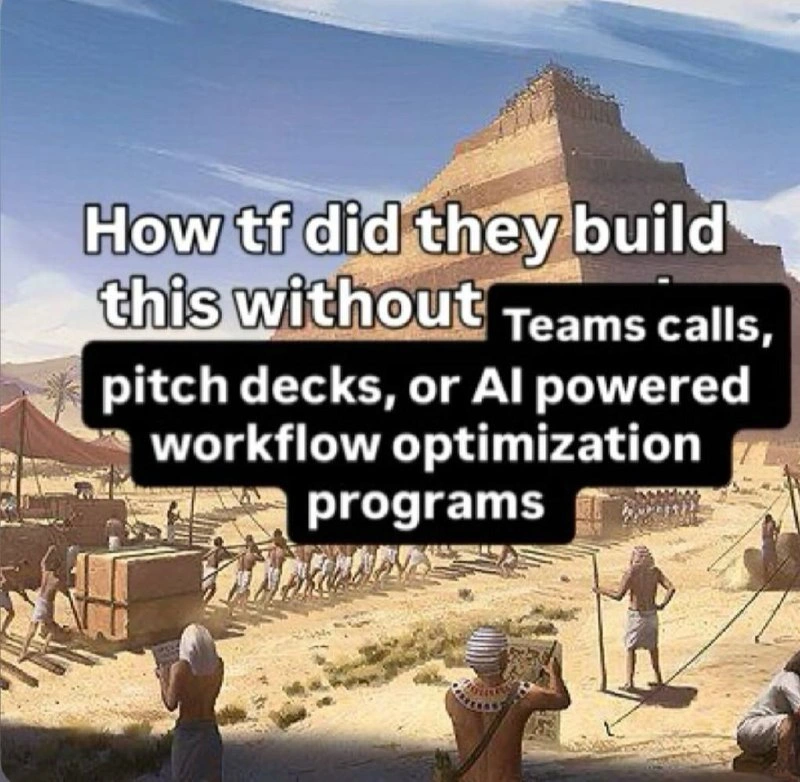
So, what’s going on here? This meme contrasts the way huge projects were done in ancient times with how we do projects now in the tech world. The picture shows ancient Egyptians hauling giant blocks to build a pyramid – one of the most ambitious engineering projects ever. The caption jokes: how on Earth did they pull this off without modern tools like Microsoft Teams, pitch decks, or AI workflow programs? Let’s break those down:
Microsoft Teams calls: Microsoft Teams is a popular app that companies use for communication. It lets teams chat, voice call, video conference, share screens – basically a hub for meetings and discussions online. Today, if a bunch of people are working together (especially if they’re remote or in different offices), they rely heavily on Teams or similar tools (like Slack or Zoom). Teams calls are those scheduled virtual meetings we all have on our calendars. The meme is pointing out that nowadays, whenever we build something (even just a new app feature), it feels like we’re constantly hopping on Teams calls to discuss progress, clarify requirements, or update stakeholders. In contrast, ancient pyramid builders obviously didn’t have digital communication. They coordinated in person, likely through a straightforward chain of command. The joke is imagining how they might react if you told them to pause dragging a 2-ton stone so they could join a conference call about “block placement synergy.” It highlights our modern dependence on meetings for collaboration.
Pitch decks: A pitch deck is essentially a slide presentation (often using PowerPoint) used to present ideas, project plans, or business proposals. In tech companies, before starting a big project or to get buy-in from management, teams often prepare a slick deck with lots of diagrams, bullet points, maybe some charts – all to “pitch” the plan. It’s a staple of corporate life; people spend hours making these slides look just right. The meme humorously wonders how the pyramid project got approved or managed with no pitch deck. Surely no one stood in front of Pharaoh with a laser pointer going through 10 slides of “Our Pyramid Objectives and Key Results”! In reality, the architects likely drew up plans on papyrus (ancient paper) or carved models and then directly got to work once the ruler said yes. The tag pitch_deck_fatigue refers to the feeling of being tired of endless presentations. If you’re new to the workforce, you’ll soon notice that sometimes you make a whole PowerPoint just to communicate something that could’ve been a short conversation. The meme exaggerates this: “They built something as grand as the pyramids without even one PowerPoint slideshow? Incredible!” It’s poking fun at how we might be overdoing the prep and polish phase.
AI powered workflow optimization programs: This is a mouthful, but basically it means software tools that use Artificial Intelligence to help plan and streamline work. Imagine an app that automatically prioritizes your tasks, or predicts project delays, or suggests how to allocate people to tasks most efficiently, all using clever algorithms – that’s an AI workflow optimizer. In the last few years (especially in the mid-2020s), there’s been a huge hype around AI. Companies are rolling out AI for everything, including project management and “productivity.” These programs promise to crunch data (like how long tasks usually take, or how people are collaborating) and then spit out recommendations to make things faster or smoother. The meme is side-eyeing that trend, essentially saying: “We have all these fancy AI tools telling us how to work, but ancient people achieved legendary results without any of that.” It’s a comparison of IndustryTrends_Hype – the AI craze – with basic old-fashioned organizing. If you’ve heard of the Tech Hype Cycle, AI is at the peak of hype in this scenario. The meme implies maybe we rely too much on these buzzword-laden solutions. After all, an AI scheduler is great, but if your team is stuck in meetings or constantly changing course, no AI can magically fix that. Sometimes simpler methods (a to-do list, a clear schedule) work fine, as proven by, you know, the entire ancient world.
Scope creep: This term is specifically mentioned (“still no scope creep”) in the title. In project lingo, scope creep means the project’s goals or features keep expanding while you’re working on it. It’s like if you’re tasked to bake a cake, and halfway through someone says “Actually, let’s make it a wedding cake with 3 tiers…and add cupcakes…and maybe also cookies.” Suddenly the project is much bigger than originally planned – that’s scope creep. It’s common in software: you start building a simple app, but then requests come in to add more features, and before you know it the project is double the size and way behind schedule. The meme jokes that the pyramid’s builders had zero scope creep. They started out planning a pyramid, and at the end, they delivered a pyramid – not a pyramid plus a sphinx plus a gift shop. In a modern office, completely avoiding scope changes is almost mythical. The joke resonates with anyone who’s worked on something that just kept getting bigger due to new ideas or stakeholder demands. The Egyptians probably had a very clear scope: build this pyramid for this Pharaoh, period. It wasn’t a software product that needed to adapt to user feedback – it was a tomb. So they could plan thoroughly and stick to it. The humor lies in envying that purity of mission. For a junior developer, it’s useful to know that managing scope is a big challenge in projects. Successful teams try to keep scope controlled – or if it changes, they adjust timelines and resources – otherwise you get endless delays. Here, “no scope creep” implies a disciplined project where nobody dared or needed to ask for extra frills once building began.
Now, why is this funny or interesting? It’s the sheer contrast. We have all these modern conveniences (video calls, digital tools, AI assistants), yet many current projects still struggle or drag on. Meanwhile, people in antiquity built something as grand as the pyramids with none of those tools. It’s a bit humbling and definitely ironic. Ancient_pyramids_engineering was done with brute force labor, clever simple machines (like levers, ramps), and basic mathematics – no computers, no software. That’s often referred to as a low-tech high-impact achievement: using very simple technology to accomplish something huge. On the flip side, in today’s high-tech world, we sometimes end up with high-tech low-impact situations, where we have every gadget and app, but the actual output (the product or project) is underwhelming or late.
This meme falls into categories like CorporateCulture and Meetings humor because it’s really making fun of workplace trends. If you’ve done an internship or started a dev job, you might have noticed a lot of time can go into “process” – the rituals and tools of working together – as opposed to actual coding or building. Corporations love to try new collaboration tools (like switching from one chat app to another, or adopting a new project tracker) and hype the latest trend (today AI, yesterday “big data”, before that “synergy” or “blockchain”, there’s always something). This can be exhausting – hence tags like pitch_deck_fatigue or ai_workflow_hype. The meme humorously says: “Look, the pharaohs got by fine without Scrum masters and productivity apps. Maybe we’re overcomplicating things.”
To a junior developer, the takeaway is partly just to laugh – it’s exaggerated on purpose. Obviously, modern projects and ancient pyramid-building are very different. (For one, tech projects usually don’t use thousands of physically coordinated laborers!) But it highlights a real feeling: sometimes work gets bogged down by too many meetings and flashy tools. The basic ingredients for getting something done remain pretty timeless: clear goals, good communication, and focus. The Egyptians had their version of project management – you could jokingly call it pre-agile project management. It wasn’t “agile” (no quick changes or iterative development); it was more like an extreme form of “waterfall” (one big plan, executed step by step). They might not have had a literal stone_age_gantt_chart on the wall, but they definitely organized tasks by time (e.g., quarry in the cool season, build when the Nile is flooding and farmhands are free) and by dependency (you need the base layers done before the top ones can be placed – that’s logical ordering akin to a Gantt chart).
The phrase “Pitch decks on parchment tho” from the post message is just riffing on the meme’s idea: it playfully suggests maybe the ancient project managers did have something like pitch decks, just using the materials of their time. Picture a scroll instead of PowerPoint, and ink drawings instead of clip art. It’s a tongue-in-cheek way to imagine the past in today’s terms – which is exactly what this meme does as a whole.
In sum, at this level we understand the meme as a humorous comparison. It’s saying “We do so much prepping and talking in modern workplaces, while these folks long ago just went out and built one of the wonders of the world – maybe there’s a lesson (or at least a laugh) in that.” The tags like MeetingHumor, CollaborationChallenges, and WorkplaceHumor signal that anyone who’s sat through a pointless meeting or had to adopt the “latest productivity app” can relate. It’s a comic reminder not to lose sight of actual work amid all the trappings of work. After all, a beautifully prepared pitch deck means nothing if the pyramid (or your project) never gets built!
Level 3: Scope Creep Sarcophagus
For seasoned developers and project veterans, this meme hits like a limestone block to the funny bone. It’s poking fun at the absurd contrast between ancient engineering achievements and today’s often bloated corporate tech culture. The Great Pyramids were built without a single Microsoft Teams invite, yet in our modern offices, even a minor app update can spawn dozens of Teams calls, Zoom meetings, and Slack threads. It’s the classic process_overhead_irony: sometimes it feels like we spend more time talking about the work than actually doing it. The meme sarcastically marvels, “How on earth (or how on sand) did they manage to coordinate anything without our fancy tools?” Seasoned folks recognize the irony that more tools and meetings don’t automatically mean more productivity – often it’s the opposite.
Scope creep, in particular, is the bane of veteran project managers. We chuckle at “still no scope creep” because it’s almost unimaginable today: who’s ever seen a project (especially in software) that didn’t get at least one extra feature or a change in requirements mid-stream? The pyramid builders apparently had a fixed vision – “Build Pharaoh’s tomb exactly like this.” No stakeholder committee popped up halfway to say, “Actually, can we add a second smaller pyramid for his cat? And maybe some pivot to a Sphinx platform as a Service?” In modern terms, the Pharaoh was the ultimate single stakeholder with a waterfall plan, and you simply did not pivot on a Pharaoh’s decree. In a darkly humorous way, one reason they had zero scope creep is because anyone suggesting late changes might literally be “removed from the project” (and not in the gentle HR way). Seasoned devs have seen the contemporary version of this too (okay, maybe without actual mummification): a strong top-down directive can freeze scope because no middle manager dares propose additions. While that’s not a healthy team dynamic by agile standards, it sure keeps the requirements from wriggling around. It’s a sardonic nod to the fact that sometimes what we call “flexibility” in modern projects just ends up as chaos and delay, whereas rigid old-school management (hierarchical, even authoritarian) can push a project to done – albeit by brute force.
The mention of Teams calls, pitch decks, or AI-powered workflow optimization programs is a roast of our current workplace obsessions:
- Teams calls & endless meetings: Every experienced dev knows the pain of meeting fatigue. Daily stand-ups, weekly syncs, sprint plannings, all-hands, “quick alignment calls” – the calendar fills up fast. The meme imagines ancient builders blissfully free of “This could have been an email” meetings. They likely coordinated in person on-site with quick shout-outs or simple routines, rather than interrupting work for a 30-minute video call about synergy. The humor is in picturing a Pharaoh’s foreman saying, “I’m scheduling a Zoom call to align all pyramid crews” – completely anachronistic and ludicrous, right? And yet, modern teams can hardly imagine tackling any large task without a flurry of invites and screen-shares. CollaborationChallenges have apparently been solved for millennia by just talking while doing, not talking about doing.
- Pitch decks: In today’s corporate environment, no big initiative survives without a polished slide deck. Got an idea for a new feature or project? Better whip up a PowerPoint presentation with charts, bullet points, maybe a meme on slide 8 for good measure, then pitch it to the higher-ups. We joke about pitch_deck_fatigue because preparing slides is a whole mini-project (and skill) of its own. The meme contrasts this with ancient times: nobody had Keynote or Google Slides in 2500 B.C. It’s hilarious to imagine an Egyptian architect gathering his team to make a papyrus scroll with pretty drawings and a SWOT analysis to convince Pharaoh Khufu of a pyramid’s ROI. One commenter quips “Pitch decks on parchment tho,” conjuring the image of an ancient project manager unrolling a parchment pitch deck by torchlight: “Slide 1: Why Pyramid? Slide 2: Timeline ( drawn as a series of hieroglyphs )…” It underscores how conditioned we are now to expect formal pitches for everything. The pyramid got built perhaps with a simple verbal mandate and a rough sketch — no quarterly business review in sight.
- AI powered workflow optimization: Ah yes, the latest silver bullet. Any senior dev has seen waves of TechHypeCycle trends promising to revolutionize productivity. Right now it’s AI for project management: tools that auto-schedule tasks, predict delays, or adjust workloads with machine learning magic. The meme lampoons this by implying even without any algorithmic “optimizer,” the ancients still delivered one of history’s greatest engineering marvels. It’s a cheeky critique of AIHype. Sure, an AI tool can suggest “allocate more workers to ramp construction in phase 2,” but 4500 years ago, common sense (and maybe some abacus math) did the trick. Many senior folks share this skepticism: they recall when “synergy platforms”, “DevOps pipelines”, or “blockchain for productivity” were hyped similarly. Often these tools add overhead – you spend time feeding data into the AI or tweaking the workflow software instead of doing actual work. In comedic terms, the meme is saying: ancient builders didn’t need Jira or an AI scrum master – they managed with human brains and maybe a good sundial. It’s a bit of a reality check: technology should serve the work, not become a new bureaucracy unto itself.
Underneath the humor, there’s a familiar pain shared by many in tech: CorporateCulture sometimes valorizes process over outcomes. We’ve all seen a simple project drown in a sea of meetings and procedural red tape. This meme exaggerates by implying our ancestors would be baffled: “You guys have robots and instant communication, yet you struggle to finish a project because you’re too busy talking about it?” It’s a funhouse-mirror reflection of our industry. Veteran engineers might recall crunching out huge projects with small teams and minimal process back in the day (the proverbial garage startup) and compare it to how big companies now require a committee and six approval docs to change the color of a button. The pyramid is a symbol of low-tech high-impact: immense results with basic tools. That contrasts with some modern projects which are high-tech low-impact (tons of fancy tools but not much to show).
The meme also hints at historical project management wisdom. For instance, the pyramids were basically delivered on (Pharaoh’s) deadline – these monuments had to be ready while the Pharaoh was still around (or at worst, shortly after he died so they could entomb him properly). Talk about a hard deadline: you can’t slip Q4 when the king’s afterlife is at stake. So there was immense pressure to execute efficiently. Modern projects often have more fluid timelines (“we’ll push to next quarter if needed”), which can breed complacency and yes, Parkinson’s Law (“work expands to fill the time available”). An old-school engineer might quip that if modern teams had to face a Pharaoh’s drop-dead date (literally), they’d cut the nonsense and get things done too. It’s a dark joke, but it resonates: clear, immovable goals can sharpen focus, whereas endless time invites endless tinkering.
To seasoned eyes, the meme’s contrast is both funny and a tad painful, because it rings true. It’s a commentary on WorkplaceHumor and how sometimes we over-engineer the process and under-engineer the product. In a senior meeting you might hear someone sigh, “We have the tools the ancients could only dream of, yet why does finishing a user story feel harder than building a pyramid?” Everyone nods, because they’ve been there. That shared understanding – that we’re drowning in our own “productivity” tools – is what makes the meme so relatable. It encapsulates a collective tech industry inside joke: Meetings and tools are supposed to help, but heaven help us if they become the whole job. The Egyptians managed to pile up 2.3 million stone blocks without a single status update email; surely we can deliver version 2.0 without scheduling yet another “sync”. Or so we hope, as we chuckle and then grudgingly click “Accept” on the next Teams invite.
Level 4: The Great Waterfall of Giza
At the most intricate level, this meme draws a parallel between ancient megaproject management and modern software process theory. Think of building a pyramid as a colossal waterfall project – not the kind with actual water, but the rigid plan-everything-upfront methodology. The Egyptians couldn’t exactly iterate on pyramid designs each week; their plans were literally carved in stone (or papyrus), an irreversible blueprint much like a finalized spec document. In project management terms, they locked the scope early, defining every layer of that pyramid before the first block was dragged into place. This pre-Agile approach meant no continuous re-scoping or sprint reviews – once the Pharaoh approved a design, it was full steam ahead to completion.
From a systems perspective, the pyramid-building effort highlights how communication overhead was minimized by a strict hierarchy. Modern org theory often notes that unconstrained group communication grows exponentially with team size (imagine trying to get 100,000 workers on the same Microsoft Teams call – you’d have an O(n²) nightmare of crosstalk). The Egyptians solved this by using a tree-structured chain of command: Pharaoh -> architects -> overseers -> laborers. Each node in this human network had a limited number of direct connections, drastically cutting coordination complexity. Orders flowed downward and status flowed upward, not unlike a well-designed distributed system using a tree topology to avoid chatter. The absence of endless multiway meetings wasn’t a fluke; it was a feature of their organizational design. In essence, they achieved concurrency control in human labor: thousands of workers executing tasks in parallel, synchronized by simple signals (drums, shouts, or the daily rising sun) rather than shared Google Calendars. Conway’s Law whispers that the pyramid – broad base, narrow top – mirrors this centralized structure: a monolithic architecture reflecting monolithic command. No surprise that monumental results often came from monolithic management.
Even without Gantt charts (which wouldn’t be invented for another 4,000 years), the pyramid builders intuitively grasped concepts akin to critical path scheduling. They had to quarry stones, ferry them at the Nile’s flood peak, drag them into precise alignment – each step carefully timed. We can imagine an ancient Gantt chart scratched into sand or inked on papyrus, scheduling when crews should be cutting stone versus building ramps. It was a low-tech critical path method: if the quarrying fell behind, everything else slipped. There was no machine learning to optimize workflows, but there was human learning passed down from earlier projects (each Pharaoh tried to outdo the last tomb). In a way, those early project managers optimized workflows via experience and perhaps a bit of brute-force labor allocation, approximating what an AI-powered workflow tool might attempt today – just with algorithms encoded in human tradition rather than Python.
Ultimately, the meme’s incredulous tone (“How tf did they build this without…”) underscores a fundamental question in productivity science: how much of our modern process and tooling is truly necessary vs. how much is ritualistic overhead? It nudges us to recall that massive feats were achieved under severe constraints – no digital comms, no cloud-based collaboration, not even slide projectors for pitch decks – by relying on first principles: clear goals, stable requirements, and a communication structure that minimized noise. The irony is rich: today we chase efficiency through ever-more complex tools (from AI scheduling assistants to DevOps dashboards), yet sometimes these introduce their own inefficiencies through complexity. The Egyptians’ approach might not scale to our fast-changing software projects (and it certainly wasn’t humane by today’s standards), but from a theoretical lens, it was an optimal solution for their problem domain. They delivered a low-tech, high-impact outcome (a pyramid that’s still standing millennia later) by embracing a simple, deterministic process model – a true historical MVP delivery with zero scope creep and 100% “done-done” at release (a Pharaoh’s burial is a pretty final deployment). In short, this meme hints at the almost paradoxical efficiency of the ancient “waterfall” and invites us to contemplate whether our modern agile, AI-enhanced workflows are always an improvement, or just the latest turn in the eternal cycle of the Tech Hype Cycle.
Description
The image displays a detailed illustration of ancient Egyptians constructing a massive pyramid under a bright, sunny sky. In the background, a large step pyramid stands partially complete, while in the foreground, dozens of laborers are shown pulling enormous stone blocks on sledges. Other figures appear to be supervising, holding scrolls or staffs. Overlaid on this historical scene is a large, black text box with white lettering that poses a sarcastic question: 'How tf did they build this without Teams calls, pitch decks, or AI powered workflow optimization programs'. The meme creates a humorous anachronism by juxtaposing one of history's greatest engineering feats with modern corporate and project management jargon. It satirizes the perceived over-reliance on meetings, presentations, and complex software in today's work culture, implying that these tools can sometimes be more of a hindrance than a help to actual progress

Comments
18Comment deleted
The pyramid's project manager's only stand-up was getting up from his chair and yelling. The only tickets they had were hieroglyphic warnings about not dropping a two-ton block on your foot
Proof that when your critical path is literally a sled in the sand, nobody needs a 30-slide OKR deck - just enough bandwidth (in manpower, not megabits) and a well-placed fulcrum
The ancient Egyptians achieved O(1) pyramid delivery with zero sprint retrospectives, proving that the only dependency injection they needed was moving 2.3-ton blocks with rope and human determination - no Kubernetes required
The pyramids were built with a simple tech stack: rope, wood, and stone - no daily standups, no sprint retrospectives, no Jira tickets. They achieved 99.99% uptime for 4,500 years without a single incident postmortem or blameless culture workshop. Meanwhile, we can't ship a feature without six stakeholder alignment meetings and a deck explaining why we need AI to optimize our workflow optimization tools. Perhaps the real technical debt is the friends - I mean, meetings - we made along the way
Conway’s Law: one pharaoh, one org chart - so they shipped a literal monolith; cap WIP and the rope scheduler beat every AI “workflow optimizer.”
Proof you can ship a monolith on time by turning off the Meetings microservice and scaling workers instead of slide decks
They orchestrated a fault-tolerant distributed system of millions without SREs, SLOs, or chaos engineering - must've aced their on-call rotation with just whips and water
nice one (they were literal slaves) Comment deleted
They had good management 🐱 Comment deleted
Как? Нуу, использовали рабов, несогласных убивали нахуй... Comment deleted
@RiedleroD Comment deleted
She don't speak russian, if that was your question Comment deleted
exactly, but she has something to say, I'm sure Comment deleted
Please, stick to usage of English around devmeme 🙏 Comment deleted
Okay Comment deleted
I would guess common sense? Comment deleted
fucking slaves Comment deleted
They had camels tho Comment deleted