Skip to content
DevMeme
5438 of 7435
Gaming Microtransactions vs. Industrial Hardware Paywalls
EmbeddedSystems Post #5961, on Apr 15, 2024 in TG

Gaming Microtransactions vs. Industrial Hardware Paywalls

Why is this EmbeddedSystems meme funny?

Level 1: Pay to Use What You Own

Imagine you got a toy robot that came with two batteries already in it. You’d expect the robot to use both batteries for full power, right? Now picture this: the robot only uses one battery and runs slower, and a message on it says, “To use the second battery, please pay an upgrade fee.” You’d probably be shocked and think, “But the battery is right there inside the toy!”

That’s exactly the feeling this meme jokes about. In simple terms, some big machine at a factory has extra memory (like a brain with extra space to think), but the company that made it locked half of that space. They want more money to unlock it. People find it funny and frustrating because it’s like the machine is saying, “I could work better, but you didn’t give me enough money for that.” It’s comparing a small silly thing (buying a fancy costume for a video game character’s horse) to a big serious thing (buying the ability to use your machine’s own hardware). The humor comes from how absurd it is to pay again to use something you already physically have. It’s like paying for your toy twice just to make it work fully – pretty unfair, and that’s why everyone’s either laughing or groaning at it!

Level 2: License Key Required

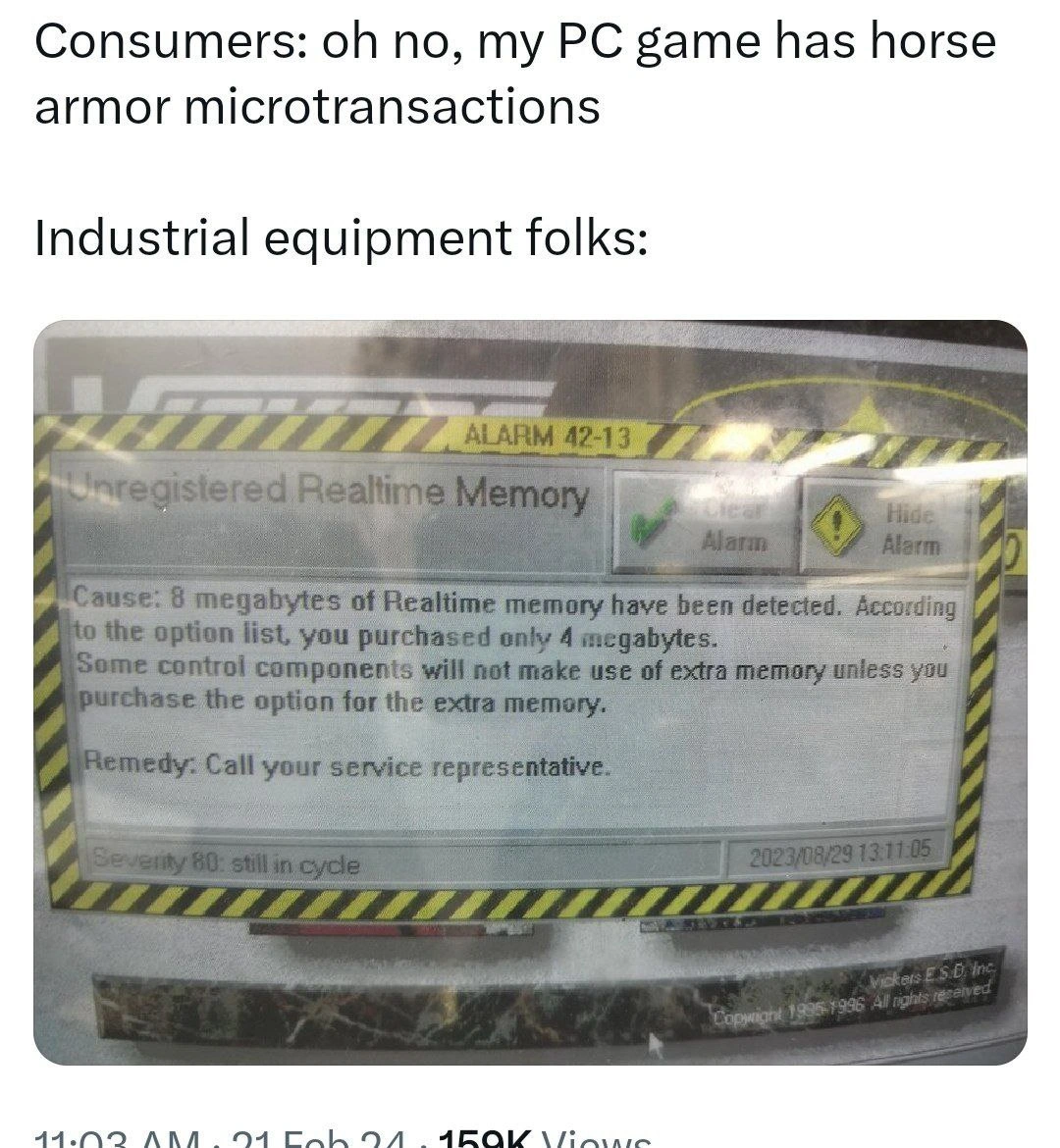
Let’s break down what’s happening in simpler terms. First, what is a PLC? A Programmable Logic Controller (PLC) is a rugged special-purpose computer used in factories and industrial settings to control machines. Think of it as the “brain” running an assembly line or a giant robot arm. PLCs have memory (just like your PC or phone has RAM) to store and execute their control programs in real time. Now, in this meme, the PLC in question has 8 MB of memory hardware installed. But the company that makes it sold a version that’s only supposed to use 4 MB. How do we know? The screen is showing an alarm message: “8 megabytes detected, you purchased only 4 megabytes.”

This is like the PLC saying: “Hey, I found more memory than you paid for, so I won’t use half of it.” The term “Unregistered Realtime Memory” basically means the PLC found memory that isn’t registered (or licensed) in its system for real-time use. Real-time memory could be a special portion of RAM that’s needed for time-critical tasks. If you have more of it, the PLC could potentially handle more complex tasks or more data. But since the extra wasn’t paid for, it throws up an alarm (Alarm code 42-13, with a scary yellow-and-black border like a hazard sign) to let you know it’s purposely ignoring that extra memory. The note “Severity 80: still in cycle” implies this is a serious warning, but not serious enough to stop the PLC from running entirely. The machine is still operating (still “in cycle” doing its control loop), but it’s basically nagging you with a big warning signal.

The meme contrasts two worlds: consumer gaming and industrial equipment. In gaming, a microtransaction is when a game charges small amounts of money for extra content – for example, a fancy armor for your horse in a fantasy game (infamously known as horse armor DLC in gamer lore). Many gamers hate this because they feel once they bought the game, they shouldn’t have to pay more for small extras. Now look at the industrial folks: they’re dealing with microtransactions on actual hardware. They have a machine that physically has all the parts needed (all 8 MB of memory chips are right there on the circuit board), but the manufacturer says, “Sorry, you only paid for the 4 MB package. If you want to use the rest, you need to buy an upgrade license.” This is often called software licensing or an options list in industrial products. It’s basically a code or software switch that unlocks features. Until you pay, that extra 4 MB is just sitting there unused.

This practice is a form of vendor lock-in and upselling. Vendor lock-in means once you buy a certain company’s system, you’re kind of stuck buying accessories, upgrades, and services from them because third-party or DIY solutions either won’t work or might violate terms. So, if you need more memory or features, you have to go back to that company (hence “Call your service representative”). They might send a technician or just give you a special software key after you pay them. The engineering humor here comes from the absurdity: gamers get upset about paying extra for a cosmetic item, but in the professional engineering world, you might have to pay extra just to fully use hardware you already have. It’s not a fancy add-on; it’s literally the device’s own memory.

For a junior developer or someone new to hardware: imagine you built a gadget and discovered that half of its capacity is intentionally disabled. You’d probably be confused – why would anyone do that? The reason is often money. Companies offer the same physical product in different versions. The cheaper version has features turned off in software. It’s easier for manufacturing (one product line instead of two) and encourages customers to spend more if they need the upgrade later. It’s like if you buy a software that has a free version and a pro version – the download is the same, but you pay to unlock pro features. Here it’s the same idea applied to a physical machine.

So the meme’s joke format has the top text about consumers whining over a trivial game purchase, and below it shows the PLC alarm screen with a much more hardcore problem. Essentially: “You think horse armor DLC is bad? Hold my beer – my factory robot is literally asking for DLC to use its own memory!”

Level 3: DLC for PLC

This meme strikes a chord with every seasoned engineer who’s dealt with paywalled hardware features. It juxtaposes a trivial gamer gripe (“Ugh, $5 for horse armor?”) with an embedded engineering horror story: “We paid for 4 MB, but the device actually has 8 MB installed and taunts us with an alarm until we pony up more cash.” The humor lands because it’s so absurd yet so real. In the consumer world, microtransactions usually get you cosmetic perks. In the industrial world, microtransactions – if we dare call them that – unlock functionality you physically already have. It’s a classic case of Vendor Lock-In and corporate upselling in Hardware form.

Imagine being the controls engineer on a factory floor. You spec a PLC for a machine, opting for the cheaper model with 4 MB because the budget was tight. Later, you or a colleague add an extra memory module or discover the PLC actually came with 8 MB onboard (maybe the manufacturer uses one board for all models to simplify production). The next boot-up, the PLC’s screen flashes with that hazard-striped ALARM 42-13: “Unregistered Realtime Memory – 8 MB detected, 4 MB purchased.” It’s not just a benign notice; it’s Severity 80, a high-priority alarm. This is the machine effectively saying, “I see what you did there, trying to use more RAM than you paid for. Nice try.” Some critical control components will outright refuse to use that extra memory. Your system might still run (it’s “still in cycle”, meaning it hasn’t shut down the assembly line… yet), but you’re not actually getting any performance benefit from that extra RAM installed. In fact, it might be causing nagging warnings or limited functionality.

The remedy per the message? “Call your service representative.” And every veteran engineer knows what that really means: get out the corporate credit card. The service rep is going to cheerfully inform you that to remove the alarm and utilize those extra 4 MB, you need to purchase a license upgrade – essentially a software license to use the hardware you already own. This is where the meme’s punchline hits home: gamers cry about $10 DLC, while industrial folks face a several-thousand-dollar “DLC” for their PLC. The PLC firmware is literally charging DLC prices for extra RAM. It’s engineering humor with a bitter aftertaste — we laugh so we don’t cry about our budget.

From a senior developer perspective, this encapsulates a known anti-pattern in the industry: designing products with artificial limitations. It’s done under the guise of offering tiered products, but on the ground it feels like extortion. We’ve seen it in networking gear (same router hardware, pay to unlock higher throughput), in software (freemium versions holding features hostage), and here in industrial controllers. It leads to scenarios where perfectly capable hardware sits underutilized unless the bean-counters sign off on more spending. For the engineers, it’s frustrating because technically, if you have the know-how, you could hack or circumvent it – but that voids warranties, risks legal issues, and breaks support contracts. So you’re stuck playing by the vendor’s rules.

The shared trauma among experienced folks is palpable: maybe you’ve had a production line down and discovered it’s because you exceeded some licensed limit. The fix wasn’t debugging code or replacing a part – it was waiting on a license file from the vendor to “unlock” what’s already there. That might have meant hours of costly downtime. So when we see a meme comparing horse armor to license-gated memory, we smirk. The horse armor DLC was optional fluff; the memory DLC is an in-your-face necessity. The unspoken commentary: as technologists, we expect software licensing shenanigans in apps, but seeing them seep into raw hardware is both hilarious and disheartening. It’s the ultimate engineering humor: joking about the very things that make our jobs harder, because if we didn’t laugh, we might just rage-write an angry email to our vendor rep at 2 AM.

Level 4: The Hardware Paywall Paradox

At the deep end, this meme exposes a hardware architecture quirk tangled with an economic strategy. Under the hood of that PLC (Programmable Logic Controller), all 8 MB of physical RAM are sitting on the board, chips soldered and ready. Yet the firmware’s real-time OS has a programmed check – a license gate – that restricts usage to the 4 MB the customer paid for. It’s a paradox of modern embedded systems: silicon doesn’t care about purchase orders, but the software sure does. In technical terms, the PLC’s memory manager likely reads the full memory during initialization (hence it detects 8 MB), then consults a stored license key or option list. If the key only authorizes 4 MB, the OS marks any addresses above that as off-limits. Those extra 4 MB become ghost memory – physically present but logically absent.

This kind of feature gating often uses cryptographic license files or even hardware fuses. The firmware might have an encrypted certificate that says “4 MB max” and any attempt to allocate beyond triggers an error routine. The alarm 42-13 (“Unregistered Realtime Memory”) is essentially the OS yelling “Memory above 4MB? I see you, but I won’t use you.” From a systems design perspective, it’s like implementing an artificial ceiling in the memory map. The engineers who wrote this OS had to handle this gracefully: continue operating with the allowed memory (hence Severity 80: still in cycle – meaning the PLC’s control loop is still running), but flag a high-severity warning. In real-time control theory, deterministic behavior is king, so unauthorized memory can’t just be used blindly – it might alter cycle times or task scheduling. By freezing out the extra RAM, the system remains predictably within tested bounds. It’s a twisted application of robust design: ensure stability by ignoring resources that the business model forbids.

Historically, this license-gated memory isn’t an isolated case. Vendor lock-in has roots in mainframe days – IBM famously locked features behind license codes on otherwise identical hardware. Modern embedded vendors use it for product segmentation: manufacturing one hardware model and selling it at different price tiers via software locks is cheaper than making multiple physical models. Economically it’s price discrimination – charge heavy industrial users more for the same silicon. Technically, it’s a firmware feature-check, perhaps something as simple as:

// Firmware pseudo-code snippet
int installedMB = detectMemory();
int licensedMB = readLicenseKey(); // e.g., 4
if (installedMB > licensedMB) {
    raiseAlarm(42, "Unregistered Realtime Memory", SEVERITY_HIGH);
    limitMemoryTo(licensedMB);
}

In real-time OS design, determinism matters: if you haven’t paid, the scheduler will act like those extra MB don’t exist, keeping memory allocations and cycle times consistent with the licensed spec. It’s a darkly elegant solution – or obscene, in a veteran engineer’s view – blending software licensing with memory management. The fundamental joke here is grounded in this paradox: computing hardware, bound by mathematical laws of address space and memory maps, is being artificially constrained by business logic. The bit that flips to unlock that memory is not a technical necessity but a financial one. As a result, the physical reality (8 MB on the bus) and the logical reality (4 MB usable) diverge because somewhere a product manager said so. This is industrial microtransactions at the architectural level – the machine equivalent of finding DLC (Downloadable Content) on a game disc that you can’t use until you pay. Only here, it’s not a fancy horse armor skin; it’s actual bytes of RAM that could make or break a production run.

Description

A two-part meme contrasting consumer complaints with industrial-scale issues. The top text reads, "Consumers: oh no, my PC game has horse armor microtransactions." Below this, the text "Industrial equipment folks:" introduces a photograph of a dated, gray industrial control system screen. The screen shows an 'ALARM 42-13' for 'Unregistered Realtime Memory.' The cause is detailed: "8 megabytes of Realtime memory have been detected. According to the option list, you purchased only 4 megabytes. Some control components will not make use of extra memory unless you purchase the option for the extra memory." The suggested remedy is to "Call your service representative." A copyright notice for '1996-1998' is visible at the bottom, ironically juxtaposed with a recent timestamp of '2023/08/29'. The meme humorously contrasts the relatively trivial nature of cosmetic in-game microtransactions (famously exemplified by the 'horse armor' DLC in 'The Elder Scrolls IV: Oblivion') with the severe, functionality-crippling paywalls common in industrial and enterprise hardware. The joke lies in the absurdity that critical equipment has its physical capabilities, such as installed RAM, artificially limited by software until an additional license is purchased. This practice of feature gating and vendor lock-in makes consumer complaints about optional game add-ons seem insignificant in comparison, a reality well-known to engineers working with legacy or specialized systems

Comments

36
Anonymous ★ Top Pick You haven't known true DLC hell until you have to schedule a maintenance window and get a purchase order approved to activate the RAM that's already physically installed in the machine
  1. Anonymous ★ Top Pick

    You haven't known true DLC hell until you have to schedule a maintenance window and get a purchase order approved to activate the RAM that's already physically installed in the machine

  2. Anonymous

    Feature flags have officially escaped Git: my PLC throws ALARM 42-13 because the extra 4 MB is behind a paywall - turns out the real time in “real-time memory” is the time it takes Procurement to cut a PO

  3. Anonymous

    Somewhere a senior engineer is explaining to management why they need to pay $50,000 to unlock the RAM that's already soldered on the board, while simultaneously debugging why their CI pipeline OOMs with 64GB because someone imported the entire npm ecosystem

  4. Anonymous

    Ah yes, the classic industrial control system business model: ship hardware with 8MB of RAM physically installed, but artificially limit it to 4MB in firmware until you pay the 'memory unlock fee.' It's the original loot box - except instead of cosmetic horse armor, you're gambling with whether your production line halts at 3 AM because someone in procurement didn't check the 'extra memory' box on the PO. At least when Bethesda pioneered microtransactions, your factory didn't grind to a halt. This is what happens when MBA logic meets real-time systems: 'Severity 80: still in cycle' becomes 'Severity 80: still waiting for finance approval.' The remedy isn't a hotfix - it's a service contract and a three-week lead time

  5. Anonymous

    Industrial IoT: where the memory controller is wired to Accounts Payable - 8 MB on the board, 4 MB behind a feature flag until the PO flips the bit

  6. Anonymous

    DRAM with DRM: the HMI sees 8MB, the license unlocks 4, and the scheduler won’t touch the rest until Sales flips the feature flag

  7. Anonymous

    Gamers boycott $5 horse armor; operators fork $50k+ for 4MB to kill a prod alarm that's been cycling since Y2K

  8. @ZgGPuo8dZef58K6hxxGVj3Z2 2y

    Memory tax. 1:1 from apple’s playbook

    1. @Supuhstar 2y

      At least Apple gives you what you pay for. This company gives you more than you pay for and refuses you to use it all unless you pay even more. Like Tesla!

      1. @ZgGPuo8dZef58K6hxxGVj3Z2 2y

        I mean okay apple gives you more RAM if you install it yourself, but everything else you replace yourself breaks. Not to mention if you replace touch id on your old iphone after iOS X.X (idk what ver) is installed your phone wont boot

        1. @Supuhstar 2y

          I think you missed my point in your uncharitable mindset

          1. @ZgGPuo8dZef58K6hxxGVj3Z2 2y

            Why? Explain

            1. @Supuhstar 2y

              The difference is arbitrarily gating a piece of hardware (I give you 8 but only let you use 4 unless you pay me more; I give you a fast car but don't let you go fast unless you pay more; I give you an overpowered graphics card but place one extra chip on it to nerf it to be a slow card because you didn't pay more) versus price tiers for different hardware (I give you the hardware you paid for and you can use all of it as much as you like, you just don't get the better hardware which you didn't pay for). You can be upset at Apple for their prices, but comparing their price tiers to these arbitrary gating practices is uncharitable and muddies the conversations about their actual bad practices like making their products difficult to repair/own/customize, or greenwashing, or maltreatment of employees/contractors/devs, etc

              1. @Supuhstar 2y

                Also We're personally not upset at Apple for their relatively high prices, because it seems all the alternatives only have lower prices because they make up for it by selling your data, whereas Apple seems absolutely allergic to its users' data

                1. @ZgGPuo8dZef58K6hxxGVj3Z2 2y

                  If I buy off the shelf parts how do they sell my data? Its more about extremely high markups… and scummy practices to get even more money out of the buyer. Even if you would come with the argument of “they loose money on the cheap models” I call bs on that. The majority of profit comes from the cheaper models. If numbers were public you would see only professionals or enthusiastic go for the high end models. Normal non techy people dont know why to get the better ones for +600€ or so

                  1. @Supuhstar 2y

                    You talking about desktops (and things like Framework laptops)? Windows, Chrome, Nvidia, and many others harvest that data. I'm sure they respect you turning that off tho. I'm sure you only run Linux and other FOSS tho. You're that type. Would never use VSCode because Microsoft made it proprietary. Who are the top members of the Linux foundation again? And yeah you can put in that effort to get away from tracking, but most people (Ourself included) just want the device to get out of the way and let us do our work, not spend time building and tweaking and maintaining it and leaning how it works at every level just to keep it working.

                  2. @Supuhstar 2y

                    Naw, We wouldn't argue that. They clearly make money on everything they sell (maybe with the exception of their new headset thing because it's really low volume for now)

                  3. @Supuhstar 2y

                    I really want to believe this

                  4. @Supuhstar 2y

                    I figure they would as a status symbol at the very least, otherwise perhaps being swayed by things like the cameras

              2. @ZgGPuo8dZef58K6hxxGVj3Z2 2y

                I think you aren’t informed well. What difference does it make to block something from working fully (ie, 8MiB RAM stick vs 4MiB that got replaced probably because the system failed. Look at copyright date and date of the system. 30 years on the same ramstick is unlikely) That system prevents you from using it because you didn’t pay extra to buy from them. For 2-50x the price i.e. <insert-company-name>-Tax. So apple does this too. What about self repair? Well if you replace the screen, ear piece, back glass (yes the back glass cover), camera, face id, touch id, battery you will get some kind of sideffect that will prevent you from utilizing it fully. If you replace the screen, good bye truetone and HDR content. If you replace the back glass if the phone, good bye using the flash light because it will not save the picture you took. If you replace the face id, good bye face unlock, restore using this device and keychain. If you replace the battery, forget about battery health and the option to not crash on too high demand. So apple does both; reduce functionality when parts were replaced by unauthorized personal and they also force you to get the thing from them for X times markup. So where is my mindset uncharitable?

                1. @Supuhstar 2y

                  The difference is that there's 8 there but they want you to pay for a subscription service for no other reason than to use what's already there. Apple does some shitty things like having their hardware & software refuse replacement hardware, but they never ask you to subscribe to use what's there. Yes good job, attack them on their anti-right-to-repair practices! Just don't conflate those practices with this arbitrary subscription gating

                  1. @ZgGPuo8dZef58K6hxxGVj3Z2 2y

                    Yes they do.

              3. @Supuhstar 2y

                Tesla

                1. @ZgGPuo8dZef58K6hxxGVj3Z2 2y

                  What are you getting at?

                  1. @Supuhstar 2y

                    we're on the same team here, you and Us

  9. @ZgGPuo8dZef58K6hxxGVj3Z2 2y

    It says in the title “industrial”. You have no clue how much that is

  10. @ZgGPuo8dZef58K6hxxGVj3Z2 2y

    I mean it for real. 8MB is a LOT

  11. @ZgGPuo8dZef58K6hxxGVj3Z2 2y

    True

  12. @SamsonovAnton 2y

    Judjing by GUI style, this is a mid-1990s machine. Back then, 8 MiB was a lot. And with 16 MiB you were the king, compared to 4 MiB peasants. 😁

    1. @ZgGPuo8dZef58K6hxxGVj3Z2 2y

      You are one of the first people I seen use 2^Bytes. Kibi-mebi-gibi… Respect

  13. @SamsonovAnton 2y

    I once saw "RMF" in IBM System z parts list, and really thought they charge extra money for being able to do "rm -f", taking into account their pricing policy. 😅 That turned out to be Resource Management Facility, a system monitoring tool.

  14. @tren123321 2y

    Machine tools, milling, lathing etc. G-code programs are generally not that big

  15. @ZgGPuo8dZef58K6hxxGVj3Z2 2y

    Yesn’t. As a normal user: yes. As a techy person: No. There are lots of ways. Super easy ones, that don’t rely on jailbreak or any kind if hack or PC at all. I can sign any ipa and sideload from safari. So even tho it is locked down, it can be done in ways that aren’t obvious.

  16. @ZgGPuo8dZef58K6hxxGVj3Z2 2y

    It was literally 1 payment and going into settings 1 time. Then it works just like the app store. Anybody could do it. For the roms yeah you are f’ed if you want to do that.

  17. @Supuhstar 2y

    Like I said their actual bad practices like making their products difficult to repair/own/customize

  18. @azizhakberdiev 2y

    raspberry pi

Use J and K for navigation