The Inevitable Path to Unmaintainable Code: An Illusion of Choice
Why is this DesignPatterns Architecture meme funny?
Level 1: Two Slides, One Puddle
Imagine you’re at a playground and there are two big slides in front of you. One slide is super fancy – it’s long and twisty and looks really well-built. The other slide is plain and straight, not special at all, but it gets you down fast. At the bottom of these slides, however, both of them drop into the same giant mud puddle. You get to choose which slide to go down, and it feels like a big decision: do you want the nice, curvy slide or the simple, quick slide? But no matter which one you pick, splash! you end up landing in that muddy puddle at the end. In the cartoon, the cow (our developer) believes it has two different paths to take — a careful, fancy way or a quick, messy way — but just like the slides, both paths join into one and lead to the same bad outcome. This is what they mean by the “illusion of free choice.” It’s funny and a bit sad: the poor cow thinks it has options, but in the end it was always going to get muddy. In simple terms, the meme is joking that whether you try really hard to do something the proper way or you just wing it, you might still end up with a big mess. The freedom to choose was just an illusion, because either way, the result didn’t change – the cow (like a developer) gets the same muddy surprise at the end.
Level 2: Best Practices vs. Whatever Works
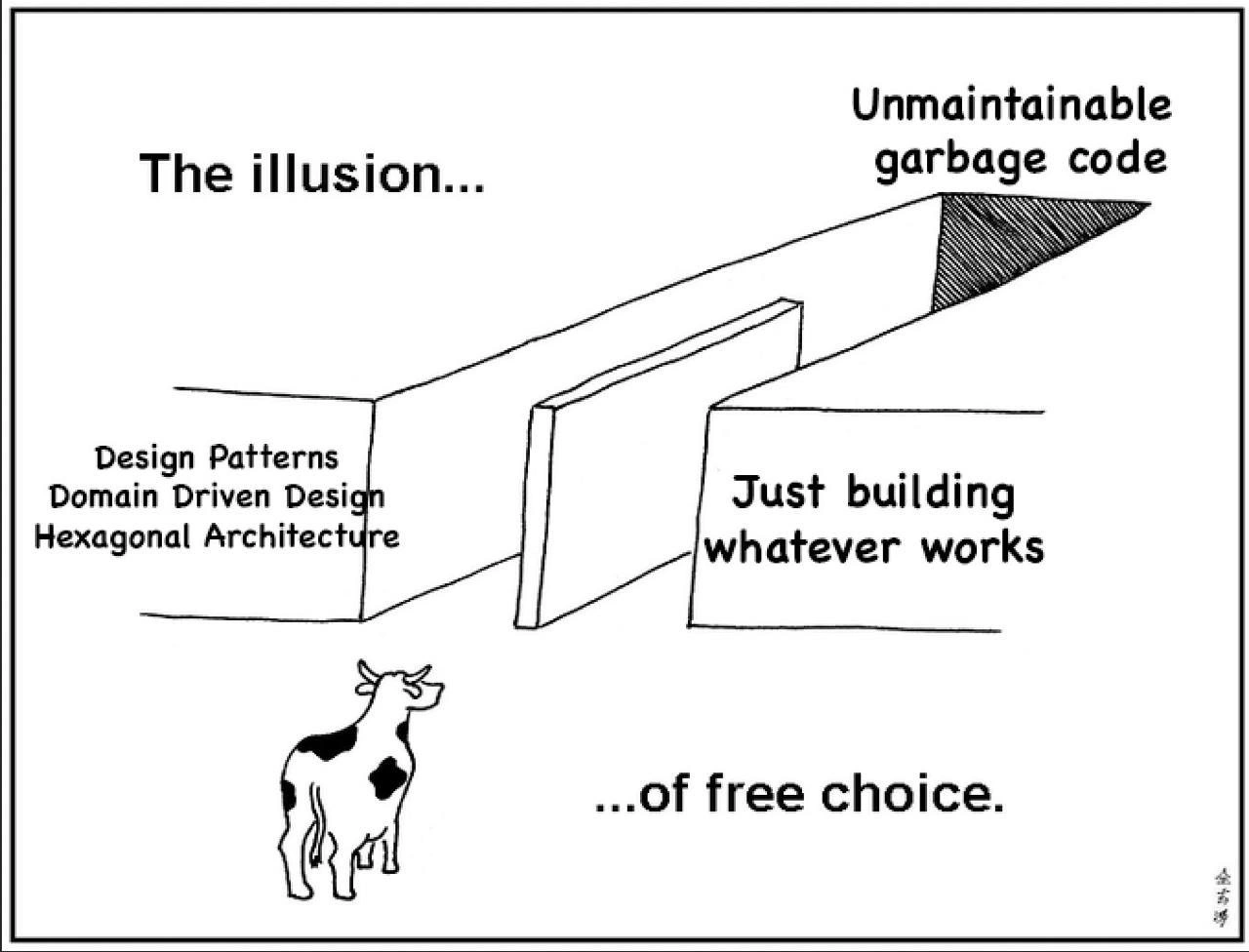
Let’s unpack the joke in simpler terms. The cartoon shows a cow (symbolizing a developer) looking at two different ways to build a program. One way is labeled with best practices like Design Patterns, Domain Driven Design, and Hexagonal Architecture – these are formal methods meant to make code cleaner and easier to maintain. The other way says “Just building whatever works”, which is the informal, get-it-done route without worrying about structure. The funny (and painful) part is that these two ways quickly join into one single narrow path that leads to “Unmaintainable garbage code” – basically a messy codebase that no one can manage easily. The caption calls this “the illusion of free choice,” meaning it looks like you have a big choice in how to do things, but in the end, you might end up in the same spot no matter what.
Now, what are those terms on the left wall? Design Patterns are common solutions to coding problems – think of them as template ways to organize your code. For example, a “Singleton” pattern ensures only one instance of a class exists, a “Factory” pattern creates objects for you, etc. They’re like tools experienced developers use to avoid reinventing the wheel. Domain Driven Design (DDD) is an approach where you structure your software around the real-world business concepts (the domain). For instance, if you’re writing an app for a library, you’d have classes like Book, LibraryCard, Catalog – and rules that mimic how the library actually works. The idea is that if your code mirrors the real world domain, it’s easier to understand and maintain. Hexagonal Architecture (also called Ports and Adapters) is a style of building software so that the core logic is independent of outside concerns. Imagine your program as a hexagon: at the center is your important logic, and on each side (port) you plug in things like the database, the web API, or user interface. This way, the core doesn’t directly depend on those external things, so you can change or test them more easily. All of these left-wall ideas are meant to enforce structure and separation of concerns, which in theory leads to high CodeQuality (making the code easier to work with and extend).
On the right wall, “Just building whatever works” is exactly what it sounds like: you dive in and code without an overarching plan. This is often called cowboy coding or being super pragmatic. You focus on solving the immediate problem as quickly as possible. The advantage is you get results fast. The disadvantage is you often end up with spaghetti code – a slang term for code that’s all tangled up, with different parts snarled together in a confusing way (like a bowl of spaghetti). Spaghetti code lacks clear structure, so if you want to change one thing, you inadvertently tug on a bunch of other things. It’s the opposite of maintainable code. A related term is code smells – these are signs in the code that indicate potential problems (for example, a really long function or lots of duplicate code are classic smells). Spaghetti code tends to have a lot of these smells.
Given these two paths, you’d expect the left one (with all the architecture and patterns) to result in a nice, clean system, and the right one to result in a messy system. And indeed, those approaches start out very differently. But the meme jokes that, in practice, many teams end up with a mess no matter what they chose initially. How could that happen? It often comes down to architecture trade-offs and how people actually work under pressure.
Consider the “best practices” path: it usually needs time, careful planning, and team agreement. If a team tries to do Domain Driven Design but doesn’t fully understand the domain or half the team ignores the rules, the code can become overcomplicated. For example, you might get tons of tiny classes and layers (in the name of Hexagonal or layered architecture) but if they’re not used consistently, it’s hard to follow what’s going on. This is sometimes called overengineering – adding complexity that you don’t actually need, which ironically makes the code hard to maintain (the very thing you wanted to avoid!). Now add typical project pressure: say a deadline is looming and a critical feature is needed yesterday. Even on a well-architected project, developers might say “We don’t have time to do it the clean way” and shove some quick, clumsy code in. Each time you do that, you introduce a bit of mess into an otherwise clean structure. Over months, those little messes accumulate. The pristine architecture gets riddled with shortcuts and exceptions. It’s like having a nice organized room but every week you toss a few random items in the corner; eventually, the room is cluttered again. The outcome? A codebase that’s theoretically structured, but in reality has so many workarounds that it’s as confusing as an unplanned one. In other words, you end up with a different flavor of unmaintainable code.
Now consider the “just get it done” path: it yields quick results, which is great initially. Many startups or hackathon projects begin this way – speed first, structure later. The trouble comes as the project grows. Without any guiding architecture, each new feature is like adding another extension onto a house with no blueprint. Pretty soon, you have a weirdly shaped building with hallways to nowhere and doors that open into walls. In coding terms, you might have global variables all over, functions doing too many things, and copies of logic scattered around because it was expedient to copy-paste. This incurs TechnicalDebt. Technical debt is a metaphor: it’s like you “borrowed” time by not doing things the right way, but you’ll “pay” for it later when that code causes trouble. Just like financial debt, if you don’t pay it off (by refactoring and cleaning up), the interest (the difficulty of working with the code) increases. Eventually, making any change is slow and risky because the code is so fragile. That’s the classic spaghetti scenario where one small change can unexpectedly break something in a far corner of the program.
So both approaches have failure modes: the structured approach can fail if it’s not followed through (or is applied in the wrong places), and the quick approach fails as the system grows beyond a certain size. The meme exaggerates that every path ends in the same trash heap, but it’s tapping into a real feeling: developers often feel that despite their best efforts, they keep encountering unmaintainable systems. It’s a commentary on how hard it is to keep code clean in the long run.
Here’s a comparison to illustrate the two paths and how they can both go awry:
| Initial Path (Approach) | Intended Goal (Why choose it) | Eventual Result (When it goes wrong) |
|---|---|---|
| Rigorous Design (DDD, Hex etc.) | Build a well-organized, modular codebase from the start. | Overly complex layers and abstractions that turn into a Big Ball of Mud if the plan isn’t consistently followed. (Structure decays into chaos) |
| "Just Make It Work" coding | Deliver features quickly with minimal upfront overhead. | Rapid initial progress leads to classic spaghetti code that’s fragile and hard to extend as the project grows. (Chaos from the get-go) |
In both cases, the intended outcome (maintainable code vs. fast progress) is different, but the actual outcome converges to “unmaintainable garbage code” when things are managed poorly. The joke lands because developers have seen this convergence happen in real life. It highlights the importance of continual diligence: picking a solid architecture is great, but you have to stick to its principles and clean up as you go; starting with quick hacks might be okay for a prototype, but you have to reorganize and improve the code before it becomes a big system. If you skip those follow-up steps, you get the same mess from either direction.
So, the meme is basically a cheeky way of saying: if you’re not careful, every road in software development can lead to a messy destination. The “illusion of free choice” is that even though you think you’re making a crucial decision by choosing one methodology over another, the weight of technical debt, rushed timelines, and human error can nullify that decision. It tickles programmers’ funny bones because it’s a bit of a cynical truth. After all, every developer likes to think their chosen approach will save the day – but seeing this cow funnelled into a single chute labeled “garbage code” reminds us of all the times things didn’t quite work out that way. It’s a humorous caution: architecture and planning matter, but only if you truly enforce them; otherwise, you might end up in the same predicament as if you had no plan at all.
Level 3: All Roads Lead to Mud
In this black-and-white cartoon, a lone developer (drawn as a cow) faces two seemingly opposite approaches to building software. On the left wall, words like Design Patterns, Domain Driven Design, and Hexagonal Architecture promise a path of disciplined best practices. On the right wall, the phrase “Just building whatever works” marks the quick-and-dirty route. Yet both walls converge almost immediately into one narrow chute ending in a dark pit labeled “Unmaintainable garbage code.” The top caption calls this setup “The illusion...” and the bottom completes it: “...of free choice.”
For seasoned developers, the humor cuts deep. We’ve all seen projects where, despite grand plans for a Clean Architecture or rigorous DDD modeling, the codebase still morphs into a tangled mess of hacks. It’s like a cosmic joke: whether you start with high-minded architecture best practices or a slapdash “just ship it” mentality, the endgame is the same technical debt nightmare. The meme reflects that uncomfortable truth: even wildly different coding philosophies can funnel into the same outcome when real-world pressures take over. It’s poking fun at the illusion that we have true freedom in how our code turns out, when in fact constraints like crunch deadlines, changing requirements, or sloppy team habits herd us all toward the dreaded big ball of mud architecture.
Let’s break down the two paths in the funnel. The left side represents the idealistic route: using formal design patterns (reusable solutions like Singleton, Factory, etc.), applying Domain Driven Design (structuring code around the business domain with well-defined boundaries), and embracing Hexagonal Architecture (a fancy layered style isolating your core logic from outer concerns via ports and adapters). These approaches exist to achieve maintainability – their whole promise is to avoid spaghetti code by design. The right side is the pragmatic (or reckless) route: no grand plan, just code things that solve the problem as quickly as possible (“whatever works”). That usually yields instant results along with a heaping side of chaos.
So why do both roads merge into the same dismal pit of unmaintainable code? The cynical answer: because in practice, architecture isn’t one big choice you make at the start – it’s the sum of all the little choices made under stress throughout the project. The meme resonates with senior devs who have watched elegant designs get eroded by reality. Imagine a team that earnestly starts with a layered hexagonal design: they have interfaces for everything, domain models, the works. Six months and several “urgent” features later, half the service calls bypass the layers, the once-pure domain objects are full of random util methods, and the carefully planned structure is held together by duct tape. On the flip side, consider a team that cowboy-coded from day one: initially they had a simple prototype, but as new features piled on without refactoring, it sprawled into a fragile tangle. Result: both projects are now equally painful to work on. The left one is an over-engineered maze (fancy patterns piled on hacks), the right one is the classic spaghetti bowl – but really, can anyone tell the difference in the dark at 3 AM when nothing works?
This cartoon gets a chuckle (and a wince) because it caricatures a common industry failure mode. We like to think using the latest architecture fad or strict design principles will save us from disaster. But the hard truth is that methodology alone can’t guarantee code quality. Why? Because maintaining quality requires constant effort – code reviews, refactoring, discipline – regardless of initial choice. If those falter, entropy takes over. In fact, there’s even a software evolution law (Lehman’s Law) which says complexity always increases over time unless you actively work to reduce it. In other words, without vigilant cleanup, any codebase will rot. The cartoon’s funnel is basically the gravity of technical debt pulling every project down to the same messy baseline. It’s a bit of dark humor rooted in reality: the best-laid architectures and the quickest hacks converge when teams skip the ongoing work needed to keep code clean.
To a jaded veteran, this feels too real. We’ve witnessed the “enterprise grade” system, complete with UML diagrams and microservice galore, devolve into a maintenance hell because of chaotic last-minute changes. We’ve also seen the quick prototype that lived too long and became mission-critical, accruing ad-hoc fixes until it’s a monster. The illusion of free choice here is that, at the outset, it looks like you can choose any development path – rigorous or sloppy – but company politics, time pressure, and human nature will often channel you into the same end-state. It’s like a rigged game. As a sardonic example, one could almost express this inevitability in pseudo-code:
def build_project(approach):
if approach == "best_practices":
implement_design_patterns() # e.g., follow DDD, layered architecture
add_extra_abstraction_layers()
else:
move_fast_break_things() # quick & dirty, no structure
codebase = deliver_product()
# Time passes: new features keep coming, but cleanup is neglected
while project_is_active:
implement_feature(deadline="yesterday")
skip_refactoring() # accumulate more technical debt each cycle
return codebase # returns "unmaintainable garbage code" regardless of approach
No matter which branch you start on, that loop of rushed features without refactoring leads you to the same outcome. Technical debt accumulates like snow in a blizzard, gradually burying any clean architecture under drift after drift of quick fixes. The result is a codebase so brittle and confusing that adding anything new feels like defusing a bomb.
The meme’s caption nails it: “...of free choice.” It echoes the classic gag of a cow in a split chute thinking it has two exits, when really both lead to the slaughterhouse. Here the “slaughterhouse” is a pile of garbage code that no developer wants to deal with. It’s a grim joke about fate. And while it’s exaggerated for effect, it rings true enough to make us laugh uneasily. Every senior dev can relate to that sigh of, “We tried to do it right, yet here we are.” So the image is funny in a bittersweet way: it satirizes the idea that in software projects, all roads can lead to the same code apocalypse. It’s a reminder (with a smirk) that without constant care, your fancy design pattern road and your quick hack road might just merge into one highway to Maintenance Hell.
Description
A black-and-white cartoon illustrating the futility of software development choices. The scene depicts a cow standing before two seemingly different pathways. The left path is labeled with sophisticated software engineering principles: "Design Patterns, Domain Driven Design, Hexagonal Architecture." The right path is labeled with a more pragmatic approach: "Just building whatever works." The visual punchline is that both paths converge into a single, narrow channel that leads to a dark, ominous destination labeled "Unmaintainable garbage code." The text at the top, "The illusion...", and at the bottom, "...of free choice.", frames the entire cartoon. This meme is a cynical but relatable commentary on the lifecycle of software projects. It suggests that regardless of whether a team starts with a highly structured, architectural approach or a quick-and-dirty, results-oriented one, the eventual outcome is often the same: a codebase that is difficult to maintain. For experienced developers, this resonates deeply, acknowledging that factors like deadlines, changing requirements, and team turnover can erode even the best architectural intentions, leading to an accumulation of technical debt. The humor lies in its fatalistic perspective on software entropy, suggesting that the struggle against chaos is a universal and perhaps unwinnable one
Comments
11Comment deleted
The road to technical debt is paved with good intentions and emergency hotfixes. You can start with hexagonal architecture, but you'll always end up at the spaghetti junction
Whether you call it Hexagonal, Layered, or ‘ship-it-now’, the code still collapses into the same shape as the org chart - Conway’s Funnel straight to legacy
After 20 years of arguing about microservices vs monoliths, event sourcing vs CRUD, and functional vs OOP, we've finally discovered the universal constant: every codebase eventually becomes that one service nobody wants to touch during on-call rotation
Every architect's nightmare: spending months designing a pristine hexagonal architecture with perfect domain boundaries, only to discover the production system is held together by a 500-line God class someone wrote on a Friday afternoon that 'just works' and nobody dares refactor because it processes $10M in transactions daily
DDD and hexagonal vs “just ship it” feels like a choice, but org entropy is a funnel - both paths end at helpers.ts glued to a shared DB; you only get to pick the buzzword in the README
DDD and hexagonal or YOLO - without time for tests and refactoring, you just ship the same pattern: Legacy on Day One
Hexagonal DDD: where your domain model's safe from I/O ports - until 'whatever works' prototypes ship faster and own prod
As I've told before: Comment deleted
No methodology can save one from doing shit if he is shitty dev Comment deleted
bullshit, through my career I worked with many different projects, and there is big difference in result after making this choice. I saw projects that had to be rewritten many times, and on the other side, which was supported in maintainable state for years. Comment deleted
The design pattern was chosen based in initial spec. Too bad that the specifications are not set in stone. Also bringing in juniors to maintain a project they have never seen while moving the lead (and only) dev to new tasks means it will be enshittified sooner or later. Comment deleted