Skip to content
DevMeme
3406 of 7435
Comic Comparing Remote Work Chaos vs Office Life Across A Typical Day
RemoteWork Post #3739, on Sep 23, 2021 in TG

Comic Comparing Remote Work Chaos vs Office Life Across A Typical Day

Why is this RemoteWork meme funny?

Level 1: At Home vs At School

Imagine you have a school day that can happen in two places: at home or at school. When you’re doing school from home, it’s comfy but also a bit crazy. You might oversleep and almost be late to your online class because you were in your pajamas and couldn’t find your headphones. Maybe your cat jumps on your keyboard right when the teacher calls on you, or your baby brother starts crying while you’re trying to do math. Even lunch at home can turn silly – you could stack up cookies, chips, and pizza slices as a tower of snacks because, hey, the kitchen is right there and no one’s telling you “no.” But then, because you’re home, you might keep doing homework all the way until bedtime, since there’s no school bell to say “stop.” Now think about a day at school. Getting to class might mean you stopped to chat with a friend at the water fountain and almost walked in late to the classroom. When you try to study, the classroom might be noisy – maybe one classmate keeps sneezing loudly or the heater is clanking and making everyone distracted. At lunch, you open the fridge in the cafeteria only to find your sandwich is gone because someone accidentally took your lunchbox, oops! By 10 PM though, the school is long closed and completely dark – no one is there, and you’re definitely at home relaxing or sleeping by then. This comic is showing those two worlds side by side – home and office (which is like school for grown-ups) – in a funny way. It’s amusing because we know both sides have their own problems: whether it’s a cat messing up your work or a sneaky person taking your lunch, stuff happens everywhere. And seeing those side by side just makes us laugh, because we recognize a bit of truth in each silly scene.

Level 2: Workplace 101: Home vs Office

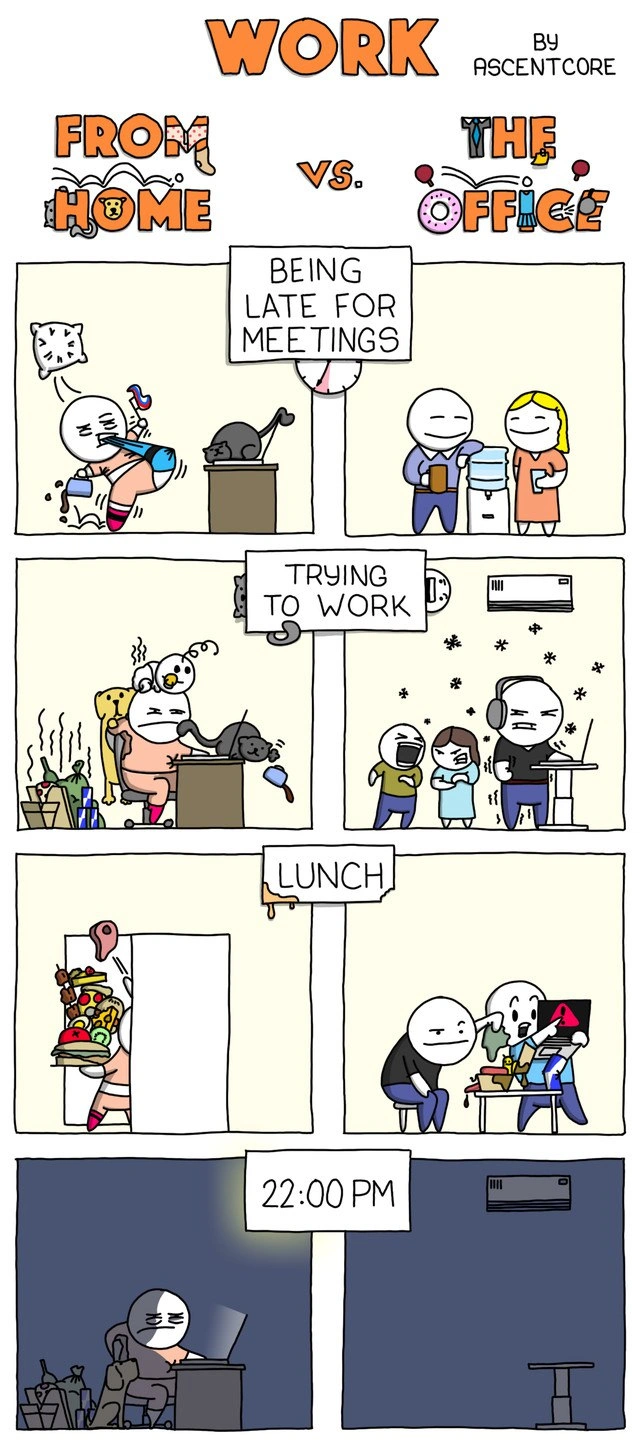
If you’re a newer developer or just starting your tech career, this comic is a lighthearted crash course in the differences between working from home (WFH) and working in a traditional office. It shows four common daily scenarios – being late to a meeting, trying to concentrate on work, eating lunch, and the late-night wrap-up – and compares how they play out at home versus in the office. Each panel is packed with relatable details that reflect typical challenges in each setting.

Let’s break it down. RemoteWork, especially now, means you do your job outside the office (usually at home) using the internet to stay connected. So for meetings, instead of walking to a conference room, you join a video call on your computer (think Zoom, Microsoft Teams, or Google Meet). In the first row labeled “Being Late For Meetings,” the left side shows the poor WFH developer scrambling: they’re tangled in headphone wires (maybe trying to connect audio to the Zoom call), still wearing pajama pants, spilling coffee on the go – even a cat is pawing at the wall leaving prints. This chaos suggests that even without a commute, a person can struggle to be on time. Ever had your laptop restart right before a scheduled online class or stand-up? Or maybe your cat knocked over your coffee exactly when you had to click “Join Meeting”? It happens! On the right side, titled “(at) The Office,” two coworkers are lingering at a water cooler and chatting casually. The water cooler is symbolic of informal office chit-chat – basically when colleagues take a break to gossip or discuss last night’s game by the water dispenser. It’s a friendly scene, but the joke is that they’re also not in the meeting yet because they got sidetracked talking. So, whether at home or in the office, you might be late to the meeting – at home due to personal mishaps or tech issues, and at the office because you were socializing or lost track of time in the hallway. For a new developer, the takeaway is: different environments, different reasons, but being late to meetings is a universal struggle (and yes, it’s usually frowned upon, but everyone has those days).

Now, “Trying to Work” (second row) compares focus and distractions in each environment. On the WFH side, the drawing humorously piles on every home distraction imaginable: the developer is literally buried under a dog, a cat on their head, and even holding a crying baby, plus there’s a mess of toys and household stuff around. It’s clearly tough to even reach the keyboard! This reflects a common home_office_challenge: family and pets don’t always understand that you’re working – to them, you being home means you’re available. Many developers have stories like a cat walking across the keyboard during a coding session, or a child needing help right when you’re debugging. On the right, the office worker is at their desk (a standing desk, which some devs use to avoid sitting all day), wearing big headphones to concentrate. Despite that, you see colleagues nearby wearing masks and sneezing or coughing, and an air conditioning unit on the wall blasting cold air (the little snowflake symbols and Brrrr indicate it’s noisy or cold). This captures typical open office problems: open-plan offices put everyone in one big shared space. It’s great for quick collaboration, but not so great when you need quiet time to think or code. People talk, phones ring, someone sneezes loudly – and yes, office air conditioning is famously either freezing or not working at all! So for a junior developer, here’s the contrast: at home, you fight for focus against family/pet interruptions; at the office, you might fight for focus against office hubbub and environmental annoyances (like noise and discomfort). In both places, you’ll need strategies to concentrate – maybe communicating boundaries to family when WFH, or using headphones and finding a quieter corner when at the office. It’s a relatable part of developer life: interruptions can come whether you’re in your living room or a sleek tech campus.

Next up is the “Lunch” comparison (third row). This one’s a bit humorous-gross in the details. On the WFH side (left), our home-working hero is peeking out of a doorway carrying a teetering tower of junk food: I spot burgers, pizza slices, a donut, a drumstick – it’s an entire buffet of unhealthy snacks. This is poking fun at how, when you work from home, the kitchen is just a few steps away. It’s very easy (and tempting!) to grab snacks or make a quick comfort lunch. No coworkers are watching, and if you’re in a rush or having a stressful day, you might just microwave some pizza pockets or pile up cookies. Many of us fell into the “snacking too much at home” habit, so it’s a comedic exaggeration of that. On the right side in the office, lunchtime looks very different: the developer brought their lunch (there’s a little name tag on the lunch bag or container – a common practice to avoid mix-ups), but they’ve caught a coworker red-handed taking it from the fridge! The office worker’s face is a mix of horror and annoyance, and the lunch thief has a guilty “uh-oh” expression while holding the evidence (half-eaten food or an empty container). This scene references a well-known bit of WorkplaceHumor: people stealing colleagues’ lunches from the shared fridge. It sounds ridiculous, but it definitely happens and has spawned many jokes and even office “wanted” posters for the mysterious Lunch Thief. 😄 For someone new to office life: most offices have a kitchen or break room with a fridge where you can store your lunch. It’s usually safe… but once in a while, someone might “mistake” your labeled lunch for theirs, or take your shiny can of soda. Thus, office etiquette 101: label your food clearly, and still, maybe don’t bring your most coveted leftovers on a day you’re not watching the fridge! The meme humorously shows that while a remote worker has total freedom over their lunch (maybe too much freedom diet-wise), an office worker has to contend with other humans potentially messing with their meal. Both are funny extremes of lunchtime struggles.

Finally, the “22:00 PM” panel (fourth row) compares late-night situations. On the left, we see the WFH developer’s room shrouded in darkness except for the computer’s glow on their tired face. It’s 10 PM, and they’re still working. The posture and expression say “I’m so done, yet I’m still here.” The home is quiet (probably family is asleep, even the pets look tired), but that poor dev hasn’t logged off. This illustrates a big challenge with remote work: separating work time from personal time. Since your work is just a laptop at home, it’s easy to keep going late, either because you lost track of time or because you flexed your schedule earlier and now you’re making up tasks. Some companies also accidentally encourage this always-online feeling, where you might feel you should answer one more email or finish one more feature before bed. On the right side, the office at 10 PM is empty – the lights are off, no one is at their desk. In a typical office, by that time almost everyone has gone home. In fact, many offices lock up or at least strongly discourage staying that late (some lights are on motion sensors and will go out, air conditioning might turn off after hours, etc.). This draws a contrast: in the office, when the day’s done, you physically leave and that helps you stop working; at home, you might keep working because you’re already at home and there’s no clear end-of-day signal. For a new developer, this is a gentle caution. Work-life balance can get tricky with remote work – you have to set your own boundaries (like “I will shut down my laptop by 6 PM”), otherwise you might end up like the cartoon, working into the late night. In an office, the boundaries are a bit more set by external factors (everyone leaving, trains to catch, office cleaners kicking you out 😅). So the meme is showing that by 10 PM, the remote worker is unfortunately still at it, whereas the office worker physically can’t be at work – the empty cubicle implies they went home and maybe are relaxing or sleeping by now.

All together, these comparisons deliver a message: both WFH and office have their pros and cons, often in a humorous way. It’s highlighting RelatableDevExperience tidbits. Newer devs who started during the pandemic may find the WFH side very familiar (maybe you haven’t experienced a real water cooler chat, but you know the panic of an unexpected home distraction during a meeting). And if you’ve interned or worked in an office even briefly, the office side will ring bells (the open-office noise, the communal fridge dramas, etc.). The comic isn’t saying one is better than the other outright – it’s more like “look, each side has its own crazy situations.” The tags like RemoteWork, MeetingHumor, OfficeCulture all point to this being a light comic take on everyday work situations. It’s meant to make you nod and laugh, thinking “Yup, that’s exactly what it’s like.” And whether you’re junior or senior, there’s comfort (and comedy) in knowing these little struggles are shared by many in the tech world.

Level 3: Household Havoc vs Cubicle Chaos

On the surface, this comic splits a developer’s typical workday into two columns – Work From Home on the left and The Office on the right – and the humor comes from how each scenario spirals into its own flavor of chaos. For seasoned developers who’ve experienced both worlds, the strip is painfully accurate and hilarious in its contrast. The meme touches on several everyday tech workplace themes: being late for meetings, trying to work despite interruptions, the drama of lunch in shared spaces, and working late (the dreaded 22:00 PM panel). Each row exaggerates realities we know too well, highlighting the trade-offs between remote and in-office work.

In the first row, “Being Late For Meetings,” the WFH developer is in a frantic scramble – tangled in headphone wires, coffee spilling everywhere, still in pajamas – basically living the nightmare of a Zoom stand-up gone wrong. There’s even a cat’s paw print on the wall and kids’ toys scattered around, implying a wild home environment. Meanwhile, the office counterpart is casually chatting at the water cooler with a colleague, looking totally unhurried. The senior engineer in us chuckles because we’ve been on both sides: at home you can technically roll out of bed two minutes before a meeting, yet still end up late due to a webcam malfunction or a pet-related incident. In the office, though, being “late” might involve getting sidetracked by impromptu hallway conversations (the classic water-cooler effect). The humor is that neither environment guarantees timeliness – whether it’s the cat unplugging your router or a coworker triggering an unscheduled gossip session, something always conspires against that 9:00 AM sync.

The second row, “Trying to Work,” portrays how developer productivity can be attacked from all sides. On the WFH side, the developer is practically under siege by pets and family: a dog and cat literally climbing on them, a crying baby on lap, and household clutter everywhere. It’s absurd, but many of us have experienced a mild version of this – the cat that insists on sitting on your keyboard right when you’re writing code, or a toddler bursting into your home office during a critical deployment call. It’s the RemoteWork reality: your home is not a controlled environment, and pets think every day is bring-your-human-to-work day. Contrast that with the office panel: the poor developer is at a standing desk, noise-cancelling headphones on, yet still grimacing. Why? Two masked coworkers nearby are sneezing repeatedly (reminding us that offices can be germ factories), and a loud air conditioner blasts snowflake-like Brrr! sounds in the background. This is poking fun at open_office_noise and the general distractions of an office: colleagues chatting, phones ringing, random sneezes or coughs (especially relevant in pandemic-conscious 2021), and that ever-present arctic air conditioning that you can’t control. Experienced devs recognize this trade-off: at home you battle domestic interruptions, at the office you battle co-worker cacophony. Ultimately, both sides require adaptability – you either master the art of hitting mute on Zoom while shooing a cat away, or you perfect concentrating with headphones while the office CorporateCulture swirls around you.

The third row, “Lunch,” is a classic scenario split. On the home side, the worker peeks out a door balancing a ridiculously tall stack of junk food: burgers, pizza, donuts – basically an entire cheat day in one meal. This parodies a known WFH pitfall: unlimited (and often unhealthy) snacks since your kitchen is only a few steps away. Without coworkers around, no one’s there to judge that triple-stacked sandwich or fourth slice of leftover pizza, so the remote dev’s lunch can devolve into a one-person feast. Compare that to the office side: our office dev looks utterly betrayed, catching a colleague red-handed stealing their clearly labeled lunch from the communal fridge. This is peak OfficeCulture humor – the notorious “who stole my lunch?” saga. Every veteran office worker has either experienced this or knows someone who has. You label your lunch with BIG letters, yet somehow mysterious forces (e.g., a ravenous PM or clueless intern) still prey upon your Tupperware. 🤷‍♂️ It’s a relatable WorkplaceReality: at home you worry about self-control (and maybe running out of Cheetos), in the office you worry about food theft or that the only thing left in the fridge is someone else’s weird cauliflower soup. The juxtaposition is funny because it’s true – both environments have absurd lunch problems, just of totally different flavors.

Finally, the fourth row, “22:00 PM,” hits a bit close to home (literally) for a lot of developers. The WFH side shows the remote worker still at their laptop late at night, room dark except for the ghastly glow of the screen, looking exhausted and over it. The day’s mess (toys, pets, coffee mug) is still all around, implying they never really escaped work or home duties all day. This highlights the work-life balance issue: when your office is your home, it’s hard to clock out. Many experienced engineers have fallen into the trap of working late into the evening when remote – whether it’s because there's always “one more bug to fix,” or simply because no one is physically shooing you out of the building. It’s a mix of passion and pressure that leads to longer hours. Meanwhile, the office panel at 10 PM is an empty cubicle farm – lights off, absolutely nobody there. In a traditional office, by that hour security guards are probably doing rounds to ensure everyone’s gone home. The emptiness on the office side underscores how, at least pre-2020, office work had a clearer stopping point (you’d catch the train home, or the cleaning crew’s vacuum noise was your cue to leave). Senior developers chuckle (perhaps a tad bitterly) at this contrast: they know that with RemoteWork they might inadvertently become the always-on developer, while the office at least used to force some downtime. It’s a comedic-yet-sobering commentary on how DeveloperProductivity and burnout are tied to our environment. Anticipating that “just one more deploy” at home can easily slip into an all-nighter, whereas in the office you’d have been out the door at 7 PM when the lights automatically shut off.

In sum, the comic resonates strongly because it exaggerates truths that industry veterans have lived through. It’s pointing out that neither remote nor office is a paradise – each has its own comedic hellscape of distractions and routines. The RelatableDevExperience here is universal: no matter where you work, something always tries to mess with your day, and you just learn to laugh it off (lest you cry). This strip by Ascentcore came in late 2021, when many developers had experienced a year or more of full-time WFH and were starting to remember (almost fondly, almost) the weird annoyances of office life. The senior perspective recognizes the meme’s cathartic humor: it’s basically saying “pick your poison” – whether it’s Fluffy the cat or Bob from accounting, something will interrupt your workflow, and you might still be typing away at 10 PM regardless. We laugh because we’ve been there – keyboard in one hand, coffee in the other, cat on the lap, watching a coworker steal our sandwich on Zoom… okay maybe not all at once, but close enough!

# Quick pseudo-code to illustrate the distraction trade-offs
distractions = []
environment = "home"  # try "office" or "home"
if environment == "home":
    distractions += ["cat on keyboard", "kids bursting in", "doorbell rings", "coffee spill"]
    meeting_start_time = "9:05 AM"  # a little late due to chaos
else:  # office
    distractions += ["chatty coworker", "sneezing colleagues", "freezing A/C", "lunch stolen"]
    meeting_start_time = "9:05 AM"  # also a little late, different reasons
print(f"In {environment}, distractions include: {distractions}. Meeting started at {meeting_start_time}.")

The code above humorously shows how whether you’re in "home" or "office" mode, you accumulate distractions – just from different sources – and either way you might start that meeting at 9:05 AM instead of 9:00. In both cases, productivity takes a hit and the day gets longer. The senior dev smile here comes from recognizing this fundamental truth: the context changes, but the core challenge – trying to get quality work done amidst constant interruptions – is the same. And that shared struggle is exactly what makes the meme so funny and so real to us.

Description

Vertical four-row comic titled “WORK” with subtitle “FROM HOME vs. THE OFFICE” and credit “by Ascentcore.” Each row has a center sign with black handwritten text and two side-by-side panels. Row 1 sign reads “BEING LATE FOR MEETINGS”; the left panel shows a pajama-clad remote worker tangled in headphones, spilling coffee while rushing to a laptop, a cat paw print on the wall, and scattered toys, while the right panel shows two office coworkers casually chatting at a water cooler. Row 2 sign says “TRYING TO WORK”; the home side depicts the same worker buried under pets, a crying baby, and household mess, whereas the office side shows the employee at a standing desk grimacing while mask-wearing colleagues sneeze nearby under a loud air-conditioner. Row 3 sign says “LUNCH”; the remote worker peeks from a door carrying an absurdly tall stack of junk food, while in the office the worker discovers a coworker stealing his labeled lunch from the refrigerator. Row 4 sign says “22:00 PM”; the home panel is dark with the exhausted worker still at the glowing laptop surrounded by clutter, and the office panel is an empty, dark cubicle farm. The strip humorously contrasts distractions, meeting lateness, meal routines, and extended hours experienced in remote versus on-site work, resonating with software engineers accustomed to distributed teams and open-office noise
Comments

14
Anonymous ★ Top Pick WFH vs. office is just choosing your failure mode: a single-tenant VM where the cat, toddler, and coffee all run as root, or a noisy Kubernetes node where every coworker is a sidecar container spamming stdout - either way the liveness probe fails by 22:00
  1. Anonymous ★ Top Pick

    WFH vs. office is just choosing your failure mode: a single-tenant VM where the cat, toddler, and coffee all run as root, or a noisy Kubernetes node where every coworker is a sidecar container spamming stdout - either way the liveness probe fails by 22:00

  2. Anonymous

    The only distributed system harder to debug than a microservices architecture is figuring out whether your team's productivity issues stem from too many meetings or from everyone's cats demanding attention during standup

  3. Anonymous

    The real difference between WFH and office isn't the commute - it's that your production incidents at 10 PM have an audience of one very judgmental houseplant, while your office's after-hours deployment at least has the janitor to witness your heroics. Both environments have their 'always-on' culture, but only one lets you debug in pajamas while your cat deploys a denial-of-service attack on your keyboard

  4. Anonymous

    WFH is Byzantine fault tolerance with cats and toddlers; the office is a DDoS called “open floor plan” - and the deploy window somehow still stretches to 22:00

  5. Anonymous

    WFH: Office empties at 22:00; home fills with hotfix deploys because the PR pipeline doesn't clock out

  6. Anonymous

    WFH is noisy peripherals, the office is noisy neighbors - either way the human CPU stays thread‑starved until the meeting scheduler releases the lock at 22:00 and throughput finally spikes

  7. @slnt_opp 4y

    Okay, not having cat or kids, got it

  8. @RiedleroD 4y

    the dude has two cats, one baby and one dog bruh

    1. @azizhakberdiev 4y

      That cat does not count as a cat. It is reference to the cat on the table

      1. @RiedleroD 4y

        there's a different one hanging off the back of his chair

        1. @azizhakberdiev 4y

          It's dog, as you said above

          1. @RiedleroD 4y

            the dog is in the last panel

            1. @RiedleroD 4y

              ohhh it's the same one lol

  9. @abstract_factory 4y

    just realized this is a child, not bug character lol

Use J and K for navigation