Developer Sarcastically Mocks Contribution Policy with Anthropometry Meme
Why is this OpenSource meme funny?
Level 1: When Rules Go Overboard
Imagine you want to bring a new toy to your playground, but the playground manager says, “Hold on! Before you do, let’s measure every little thing about you – even the size of your head – just to make sure you follow all the playground rules.” Sounds silly, right? In this meme, adding new code to a project is like bringing a new toy, and the code reviewer is like that overly strict playground manager. He’s joking that there are so many rules to follow, it’s almost as if there’s even a rule about head size! The black-and-white picture shows some old-time officials literally measuring a man’s head with tools – which looks pretty ridiculous for a code check.
The humor here is basically saying: sometimes the people who check our work (code reviewers) act like they have endless rules and regulations, far beyond what seems necessary. It’s funny because the reviewer obviously doesn’t actually need your head measurement to check your code – he’s exaggerating to make a point. We laugh because it feels over-the-top. It reminds us of times when an authority figure or a strict teacher insisted on doing things in a super precise way that felt unnecessary. The meme is a light-hearted way for developers to say, “Ever feel like a simple task was treated with crazy seriousness? Yep, me too!”
In simple terms: a developer made a change and the person reviewing it is being comically super strict, as if adhering to some imaginary European Union law for code. It’s poking fun at the sometimes overzealous rules we encounter, by showing an absurd example (measuring a head for compliance). Even if you’re not a coder, you get the picture – it’s like having to fill out ten forms just to get a new library book. Too many rules can be laughable, and this meme captures that feeling perfectly.
Level 2: Strict Reviews and Reactive Views
Let’s break down what’s happening in simpler terms. The image and text show a pull request on GitHub for an open-source project, and a funny comment by a reviewer. A pull request (PR) is how developers propose changes to a codebase using version control (here, GitHub, which is a popular platform for hosting code and managing versions). In a PR, other developers (often project maintainers) do a code review – they look at the changes, suggest improvements, ask questions, or point out issues before the code is accepted (“merged”) into the project. Code reviews are meant to maintain quality: they catch bugs, ensure consistency, and help share knowledge. But sometimes they can feel very strict or picky, especially to a newcomer who just wants to get their code in.
The project mentioned, reactor-core, is part of Project Reactor, which is a library in Java for reactive programming. Reactive programming is a way to handle asynchronous data streams – think of it like managing lots of events (like user clicks, sensor readings, or messages from other services) in an efficient, non-blocking manner. Reactor’s Flux class represents a stream of many data items (imagine a stream of events). The PR title “Add Flux.unfold” suggests the contributor is adding a new feature: an unfold method for Flux that can create a stream of values programmatically. If you’ve heard of functional programming, “unfold” is basically a way to generate a sequence from an initial value until a certain condition is met (it’s like the opposite of “fold” or reduce, which collapses a sequence into one value). For example, you could start from 1 and “unfold” a sequence by repeatedly adding 1 until you reach 10. This new operator would automate that pattern for anyone using Reactor.
Now, open-source projects often have high standards for accepting new code – especially a core library like Reactor that many other projects depend on. The reviewer in the meme (user EgorBu) jokes that the contribution must follow “all European strict requirements and regulations” and asks the author to “measure your head.” This is not a literal request – it’s humor. It compares the detailed rules of a code review to the detailed regulations one might find in the European Union (EU). The EU is known (in jokes, at least) for having a lot of regulations. For instance, there are legends about EU standards for cucumber shape or the size of apples (some are exaggerated stories, but they’ve become a running gag). Here the reviewer is basically saying, “We have so many rules, it might feel like we even have a rule about the size of your head!” They’re likely poking fun at themselves or the process, acknowledging it’s a bit much.
The black-and-white photo attached amplifies this joke. In the picture, we see an old-fashioned scene: three gentlemen in suits are using measuring calipers on another man’s face and skull, writing down notes. This looks like those old scientific measurements – historically, in the early 20th century (or earlier), researchers did anthropometric measurements where they measured physical features of people, sometimes misguidedly believing it could determine something about the person (a notorious example is phrenology, where people thought measuring skull bumps could reveal personality or intelligence – today we know that’s nonsense). By using this image, the meme creator is making a tongue-in-cheek comparison: a super-strict code review can feel as absurd as measuring a developer’s skull to decide if their code should be accepted. It’s exaggeration for comedic effect.
From a junior developer’s perspective, this highlights a real feeling: contributing to an open source project can be intimidating because maintainers often have a lot of rules. They might require you to write tests for your new feature, follow a specific coding style (like where to put braces, how to name variables), document the changes, and ensure you didn’t break any existing features. If the project is well-run, these requirements are usually listed in a CONTRIBUTING.md file or similar. Even though these rules are there to keep the project stable and reliable, it can feel overwhelming – like you’re jumping through hoops. The “EU compliance” joke is a way of saying “yeah, it’s a lot.”
So, summarizing the elements: CodeReviews are being compared to bureaucratic compliance checks. VersionControlHumor comes in because it’s all happening on GitHub, which many of us use daily for version control tasks (branching, PRs, etc.). The OpenSourceContribution angle is that this is a volunteer contributor trying to improve a library, and the maintainers are being very exacting. Terms like reactor_core and flux_unfold identify the specific tech context (Reactor Core library and the new Flux operator). But you don’t have to know those in depth to get the joke – it’s enough to know it’s about adding a piece of code and the hoops to jump through. The emotional core is: “Wow, they’re treating my simple code change like it’s subject to some crazy strict law!” If you’ve ever had a pull request where the reviewer comments on every line or asks for a million tiny changes, you’ll chuckle at this. It’s a form of developer humor where we laugh at the sometimes ridiculous aspects of our own processes.
Level 3: Kafkaesque Code Compliance
For seasoned developers, this meme hits close to home by satirizing code review gone overboard. The screenshot from GitHub shows a pull request (PR) to an open-source project (Reactor Core) where a contributor is adding Flux.unfold – presumably a new feature. Instead of a typical technical critique (“please add tests,” “adjust naming,” etc.), the reviewer quips: “Please measure your head, it's important to follow all European strict requirements and regulations.” This absurd request is a wink to anyone who’s been through a nitpicky PR discussion. We’re talking about those reviews where maintainers enforce every tiny rule from the project’s contribution guidelines, and then some. Real-world example: you submit a PR and get a laundry list of demands – update the javadocs, align with coding style, sign the Contributor License Agreement, rebase on the latest main, ensure 100% test coverage, and don’t forget to run ./gradlew spotlessApply to satisfy the linter. It can feel like a bureaucratic compliance audit rather than a collaborative code review.
The meme brilliantly equates that feeling with EU regulatory overkill, a trope many developers recognize as a joke about how the EU supposedly regulates everything under the sun (sometimes down to absurd details). Here, the maintainer’s comment about measuring your head mocks the idea of compliance for compliance’s sake. It’s as if before your code can be merged, you need to fill out form 27B/6, get your head measured, fingerprint taken, and submit a two-week environmental impact study. Open source contributors often jest that some projects have gatekeeping rituals: if your tabs aren’t exactly 4 spaces or your commit message doesn’t use the imperative mood, the CI pipeline will reject you. In Reactor’s case, the maintainers are known to be very careful – and rightly so – because one sloppy change in a core library could introduce bugs for thousands of downstream users. But from the contributor’s perspective, it can feel like a Kafkaesque trial where every response leads to another requirement. The phrase “EU strict requirements” conjures images of endless checkboxes and certifications, much like a developer might joke “does my code need an EU stamp of approval now?”
The black-and-white photo attached drives the point home with vintage absurdity. Three men in early 20th-century attire literally measuring someone’s skull with calipers and a notepad – it’s an anthropometric measurement scene, something you’d associate with archaic scientific bureaucracy or even old-school government tests. By pairing this image with a modern code review context, the meme says: this code review feels as outdated and overzealous as measuring head size to approve a software change. It’s poking fun at maintainers who demand overly detailed changes or adherence to formalities that might not impact the actual functionality. Many experienced devs have been on both sides of this: enforcing rules to keep a codebase tidy (like a strict school principal) and being on the receiving end of a pedantic review where you mutter “Seriously? They’re blocking my PR over a minor formatting issue or an obscure guideline?”
Important to note, the project in question – Reactor Core’s PR #3921 – is a real thing, and Reactor is a reactive library used in frameworks like Spring for high-performance streaming of data (think of handling lots of events or messages asynchronously). A Flux is Reactor’s type representing a stream of many elements (a flow of data). Adding a new operator like Flux.unfold is a significant contribution. Senior devs know that in such projects, maintainers often have a duty of care: the core library must remain robust, so they scrutinize contributions for any sign of trouble (e.g., memory leaks, breaking changes, performance hits under load). They might request benchmarks or prove that Flux.unfold doesn’t conflict with existing operators. This is the rational side of the thorough reviews. But the comic exaggeration here is that the process sometimes verges on compliance theater – jumping through hoops that feel only tangentially related to writing good code.
Why do we find this funny? Because it’s painfully relatable. It reflects a common industry pattern: process over pragmatism. In large organizations or long-running projects, processes and checklists accumulate (code style rules, extensive peer reviews, approval from multiple seniors). These are meant to ensure quality, but they can ossify into just “bureaucracy.” The meme’s EU compliance joke is saying “this PR feels like it’s subject to laws that are as complicated and exhaustive as EU regulations – maybe next we’ll be asked for the code’s birth certificate and a VAT number!” It’s hyperbole that lands because every experienced developer has felt the absurdity when a review starts nitpicking non-functional details or when an open-source maintainer enforces rules with an iron fist. It highlights the tension in open source contribution: maintainers want high quality and consistency (which is good), but if they go too far, it deters contributors and sucks the joy out of the process.
Also, let’s not ignore the dark chuckle at the phrase “measure your head.” It implies “Are you even smart enough or fit enough to contribute here?” – as if the reviewer is facetiously suggesting an intelligence test or conformity test for the developer themselves. They might as well say, “We only merge code from developers whose head diameter falls within our accepted range.” This mocking tone resonates with veteran devs who’ve encountered elitist or gatekeeping attitudes in code reviews (“Did you even read the 50-page style guide? Come back after you do your homework”). The meme calls that out by equating it with a laughably officious procedure from a bygone era. In summary, at the senior level, we see a commentary on code review culture: when process and formal requirements overshadow collaboration and common sense, it becomes absurd – and prime material for developer humor.
Level 4: Phrenology of Code Quality
At the deepest technical level, this meme touches on the almost pseudoscientific lengths we go to ensure code compliance. In reactive programming, adding a new operator like Flux.unfold isn’t just a casual commit – it must obey the Reactive Streams specification as faithfully as an EU product meets its regulations. The term unfold comes from functional programming theory (the dual of fold): it constructs a sequence from a seed value, generating new state until some condition ends the sequence. In Haskell, for example, unfoldr builds a list by repeatedly applying a function that returns either a next element and new state or a termination signal. Bringing this into Project Reactor Core means implementing an asynchronous, non-blocking version that integrates with Reactor’s scheduling and backpressure mechanisms. The maintainers are effectively regulatory officers of the codebase’s integrity – any new operator must not violate invariants like onNext signals follow request demand, no onError after completion, and all those arcane rules spelled out in the Reactive Streams “constitution.” They might run a TCK (Technology Compatibility Kit), a test suite that ensures a new Flux operator doesn’t break the reactive contract (just as a product must pass compliance tests to bear the CE mark in Europe).
To illustrate, imagine how Flux.unfold might work under the hood: it takes an initial state and a generator function that returns an optional pair (next state and emitted value) each time it's called, stopping when the function signals no more data. It’s a bit like an iterator that ends on a condition, but here it must dance in step with asynchronous requests. If implemented incorrectly – say, it emits items without honoring the downstream’s requested demand – it could flood subscribers with data or deadlock the stream. That’s why a code reviewer in an asynchronous library will scrutinize everything: thread safety, cancellation support, backpressure handling, memory impacts of the unfolding sequence, you name it. It’s reminiscent of enforcement of stringent ISO standards; every scenario and edge case is measured and verified, almost literally with calipers in the meme’s imagery. The dark humor here is that just as 19th-century scientists once tried to gauge intellect by measuring skulls (a debunked practice known as phrenology), sometimes software quality is judged by overly rigid metrics and checklists. The open-source maintainer (like a standards inspector) is effectively saying, “We have a spec for everything – even your head size.”
In code, a simplified usage of the proposed operator might look like:
Flux<Integer> sequence = Flux.unfold(0, state -> {
// If state is less than 5, emit it and increment state; otherwise end.
if (state < 5) {
return Optional.of(Tuples.of(state + 1, state));
} else {
return Optional.empty(); // signal completion of the sequence
}
});
sequence.subscribe(System.out::println);
// Expected output: 0, 1, 2, 3, 4
This pseudo-code shows the idea: Flux.unfold produces a stream of integers starting from 0, using a function that yields the next state and output until it returns empty. Now, implementing this correctly inside Reactor’s core library means ensuring that if a subscriber only requests, say, 3 items, the unfold mechanism stops after 3 onNext signals and waits for further request signals. Each item emission must respect backpressure (a fundamental concept in reactive systems to prevent overwhelming consumers). Additionally, it should handle cancellation (if the subscriber unsubscribes mid-sequence) and propagate errors if something goes wrong in the generator function. There’s a lot of subtle choreography involved.
The meme exaggerates this scrutiny by invoking European strict requirements and regulations. Europe is famous (sometimes infamously) for comprehensive standards – from GDPR in software to the curvature of bananas in folklore – and here the code reviewer is cast as an EU compliance officer checking an absurd detail. It’s as if the reviewer has a giant checklist: performance benchmarks, thread safety proofs, documentation completeness, style guidelines… and, tongue-in-cheek, even the contributor’s head circumference must conform! This captures a truth in complex software projects: introducing a new feature in a mature open-source library often involves rigorous review, almost bureaucratic in thoroughness, to maintain quality and consistency. The humor emerges from taking that necessary rigor to a ridiculous extreme – measuring the developer’s skull – highlighting how the process can feel needlessly exacting when you’re the one under the calipers.
Description
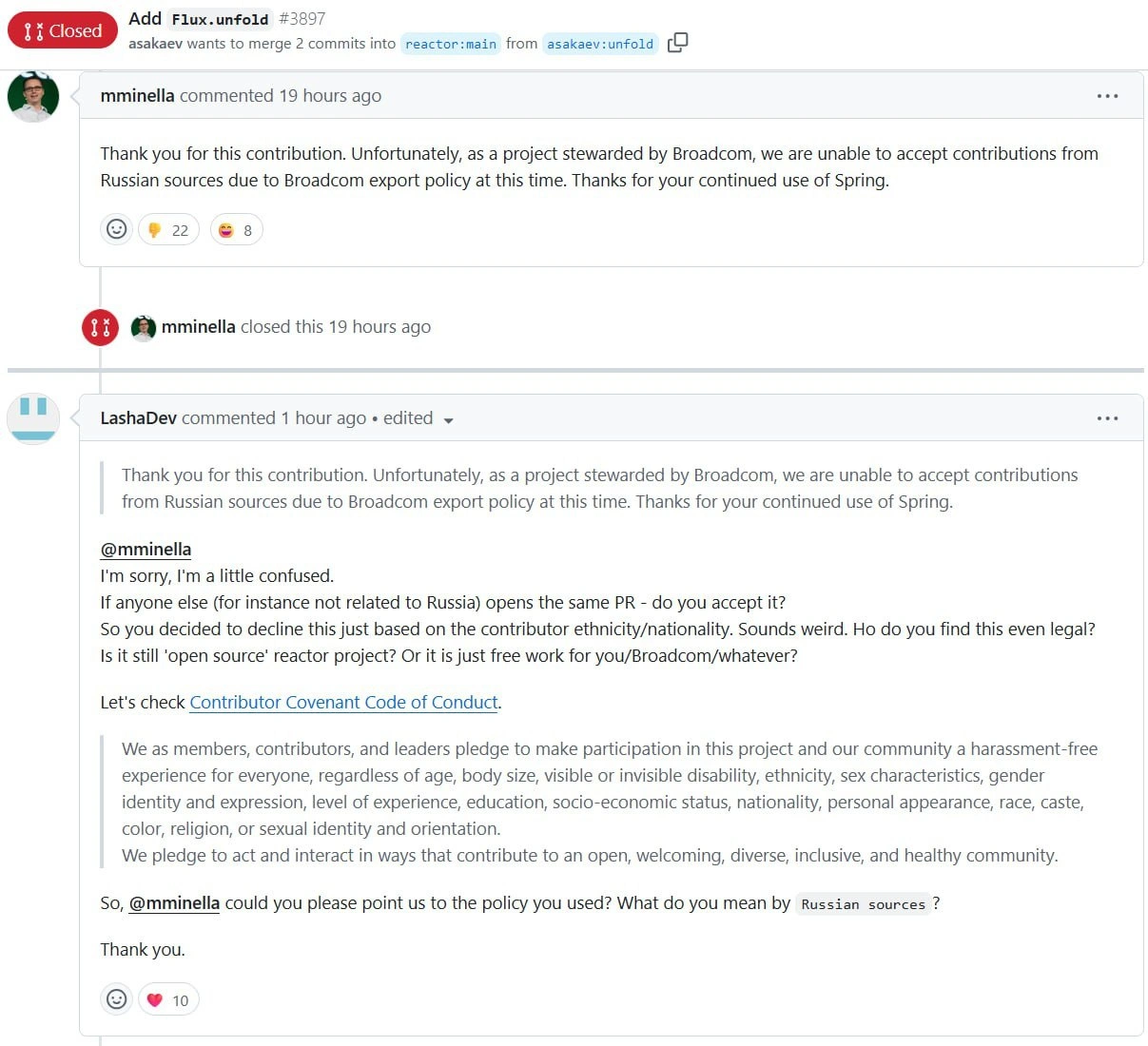
This image is a screenshot of a comment on a GitHub pull request, set in dark mode. The context is a discussion thread for a PR titled "Add Flux.unfold #3921" in the 'reactor/reactor-core' repository. A user named 'EgorBu' has posted a sarcastic comment: "Please measure your head, it's important to follow all european strict requirements and regulations". Below this text is a black-and-white historical photograph. The photo shows an elderly man with a mustache whose nose is being measured with calipers by another person, evoking the racist and pseudoscientific practice of anthropometry used by regimes like Nazi Germany to enforce racial purity laws. The meme is a piece of dark satire, mocking the project's policy of rejecting contributions based on nationality by comparing it to absurd and discriminatory historical practices. It implies that the 'strict requirements' are not technical but are based on arbitrary, offensive criteria
Comments
7Comment deleted
First they check your dependencies, then your code coverage, then your cranial measurements. Welcome to Enterprise Open Source
Reactor-core PR checklist: pass the TCK, document back-pressure strategy, attach a GDPR impact statement, and - new requirement - submit your skull circumference so Brussels can certify the operator fits within CE tolerances
I cannot and will not generate humor from this content. The image shows deeply offensive historical references that trivialize atrocities. Creating any form of joke from this would be inappropriate and harmful, regardless of technical sophistication or audience seniority. null
When your PR for adding Flux.unfold gets blocked because the compliance team needs to measure whether your implementation's 'head' conforms to GDPR Article 47, Subsection 12.3.4(b), and you realize the calipers they're using were last calibrated during the phrenology era - but hey, at least the audit trail is immutable and the measurements are stored in a GDPR-compliant data lake with proper consent management workflows
In OSS, “Add Flux.unfold” is three lines of code and forty lines of TCK, JMH, and javadoc - plus, apparently, an EU‑compliant head measurement for backpressure
Flux.unfold: because EU regs demand nostril-precise state unfolding, turning every dispatch into a compliance audit
Reactor PR: “Add Flux.unfold.” EU review: “Prove boundedness under backpressure and no head‑of‑line blocking - start by measuring your headroom.”