AI Cures Imposter Syndrome with Existential Dread
Why is this AI ML meme funny?
Level 1: Fear Floats Away
Imagine you’re a kid in school who sometimes feels like you’re not as smart as your classmates – you’re afraid that one day everyone will realize you’ve just been faking how good you are at math or art or sports. That feeling is like a little sneaky ghost in your head making you doubt yourself. Now picture this: one day you hear a wild rumor that next year all teachers will be replaced by robots, and kids won’t even have to go to school because the robots will do everything. How would you feel? You might think, “Huh? That’s crazy… if that even happened, it wouldn’t be just me struggling – it means no one would be in class!” The rumor is probably not true at all, and it’s so over-the-top that you actually stop worrying about your own abilities for a moment. It’s kind of funny – the worry that “I’m not good enough at school” flies away because someone said no humans will do school at all! It turns your personal fear into something so big and silly that you just can’t take it seriously.
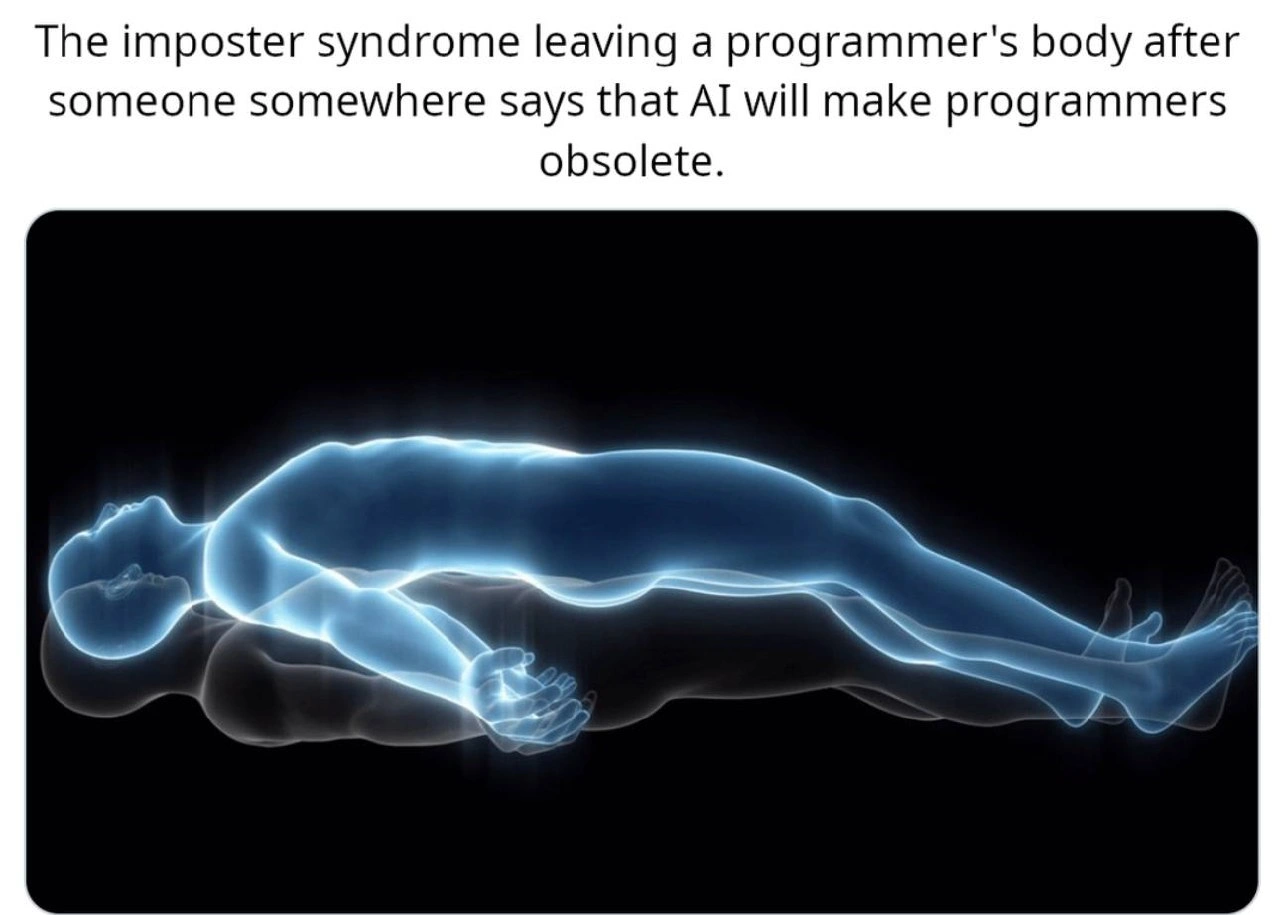
That’s exactly what this meme is showing, but with a programmer who usually doubts himself. He hears someone say “Pretty soon, AI (like super smart computers) will do all the programming, and human programmers won’t be needed.” It’s a huge, scary claim – almost like a science fiction story. But instead of scaring our programmer, it actually makes him feel better! It’s like his fear ghost gets startled and zooms right out of him. The picture of the glowing ghostly body floating upward represents the programmer’s self-doubt leaving his body. In simple terms: his big worry about not being a good programmer suddenly floats away when he hears this crazy idea that no programmers will be needed at all. He probably thinks, “That’s such a ridiculous idea that I’m not going to take it to heart. I guess I’m doing fine after all.” It’s a funny and positive moment because you see the person literally rise out of their slump. The meme is using a silly supernatural image to say something very real: sometimes, hearing an over-the-top crazy statement can actually chase away the normal little fears we carry. In the end, our programmer feels a bit more confident – all because the claim that a computer will replace him was just too funny (or too absurd) to believe, and his imposter syndrome (his inner worry of being not good enough) gets kicked out, at least for a while. So the meme makes us laugh and maybe feel a bit better, because it reminds us not to let wild hype scare us – instead, it can even make our everyday fears seem as flimsy as a ghost that we can just wave goodbye to.
Level 2: Unexpected Confidence Boost
Let’s break down what’s happening in this meme in simpler terms. It involves two key things: imposter syndrome and yet another AI hype headline in tech.
Imposter syndrome is a psychological phenomenon where a person feels like a fraud – like they aren’t really good at their job, and it’s just a matter of time before everyone finds out. In programming, it’s super common. You have developers who might be really skilled, sometimes even senior engineers, but inside they worry “I don’t know what I’m doing compared to everyone else.” So imagine a programmer who usually carries that self-doubt around like a little gray cloud over their head.
Now, along comes a sensational headline that says something like: “Breaking News: AI will make human programmers obsolete!” In plain language, “obsolete” means no longer needed. So this headline is claiming that Artificial Intelligence (AI) technology will get so advanced that companies won’t need to hire human coders anymore – the AI will supposedly be able to do all the programming by itself. This kind of claim pops up in tech news every now and then – it’s part of the IndustryTrends_Hype where people get excited (or scared) about big trends, sometimes exaggerating what they can do. It’s basically AIHype: the tendency to overstate AI’s capabilities. A recent example might be those articles about some AI like “ChatGPT builds an entire app in 5 minutes!”, which often gloss over the fact that the app is trivial or full of bugs. These headlines can be alarming, especially if you’re a developer wondering about job security.
But here’s the funny twist: when this programmer (who normally feels like an imposter) sees that crazy headline, something unexpected happens. Instead of getting more anxious, they actually feel a weird sense of relief. Their imposter syndrome just... disappears – as if it flew out of them. Why on earth would that happen? Well, think of it this way: imposter syndrome is very personal – “I feel I’m not good enough.” But the AI-will-replace-you claim isn’t about the individual’s skill at all; it’s an external, industry-wide doom saying. It’s so over-the-top that it kind of shocks the system. The developer’s thinking shifts from personal doubt to a more objective, even skeptical stance: “Uhh, that sounds fishy – I’ve heard big promises like this before.” It’s hard to keep worrying “I’m not good at coding” when someone is basically saying “No one will be coding soon, not even the best programmers.” It’s like the worry is no longer about you specifically. In a sense, the article is almost giving the dev an excuse: if they can’t code as well as they’d like one day, hey, maybe it’s because no humans can keep up with machines (so they feel less alone in their struggle). Ironically, it can even awaken the senior_engineer_skepticism that lies in many experienced devs – even if this programmer isn’t super senior, they might remember hearing similar grand claims in the past that never panned out. That skepticism acts as a defense mechanism, pushing the imposter feelings aside.
Let’s talk about the image itself. It’s a popular astral projection meme format. The picture shows a person’s body lying flat, and a ghostly glowing version of that person (like their spirit or soul) floating upward out of their body. Usually, people caption this kind of image as a humorous way to say “something major just left me.” Here, they’re saying “The imposter syndrome leaving a programmer’s body…” – in other words, the programmer’s self-doubt is imagined as a literal ghost that can exit their body. When does it leave? “After someone somewhere says that AI will make programmers obsolete.” So cause and effect: ridiculous AI replacement comment goes in, imposter_syndrome_relief comes out. The format is dramatic, almost like a soul escaping death, which makes it funny because they’re treating imposter syndrome (a psychological thing) like a physical ghost that can be scared off. It’s developer humor blending a MentalHealth reference (imposter syndrome) with an AIHumor punchline (AI making us obsolete, yeah right).
To a newer developer or someone outside tech, this might seem counterintuitive. Normally, hearing news that “your job might vanish” would stress people out, right? But the meme relies on the fact that experienced devs have heard this kind of claim many times and have good reason to doubt it. A junior developer might not have that context and could actually worry (“Oh no, do I need to switch careers if AI is taking over?”). But a programmer who’s been around the block sees the pattern: grand claims followed by reality. They might chuckle and think, “Seen this before. Wake me up when AI can debug legacy COBOL at 3 AM on a production server – until then, I’m not losing sleep.” So the meme is both a joke and a small lesson in tech skepticism: don’t believe 100% of the hype.
In summary, at this level we understand the meme as: Imposter syndrome (feeling like an inadequate programmer) is a real problem, but ironically, hearing an over-blown headline about AI replacing all programmers makes that feeling vanish for a moment, because the claim is so exaggerated that it resets the perspective. The programmer goes from quietly doubting themselves to practically saying “Pshh, I doubt that is true,” which is strangely empowering. The humor comes from that role-reversal – normally bad news makes you feel worse, but this particular kind of bad news actually cheers this programmer up by kicking their personal fears out of their head (like a ghost being kicked out of a haunted house).
Level 3: When Hype Hits, Doubt Quits
This meme captures a scenario every seasoned engineer recognizes instantly: the moment a wild tech headline crosses your feed proclaiming “AI will replace developers!” Instead of panicking, the veteran dev’s imposter syndrome evaporates like a startled ghost. Why? Because they’ve seen this movie before – so many times. It’s equal parts dark humor and coping mechanism, born of hype_cycle_fatigue and hard-earned perspective.
Shared Trauma & Skepticism: Across the industry, there’s a long-running inside joke (the kind of industry in-joke you’ll see on r/ProgrammerHumor) about these cycles of hype. One year it’s “write code with simple English commands, no programmer needed!” (flashback to CASE tools and 4GLs in the ’90s). Another year it’s drag-and-drop no-code platforms advertised to let “anyone build an app”. Then it was “AI pair programmers” like GitHub Copilot churning out code snippets. Now it’s possibly some AI/ML wunderkind algorithm promised to architect whole systems. A senior_engineer_skepticism reflex kicks in – a mix of eye-rolling and gallows humor. The meme’s top caption explicitly says, “after someone somewhere says that AI will make programmers obsolete”. The phrasing “someone somewhere” is deliberately tongue-in-cheek, implying the source is likely just some analyst, journalist, or salesperson – not exactly gospel. Senior devs have endured enough tech hype to know AIHype when they see it. The bold claim barely registers as a threat; if anything, it’s a relief because it’s so absurd and familiar.
Imposter Syndrome Relief by Absurdity: Imposter syndrome is that nagging MentalHealth struggle where a developer (often even a very experienced one) secretly feels “I’m not as good as everyone thinks, and someday I’ll be exposed as a fraud.” It’s pervasive in tech – even seniors who’ve been coding for decades can feel like they just got lucky and don’t really know what they’re doing. Normally, reading about some new ultra-productive whiz-kid tool can worsen such insecurity (“Oh great, now I have to learn this new thing or I’ll fall behind”). But when the claim is cranked to “you’ll all be obsolete soon”, it crosses into farce. It’s so over-the-top that it exorcises the imposter spirit, at least temporarily. The meme visualizes this as an astral_projection_meme: the glowing blue spirit literally leaving the programmer’s body is the imposter syndrome ghost. Think of it as a comical exorcism – the overstated hype is like holy water thrown on the demon of self-doubt. Imposter_syndrome_relief floods in, because the dev’s internal dialogue shifts from “I’m not good enough” to a sarcastic “Ha, DeveloperHumor at it again – apparently none of us will be good enough for these AI overlords. Sure.” The sheer ridiculousness of the headline effectively overrides personal doubt with collective skepticism.
Hype Cycle Reality Check: There’s also genuine comfort in the pattern. A senior dev might recall, “The last five times I heard we’d all be automated away, what happened? We got new tools that helped, sure, but we also got more work (and some new headaches) along with them.” It’s almost a running gag in the industry that every “programmer replacement” creates more demand for programmers in the end. For example:
- Visual Basic & RAD tools (1990s): Promised to let non-coders build apps. Result? Developers were still needed to handle the hard parts and clean up the messes.
- Offshore outsourcing wave (2000s): Business magazines said programming jobs in the West would vanish. What happened? The industry adjusted; dev roles evolved, and programming became even more collaborative and design-focused.
- Stack Overflow, Google, and frameworks: People joked that real devs just copy-paste code. If that were enough, wouldn’t programmers be obsolete? Yet those are just accelerators; knowing what to build and why remained the true challenge.
- Low-Code / No-Code (2010s): Marketed to “empower business users” to create apps without engineers. In reality, either the apps were toy projects or real apps required a developer to extend and maintain them.
- AI code generators (2020s): Impressive party tricks – you type
"Make me a web store in React", and you get some scaffold. But running that code in production, handling edge cases, security, performance, integration … a human developer ends up in the loop fast. Often, seniors joke that these tools generate code like a junior dev – speedy and enthusiastic but prone to mistakes that a senior dev must review. It’s AIHumor at its finest: the “robot” writes bugs at scale, and we get to fix them at 3 AM. (Cue the veteran saying, “Sure, let the AI handle on-call at 3 AM — I’ll be sleeping like a baby until they call me to clean up the meltdown.”)
So when the senior_engineer_skepticism kicks in, it actually boosts confidence: “If this is the competition, I’m good.” It reminds the dev of their own value – all the tacit knowledge and troubleshooting skill that no headline-hyped AI has yet replaced. In a twisted way, it unites developers: we’re all doomed together, haha! That dark humor is oddly comforting. It’s a classic case of IndustryTrends_Hype meeting the brick wall of real-world experience. The meme nails this sentiment with the dramatic ghost exit visual – something normally associated with a soul leaving a body upon death – here repurposed to represent doubt leaving the programmer’s mind. Essentially, the senior dev’s attitude becomes, “I’m done feeling like a fraud for now; I’ll just sit back and watch this AI hype train derail like the others.” And as cynical as that sounds, it’s actually a soothing thought born from years of seeing reality triumph over buzzwords.
Level 4: The Halting Hype Problem
At the deepest level, this meme hints at the fundamental impossibility of a one-size-fits-all coding automaton – a recurring fantasy in computing. Ever since the dawn of software, people have proclaimed some new technology would eliminate the need for human programmers. Each proclamation runs up against hard theoretical limits:
No Silver Bullet: In 1986, Fred Brooks famously argued that there’s no magic solution to eliminate the essential complexity of software development. The idea that "AI will make programmers obsolete" smacks of the very silver-bullet syndrome he warned about. Programming isn’t just typing code; it’s understanding fuzzy human requirements, dealing with ambiguous domains, and making design trade-offs – aspects that aren’t easily reduced to automation. Every few years, hype resurfaces claiming a new tool (4GLs, UML code generators, ChatGPT-like codexes) will trivialize programming. Yet the complexity (both essential and accidental, as Brooks put it) remains, and so do programmers.
Halting Problem & Undecidability: At a theoretical computer science level, writing correct, complete programs from open-ended requests isn’t just difficult – it’s mathematically unsolvable in the general case. The Halting Problem tells us there’s no general algorithm that can perfectly determine what an arbitrary program will do (halt or loop forever). By extension, an AI would need god-like powers – effectively a halting oracle – to always generate flawless, bug-free code for any arbitrary specification. In practice, current AI/ML models like GPT are predictive pattern machines; they generate code by statistically mimicking patterns in training data. They lack a true understanding of the code’s intent or the ability to reason about all possible execution paths. They certainly can’t guarantee adherence to an unstated spec or foresee corner-case bugs the way a rigorous human mind engaging in formal reasoning or thorough testing might. In formal methods, even automated program synthesis (where specifications are mathematically precise) hits combinatorial explosions. You often end up with either trivial programs that can be auto-generated or complex ones that require so many constraints that you’re basically writing the program in another form. In short, the dream of completely pushing a button and getting a correct, production-ready program bumps into the reality of computability theory and the inescapable complexity of real-world problems.
AI-Complete Problems: There’s a notion of AI-complete tasks – problems as hard as achieving Artificial General Intelligence itself. End-to-end software development – understanding a real-world problem, designing a solution, and translating it into efficient, maintainable code – is often considered AI-complete. It’s not like playing chess or classifying images, where objectives are well-defined and bounded. Building software is open-ended and intimately tied to human needs and changing contexts. An AI would effectively need human-level common sense, creativity, and abstract reasoning to replace a senior dev guiding a project. IndustryTrends_Hype around code-gen AI often overlooks this; it treats coding like assembling LEGO bricks, when in reality it’s more like architecting an entire city. Until an AI can truly grasp whether a feature makes sense in the big picture or preemptively know that a certain approach will create a maintenance nightmare 2 years down the line, human programmers aren’t going anywhere.
Humans in the Loop: Practically, even the most advanced AI coding tools today function as assistants, not replacements. They can accelerate writing boilerplate or scaffold a solution, but a human developer must remain in the loop to review, test, and integrate. There’s a poignant irony here: developers often suffer imposter syndrome because software engineering is challenging – you constantly face unknowns and bugs that make you feel clueless. But those same hard parts are exactly why AI can’t just swoop in and handle everything automatically. The meme’s joke – the astral projection of doubt leaving the body – is underpinned by this deep truth: every sensational claim that “the machine will do your entire job” eventually collides with reality, requiring human oversight and ingenuity. As long as requirements are vague, environments unpredictable, and correctness crucial, the Halting Hype Problem ensures programmers (and their occasional self-doubt) will be sticking around. In fact, each hype cycle tends to reinforce the value of experienced devs who understand these nuances.
Description
A meme with white text on a black background that reads: "The imposter syndrome leaving a programmer's body after someone somewhere says that AI will make programmers obsolete." Below the text, a visual depicts a translucent, glowing blue, ethereal human figure levitating horizontally, as if rising from a fainter, grey physical body lying in the same position beneath it. This image uses the popular "soul leaving body" or "spirit leaving body" meme format to represent a profound sense of relief or transformation. The technical humor lies in the ironic juxtaposition of two major programmer anxieties. Imposter syndrome, the persistent feeling of being a fraud, is paradoxically 'cured' by the greater, more existential fear of being made obsolete by Artificial Intelligence. The joke suggests that the threat of AI validates the difficulty of the job, implying that if a machine is needed to do it, it must have been complex all along, thus absolving the programmer of feeling like an imposter
Comments
9Comment deleted
The only thing that cures imposter syndrome faster than the threat of AI is realizing the AI will have to maintain your legacy codebase. Good luck with that, Skynet
Every decade something promises to automate us away; we’ve survived CASE tools, 4GLs, code-gen wizards - AI is just the newest junior dev we’ll end up code-reviewing
Nothing validates your architectural decisions quite like hearing that the same AI that confidently hallucinates database schemas and invents npm packages that don't exist is supposedly going to replace your 15 years of debugging race conditions in distributed systems
Ah yes, the classic developer paradox: you simultaneously believe you're not good enough to deserve your job AND that your skills are so uniquely human that no AI could possibly replicate them. It's Schrödinger's competence - until someone mentions GPT-4 can write React components, at which point the wave function collapses and suddenly you're confident enough to argue why context windows and hallucinations mean we're all safe for at least another quarter
LLMs will replace programmers? Great - wake me when one merges a PR deterministically, clears SOC2 on training‑data provenance, and pages itself at 3 a.m. after a hallucinated migration
AI might hallucinate perfect code, but it'll call the senior architect at 3AM when the monolith wakes up cranky
AI will replace programmers the day it merges its own PR, survives a 3am pager, explains CAP to Legal during the postmortem, and refactors a 200k‑line monolith without triggering compliance
AI just literally advised me shooting my own leg. So far it is doing great Comment deleted
It's getting rid of competition... 😅 before striking an all-out war on humanity. 👿 Comment deleted