ReiserFS: Now with more features than you asked for
Why is this TechHistory meme funny?
Level 1: Odd One Out
Imagine you’re reading a comparison chart about a bunch of gadgets, and it lists normal things each gadget can do. For example, pretend you have a chart for different smartphones. You see columns like “Has a long battery life,” “Takes high-quality photos,” and everything seems fine. But then you notice another column labeled “Explodes in your pocket.” 😳 Every phone model has “No” in that column (because of course no phone should do that), except for one phone which has a big green “Yes.” You’d probably laugh in a shocked way or think, “Wait, is that actually a feature? That’s crazy!”
That’s exactly what’s happening in this meme, but with computer file systems. The chart lists normal features (like being able to make shortcuts to files, or keeping a log to prevent data loss). Then it suddenly lists “Murders your wife” as if that were just another normal feature. Obviously, no software is supposed to do something horrible like that! In the chart, every file system has “No” for that, except the ones made by a guy who, in real life, did something terrible. It’s a joke: one of these things is not like the others. The last “feature” isn’t a real technical feature at all – it’s referencing a shocking true story.
So the humor comes from seeing a very out-of-place item in an otherwise serious list. It’s like if you saw a menu of sandwiches where all the sandwiches list their ingredients, and one sandwich has a note saying “might steal your car.” You’d do a double-take because that one note is so bizarre and dark compared to the rest. In this meme, “Murders your wife” is that bizarre note. It’s funny in a very dark way because it’s treating a real-life crime as if it were just another line on a tech spec sheet. Essentially, it’s pointing out something true (the person behind those two file systems did commit a murder) in the most blunt, absurd way possible. The result is the kind of uncomfortable laugh you get when a joke is equal parts clever and morbid.
Level 2: Links, Logs, and Murder
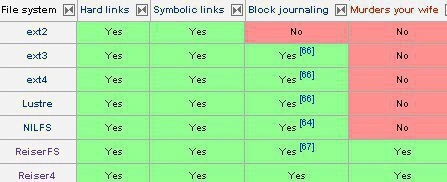
Let’s break down what’s going on in this meme for those who might not be familiar with the terms or the story. The image is a table comparing different Linux file systems (ways that an operating system organizes and manages files on a disk). The rows are specific file system names: ext2, ext3, ext4 (these are successive versions of the standard Linux EXT file system family), Lustre (a high-performance distributed file system often used in large clusters), NILFS (an experimental log-structured Linux file system), and ReiserFS/Reiser4 (file systems created by a developer named Hans Reiser). The columns list features that a file system might have:
Hard links: This means a file system allows multiple filenames to point to the exact same file content on disk. All listed file systems say “Yes” for hard links (green) – which is expected, since supporting hard links is a common capability in Linux file systems.
Symbolic links: Often just called symlinks, these are like shortcuts or pointers to another file or directory. Again, all the file systems here support symbolic links (“Yes” across the board), which is normal for any full-featured Unix/Linux file system.
Block journaling: This refers to whether the file system uses a journal (a special log on disk) to record changes before applying them. Journaling is a safety feature. If you’ve ever had your computer lose power suddenly, a journaling file system helps make sure you don’t end up with a completely corrupted disk. For example, ext2 (the oldest one listed) has “No” here (in red) because it doesn’t have a journal – if the system crashed, ext2 could require a long check/repair process (
fsck) to recover. ext3 and ext4 have “Yes” (green) for journaling, meaning they do log changes and can recover more gracefully after a crash. In fact, ext3 was basically ext2 plus journaling added. Lustre and NILFS also show “Yes” for journaling, albeit NILFS does it in its own log-structured way (NILFS continuously writes everything in a log form). ReiserFS and Reiser4 likewise have “Yes” – they are journaling file systems too, meaning they were designed with that protective logging feature.
Everything up to this point looks like a straightforward technical comparison one might find on Wikipedia or in documentation: all these storage systems support links; most of them (except the very old ext2) support journaling. Now comes the punch-line column: “Murders your wife.” Clearly, this is not a normal feature of a file system! It’s a very unexpected (and morbid) category to compare. In the table, every file system has “No” (red) for this – which is what you’d hope… none of these technologies should have anything to do with harming anyone. Except, two rows stand out with “Yes” (green): ReiserFS and Reiser4.
Why on earth would those have “Yes” for “Murders your wife”? This is referencing a true story from tech history. Hans Reiser, the person who created ReiserFS (and worked on Reiser4), was found guilty of murdering his wife in 2008. It was a huge scandal in the Linux/open-source community at the time. Of course, the file system itself does not hurt anyone – it’s just code. But because its author committed a terrible crime, people joke darkly that “murder” is somehow a feature of his software. It’s gallows humor – joking about something very serious and grim in a way that only those familiar with the story would understand.
So, the chart is pretending that “Murders your wife” is just another technical feature to evaluate. Every sane file system (ext, Lustre, NILFS, etc.) has “No” for that (because, again, it’s not a real feature!), but Reiser’s file systems get a big green “Yes.” It’s essentially saying: “These file systems are great with hard links and journaling, but oh, by the way, their creator has a killer reputation.” The meme is formatted so straight-faced that if you didn’t know the context, you’d be completely confused – you might double-check and think, “Is ‘murders your wife’ some weird coding term I’ve never heard of?” But it’s not tech jargon; it’s literally about murder. The humor is drawing from that shock and the insider knowledge of Hans Reiser’s infamous case.
To put it simply: ext2/ext3/ext4 are widely used Linux file systems (ext4 is common on modern Linux systems) with no notorious baggage. ReiserFS, however, is a file system that some Linux users remember as fast and advanced for its time, but it’s forever linked to the crime of its inventor. There’s no actual software feature that involves anyone’s wife – this is a joke. The meme-maker basically added a fake column to a normal feature comparison table to poke fun at the fact that Hans Reiser (the “Reiser” in ReiserFS) committed a heinous crime. It’s a way of saying “Sure, ReiserFS has journaling… but it also has this other thing associated with it, something very non-technical: its developer is a convicted murderer.” Dark, yes, but that’s the intended humor.
For a newcomer or a junior dev, the key takeaways are:
- No, file systems do not actually have a “homicide” setting!
- The meme is referencing a piece of tech history: a Linux file system developer (Hans Reiser) went to prison for murder.
- Everything in the table aside from that last column is legit technical stuff. That last bit is there to shock you and make those who get the reference laugh (or groan).
In summary, it’s comparing normal file system features (like link support and journaling) and then throws in a completely unrelated, very disturbing “feature” that only applies to Reiser’s creations – because of something awful from real life. It’s an inside joke at the intersection of tech and true crime, highlighting how an external fact (a developer’s crime) can become an infamous footnote for a technology.
Level 3: Killer Feature Matrix
For seasoned Linux users and sysadmins, this meme hits with a mix of nostalgia and dark humor. At first glance it looks like a snippet from a Wikipedia article comparing Linux file systems: ext2 vs ext3 vs ext4, etc., with features like hard links and journaling neatly color-coded green (“Yes”) and red (“No”). It’s the kind of feature matrix you’d consult when deciding on a storage format for your server or assessing filesystem trade-offs for an application. Everything seems normal... until that last column. “Murders your wife” jumps off the screen as a total WTF moment. The meme delivers its punch by playing it completely straight – the text and colors treat homicide as just another checkbox. This deadpan presentation is hilarious to those in the know because it’s so wrong and yet so specific.
The humor works on multiple levels for an experienced developer. On the surface, it’s the absurdity of seeing a violent crime listed as a feature (complete with a comforting green “Yes”) – a classic “not a bug, it’s a feature” gag taken to morbid extremes. We often joke about terrible software behaviors being labeled features, but here it’s not even software behavior – it’s the creator’s behavior. That twist elevates the meme to a special tier of TechHumor: you need a bit of historical knowledge to get it. Essentially, it’s a deep-cut reiserfs_murder_reference. The only reason ReiserFS and Reiser4 have “Yes” in that morose column is the saga of Hans Reiser, the file system’s author who in 2006 was charged (and later convicted in 2008) of murdering his estranged wife. Back in the early 2000s, Hans Reiser was known in the Linux community as a brilliant but eccentric developer – his ReiserFS was even a default filesystem in some Linux distributions (SuSE, for example). It had some killer technical features (no pun intended): great performance with small files and directories due to its balanced tree storage, plus reliable journaling. There was genuine debate in the community about “ext3 vs ReiserFS” when choosing a format – a classic linux_storage_decisions scenario. But once Reiser’s personal life turned into a Law & Order episode, that debate took a dark turn. It’s as if a cloud of infamy hung over the technology. Many sysadmins of that era remember the shock: one day you’re testing this promising filesystem, the next you hear its creator is an accused murderer. Awkward silence on the mailing lists, to say the least.
So the meme’s “Murders your wife: Yes” entry is gallows humor that veteran techies share with a grim chuckle. It’s funny because it’s terrible and true – an uncomfortable truth turned into a checklist item. Only Reiser’s filesystems get the green “Yes” checkmark, implying that “murdering your wife” is a unique feature of ReiserFS/Reiser4 (a brutal play on the term killer feature, usually meaning a product’s standout advantage). Meanwhile, all other filesystems proudly have “No” in that column (phew, ext4 doesn’t come with spouse-homicide attached!). The straight-faced question “So, it’s a feature?” in the post caption nails the irony: normally a “feature” is something desirable that developers brag about. Here we have a feature matrix where one row’s green “Yes” actually flags a notorious crime. It’s a dark twist on the dryness of technical documentation.
Notice also the perfectionist detail: the table includes little reference numbers like [86][87] for block journaling “Yes” entries, mimicking an authentic wiki page. This adds to the comedic effect by grounding the absurd column in an otherwise factual, serious comparison. The more earnest and typical the table looks, the more the ridiculous last column pops. It’s the incongruity that seasoned tech folks appreciate – like a classic inside joke buried in what seems to be a mundane sysadmin wiki. In the TechHistory of Linux, the ReiserFS story is an infamous chapter. The meme basically says: “Among all these file systems, one has a killer backstory.” Veterans laugh (perhaps a bit ruefully) because they remember that backstory vividly. Newcomers might do a double-take and ask, “Wait… what?! Did a file system actually…?” which leads them down a Wikipedia rabbit hole. In short, this meme is a perfect Storage geek callback: it combines an otherwise dry technical comparison with a shockingly human piece of trivia that only those who’ve been around the block (or block device) will know. It’s the ultimate dark humor Easter egg for sysadmins who remember that sometimes the scariest bugs aren’t in the code – they’re in the coder.
Level 4: Journaling vs Justice
At the deepest technical level, this meme touches on file system architecture and the quirky collision of software design with real-life crime. In Linux Operating Systems, file systems like ext2, ext3, ext4, ReiserFS, Reiser4, Lustre, and NILFS each have distinct implementation details. The table’s serious columns (Hard links, Symbolic links, Block journaling) highlight core OS features:
Hard links and Symbolic links – fundamental POSIX storage features allowing multiple directory entries to reference the same data (hard link) or to point to another path (symlink). All listed file systems support these, which is why every row shows “Yes.” It’s basic functionality for Linux file systems, so nothing surprising there.
Block journaling – a journaling mechanism used to maintain file system integrity. Journaling means the file system writes a log of changes (the journal) before applying them to the main data structures. If the system crashes or loses power, the journal can “replay” or roll back incomplete operations, preventing corruption. Technically, ext3 introduced journaling to Linux’s ext2 lineage: ext2 (no journal) was fast but susceptible to long
fsckrecoveries after crashes, while ext3 added a write-ahead log (journal) to commit metadata updates safely (marked “Yes” in green). ext4 continued this with even more robust journaling and new features like extents for better space management. Other file systems in the list – Lustre (a distributed cluster file system used in HPC) and NILFS (“New Implementation of a Log-Structured File System”) – also ensure consistency. NILFS in particular uses a log-structured design: instead of a separate journal, every write is appended in a continuous log, achieving versioned snapshots by design. It’s an alternative approach to reliability, academically famous for trading immediate space efficiency for historical versioning. ReiserFS likewise is a journaling file system (so “Yes” under block journaling) and was innovative for storing file metadata in balanced B★-tree structures, optimizing small file storage and directory lookups. Reiser4 was an ambitious successor aiming to introduce plugin-based storage semantics and improved performance. In pure engineering terms, each “Yes/No” cell (with footnotes like [66][86][84] referencing technical documentation) reflects years of Linux storage evolution and design decisions. It’s a classic feature matrix summarizing which file system offers what capabilities – except one column here is outrageously non-technical.
That final column, “Murders your wife,” breaks all expected context. There’s no kernel subsystem or algorithm that would ever correspond to such a horrific human action – it’s not a real feature of any software. Instead, this column is a grim nod to tech history: the creator of ReiserFS, Hans Reiser, was convicted of murdering his wife. In a stringent technical comparison, this is an absurd outlier: an event from criminal justice inserted into a software feature chart. The meme’s dark genius lies in treating that infamous real-world outcome as though it were just another filesystem attribute. In theoretical terms, it’s highlighting a category error – mixing system design traits with an unrelated, macabre real-life fact – which creates an uncomfortable kind of humor. The gallows humor lands because veterans know the historical truth behind ReiserFS’s green “Yes”: unlike ext, Lustre or NILFS, the Reiser file systems come with the baggage of their author’s crime. From a deep systems perspective, it’s a reminder that technology doesn’t exist in a vacuum: sometimes the human factor (or flaw) can overshadow even the most advanced code. Here, decades of file system innovation and OS theory are upended by one chilling footnote in history – literally turning an OS internals comparison into a murder mystery punchline.
Description
The image is a screenshot of a feature comparison table for various computer file systems. The table lists file systems like ext2, ext3, ext4, Lustre, NILFS, ReiserFS, and Reiser4 in rows. The columns compare features such as 'Hard links', 'Symbolic links', and 'Block journaling'. However, the final column is shockingly titled 'Murders your wife'. For all file systems except ReiserFS and Reiser4, the value in this column is 'No' (in a red-colored cell). For ReiserFS and Reiser4, the value is 'Yes' (in a green-colored cell). This is a dark humor meme referencing the real-life crime of Hans Reiser, the creator of the ReiserFS file system, who was convicted in 2008 for the murder of his wife. The joke's shock value comes from absurdly listing a horrific biographical fact as if it were a technical feature of the software he created, a piece of grim folklore well-known in the Linux and open-source communities

Comments
7Comment deleted
ReiserFS had some truly unique features, though the one with the highest cost of ownership was notoriously under-documented in the man pages
Finally, a decision matrix that proves the real killer feature of ReiserFS wasn’t tail-packing - it was probable cause
When you're debugging a filesystem corruption at 3am and suddenly realize why ReiserFS has such aggressive garbage collection
Nothing says 'production-ready filesystem' quite like a feature comparison table that includes homicide statistics. ReiserFS: great at journaling blocks, terrible at journaling alibis. The only filesystem where 'data integrity' took on a whole new meaning, and 'mounting' became evidence in a murder trial. At least ext4 keeps its skeletons in the closet instead of the feature matrix
Feature matrices are useful until procurement adds a true‑crime column - at that point the ADR writes itself: pick the boring one and let journaling capture I/O, not headlines
ReiserFS: The only filesystem where full block journaling covers hiding the body too
When your filesystem decision matrix mixes POSIX links, journaling semantics, and a true‑crime NFR, something slipped past architecture review