Skip to content
DevMeme
5075 of 7435
The Economics of Hobbyist Crypto Mining
Blockchain Post #5555, on Oct 4, 2023 in TG

The Economics of Hobbyist Crypto Mining

Why is this Blockchain meme funny?

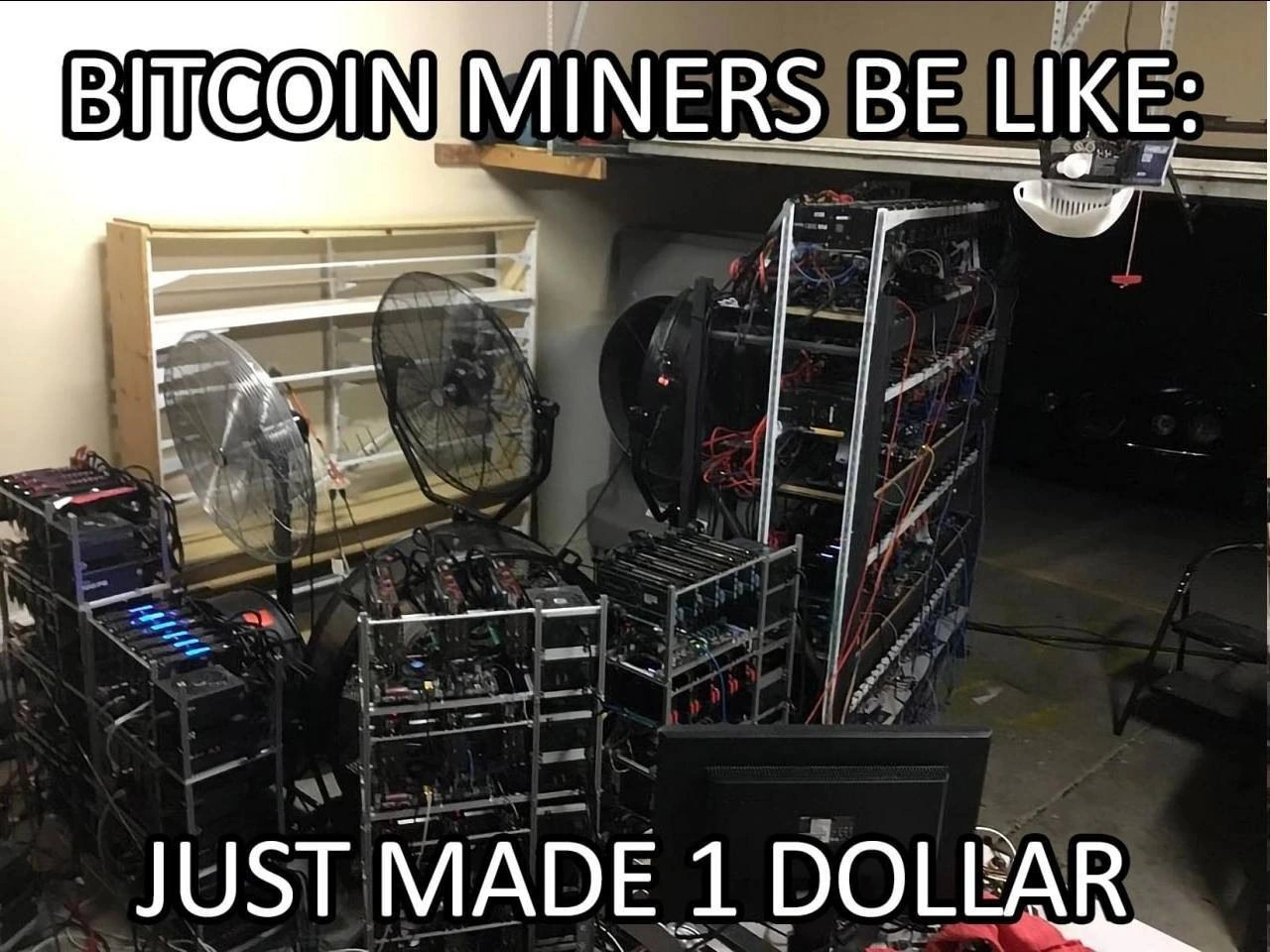
Imagine spending your entire day building and running a huge, loud machine in your garage – a machine with lots of whirring parts, fans blowing like a windstorm, and cables everywhere – and after all that effort, the machine gives you just one single dollar. It’s like baking all day long for one tiny cookie. You’d use tons of ingredients, heat up the oven for hours, make the kitchen super hot and messy… and at the end you pull out one little cookie from the oven. You can probably sense that’s not a great deal, right? All that work, mess, and cost for something that you could have gotten with very little effort.

That’s exactly why this picture is funny. The people in the meme have a giant setup (lots of computer cards and big fans – think of it as a giant oven with many trays) running probably non-stop, and they are excited because they “just made 1 dollar.” It’s poking fun at the idea of huge effort for a tiny reward. Even if you don’t know anything about Bitcoin or computers, you can laugh at the silliness: it’s as if someone built a super complex engine, kept it running all day, and proudly held up a single coin as the result. The emotion here is a mix of pride and absurdity – they’re proud of that $1 like it’s a big achievement, which is goofy because clearly the setup looks like it should make much more. It’s a simple joke about overkill: using a cannon to shoot a mosquito, or driving a monster truck to deliver a loaf of bread. The mismatch between the massive effort and the tiny outcome makes us giggle. You don’t need any tech knowledge to get that – it’s a universal kind of funny, where you can almost hear the person happily saying, “Yay! I got a dollar!” while standing next to a contraption that probably cost a fortune to run.

Level 2: Big Rig, Small Reward

Let’s break down what’s happening in this meme in simpler terms. The picture shows a cryptocurrency mining rig – basically a custom-built computer with a bunch of high-end graphics cards (GPUs) all working together on the task of mining Bitcoin (or a similar cryptocurrency). Bitcoin mining is the process of computing a special mathematical puzzle that, if solved, rewards you with some amount of Bitcoin. These puzzles involve calculating hashes (the output of a cryptographic function) over and over millions of times per second, trying to find one “lucky” result that the Bitcoin network will accept.

Now, a single GPU (Graphics Processing Unit) is a powerhouse at doing repetitive calculations in parallel – it’s the same kind of chip that renders video game graphics, repurposed to crunch cryptographic numbers. A mining rig like the one in the image has many GPUs stacked together to increase the total computing power (hash rate). Those rectangular frames with rows of cards and all the wiring are actually open-air computer cases holding the GPUs, because a normal PC case can’t fit that many or keep them cool. You can see all the tangled cables connecting to power supplies and the motherboards. It’s a bit messy, but that’s pretty normal for a DIY mining setup in a garage or basement – function over form! The builder likely put this together to maximize how many hash computations they can do per second, hoping to earn more cryptocurrency.

But here’s the funny part: Bitcoin (and many popular cryptocurrencies) automatically adjust the difficulty of the mining puzzle. When more people (or more GPUs) are mining, the network makes the puzzle harder to solve so that coins aren’t found too fast. Think of it like a lottery that more and more people are buying tickets for – your chance of winning goes down as more tickets (miners) enter the draw. By 2023, there are so many specialized miners (including entire warehouses full of custom mining machines called ASICs, which are even more powerful than GPUs) that a little home rig has a tiny chance of finding a winning solution on its own. In fact, individual miners often join mining pools (group efforts where many people share the work and split the reward) to get at least some steady trickle of earnings. So that huge collection of GPUs in the picture? It might only contribute a minuscule fraction of the total global mining power. The caption “JUST MADE 1 DOLLAR” implies that after all the work these machines did (possibly running for a long time), the miner earned just $1 worth of Bitcoin.

Let’s talk energy and heat: all those GPUs running at full tilt consume a lot of electricity and produce tons of heat. Notice the two big floor fans pointed at the rigs – those are there for cooling. When computers work hard, they get hot (like how your laptop’s fan kicks on during a heavy task). Here we have dozens of GPUs each maybe using 150-300 watts; together, it’s like a few hairdryers or space heaters running at once. Without cooling, the GPUs would overheat, possibly triggering thermal shutdowns or even permanent damage. The fans help blow away hot air and keep the rigs at a stable temperature. However, running fans and GPUs around the clock adds to the electricity bill.

This is where the joke about profitability comes in. Profitability in mining means how much money you make from the Bitcoin versus how much you spend on electricity (and the cost of the hardware). An important term here is ROI – Return on Investment. If you spent, say, $5,000 on all the GPUs, cables, and fans for this setup, you’d want to earn that $5,000 back and then some. If the rig makes only $1 per day, that’s 5,000 days just to break even – which is about 13.7 years! And that’s not even counting the electricity cost each day. Electricity costs can be significant: this rig could easily use several dollars’ worth of power a day. If it’s earning $1 but using $2 of electricity, the person is actually losing money while generating a lot of heat and noise. The meme exaggerates to highlight this scenario: a diminishing returns situation where throwing more hardware at the problem isn’t yielding proportional results. In simpler terms, it’s like spending more and more effort for less and less gain.

For context, in the early days of Bitcoin, mining was much easier – fewer people were doing it, so even basic computers could win rewards. But as Bitcoin became popular and valuable, more folks joined in, building bigger and better rigs. The network kept raising the difficulty of the puzzle to keep things fair and on schedule. Nowadays, mining Bitcoin competitively requires specialized hardware and cheap electricity (some big operations even situate next to power plants or in cold climates for cooling). A home GPU mining setup like the one in the picture is mostly a hobbyist experiment at this point. It might actually be mining some other cryptocurrency (since Bitcoin mining with GPUs isn’t common anymore due to those ASICs), but then the miner might convert that to Bitcoin – hence saying they made $1 of Bitcoin value. In any case, the principle holds: it’s an enormous technical effort for a very small reward.

In summary, the image is funny to developers and hardware enthusiasts because it shows a massive hardware effort (lots of components, careful assembly, serious cooling measures) resulting in what’s essentially pocket change. It’s highlighting the concept of chasing performance or output at scale and hitting the point of almost no returns. Knowing all the BlockchainTechnology and hardware involved, we smirk because we understand the imbalance: the rig is real and serious, but the payoff is almost comically tiny. It’s a bit of HardwareHumor mixed with a lesson about how crypto mining profitability has declined – the classic case of a big rig yielding a small reward.

Level 3: Overclocked and Underpaid

For seasoned engineers, this image evokes the telltale scene of the GPU mining craze: open-air metal racks filled with high-end graphics cards, a snake’s nest of power cables, and industrial fans propped up to blast cooling air over the whole contraption. The top caption “BITCOIN MINERS BE LIKE:” sets the tone – we’re about to see an exaggerated miner’s boast. The bottom caption delivers the punchline: “JUST MADE 1 DOLLAR.” It’s a classic tech irony: an expensive, power-guzzling setup proudly yielding a virtually trivial profit. If you’ve ever managed hardware at scale or crunched ROI numbers, you can practically feel the heat from those GPUs and hear the electric meter spinning for that single dollar earned.

What makes this funny to an experienced dev? It’s highlighting the diminishing returns and almost tragicomic inefficiency of late-stage crypto mining. Back in the early days of Bitcoin (circa 2010-2011), a couple of GPUs in your dorm room could mine dozens of BTC – a veritable goldmine in hindsight. But fast forward to 2023: unless you have specialized ASIC hardware or nearly free electricity, a home-built GPU rig is largely futile. The meme riffs on those who either didn’t get that memo or are stubbornly optimistic. We see dozens of GPUs (which likely cost hundreds of dollars each) running 24/7, and the operator is celebrating a $1 gain – which is likely before subtracting the hefty electricity bill! It’s a tongue-in-cheek nod to how many hobbyist miners ended up overclocking top-of-the-line GPUs (pushing them to run faster and hotter for marginal gains) while being “underpaid” by the blockchain lottery in return. Each GPU might be cranking out, say, 60 MH/s (million hashes per second) on an altcoin or a negligible fraction of the Bitcoin network – and all that earns maybe a few cents a day per card. The entire rig might clear around $1 daily, while possibly consuming $2 or more in power. The celebration of that buck is dripping with sarcasm.

The image also screams heat and noise. Those two big metal fans in front aren’t there for fun – they’re critical for heat dissipation. A rig like this can easily output heat comparable to several space heaters running at once (several kilowatts). Seasoned engineers will chuckle at the DIY cooling: it’s the homebrew equivalent of a data center’s HVAC system. You know you’re in deep when you have to point oversized garage fans at your gear just to prevent a meltdown. The meme is essentially saying: After all this chaotic engineering – assembling custom frames, wiring up multiple power supply units, tripping the house circuit breaker a few times, turning your garage into a sauna of whirring fans and GPUs – you’ve made a whole $1. Congratulations! It satirizes the absurd commitment versus reward ratio.

There’s also a nod to performance tuning gone wrong. As developers, we’ve all had moments of optimizing something to an extreme degree and then realizing the real-world benefit is minuscule. This mining rig is the physical, hardware equivalent. It’s like spending weeks parallelizing and micro-optimizing an algorithm, only to improve runtime from 10.00 seconds to 9.98 seconds – technically a win, but practically negligible. Similarly, the miner in the meme might have meticulously tweaked each GPU’s clock speeds, flashed custom firmware, and balanced the PCIe risers, squeezing every last hash out of the setup. The end result? A “profit” so small you could find the same amount of money under your couch cushions. That disconnect is hilarious to those of us who’ve chased diminishing returns in any system.

Additionally, the long-time crypto folks will appreciate the implicit economic reality check. In a competitive Proof-of-Work environment, any consistently high profits get arbitraged away by new participants increasing the difficulty. It’s a bit like the old “gold rush” analogy: in 1849, a few prospectors got rich, but soon everyone was panning for gold and the average Joe barely covered his costs. By then, the only guaranteed winners were those selling shovels (or GPUs and electricity, in this case). The meme’s giant rig making $1 drives home that we’re in the late stage of that gold rush – where only huge industrial mining farms make significant money, and a DIY rig in your garage is mostly heating your house with a side effect of earning pocket change. The BlockchainTechnology and HardwareHumor on display connect to real engineering woes: high-performance rigs running into scaling limits and diminishing returns. Anyone who has seen a personal project balloon in complexity but barely deliver value will chuckle (and perhaps cringe) in solidarity. This is the inside joke among developers: sometimes our grand setups yield comically tiny results, and you’ve got to laugh and say “at least it works… sorta.”

Level 4: Proof-of-Work Paradox

At the deepest technical level, this meme highlights a Proof-of-Work paradox in the world of blockchain. Bitcoin’s security model relies on miners performing astronomical numbers of cryptographic hash computations (specifically SHA-256) to find a valid block. This massive GPU rig is essentially brute-forcing trillions of hashes per second, searching for a rare solution that meets Bitcoin’s network difficulty target. But here’s the catch: as more total computing power (hash rate) joins the network, the protocol automatically raises the difficulty. It’s a self-adjusting mechanism to keep new blocks coming roughly every 10 minutes. In practical terms, the more miners that race, the harder it becomes for each one to win the race. This creates a paradoxical situation: adding more hardware doesn’t guarantee proportionally more reward – in fact, beyond a certain point it yields diminishing returns.

The meme’s humor stems from this very dynamic. The GPU farm in the image, which likely draws kilowatts of power and computes on the order of $10^{13}$ hashes per second, is still a drop in the ocean of the Bitcoin network (which operates at quintillions of hashes per second globally). The outcome? The rig finds solutions so infrequently that its expected earnings approach near-zero per hour. In a mathematically fair system, many miners working in parallel end up splitting the fixed block reward into tiny fractions – hence the celebration of a measly $1 in profit. It’s an illustration of the cryptographic arms race: each participant must expend ever more energy for ever smaller slices of the pie.

From a theoretical standpoint, this stems from the equilibrium of Proof-of-Work mining. As soon as mining becomes profitable, more miners join until the cost of mining (electricity, hardware wear) almost equals the reward earned. Think of it like a thermodynamic system: almost all the electrical energy pumped into those GPUs ends up as waste heat, with only a tiny sliver manifesting as digital value (that $1 of Bitcoin). This is essentially Landauer’s principle in action – each bit of computation has a minimum energy cost, and mining chews through unimaginable numbers of bits. The reason the rig must be so massive for a $1 payoff is fundamentally rooted in physics and game theory: Proof-of-Work deliberately makes solving these cryptographic puzzles fiendishly hard and competitive to ensure Bitcoin’s ledger is secure. The end result is a diminishing returns curve so steep that our intrepid miner’s huge effort yields only a laughably small reward. That contrast – enormous hashpower and thermal output versus a single dollar of value – is what makes this scenario both absurd and academically fascinating.

Description

A meme depicting a cluttered garage transformed into a cryptocurrency mining farm. The image shows multiple open-air server racks packed with hardware, likely GPUs, with a complex web of wiring. Several large, industrial-style floor fans are aimed at the equipment for cooling. The overall impression is one of a significant, power-intensive, and somewhat chaotic home-built operation. White text with a black outline is overlaid on the image, with 'BITCOIN MINERS BE LIKE:' at the top and 'JUST MADE 1 DOLLAR' at the bottom. The humor comes from the stark contrast between the massive investment in hardware and electricity (implied by the scale and cooling needs) and the comically small financial return. It satirizes the difficulty and often low profitability of small-scale crypto mining, a reality well-understood by those familiar with the increasing difficulty of proof-of-work algorithms and competition from large-scale mining operations

Comments

30
Anonymous ★ Top Pick That's not a mining rig; it's an inefficient space heater that occasionally outputs a few satoshis as a side effect
  1. Anonymous ★ Top Pick

    That's not a mining rig; it's an inefficient space heater that occasionally outputs a few satoshis as a side effect

  2. Anonymous

    Proof-of-Work: the only workload where you scale from 4 to 400 GPUs and watch your hash rate follow Moore’s Law while your profit follows IEEE underflow

  3. Anonymous

    The real proof-of-work here is convincing your spouse that the $15,000 mining rig heating your entire house to 95°F is actually 'passive income' while you celebrate breaking even on last month's electricity bill

  4. Anonymous

    The classic cryptocurrency mining paradox: spending $50K on GPUs, $500/month on electricity, and countless hours on thermal engineering - all to discover that after difficulty adjustments and power costs, you're essentially running a very expensive space heater that occasionally pays you minimum wage. It's like building a distributed system where the only thing that scales linearly is your electric bill, while your returns follow an inverse exponential curve. At least with traditional distributed computing, the ROI doesn't depend on whether Elon tweeted today

  5. Anonymous

    Proof-of-work economics: CAPEX in open-frame GPU racks, OPEX in kilowatt-hours; with a PUE of two box fans and a prayer, the block reward mostly routes to the utility company

  6. Anonymous

    Petahash cluster deployed, ROI still waiting for the next difficulty adjustment - like scaling a monolith for satoshi drips

  7. Anonymous

    Optimized for hash rate, ignored TCO - congrats, you’ve architected a highly available space heater that occasionally mints a dollar

  8. Max 2y

    This is the perfect cloak for a weed plantation.

    1. @revolutionarygirlutena 2y

      weedcoin

  9. @Alex_Helion 2y

    this meme is late for 8-10 years

    1. @RiedleroD 2y

      more like 3-5, but yea

      1. @arnonrdp 2y

        Nowadays, how much would a setup like this do?

        1. @RiedleroD 2y

          idunno

  10. @vslkshkn 2y

    Nobody mine bitcoin on a graphic cards by the way… And it’s a lot more then 1$ if you are know what and how to do 👀

    1. @callofvoid0 2y

      where then ?

      1. @vslkshkn 2y

        Where to host asic’s you mean?

        1. @callofvoid0 2y

          ah got my answer

    2. dev_meme 2y

      It’s not really a lot more 👀

      1. @vslkshkn 2y

        Why’s that? About 1000$ daily on a modern hardware (if you have ~ 100 units of course ) Minus electricity costs, about 4 cents per kw So its about 1000$ - 336$ electricity… About 664$ clean income each day. We also need to count hardware costs to understand business itself. But its a lot more then 1$ anyway))

  11. @vslkshkn 2y

    And it depends on BTC exchange rate for sure - but we all know what will happens afrer halving 🚀

    1. @RiedleroD 2y

      well, we do know

      1. @RiedleroD 2y

        this is just from today btw

        1. @vslkshkn 2y

          Looks strange - now its higher then 27400 🤔

          1. @RiedleroD 2y

            idk I just took the first website I found

            1. @vslkshkn 2y

              That was a mistake)

              1. @RiedleroD 2y

                fair point but I still won't invest a single cent into crypto

                1. @vslkshkn 2y

                  Thats only your choice for sure.

  12. @vslkshkn 2y

    My bot is waiting for 27k drop - so i will be the first who will know ))

  13. @vslkshkn 2y

    I will try to not forget to come back here after 194 days and 12 hours )

    1. @RiedleroD 2y

      👌

Use J and K for navigation