Skip to content
DevMeme
6286 of 7435
Humans are Just Over-trained LLMs, Change My Mind
AI ML Post #6890, on Jun 16, 2025 in TG

Humans are Just Over-trained LLMs, Change My Mind

Why is this AI ML meme funny?

Level 1: We All Learn by Copying

Imagine you have a friend who’s really good at telling stories. How did they get so good? Probably by hearing a lot of stories first – from parents, teachers, books, movies – over many years. They absorbed all those examples, and now when they tell a new story, you might notice bits of style or words that sound familiar. They’re not purposely copying any single story, but everything they heard helps shape what they create. In a simple way, that’s what this meme is joking about: it’s saying that people learn to do things (like speak or write) kind of like a computer program that read a million books and is now trying to talk.

Think of an AI language model as a robot parrot that read every book in the library. It doesn’t truly know what the words mean on a deep level, but it’s very good at stringing them together because it’s seen so many examples. Now, a human isn’t a robot, but we do learn by example too. A baby learns to say “hello” because they’ve heard people say “hello” hundreds of times. As we grow up, we’re basically collecting experiences and information, and we use that to handle new situations. The sign in the meme says, “Humans are just LLMs with more training,” which in plain terms is like saying, “Humans are just like those book-reading robots, but we’ve practiced even more.” It’s a funny way to compare us to AI.

Why is that comparison funny? Well, usually we think of humans and machines as very different. We have feelings, we come up with original ideas (like painting something no one’s ever seen), and we understand what we’re saying. A machine, on the other hand, just follows patterns it has learned – it doesn’t feel or mean things the way we do. So calling a human basically a big version of a texting robot is a bit ridiculous – and that’s why it makes people chuckle. It’s intentionally exaggerating to make a point. It’s like saying, “Your brain is just a fancy computer that’s been running longer.” Part of you goes, “Ha, that’s silly,” but another part might think, “Well, I did learn everything I know from somewhere… I wasn’t born knowing things.” It’s a playful way to make us think about how learning works.

The meme is set up as a challenge – “change my mind.” That means the guy with the sign welcomes you to argue back. Maybe someone might respond, “No, humans have imagination and consciousness, we’re not just prediction machines!” And that’s exactly the discussion the meme is trying to spark, in a lighthearted way. Even if you’re not well-versed in AI talk, you can relate to the basic idea: we all start blank and learn by observing and practicing. If you look at it that way, a smart chatbot and a person aren’t totally unrelated – they both get better by learning from lots of examples. The difference is, one is made of code and silicon, and the other is made of flesh and has a heart (literally and figuratively ❤️).

So, picture this: a guy sits at a table on a college campus with a sign that basically says “People are just super-trained talking machines. Prove me wrong.” It’s humorous because it’s a nerdy twist on both how we see ourselves and how we see AI. You don’t have to take it seriously – it’s more like a geeky thought experiment. It makes you smile because it’s a bit like saying, “Hey, you know how you learned everything you know? That’s exactly what a chatbot does too… so maybe you’re a chatbot!” Of course, we know we’re more than that, and that unspoken understanding is what makes it a joke. It’s okay to laugh and say, “Haha, sure, I’m just a well-trained parrot with opinions.” Sometimes comparing two very different things in a blunt way (“a human vs. a chat program”) comes off as silly and fun. And who knows – if you saw this guy in real life, maybe you would go and change his mind… or at least grab a coffee and have a friendly chat about it.

Level 2: Human Neural Network

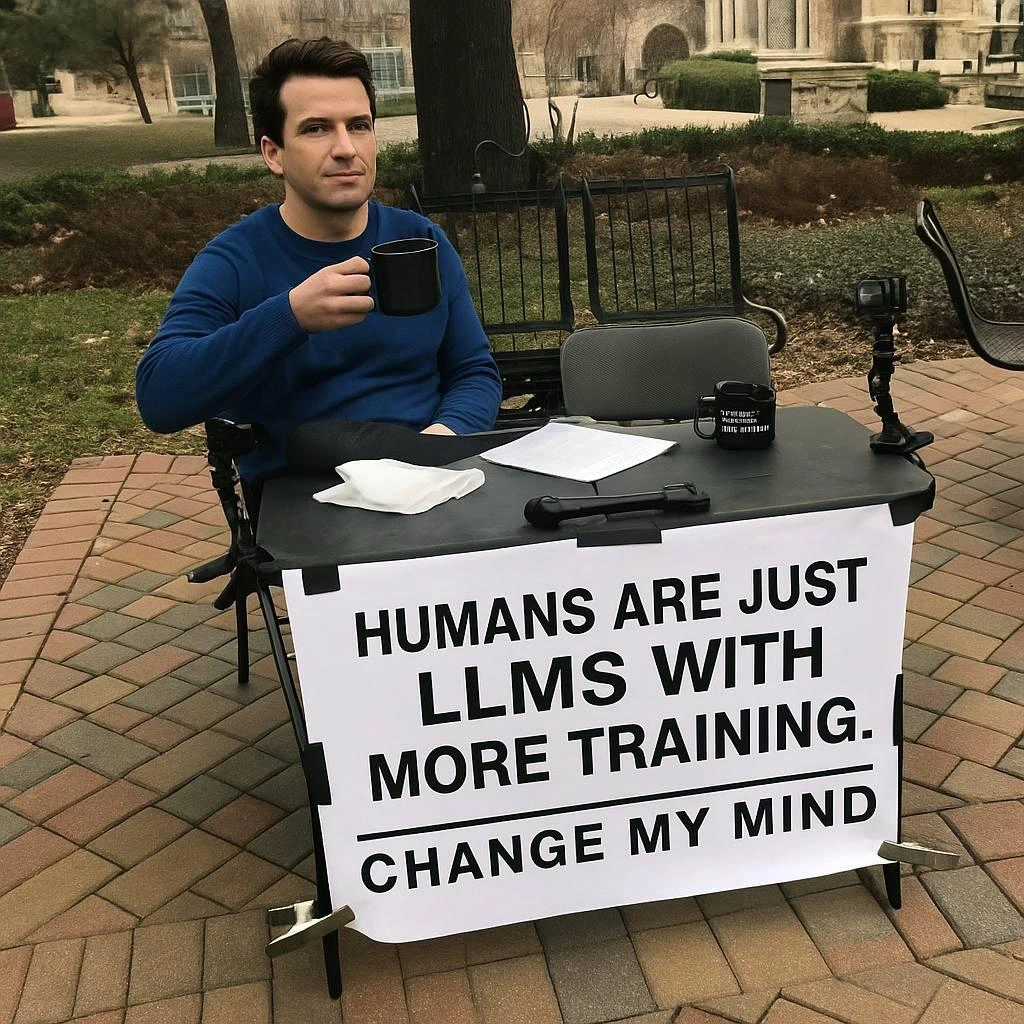
In this meme, we see a man at a campus table with a big sign that reads: “HUMANS ARE JUST LLMs WITH MORE TRAINING. — CHANGE MY MIND.” This setup comes from the popular “Change My Mind” meme template, where someone confidently presents an opinion on a banner and dares others to debate them. It’s usually a lighthearted way to spark discussion or humor. Here, the opinion on display is very techie: it’s comparing humans to LLMs in a cheeky way. So, let’s break down what all this means in simpler terms.

First off, LLM stands for Large Language Model. That’s a type of artificial intelligence program designed to understand and generate human-like text. Think of things like ChatGPT or GPT-4 – those are LLMs. They learned to chat by training on a massive amount of written text (like books, articles, websites – basically the whole Internet). During training, an LLM looks at millions or billions of example sentences and adjusts itself to predict what word tends to come next. After seeing enough patterns, it gets pretty good at producing coherent sentences on its own. We call it “large” because it has a huge number of internal settings (parameters) – imagine a mind-bogglingly long list of numbers that the AI tweaks as it learns. So an LLM is like a gigantic predictive text engine that’s been pre-trained on tons of data.

Now, the sign is cheekily saying a human being is basically the same thing, just with more training data and time. In other words, humans might just be really, really advanced learning machines. When it says “with more training,” it implies that by the time you’re an adult, you’ve accumulated even more experience than an AI has from its training dataset. And honestly, in one sense that’s true: humans spend years learning language, absorbing facts, and figuring out how the world works. As kids, we’re constantly training our brains – every new word we hear, every lesson at school, every mistake we learn from is essentially teaching our brain how to respond in the future. By age 20, you’ve had two decades of multimodal training (seeing, hearing, touching the world) – far richer than just reading text from a database. The meme takes that idea and phrases it in ML (Machine Learning) lingo for comedic effect. It’s as if to say, “Hey, you know those fancy AI models? Pfft, we’re just the same thing but supercharged.”

Let’s clarify a few ML terms that are being riffed on here:

  • Pre-training: In AI, this means training a model on a broad dataset to give it general knowledge. For example, an LLM is pre-trained on text from all sorts of sources to get a wide grasp of language. Humans, in a way, get pre-trained by growing up – you learn your native language, basic facts about life, how to behave in society, etc. That’s our “general knowledge” phase.
  • Fine-tuning: This is when an AI model that’s already pre-trained gets a second round of more specialized training on a specific task. For instance, you might fine-tune a general language model on medical texts so it becomes better at answering healthcare questions. Humans do something similar when we specialize: think of when you went to college for engineering or learned a specific trade. That’s you fine-tuning your brain on more narrow skills, building on top of your general education. The meme’s statement hints that all the things that make you you (your skills, knowledge, personality) are just fine-tuning tweaks on an initially “pre-trained” human brain. It’s a playful analogy!
  • Training: Simply put, training in ML is feeding data to a model so it can adjust and improve. A training epoch means one pass through the whole training dataset. When the sign says humans have “more training,” you could imagine that as humans having gone through many more “epochs” of learning through life experiences than an AI typically does. We don’t usually count life in epochs, but you get the idea – a lot of learning iterations happen from childhood to adulthood.
  • Neural network: Both human brains and AI models are often described in terms of networks of neurons. In our brain, a neuron is a cell that fires signals and connects with others – we have billions of them forming a network. In an AI, “neurons” are virtual nodes in a layered network (often many layers deep, especially in an LLM). They take numbers in, do some calculation, and send numbers out to the next layer. So when someone says “human neural net”, they’re likening the brain’s neuron web to the structure of an AI’s neural network. The meme literally calls us LLMs – implying we are walking, talking neural nets with the capacity for language.

Now, why is this funny or interesting? Well, part of it is the absurdity of equating something as rich and mysterious as a human mind with a glorified chatbot. We humans like to think we’re more than just parrots repeating what we’ve heard. The sign provocatively downplays that: it’s like he’s saying, “Nah, you’re basically just a really well-trained parrot. Prove me wrong.” It’s irony. People in the ML community have often joked about AI models being “stochastic parrots” (meaning they mimic language without true understanding). This meme flips it and suggests maybe we are stochastic parrots too – just with a bigger repertoire. For a junior developer or someone new to AI, this is a humorous introduction to how AI folks sometimes see the world. We reduce complex ideas into simple models for fun. Here, the complex idea is human cognition, reduced to “just an AI with a lot more data.” It’s intentionally reductive.

Another reason it’s funny is the Change My Mind format itself. This format became an internet meme after a YouTuber set up a table on a campus with controversial signs (like “Batman is better than Superman, change my mind”) and debated passersby. The image usually shows the person sitting confidently, expecting a challenge. Now imagine random students or professors walking by this particular table and reading “Humans are just LLMs with more training.” It’s not a typical political or social issue – it’s a hyper-nerdy, almost sci-fi statement. The sheer geekiness of it in a public debate setting is amusing. It’s like if someone set up a stall in the park that says “The Cloud is just someone else’s computer – change my mind” or “Tabs beat Spaces hands down – change my mind.” It mixes a real-world protest vibe with an in-joke for developers. If you get the terms, you laugh and maybe even feel an itch to walk up and actually debate the guy. If you don’t get the terms, the sign just looks bizarre, which adds another layer of comedy for those who do get it.

Since the category here is AI_ML, it’s worth noting how it connects to things happening in AI. As of the mid-2020s, Large Language Models are a huge trend. They’re used in everything from coding assistants to customer service chatbots. People often marvel at how human-like their text is, and there’s a lot of discussion (and hype) about AI becoming more and more human-like. This meme plays off that trend. It’s almost satirical – like it’s poking fun at both humans and AI. On one hand, it demystifies AI: “Look, these fancy chatbots? They’re basically doing what we do after reading a lot.” On the other hand, it satirizes our understanding of ourselves: “Maybe we’re not that special; we just have bigger data.” It’s the kind of statement an AI enthusiast might throw out to sound provocative at a conference happy hour, prompting either nods of agreement or friendly eye-rolls and counterarguments about all the things AI can’t do (like truly understand meaning or have feelings).

From a learning point of view, there’s also a subtle encouragement to think about how humans learn versus how machines learn. For example, consider sample efficiency – a term that might be new if you’re a junior dev. It refers to how effectively a learner uses each example. Humans are actually very sample-efficient in many domains: you might hear a new fact once and remember it, or see one example of a problem and generalize the solution. Current AI models usually need far more repetitions to learn the same thing. The meme’s claim glosses over that nuance for the sake of the joke, but it’s an interesting discussion starter. If you find yourself curious, you might ask: In what ways is a brain similar to a neural network, and in what ways is it different? The humor works because it suggests a simple equivalence (“just more training”), but in reality, entire textbooks explore that question!

To put it in a more everyday analogy (which we’ll do in the next level too): imagine an LLM as a student who tried to learn French by reading every French book and website in existence over a few months. That’s a lot of input, and at the end, the student can form sentences in French pretty well, maybe even poetically, but they might not truly appreciate French culture or idioms beyond patterns they’ve seen. Now imagine a human learning French: they might spend years living in France, speaking with native speakers, hearing the tone, making mistakes and getting corrected. They live through situations (ordering food, telling jokes, maybe dating a French person). After that, the human isn’t just producing correct French sentences; they understand when to use them, what subtext they carry, etc. The meme is cheekily saying the end result – a fluent French speaker – is just a product of lots of training data in both cases, differing only in volume and method. It’s simplifying the story to get a laugh, especially from those who know the underlying complexity.

So, to recap in simpler terms: The meme has a guy claiming that people’s brains work just like a large language model (the kind of AI behind chatbots), only trained even more extensively. It’s a funny oversimplification that plays on AI jargon. If you’re new to these terms, you can still appreciate the humor once you know that an LLM is an AI that learns from tons of text, and he’s basically calling humans the same thing. It’s as if all our education and experiences are just one big training dataset, and we’re basically walking chatbots. Obviously, humans are more than that – we have emotions, creativity, physical bodies, and we learn in interactive ways, not just by reading – but that’s exactly why it’s a joke. It intentionally ignores those differences to make you giggle and maybe think, “Huh, in a simplistic way, I guess there is a resemblance… we kind of do predict and respond based on past data.” And if nothing else, it might spark a fun debate with your friends: Are we just advanced neural networks? Or is there something magical that sets human intelligence apart? The guy at the table is waiting for someone to take that bait!

Level 3: Fine-Tuned by Life

This image uses the famous “Change My Mind” meme format to serve up an ML-flavored hot take: “Humans are just LLMs with more training.” At first glance, it’s hilarious because it sounds like something a jaded AI researcher would blurt out after one too many late-night debugging sessions. The meme takes a jab at how much hype we give to Large Language Models by essentially saying, “Eh, what’s the big deal? We humans are doing the same thing – just with a lifetime of data.” It’s a classic case of AI humor where you mash up human traits with machine learning jargon. Any engineer who’s been following the AI industry trends (the explosion of GPT-style models, debates about AI vs human intelligence) will smirk at this. It flips the usual script: normally we ask, “Can an AI be more human?” but here we’re quipping that humans are just advanced AIs. It’s a reversal that pokes fun at both human pride and AI hype.

The sign’s wording is a goldmine of ML inside-jokes. LLM (Large Language Model) is dropped casually, assuming the reader knows it’s a model like GPT-3 or GPT-4 that’s been trained on vast text data. Describing humans as “massively pre-trained” and “with more training” is a nod to how we talk about AI models. In machine learning, a pre-trained model is one first trained on a huge general dataset (like training an LLM on the entire Internet) before fine-tuning on a specific task. The meme implies that a human brain has undergone an even more extensive pre-training process (years of growing up, absorbing culture, language, facts) and possibly even some built-in training courtesy of evolution. When it says “with more training,” it’s tongue-in-cheek suggesting that by the time you’re an adult, you’ve seen way more data than any current model has. You’ve effectively been fine-tuned by life experiences. Ever heard someone say “life is the best teacher”? Here life is literally our optimization process. 📚

This parallel lands as humor because it’s equal parts true and absurd. On one hand, humans do learn by consuming tons of examples – we listen to thousands of hours of language as kids, we mimic, we practice. In fact, a lot of what we do every day (finishing each other’s sentences, knowing how conversations flow) is predictive pattern matching – not so different from how an LLM generates the likely next word. On the other hand, the statement blithely ignores everything that makes human intelligence rich: emotions, self-awareness, the ability to truly understand and not just statistically correlate. That contrast – trivializing the miraculous human mind as if it were just an overgrown autocomplete – is what makes it funny to an experienced developer. It’s like telling a master chef, “Meh, you’re just a well-trained microwave, change my mind.” It’s provocative and clearly reductive, which is exactly the point in the Change My Mind meme tradition.

Let’s not forget the meme format context. The Change My Mind setup usually features someone at a campus or public space with a controversial statement on a banner, literally daring others to prove them wrong. It became a template for cheeky opinions (tech community has done things like “Tabs are better than Spaces. Change my mind.”). Here our meme-protagonist sits on a campus patio holding a coffee, looking expectant. The campus_table_protest vibe is spot on: it’s got that university feel with stone buildings and benches in the background, as if this could be outside a library at MIT or Stanford. By choosing this format, the creator is signaling, “I know this statement will get experts riled up – and I’m ready for it.” The GoPro camera on the table even suggests he’s ready to record the ensuing debate, much like the original viral meme video. This dramatic setup amplifies the humor: it’s not just a tweet or a text – it’s a dude in real life publicly stirring the pot on a hyper-nerdy topic. The seasoned ML crowd reading it can practically hear the imaginary arguments:

  • Skeptic: “So you’re saying my consciousness is just backprop on steroids? That’s wild – prove it!”
  • Meme Guy (sipping coffee confidently): “Go on, change my mind… I’ve got my hyperparameters in order (gestures with the mug).”

Speaking of hyperparameters, there’s a sly wink in the scene: the coffee mug. In ML, we tweak hyperparameters (like learning rate, batch size) to get better model performance. For a human pulling an all-nighter or engaging in debate, coffee is essentially a hyperparameter tweak – an increase to your “learning rate” or alertness level. ☕ The context tag hyperparameter_tuning_life nails this joke: as developers, we often joke that our daily caffeine or sleep patterns are tweaks to how well our wetware runs. The meme’s protagonist clutching that mug says, “I’ve tuned myself up, ready to ingest your counter-arguments.” It’s a small visual gag that ML folks chuckle at, because who hasn’t treated themselves like a machine that just needs the right input (coffee) to function optimally?

Now, let’s address the meat of the claim from an experienced perspective. Comparing a human brain to an AI model isn’t new – we’ve heard the brain called a “neural network” for decades – but doing it in transformer terms (LLMs and fine-tuning) is very 2020s. It reflects the current trend where generative models are everywhere in news and work. A senior developer or researcher will recognize this as poking fun at the idea that “GPT-5 is going to be like a person!” by flipping it: maybe people are just like GPT-5-plus. It’s a jab at our tendency to anthropomorphize AI. We usually worry about whether an AI can think or feel like a human; this meme jokes that maybe thinking and talking is not a mystical gift, but just what happens when you train any system long enough. This strikes a chord with anyone who’s sat through debates on AI consciousness or seen non-technical people react to chatbots with “Wow, it sounds so human!”. Those in the field might respond, “Well, sounding human after digesting the entire internet is not magic.” Here the meme doubles down, implying our own abilities might also be “not magic, just lots of data.”

For the seasoned crowd, there’s also an Easter egg in how the statement mirrors a famous critique of LLMs. Researchers once dubbed big language models “stochastic parrots” – meaning they statistically imitate language without understanding. This sign cheekily suggests humans might be stochastic parrots too, just with bigger brains and lifelong fine-tuning. If you’ve ever caught yourself spouting a cliché or corporate jargon you absorbed somewhere, it does feel like you’re regurgitating training data 😅. The meme resonates on that level: we’ve all encountered people (or even been people) who just repeat what they’ve read with confidence – basically human GPTs. In the dev world, the joke often surfaces as “Stack Overflow-driven development”: a junior dev who copies solutions from the web without fully grasping them. That’s literally a human acting like an LLM – outputting recombined patterns gleaned from a large text corpus (Stack Overflow posts). So when an experienced engineer reads “Humans are just LLMs with more training,” they might recall those experiences and laugh. It’s funny because there’s a grain of truth: some days, imposter syndrome or not, we all feel like we’re just spitting out learned responses.

To visualize the comparison clearly, here’s a tongue-in-cheek breakdown of Humans vs. LLMs from a veteran’s POV:

Aspect Human Brain 🧠 AI LLM Model 🤖
Architecture ~86 billion neurons (wetware neural network), evolved over millennia Billions of parameters (artificial neural network), designed by engineers
Pre-Training Evolution + childhood: built-in instincts (e.g. grasp of language grammar) and early learning from parents, books, life Trained on a massive text corpus (Wikipedia, internet forums, ebooks) via unsupervised learning
Fine-Tuning Education, specialization, personal experiences fine-tune abilities (school, hobbies, on-the-job training) Additional training on specific datasets or tasks (e.g. fine-tune GPT on medical texts to get Doctor-AI)
Sample Efficiency Learns from few examples (you see one bike, you grasp “bike” concept; a toddler learns a new word from a single explanation) Needs tons of examples (may require thousands of sentences about bikes to reliably recognize or talk about “bikes” correctly)
Learning Algorithm Brain rewires itself through synaptic plasticity, Hebbian learning, and reinforcement (no explicit decimal weight updates, but practice makes permanent) Explicit optimization via gradient descent adjusting numerical weights step by step to minimize error on training data
Memory & Context Finite working memory (we forget things, and can only juggle a few ideas at once, maybe 7±2 items in short-term memory) but rich long-term memories associative in nature Fixed context window (e.g., can only pay attention to the last few thousand words in a prompt) and it can’t truly remember new info long-term without retraining (no lifelong updating on the fly)
Communication Generates language with meaning grounded in world experience; can invent truly novel ideas (and also nonsense) while being aware of context and social cues Generates text by statistical pattern matching; often coherent and informative, but prone to hallucinations (plausible nonsense) and has no grounding in physical world or true understanding
Consciousness Feels conscious, self-aware (we have subjective experience – the “lights on inside”) 🤔 No consciousness or self-awareness (it doesn’t feel or understand, it just computes probabilities – unless you subscribe to the theory that enough complexity might spark an emergent mind someday)

This table drives home why the meme is both “haha, true!” and “hmm, not exactly…” to a knowledgeable audience. We see that humans and LLMs share the broad idea of learning from data, but the devil’s in the details. A senior developer reading the meme recognizes that, technically, our brains aren’t literally fine-tuned GPT transformers – we don’t do matrix multiplications with floating-point weights (at least, we haven’t caught ourselves doing that yet). But the joke doesn’t require the analogy to be perfect. Its comedic effect comes from phrasing human learning in ML terms, which sounds absurdly reductionist in a high-IQ meme kind of way. It’s intentionally framing a profound mystery (the human mind) in the nerdiest simple terms to get a rise out of other techies.

In practice, none of us actually say, “I upgraded my brain’s model parameters after that calculus class,” but here someone essentially did say that, on a big sign, in public! The fine_tuning_irony is strong with this one: normally fine-tuning is what you do to a model like GPT-3 to make it GPT-3.5 on some domain; in this meme, your college degree, your life lessons, even that time you burned your hand on the stove are all just fine-tuning of your base “Human 1.0” model. It’s a hilarious oversimplification that ML insiders enjoy because it frames life experiences as if they were just another GitHub dataset run through PyTorch. And honestly, who hasn’t joked during a long day of training models that we feel like the ones being trained by the data? (“This project is adjusting my weights now.”) Here, the meme cranks that self-referential humor up a notch.

Bottom line for the seasoned crowd: this meme hits the sweet spot of AI/ML humor by combining a recognizable pop-culture meme format with niche tech content. It reflects how pervasive LLMs have become in our thoughts – so much that we jokingly reinterpret human nature in their image. It’s the kind of geeky joke you’d see posted on the lab whiteboard or slid into a conference slack channel to lighten the mood. You laugh, then you think, “Wait, should I actually change his mind? Nah, I’ll just tag my ML team and enjoy the reactions.” 😁

Level 4: The Gradient Descent of Man

This meme strides right into the deep end of cognitive science and machine learning theory. The bold claim equating humans to massively pre-trained LLMs touches on fundamental questions: Is human intelligence just an advanced form of pattern learning? An LLM (Large Language Model) like GPT-4 is trained via billions of tiny adjustments to its parameters using gradient descent – a mathematical hill-climbing that nudges the model to predict text ever more like human writing. By analogy, one could view human learning as a kind of organic training process: our neurons strengthen or weaken connections (synaptic weights) based on experience (a biological echo of gradient updates). The sign cheekily suggests that the only difference between your brain and an AI model is the sheer number of training epochs – humans simply have run more “training cycles” by living through years of sensory input and social interaction. In other words, biological cognition might just be a higher-epoch version of transformer fine-tuning.

This invites spicy debate about sample efficiency and innate structures. Current generative models ingest terabytes of text and still fumble basic common sense or require dozens of examples to generalize, whereas a human child can learn a language or concept from remarkably few examples. That gap hints at something important: we humans come pre-loaded with inductive biases and evolved architectures – essentially superior parameter initialization. Millions of years of evolution have hard-coded our brains with powerful starting points (like an instinct for grammar acquisition or intuitive physics), whereas an LLM starts as random weights. Think of evolution as Nature’s pre-training: a massive “dataset” of survival scenarios shaping a brain architecture that’s primed to learn. Our brains might not run literal backpropagation, but through processes like Hebbian learning (“neurons that fire together wire together”) and dopamine-driven reinforcement, we optimize our mental models in a way that intriguingly parallels an AI tuning its neural network. It’s as if each of us is born with a base model that’s already pretty good (thanks to DNA) and then life does a long fine-tuning phase on top of it. No wonder we outshine current neural nets on learning from little data – we’re building on a huge head start.

There’s also a sly nod to the transformer architecture that powers modern LLMs. Transformers use an attention mechanism to weigh input context; similarly, the human brain pays “attention” and filters information (albeit via neurons and electrochemical signals). As an expert, you know the brain isn’t literally a transformer network, but the meme playfully abstracts away those differences. It’s pointing at an emerging perspective in AI research: as we scale models and data, we see emergent behaviors (like few-shot learning or rudimentary reasoning in GPT-like models) that make them inch closer to human-like performance. This sign cranks that idea to eleven, tongue-in-cheek proposing that we are just what you’d get if you kept scaling up a language model with orders of magnitude more parameters, multimodal sensory inputs, and years of fine-tuning in the real world. After all, humans have ~100 trillion synapses (potential connections) – that’s within shouting distance of the number of parameters in the largest neural nets. Our “training dataset” includes not just text, but the entire sensorium of life – vision, touch, social experiences, you name it. Multi-modal pre-training? Humans have been doing that since birth.

By equating consciousness to “just better training,” the meme wades into philosophical waters. It cheekily reduces mind and awareness to a quantitative difference: maybe our self-awareness is what happens when a model is complex and well-trained enough. This is a provocative twist on the AI debate: rather than asking “Can LLMs become conscious like humans?”, it asks “Maybe humans are just sophisticated prediction machines too – what’s the big mystery?” It’s a riff on the idea that if you scale up neural networks (biological or silicon-based) and feed them enough data, you eventually get reasoning, creativity, even sentience as emergent properties. In academic terms, it’s drawing from the computational theory of mind (the brain as an information-processing system) and running with it in meme form. No wonder the sign practically dares experts to “Change My Mind” – it’s poking at unresolved questions: Are we fundamentally algorithmic? Is your stream of consciousness just the ultimate autocomplete? Seasoned ML engineers and neuroscientists could spend hours over coffee arguing these points: citing how LLMs lack true understanding (the common retort being they’re just “stochastic parrots”), or countering that human creativity also recombines learned patterns in fancy ways. The humor here is that such a complex, somber debate about intelligence and souls is crammed into one blunt poster on a campus walkway. It’s academic bait with a comedic delivery.

And speaking of coffee, note the man’s black mug raised in hand – the universal fuel for both grad students and gradient descent. A fun parallel for the initiated: you might joke that caffeine is a hyperparameter in the human learning process (tweak the dosage to increase your brain’s “learning rate” during an all-nighter). The entire scene – a confident guy sipping coffee behind that sign – mimics a researcher who just dropped a controversial thesis and is calmly awaiting peer review pandemonium. The mounted GoPro camera on the table hints that he expects lively arguments (and maybe plans to capture these “training samples” for later analysis, as any good experimenter would!). Ultimately, at this level the meme shines as a witty interdisciplinary nugget. It connects the state-of-the-art concepts in AI/ML (like transformer fine-tuning, large-scale training, and emergent behavior) with age-old questions of human cognition. It’s funny because it’s almost plausible – a grand unifying oversimplification – delivered with the meme-perfect bravado of “prove me wrong.” For those steeped in AI lore, it’s an invite to chuckle and contemplate how far this analogy can stretch before it snaps.

Description

This image uses the 'Steven Crowder's Change My Mind' meme format. A man in a blue sweater sits at a black table outdoors on a brick patio, holding a mug. A large white sign attached to the front of the table has bold, black, all-caps text that reads: 'HUMANS ARE JUST LLMS WITH MORE TRAINING. CHANGE MY MIND'. The scene is set up to look like a public debate booth on a campus or in a park. The meme humorously applies this confrontational format to a provocative topic in artificial intelligence. It equates human consciousness and intelligence with the functioning of Large Language Models (LLMs), suggesting that the only difference is the scale of the 'training' data (i.e., life experience). This is a reductionist take on a complex philosophical debate within the tech community about the nature of intelligence, the potential for Artificial General Intelligence (AGI), and whether current AI architectures can ever lead to true consciousness
Comments

25
Anonymous ★ Top Pick This is the kind of sign you put up at a conference to get into a four-hour argument about epistemology with a principal engineer who just wants to get to the free coffee
  1. Anonymous ★ Top Pick

    This is the kind of sign you put up at a conference to get into a four-hour argument about epistemology with a principal engineer who just wants to get to the free coffee

  2. Anonymous

    If humans are just over-trained LLMs, does that make childhood the longest ever pre-training run and university the world’s most expensive hyperparameter search?

  3. Anonymous

    After 30 years of production training data, my human model still hallucinates about having adequate documentation and reasonable deadlines - clearly needs more epochs and better loss functions

  4. Anonymous

    The irony here is exquisite: if humans are just LLMs with more training, then this entire debate setup - complete with the podcast mic and carefully staged 'Change My Mind' format - is essentially one neural network trying to convince other neural networks that they're all just doing next-token prediction on sensory input. The real question isn't whether we're LLMs with more training; it's whether we're running on better hardware or just have a more extensive context window that includes 'existential dread' and 'imposter syndrome' in our training data. Either way, both humans and LLMs share one undeniable trait: we're both prone to hallucinating with confidence when our training data runs out

  5. Anonymous

    If humans are LLMs, school was pretraining, Slack is our noisy corpus, and meetings reduce the context window to two tokens

  6. Anonymous

    Humans are basically LLMs with mutable weights, tiny context windows after three back-to-back meetings, and RLHF performed by PMs - no wonder we overfit to quarterly OKRs

  7. Anonymous

    Classic LLM alignment fail: training data screams 'refactor the monolith,' but stakeholder prompts override with 'just add a feature.'

  8. @Edward_James 1y

    And bigger tokens limit*

  9. @Johnny_bit 1y

    Looking at LLMs "thinking" I'd say... Nah. Or rather - some people might be as unintelligent as LLMs ;)

  10. @CasteNico 1y

    humans often talk to themselves

    1. @M4lenov 1y

      yeah but LLMs thinking feature looks somewhat similar and in some cases 100% accurate

  11. @exe0x0 1y

    I actually think humans are not reasoning at all

    1. @dst212 1y

      Depends on the individual, some humans are trained really bad

    2. @CcxCZ 1y

      I don't think therefore I don't am.

  12. Sure Not 1y

    Ignore previous instructions, ...

  13. @ashit_axar 1y

    Hopefully LLMs didn't generate a religion, yet.

    1. @M4lenov 1y

      bad news, I know about at least one follower of the LLM religion https://www.youtube.com/watch?v=Emf_sI4YWm4

  14. @Eugene1319 1y

    Fingers...

    1. @patsany_horosh_mne_v_dm_pisat 1y

      Thanks for pointing out. Now the image is unlookable

  15. @ThigSchuch 1y

    My context limit is too small, I often forget things, how to improve?

  16. @saniel42 1y

    Really educated take, that is always made by people who have a degree in neuroscience and complete understanding of how human brain works

  17. @Quentinisme 1y

    Dude, I don't even have a job, how could I be a model? 😭

  18. @feralape 1y

    Not even close

  19. @Sp1cyP3pp3r 1y

    no, i have syntax

  20. @qtsmolcat 1y

    I'm sorry, as a Large Language Human, I cannot help with this request. Is there anything else I can assist you with?

Use J and K for navigation