Skip to content
DevMeme
Fixing One Bug and Creating Ten More
Bugs Post #73, on Feb 8, 2019 in TG

Fixing One Bug and Creating Ten More

Why is this Bugs meme funny?

Level 1: The Roach Always Has Friends

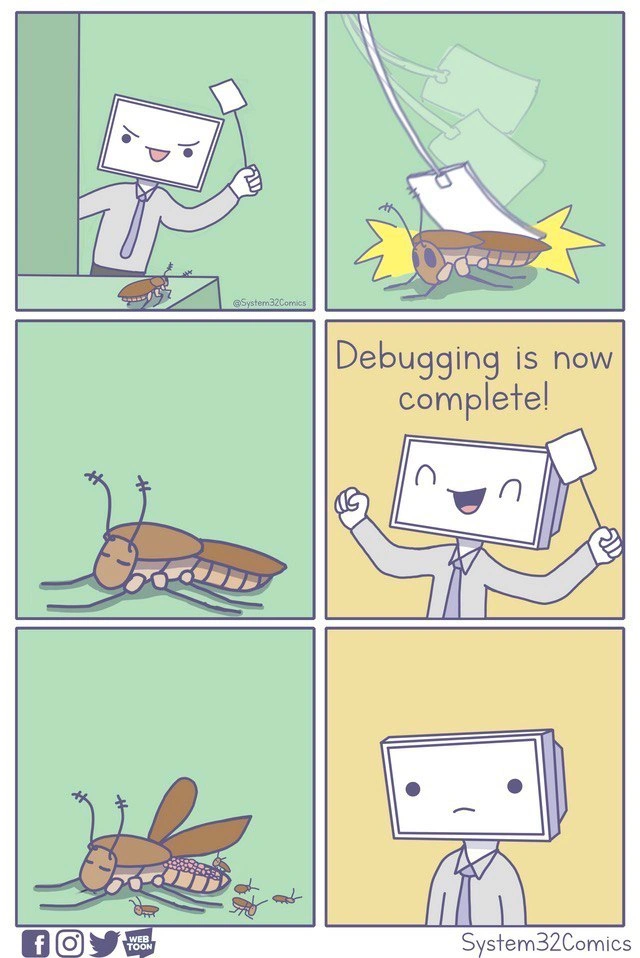
You see one cockroach in the kitchen, grab a slipper, and WHAM — got it! You do a little victory dance, because the kitchen is clean now, right? Then you lift the roach and underneath there's a whole pile of tiny eggs, already hatching, with baby roaches sprinting under the fridge. Your dance stops mid-move and you just stand there with empty eyes — exactly like the square-headed guy in the last panel. That's the joke: in computers, like in kitchens, problems rarely come alone, and the worst moment isn't finding the bug — it's realizing, one second after celebrating, that it had babies.

Level 2: Why One Fix Becomes Many Bugs

Terms worth unpacking:

  • Bug: any defect making software misbehave. The name's most famous origin story involves an actual moth taped into a Harvard Mark II logbook — the insect metaphor is load-bearing in this comic.
  • Debugging: the detective work of finding why something fails, not just observing that it does.
  • Regression: a bug introduced by a change — often by a fix. You repaired the login page and somehow broke password reset. The babies scattering in panel five are regressions.
  • Root cause: the underlying reason a bug existed. Squashing the visible roach without finding the nest means the same class of bug returns wearing a different timestamp.
  • Regression testing: re-running your full test suite after every change so that fixing one thing can't silently break others. It is, literally, checking under the wing.

The career moment this comic captures usually arrives in your first months: you fix a bug, demo it proudly, and a day later three new tickets appear referencing your commit. Nothing is wrong with you — you've just discovered that code is an ecosystem, and changes ripple. The cure is unglamorous: write a test that reproduces the bug before fixing it, fix it, keep the test forever, and stay suspicious of any victory that took less than ten minutes.

Level 3: Regressions Lay Eggs

This six-panel System32Comics strip is a complete software incident in entomological form. A monitor-headed developer spots a cockroach on his desk, swats it with rolled-up paper (impact stars and all), confirms the corpse belly-up, and declares on a triumphant yellow panel:

Debugging is now complete!

Then the dead roach's wing lifts — revealing a clutch of eggs already hatching, baby roaches scattering in every direction — and the final panel is just the dev's blank, thousand-yard monitor stare. Anyone who has closed a ticket on Friday and opened Slack on Monday knows that face.

The comic nails the central epistemological trap of debugging: you fixed the symptom you could see, not the system that produced it. The visible roach was one manifestation; the eggs are everything the quick fix didn't touch — the same flawed assumption copy-pasted into five other modules, the race condition that this crash merely exposed, the malformed data the bug already wrote to the database that will keep hatching errors for weeks. Veteran engineers learn to ask "why did this bug exist?" before celebrating "the bug is gone," which is the whole point of practices like root cause analysis and the "five whys" — the swat addresses the roach; the RCA asks who left the food out.

There's also a sharper reading where the eggs are regressions spawned by the fix itself. In tightly coupled systems, patches have ecology: change a default here, and three callers that silently relied on the old behavior break over there. This is precisely what regression test suites exist to catch — they're the pest control that inspects under the wing before you declare victory. The dev's premature yellow-panel celebration is the comic's version of marking a ticket Resolved based on one happy-path check, a ritual so common that "closed ≠ fixed" could be tattooed on most QA teams. Industry folklore compresses the entire strip into one rhyme: 99 little bugs in the code, take one down, patch it around — 127 little bugs in the code.

And the artist's signature visual gag deepens it: the developer's head is a monitor. The bug isn't somewhere abstract; it's on his desk, in his space, practically in him. Debugging is never adversarial against an external enemy — you're swatting at your own past decisions, and they reproduce.

Description

A six-panel comic strip by System32Comics featuring an anthropomorphic computer monitor character in a shirt and tie. In the first panel, the character spots a large cockroach (a literal 'bug') and approaches it menacingly with a fly swatter. The second panel shows the character smashing the bug with a 'whack' effect. In the third panel, the squashed bug lies on the floor. The fourth panel shows the character celebrating, proclaiming, 'Debugging is now complete!'. The fifth panel zooms in on the dead bug, revealing that it has released a swarm of tiny baby cockroaches. The final panel shows the character's triumphant expression replaced with a deadpan, horrified stare, realizing the problem has multiplied. This comic is a classic metaphor for a common software development nightmare: a hasty fix for a single, visible bug ends up creating numerous smaller, often more difficult-to-find, secondary bugs. It speaks to the concept of unintended consequences and the fragility of complex systems, a scenario all too familiar to experienced engineers who know that true 'debugging' involves more than just swatting the most obvious problem

Comments

8
Anonymous ★ Top Pick I love the optimism of a pull request that says 'Fixes #1234'. It rarely mentions that it also creates #1256, #1257, and the entire #1300 series
  1. Anonymous ★ Top Pick

    I love the optimism of a pull request that says 'Fixes #1234'. It rarely mentions that it also creates #1256, #1257, and the entire #1300 series

  2. Anonymous

    Lesson learned: without a regression suite, every ‘squash’ is basically a fork bomb for cockroaches

  3. Anonymous

    The senior dev who confidently merged the "simple one-line fix" directly to production on Friday afternoon just discovered why the junior's 47-file PR with extensive error handling wasn't overthinking it

  4. Anonymous

    Closed 1 ticket, the fix laid eggs in three downstream services. QA calls it a regression; entomology calls it Tuesday

  5. Anonymous

    Every senior engineer knows the first rule of production debugging: fixing one bug is just a commit message away from discovering you've actually fixed zero bugs and introduced N+1 new ones. It's not a bug, it's an emergent distributed system where each fix spawns child processes of technical debt

  6. Anonymous

    That moment your one‑line hotfix disables the repro case and enables a dormant RoachFeatureFlag: wings=true; spawn(n>100). Congrats - now you’ve got distributed insects and a flying Heisenbug

  7. Anonymous

    Declared “Debugging is now complete!” - turns out the patch wasn’t idempotent; its side effects spawned a colony of regressions

  8. Anonymous

    Tried debugging CockroachDB the hardware way - turns out it's truly fault-tolerant and self-replicates across nodes

Use J and K for navigation