Functional Programming and Immutable Lightbulbs
Why is this FunctionalProgramming meme funny?
Level 1: New House for One Bulb
Imagine you have a toy house, and the little lightbulb in the house stops working. Most people would just take the old bulb out and put a new bulb in, right? That’s the normal easy way. But the joke here is saying the functional programmer would do something wildly different: they’d build an entirely new house that’s exactly the same as the old one in every way, except it has a new lightbulb installed! Then they’d move into the new house and throw away the old house (since its bulb was bad). 😹 Sounds crazy, doesn’t it? It’s like solving a simple problem (changing a bulb) with a super complicated solution (rebuilding everything from scratch).
Why is that funny? Because it’s obviously overkill! It highlights how some people approach problems in a very strict way. The functional programming idea is “don’t change the original, make a new copy with the change.” In normal life, that’s like not touching your old house at all, and instead recreating the whole house just to fix one thing. It makes us laugh because it’s such a huge effort for a tiny fix – kind of a silly way to do it. The cat in the comic cheerfully says “easy-peasy!” while doing this enormous task, which is goofy because we all know changing a bulb shouldn’t be that hard. The humor comes from seeing an everyday task (replacing a lightbulb) being done in a ridiculously roundabout way. It’s telling us about a programmer habit in a simple, exaggerated analogy: sometimes, to avoid messing up anything else, they’ll just build a whole new thing. It’s like using a bulldozer to crack a nut – extremely safe in terms of not damaging the nut’s contents, but definitely not the simplest way! In the end, the joke helps us remember that idea of immutability (no direct changes) by showing how absurd it would look in real life. And that contrast is what makes it funny and easy to understand.
Level 2: Immutable Lightbulb 101
So what’s going on here? Let’s break down the joke in simpler terms. Functional programming (FP) is a way of writing code where you avoid changing things directly. Instead of modifying something, an FP program creates a new thing with the change. This is what we call immutability (immutable means unchangeable). If some data is immutable, you can’t alter it once it’s created – if you need a different value, you make a new copy with that one part changed.
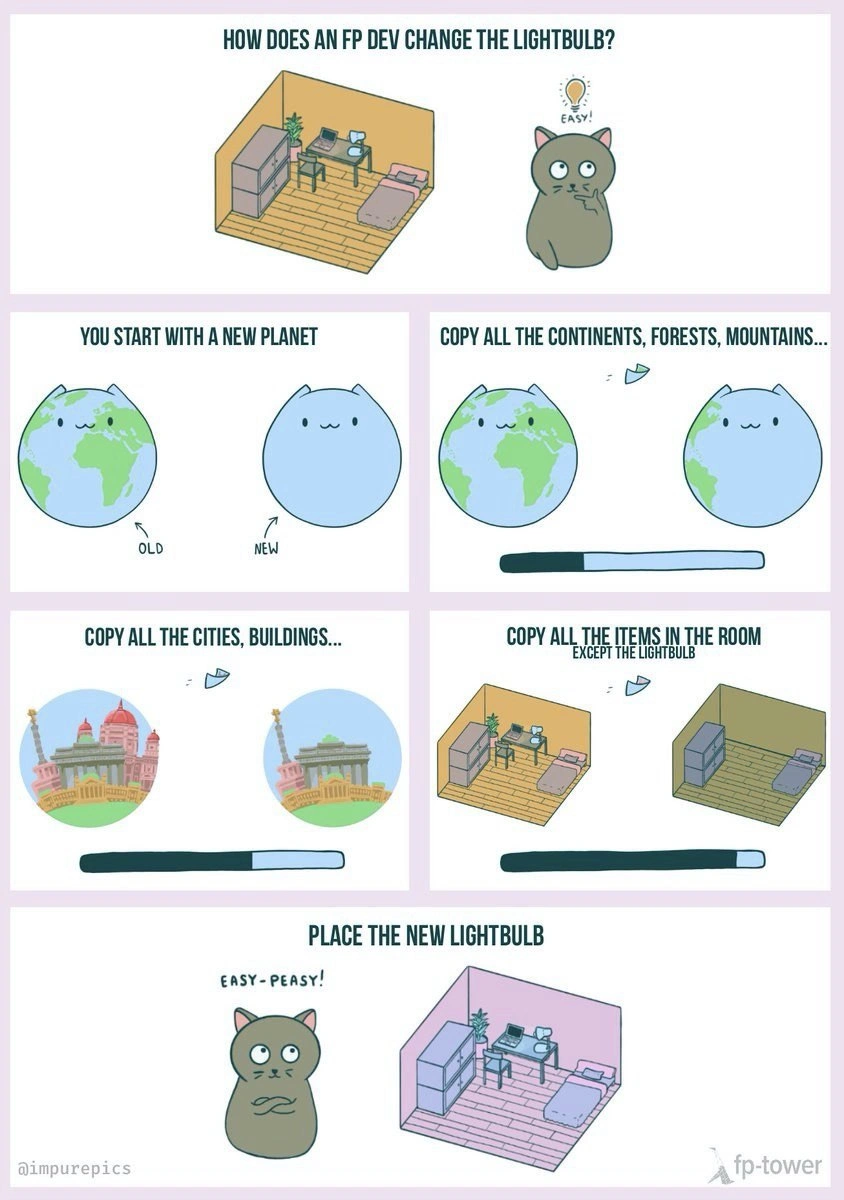
The meme asks, “How does an FP dev change a lightbulb?” and then humorously answers: by not actually touching the original lightbulb at all! In the cartoon panels, the developer is a cat character who demonstrates an immutable state update using a lightbulb as the example. Here’s the sequence:
- Start with a new planet: The cat creates an entirely new planet (think of this like making a blank copy of the world). In programming terms, imagine making a new object or data structure that’s going to represent the world’s new state. The old planet (old state) is left unchanged.
- Copy all the continents, forests, mountains…: Now the cat copies all the big parts of the world onto the new planet. This is like copying all the major sections of a data object. If our “world” data has continents as sub-parts, we take each continent from the old world and put a copy into the new world object. Nothing is modified yet; it’s just duplicated.
- Copy all the cities, buildings…: The cat continues down the hierarchy. After continents, it copies all the cities and buildings from the old world into the new world. This means every structure, every detail is painstakingly replicated. In a program, if you have nested data (e.g., an object containing other objects), you’d be copying each nested piece into your new copy.
- Copy all the items in the room (except the lightbulb): Now we get to the specific room where the lightbulb lives. The cat copies everything in that room – the desk, the laptop, the mini-fridge, the plant, the floor cushion – into the new room on the new planet. But it leaves out the old lightbulb, because that’s the thing we want to change. This corresponds to copying all fields of a data structure except the one field we intend to update. In many programming languages, you might do something like “create newRoom = copy of oldRoom, but with a different lightbulb property.”
- Place the new lightbulb: Finally, the cat adds a brand new lightbulb into the new room on the new planet. This is the actual "change" we wanted – the lightbulb is now new. We didn’t replace the bulb in the old world; we’ve placed a new bulb in the new world that’s a clone of the old one with this one difference.
When it’s all done, the cat stands proudly next to the fully copied room in the new world and says “Easy-peasy!”. The joke is that the cat (the FP developer) thinks this process is straightforward. And in a sense, it is straightforward in concept: you never mutated (touched) the original world or bulb at all, you just built a new version. This approach is called state immutability. It’s like saying: instead of changing the original, make a new version with the change. Programmers often use this to avoid bugs that come from unexpected changes. If the old state is never changed, you don’t have to worry about breaking something else that was using that state.
To relate this to something concrete: think about strings in many programming languages (like Python, Java, or JavaScript). Strings are usually immutable. If you have the string "CAT" and you want to change the C to a B to make "BAT", you can’t just change the first letter of the original string. What actually happens is the program creates a brand new string "BAT" and leaves the original "CAT" untouched. It feels like you changed a letter, but under the hood you made a new string. Similarly, if you want to change a single item in an array or object without mutating it, you’ll create a new array/object that’s a copy of the original but with that one item different. For instance, using JavaScript syntax, if we had an object for a room, we could do:
const oldRoom = { lightbulb: "old", chair: "cushion", fridge: "mini" };
// Create a new room object by copying oldRoom and replacing the lightbulb
const newRoom = { ...oldRoom, lightbulb: "new" };
Here ...oldRoom copies all the properties from oldRoom into newRoom, and then we override the lightbulb property to be "new". After this, oldRoom still has the "old" lightbulb; newRoom is the one with the "new" lightbulb. We’ve not mutated the original oldRoom at all. This is a real coding technique used in functional programming and in libraries that encourage immutability (like the Redux state management library for React apps). The meme basically takes that code concept and blows it up to a planetary scale for laughs.
It’s worth noting that in reality, functional programming languages don’t actually grind your computer to a halt by copying everything byte for byte. They use clever methods behind the scenes (like structural sharing or copy-on-write, as mentioned above) so that only the changed parts are newly created, and everything else can just point to the old stuff. That’s like if the cat, instead of physically cloning continents, just said “the new planet will reuse the old continents since they’re the same” – but that wouldn’t look as funny in a cartoon, would it? 😸 So the comic plays up the literal interpretation for comedic effect.
The overall humor here also ties into the classic “lightbulb joke” format. Traditionally, you hear jokes like “How many developers does it take to screw in a lightbulb?” with various punchlines. This meme gives it a programming twist: it doesn’t ask “how many,” but rather “how” a functional programmer would do it. And the answer is delightfully over-complicated! A normal person (or an imperative programming dev) would simply unscrew the old bulb and put a new one in the same socket – straightforward replacement. That’s analogous to just updating a variable or property in place in a typical program. But the FP dev in this joke follows the rules of immutability to the letter, treating the whole world as an immutable data structure. The cat developer essentially says: “Don’t touch the original world. Make a new world that’s almost identical, except with a new lightbulb.” This indeed is functional state update logic in a nutshell.
By using a cat as the developer character (with those big enthusiastic eyes) and phrases like “Easy-peasy!”, the meme makes the scenario light-hearted and cute. It’s depicting the FP developer as innocently confident that this approach is the correct and simple one. If you’re new to these concepts, it highlights the contrast: Why the heck would you go through all that trouble?! The answer in functional programming is: to avoid side effects and unintended consequences. The meme underscores that message through absurd exaggeration. And that’s why developers find it so funny and relatable – it’s taking a real concept we deal with (immutable updates) and pushing it to cartoon extremes. After seeing this, you’ll definitely remember what immutability means: no changing things in place – not even a lightbulb! 🔄💡
Level 3: Refactoring the Universe
This meme is hilariously illustrating the functional programming approach to a classic joke scenario. The question at the top asks, “HOW DOES AN FP DEV CHANGE THE LIGHTBULB?” – tapping into that familiar format of developer jokes (like the many “change a lightbulb” gags for different tech roles). Instead of unscrewing the bulb directly, the functional dev (depicted as a cute, wide-eyed cat) cheerfully declares it’s “EASY!” and proceeds to do something outrageous: clone the entire world just to avoid mutating the original lightbulb in place. Each panel breaks down the epic immutable update step by step, and experienced devs can’t help but laugh because it’s so extra yet oddly relatable!
What makes this so funny to seasoned programmers is that it’s a spot-on parody of the immutability mantra in functional programming. In FP-heavy languages (like Haskell, Clojure, or purely functional subsets of JS/Java with libraries), you’re told never to change (mutate) existing data. Instead, you always create a new updated version. The meme exaggerates this idea to an absurd extent: to change one small thing (the lightbulb), our FP dev systematically rebuilds the entire nested context around it. They start with a fresh planet (a brand new top-level state), then copy all the continents, forests, mountains… (i.e. all the big pieces of data in that state), then copy all the cities, buildings… (copy the next level of detail), and even copy all the items in the room except the lightbulb (essentially clone every object except the one thing we want different). Finally, in the last panel, the dev places the new lightbulb into this meticulously cloned room on the new planet and proudly says “Easy-peasy!”. The punchline is that the developer finds this convoluted process simple and straightforward — a tongue-in-cheek nod to how FP enthusiasts sometimes tout immutable updates as easier to reason about, even if it sounds insane in literal terms.
Anyone who’s worked with immutable data structures or state management libraries (like Redux for UI state) will chuckle here. For example, in Redux (in JavaScript apps), you never mutate the state object. Instead, you return a new state object with the changes. The first time a newcomer implements this, it does feel like “copying the whole world”: you might do something like spread an entire object just to change one field. In code, it ends up looking like:
// Redux-style state update example (immutable update)
const newState = {
...state, // copy all properties of the old state
lightbulb: "NEW" // override the lightbulb property with a new value
};
If state were very nested, you’d copy each layer similarly. The meme’s panels literally walk through copying each layer of the “world” data structure. Senior developers recognize this as the copy-everything-except-the-changed-piece pattern, also known as a functional state update. The humor is that the cat developer does it with a ridiculously granular thoroughness – copying continents and cities – highlighting the perceived overhead of immutability. It’s poking fun at that classic concern: “Isn’t it inefficient to create a whole new object just to change one part?” The answer from an FP dev is usually, “Under the hood it’s optimized, and the clarity is worth it!” – but the meme runs with the naive interpretation for comedic effect.
There’s also an inside joke with the watermarks here: @impurepics and fp-tower. The handle “impurepics” is ironic, since in FP we strive for pure functions (no side effects), yet the comic itself is about doing something in a hilariously convoluted pure way. It suggests the creator is steeped in FP culture and comfortable laughing at their own paradigms. The whole scenario is a bit of self-deprecating humor from the functional programming community. We’ve all heard the debates: “mutable vs immutable”, “OOP vs FP”. This comic leans into the stereotype that FP folks will avoid mutating state even if it means (conceptually) rebuilding the universe from scratch.
Experienced devs nod knowingly at this because it reflects real trade-offs we grapple with. Immutability can greatly simplify reasoning about code – no unexpected side-effects, easier debugging, and safe parallelism because no one else is changing your data out from under you. It’s a huge win for Developer Experience (DX) when dealing with complex systems: fewer spooky-action-at-a-distance bugs. However, it can come with a cost in performance or memory if used naively. The meme highlights that cost by showing a progress bar filling up as the cat copies everything. We’ve seen scenarios where heavy use of immutable copies leads to excessive garbage creation and slowdowns. Seasoned engineers know to mitigate this with techniques like structural sharing (so you’re not truly copying everything, as mentioned in Level 4) or batching changes, but the initial impression is exactly what the comic shows. It’s a shared laugh: we’ve all written that code or attended that FP 101 talk where someone asks, “Wait, do we really copy the whole object?” and the answer is “Conceptually yes, but it’s fine, trust us!”.
The phrase “Refactoring the Universe” could be another subtitle for what the cat is doing. It resonates with senior devs who have experienced over-engineered solutions where a tiny change triggers a massive refactor. It’s funny because it’s true: sometimes to preserve some lofty principle (like immutability or purity), we undertake changes that feel like using a sledgehammer on a nail. Yet, in complex codebases, that principle can save us from even worse headaches down the road. The meme strikes a chord by balancing on that thin line between comically absurd and technically accurate. Yes, an FP dev would conceptually create a new world state with a new lightbulb rather than twist the old bulb in place. And as every battle-scarred senior knows, there are times in real projects when we essentially “clone the world” (copy huge objects, duplicate databases, recreate entire server environments) just to safely make a minor change without breaking the original. It’s both a parody of FP and a reflection of real developer life choices.
In short, the comic is relatable developer humor (DeveloperHumor) because it exaggerates a well-known practice in functional programming. The cat developer character cheerfully demonstrates the immutable update process, and we laugh because we recognize both the wisdom and the absurdity. It’s always easy-peasy until you consider the memory footprint! But hey, no side-effects were introduced in the making of this new planet – and that’s the punchline for those of us who live and breathe code.
Level 4: Cosmic Copy-On-Write
In the theory of functional programming, state is treated as immutable — once created, a piece of data cannot be changed. This idea comes from the lambda calculus foundations of FP, where variables are single-assignment and functions have no side effects. To "change" something, you must instead create a new version of it with the desired difference. Academically, this is formalized as persistent data structures: data structures that preserve older versions of themselves when modified. The old version remains intact (just like the old planet in the meme), and a new version (the new planet) is produced with the change. This ensures referential transparency – any function will always return the same result given the same input and never depend on hidden state changes. It's one of the core principles that make purely functional code easier to reason about mathematically.
Of course, literally cloning an entire universe of data every time you change a lightbulb would be absurdly inefficient! 😅 The brilliance of real FP languages is that under the hood they use smart strategies like structural sharing and copy-on-write optimization. That means much of the "old world" is reused rather than duplicated bit-for-bit. For example, if you have an immutable list and create a slightly modified list, it might internally reuse most of the original list's nodes, copying only the parts that changed and pointers to the rest. The meme exaggerates it as copying all continents, forests, cities, etc., but in practice a new immutable object can share the bulk of its structure with its predecessor. This yields efficiency close to mutable approaches, often with complexities like $O(\log N)$ or even $O(1)$ for certain updates instead of $O(N)$ full copies. Classic FP research (like Okasaki's work on purely functional data structures) has shown how to build efficient immutable collections that avoid rebuilding the entire world from scratch.
Another theoretical aspect here is how garbage collection and memory work in an immutable paradigm. When you create that "new universe" (new state), the runtime's GC can eventually clean up the old one if nothing references it. Immutability also plays well with concurrency and parallelism – if one thread has the old world and another has the new world, they don't interfere with each other because the old world isn't being mutated, just replaced. This is akin to copy-on-write in operating systems: when a process is forked, the OS doesn't actually duplicate all memory pages immediately – instead, pages are copied only when a write occurs. Similarly, functional updates conceptually look like "clone everything with one change," but thanks to lazy copying and sharing, the system isolates the changed part without duplicating the untouched parts. The meme's cosmic scale of cloning humorously hints at this copy-on-write principle on a planetary level. It’s a playful take on the deep CS idea that you can maintain immutability and still be efficient by cleverly sharing structure. So while the cat’s method looks ridiculously costly (a whole new Earth!?), it’s illustrating a fundamental truth of FP: you avoid side-effects by creating new state, backed by some serious computer science magic to make it feasible.
Description
A six-panel comic strip illustrating how a functional programming (FP) developer changes a lightbulb, featuring a cute, stylized cat character. The comic begins with the question 'HOW DOES AN FP DEV CHANGE THE LIGHTBULB?'. The cat confidently exclaims 'EASY!'. The subsequent panels depict a comically exaggerated process based on the principles of immutability. Instead of changing the bulb in place, the developer 'starts with a new planet,' then proceeds to 'copy all the continents, forests, mountains...', 'copy all the cities, buildings...', and 'copy all the items in the room except the lightbulb'. Finally, in the last panel, the new lightbulb is placed in the newly created room, and the cat declares it 'EASY-PEASY!'. This meme humorously critiques the overhead of immutability in functional programming, where state is never modified but instead, a new state is created with the desired changes. For senior developers, it's a relatable joke about the trade-offs between the conceptual purity of FP and its practical performance implications for seemingly simple tasks
Comments
7Comment deleted
An object-oriented programmer just changes the bulb's 'is_burnt_out' property to false. The functional programmer creates a whole new universe to achieve the same result, but at least they can guarantee there are no side effects, except for, you know, the heat death of the old universe
Functional dev SOP: terraform Planet_v2, bulk-copy continents, flip DNS from Earth_v1, then GC the old universe. CFO: “All that to swap one bulb?” Dev: “State stayed pure; your budget didn’t.”
This is why our FP team's AWS bill is $2.3 million per month - turns out implementing Redux at planetary scale with time-travel debugging enabled wasn't the performance optimization we thought it was
This perfectly captures the FP purist's dilemma: when your commitment to immutability is so absolute that changing a lightbulb requires cloning the entire universe. It's the logical conclusion of 'never mutate state' - just create a new planet with the desired state and garbage collect the old one. Of course, in production, you'd optimize this with structural sharing and persistent data structures, but where's the fun in that? The real question is: did they remember to make the planet-copying function pure and referentially transparent?
In FP you don’t change a lightbulb; you append BulbReplaced to the World stream and replay the universe - referentially transparent, financially opaque
We don’t change the bulb; we return Universe′ with room.light = Some(On) - structural sharing makes it O(log n), but the PM saw the heap spike and filed a “stop deep‑cloning Earth” ticket
FP lightbulb swaps: O(1) with perfect hashing, or O(universe) if you're naively recursing copies