Skip to content
DevMeme
1467 of 7435
California Road Grid as Commit Graph
VersionControl Post #1642, on May 29, 2020 in TG

California Road Grid as Commit Graph

Why is this VersionControl meme funny?

Level 1: Roads Like Code

This is like looking at a map of roads and realizing it looks like a family tree for computer changes. One road splits away, another comes back, and the whole thing starts to look like people trying to combine their work. The joke is that developers see their tools everywhere, even in a map of farmland.

Level 2: Branches On Roads

Git is a version-control tool that records changes to code. A commit is one saved snapshot. A branch is a separate line of work, often used for a feature or bug fix. When that work is brought back into the main line, teams perform a merge.

Git tools often show this as a graph: one line continues forward, another line splits away, and later the lines join again. The roads in the image look like that graph. The straight vertical road feels like the main branch, while the diagonal roads resemble feature branches crossing or rejoining the central history.

For newer developers, this meme points at a real workflow lesson. Branches are useful because they let people work safely in parallel, but too many branches left open for too long create confusion. Merge conflicts become harder, reviews become larger, and nobody remembers why a change was made. Good version control is not only about saving code; it is about making the history readable for the next person.

Level 3: County Merge Graph

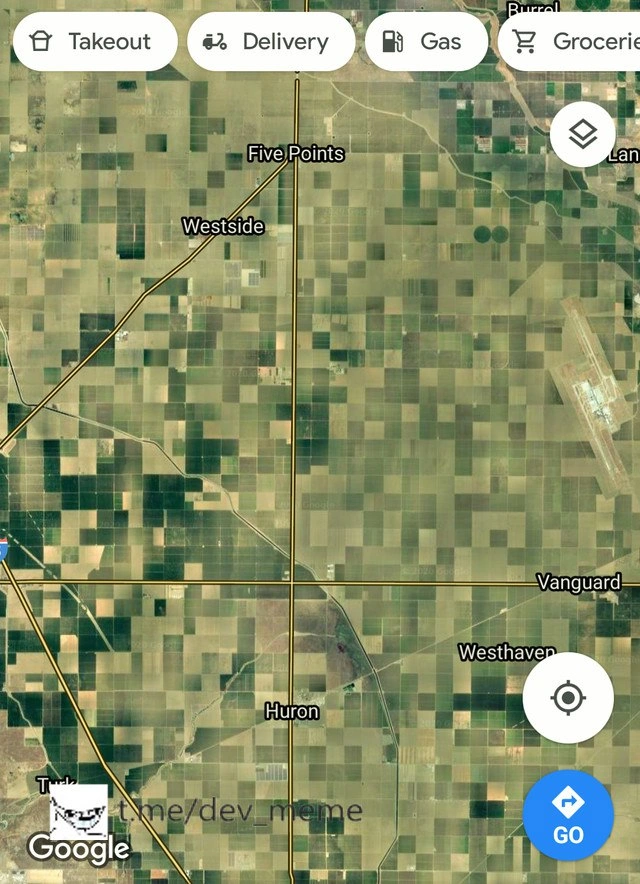
The caption says, This region of California looks like a GitHub commit log, and the map makes the comparison immediately legible. A vertical road runs through labels like Five Points and Huron, a long diagonal road cuts in from the left through Westside, and other straight segments intersect across agricultural blocks. To a non-developer, it is just road geometry. To someone who has stared at a Git graph after a release freeze, it looks like several feature branches trying to rejoin main without admitting what happened.

The humor comes from visual pattern recognition. Git history is often drawn as lines of commits, with branches splitting off and merge commits pulling them back together. Clean teams try to keep that graph understandable: short-lived branches, regular rebases or merges, clear pull requests, and releases that do not require a séance. Messier teams create histories that look exactly like this map: diagonals, crossings, long isolated paths, and one branch that has apparently been trying to reach production since irrigation was invented.

The map UI intensifies the joke because it is mundane. Buttons labeled Takeout, Delivery, and Gas sit above a landscape that developers read as repository archaeology. That is a classic developer-brain moment: once your job trains you to see dependency graphs, branch topology, data flows, and deployment paths, ordinary infrastructure starts looking like tooling diagrams. Congratulations, the profession has installed a browser extension directly into your visual cortex.

The deeper version is about branching strategy. A commit graph is not just decoration; it records coordination choices. Long-lived branches can mean delayed integration, hidden conflicts, duplicated work, and painful merges. A simple straight road resembles trunk-based development. A web of diverging and rejoining lines suggests feature branches, hotfixes, release branches, and experimental work all sharing the same geography. The map is funny because it accidentally visualizes the social life of code.

Description

A Google Maps satellite screenshot shows an agricultural grid in California with long straight roads, diagonals, and intersections that resemble branches and merges in a version-control history. The visible UI includes pill buttons labeled "Takeout", "Delivery", "Gas", and a partially cut off "Groceries", plus map labels such as "Burrel", "Five Points", "Westside", "Huron", "Vanguard", "Westhaven", "Google", and a blue "GO" button. The source caption says, "This region of California looks like a GitHub commit log," turning real-world road geometry into a Git history visualization. The humor works because engineers immediately recognize the branching-line pattern as the kind of commit graph produced by feature branches, merges, and long-lived parallel work.

Comments

1
Anonymous ★ Top Pick Somewhere in that road network is a feature branch that missed three releases and now owns the county's schema migration.
  1. Anonymous ★ Top Pick

    Somewhere in that road network is a feature branch that missed three releases and now owns the county's schema migration.

Use J and K for navigation