Skip to content
DevMeme
4240 of 7435
Competitive coders' variable names make you reach for holy water
CodeQuality Post #4636, on Jul 4, 2022 in TG

Competitive coders' variable names make you reach for holy water

Why is this CodeQuality meme funny?

Level 1: Alphabet Soup Code

Imagine you’re reading a story, and instead of real names for the characters or places, everything is replaced by random letters. For example, the story might say “B went to X to get Z from Y.” Huh? You’d be completely confused because those letters don’t tell you who or what they stand for, right? In real life (and in normal writing), we use clear names so everyone knows what’s going on. Programming is similar: when we write code, we usually give variables descriptive names, like calling a score total totalScore or a list of ages ageList. Now, some competitive coders in programming contests use just single letters for their variable names (a, b, c, etc.), and reading that kind of code feels just like that baffling letter-only story. It’s so confusing that it almost seems wrong, like something is out of place. The meme jokes about this feeling by showing a person reaching for holy water to “cleanse” their eyes after seeing such code. (Holy water is like a special water some people use to ward off evil or bad things.) In other words, the variable names were so bad and hard to understand that the person jokingly acts like they saw something evil and needs to wash it away! It’s a funny, exaggerated way of saying, “Those variable names are terrible – please use better names that actually mean something!”

Level 2: Naming Nightmares

If you’re a newer developer, you’ve probably learned that giving variables meaningful names is important. (A variable is just a placeholder or container for a value in your program, kind of like a box with a label on it.) Now, competitive programming is a coding sport where people race to solve algorithm puzzles under tight time limits. In that fast-paced setting, a lot of coders use very short variable names – often just one letter like x or y. This is the opposite of what you’ll see in clean, professional code or even in your class projects, where variables might have names like totalScore, playerAge, or priceSum. When you look at competition code full of single-letter names, it can feel like trying to read alphabet soup. It technically works, but wow is it hard to make sense of at first glance!

Why would anyone do this? In competitions, the goal is to get a correct solution as fast as possible. Typing distance versus d might not seem like a big difference, but when every second counts, some coders default to the shortest names to save time. Plus, they’re writing code just for a computer judge and themselves — they don’t expect anyone else to ever read or maintain it. In other words, they trade off clarity for speed. This might be okay for a one-time contest submission, but it goes against the usual lessons about writing good code. In real projects (or any code someone else might read), you generally want to prioritize readability. Clear code is considered high code quality, meaning it’s easier to understand, maintain, and less prone to mistakes.

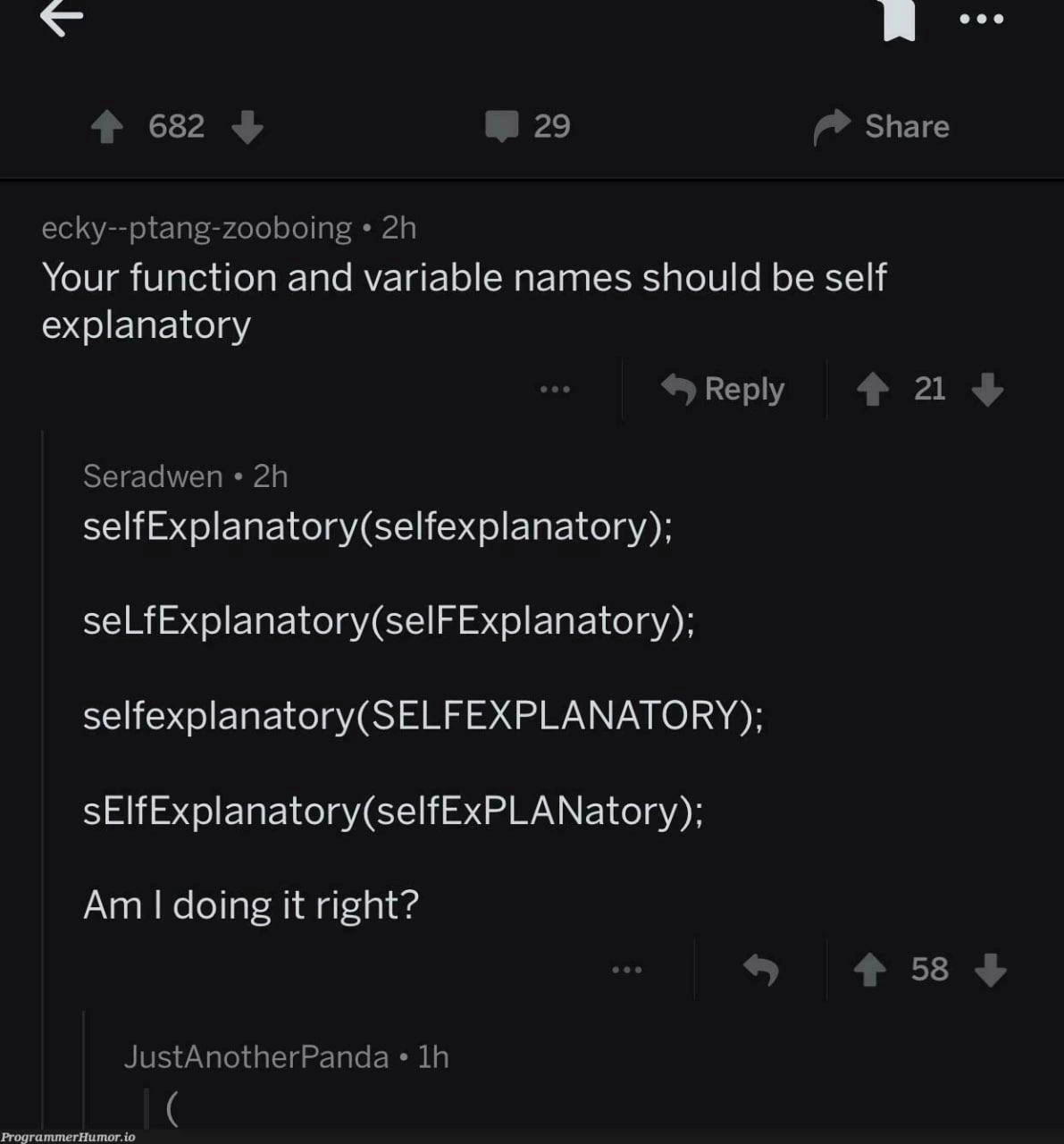
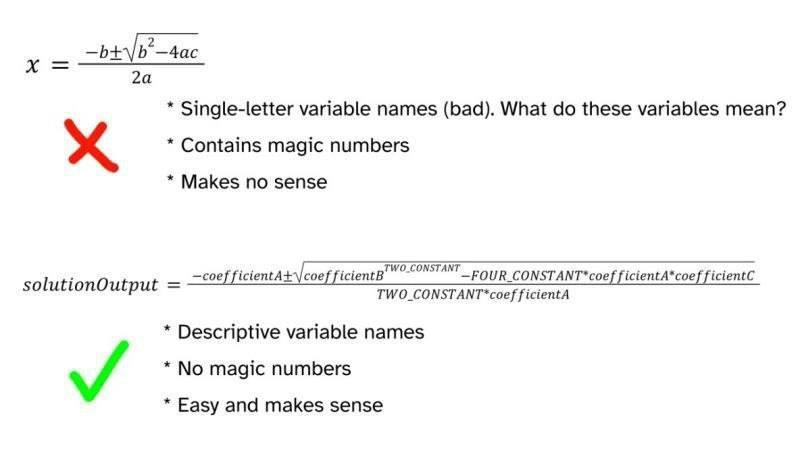
In most programming languages, you’re allowed to name a variable pretty much anything, as long as it’s not a reserved word. The computer doesn’t mind if you call your variable x or total_sum – it will run just the same. But people mind a lot, because the name should tell us what that variable represents. For example, compare these two tiny Python snippets that do the exact same thing (adding up a list of numbers):

# Competitive programming style: short, cryptic names
n = int(input())                     # 'n' is the number of elements
a = list(map(int, input().split()))  # 'a' is the list of numbers
s = 0                                # 's' will hold the sum
for x in a:                          # 'x' is each number in the list
    s += x
print(s)
# Clean code style: descriptive names
count = int(input())                 # 'count' is the number of elements
numbers = list(map(int, input().split()))  # 'numbers' is the list of input values
total_sum = 0                        # 'total_sum' will hold the sum
for number in numbers:               # 'number' clearly represents each item
    total_sum += number
print(total_sum)

In the first version, you have to remember or guess what n, a, s, and x stand for. Without the little comments I added, a reader could get lost. In the second version, each name is like a helpful label: count tells you exactly what that number means, and total_sum clearly is the sum of all numbers. This shows a key principle of variable naming: a well-chosen name is self-explanatory, almost like a tiny comment about the variable’s purpose. The clean version is longer to type, but it’s much easier to read and understand later.

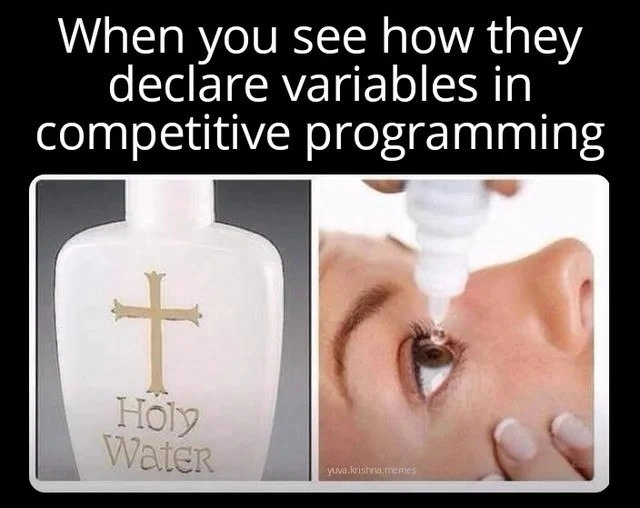
Now let’s connect this to the meme. The caption says, “When you see how they declare variables in competitive programming,” and below it we have two images side by side. On the left is a small bottle labeled “Holy Water” with a cross on it; on the right, it’s blurred but looks like someone aggressively dousing their eyes with a much bigger container of holy water. Holy water is something people use in stories or religion to chase away evil or purify things. So, what’s the joke? Seeing code with those one-letter names is portrayed as such a horrifying sight that a programmer feels the need to purify it with holy water. A tiny bottle (a mild reaction) isn’t enough — they go for a giant, heavy-duty splash to cleanse what they’ve just seen. It’s a playful exaggeration. In reality, you wouldn’t literally spray water on bad code, but you might feel an intense urge to fix those names right away. The meme is basically saying, “these variable names are so bad, they look almost possessed or cursed, and I must exorcise them!”

For a newcomer, it’s important to know this is a joke – but it’s based on a real sentiment in programming. CodeQuality and clarity matter a lot when you’re working on anything more permanent than a contest entry. There’s a famous saying: “Code is read far more often than it is written.” That means you (and others) will spend much more time reading code later than you did typing it out. If the names in the code are a, b, c, x, y without meaning, it’s like trying to read a book where every character’s name is just one letter. It gets frustrating quickly! The meme’s over-the-top holy water gag makes developers laugh because we’ve all been there — opening someone’s code, seeing gibberish names, and dramatically thinking “I need to wash my eyes out after witnessing that.” It’s a lighthearted way to remind everyone that NamingThings properly in code is important. Good names help others understand your work, and prevent that shocked reaction (and the imaginary need for an exorcism) when someone else reads your code. In short: the meme uses comedy to say “please use meaningful variable names, or the code readers of the world might just reach for the holy water!”

Level 3: Exorcising Unholy Variables

In the realm of competitive programming, code readability often gets sacrificed on the altar of speed. Seasoned developers have a saying: “There are only two hard things in Computer Science: cache invalidation and naming things.” This meme hits on that second part — the bane of VariableNaming. In programming contests, it’s common to see every variable named as a single letter or two (i, j, k, x, y...), chosen for quick typing rather than clarity. These short names are practically an accepted norm in algorithm competitions: why spend time coming up with totalCount or priceSum when t or p will do and you’re racing the clock?

To an experienced eye, though, this is borderline blasphemy in terms of CodeQuality. We spend years drilling into juniors that code is read far more often than it’s written. Meaningful names are a cornerstone of writing self-documenting code. In a professional codebase, deliberately using such single-letter identifiers is almost sacrilegious. We have entire naming conventions and style guides telling us to use self-explanatory identifiers. (There’s even the oft-repeated joke that naming things is one of the hardest problems in programming, precisely because good names are so crucial and so tricky.) But in a contest, who cares if x meant coordinateX or totalCount? The code only needs to run correctly once and never be touched again. It’s disposable. The result, however, is that anyone else reading it experiences a kind of code style shock: a visceral recoil at seeing logic hidden behind one-letter variables. Imagine stepping into a large legacy codebase and finding that every variable is named after a different letter of the alphabet with no comments to guide you. You’d suspect either a cruel joke, or that the original coder was quietly summoning eldritch beings via one-letter identifiers.

The humor here leans on religious parody: those cryptic one-letter variables feel so “impure” or unholy to a clean-code devotee that they jokingly reach for holy water. The meme literally shows a small modest bottle labeled “Holy Water” versus a much larger, blurred-out torrent being applied (basically an industrial-strength holy water spray to the eyeballs). A tiny sprinkle won’t cut it — you need a full-blown exorcism! It’s exaggerating that gut reaction many of us share: “This code is so cursed I need to cleanse it!” The meme format itself is part of a running joke: reaching for holy water (a symbol of purification) when encountering something cursed in code. In developer humor, a holy_water_meme usually means “this thing is so wrong, it needs a spiritual cleansing.” In this case, the “evil” is those variable names, and the punchline is that a normal amount of holy water (minor irritation) isn’t enough — you require the big guns to purify your poor eyes after seeing such naming.

Why do competitive coders do this, knowing it’s a readability sin? Context is key. In competitive_programming, every second counts. The priority is solving the problem under time pressure, not writing maintainable software. Typing out full words for variables can feel like it slows you down. Many contestants also treat their code like a disposable script: it only needs to be correct and fast; it doesn’t need to be pretty. They assume no one (including themselves) will ever read or maintain that code in the future. So things like descriptive naming or comments are viewed as luxuries, sometimes even liabilities. There’s also tradition and muscle memory: contestants get used to certain patterns (n for array length, i for index, t for test cases, etc.) so they can crank out solutions without pausing to think of names. The ironic part is that outside of the contest bubble, these habits can be jarring or even counterproductive. In a real project, code with meaningful names can be a lifesaver for your teammates (and for future you).

This clash of styles often causes what we might jokingly call variable declaration anxiety. You open someone’s contest solution and see int a, b, c; at the top of a function, and your heart skips a beat. What on earth are a, b, and c? Without any context, those names are essentially opaque. Is a a count? An array? An important object? It’s anyone’s guess until you dig deeper. Reading such code, you constantly have to deduce the meaning from usage, which slows you down and opens the door for misinterpretation. If a bug appears, debugging a tangle of single-letter variables is like solving the original problem from scratch, but now with an added layer of obscurity. One might joke that reading this kind of code at 3 AM could actually summon demons — not literal ones, but the demons of confusion and frustration (and probably some choice words for the author).

In well-maintained codebases, by contrast, teams enforce clear naming through code reviews and linters. Many style guides explicitly discourage single-letter names except for throwaway loop indices or very small scopes. There’s a reason: clear code saves time for everyone in the long run. It’s the classic maintainability vs. speed trade-off. What’s fascinating is that technically, modern computers and compilers don’t care about name length at all. You could name a variable x or descriptive_total_count and the compiled program or output will run just as fast. (In the early days of programming, memory was scarce and some languages had fixed name length limits, so short names sometimes had a technical reason — but that’s ancient history now.) So using one-letter variables is purely a human choice for convenience, not a machine requirement. You’re saving a few keystrokes and maybe a microsecond of thought, but you’re potentially causing hours of extra work for anyone reading the code later. Seasoned devs know this pain well. As the joke goes, “Weeks of coding can save you hours of planning” — and here, not spending a few seconds on a good name can cost hours in code comprehension down the line.

The meme’s comedy lands because it’s a shared experience across the industry. Pretty much every programmer remembers the first time they opened someone else’s code (or even their own old code) and saw a jungle of a, b, c, aa, bb as variable names. That facepalm and “oh no, what is this?” feeling is universal. Instead of just groaning, the meme exaggerates it to absurdity: it equates bad variable naming to something so morally wrong or frightening that you’d break out religious tools to deal with it. It’s tongue-in-cheek, of course — we don’t actually keep holy water on our desks — but it humorously conveys how strongly developers feel about CodeQuality issues. Good naming is almost sacred in software craftsmanship, so when we see it violated on a massive scale, our dramatic “bring out the holy water!” response gets a laugh. We’re basically poking fun at ourselves for being so uptight about clean code, while also genuinely saying “Please, no more one-letter variable hell.”

Description

Meme with white text on a black background reading, "When you see how they declare variables in competitive programming". Beneath the caption, the image is split in two: on the left is a photograph of a small translucent plastic bottle labeled "Holy Water" with a gold cross printed above the text; on the right, the area is intentionally blurred but clearly suggests a much larger container or more intense spray of holy water. The visual joke contrasts the modest bottle with the implied industrial-strength option, mocking the cryptic one-letter or symbol-heavy variable names common in competitive programming. For developers, it highlights code-quality pain points around naming conventions and readability, using religious imagery for comedic exaggeration
Comments

6
Anonymous ★ Top Pick Merging competitive-programming code into prod feels like committing gzip without the decompressor: int a,b,c; - quick, bless the repo before that becomes the canonical domain model
  1. Anonymous ★ Top Pick

    Merging competitive-programming code into prod feels like committing gzip without the decompressor: int a,b,c; - quick, bless the repo before that becomes the canonical domain model

  2. Anonymous

    The same engineer who writes pristine, self-documenting code with names like `CustomerAuthenticationService` becomes "int a,b,c,n,m,dp[1005][1005];" the moment LeetCode says they have 30 minutes left

  3. Anonymous

    Competitive programmers treat variable names like they're paying per character - meanwhile, the rest of us are over here writing `userAuthenticationServiceFactoryProvider` because we read Clean Code once and took it way too seriously. The real competitive advantage? Being able to decipher what `dp[i][j]` actually represents six months later when the production incident hits at 3 AM

  4. Anonymous

    CP vars: single letters for keystroke economy; prod code: camelCase novels for the maintainer who isn't you

  5. Anonymous

    Competitive programming variable names are Huffman-coded intent - save keystrokes with a,b,i,j; decompression in prod requires a staff engineer, three greps, and holy water

  6. Anonymous

    Only in competitive programming does '#define int long long' count as tuning; my code review ritual applies holy water named clang-tidy and makes mp interview for a real domain name

Use J and K for navigation