Skip to content
DevMeme
4334 of 7435
Hollywood Hackers vs Real Hacking: From Matrix Screens to Endless Waiting
Security Post #4737, on Aug 7, 2022 in TG

Hollywood Hackers vs Real Hacking: From Matrix Screens to Endless Waiting

Why is this Security meme funny?

Level 1: Waiting Game

This meme is basically saying: movies make hacking look super quick and exciting, but in real life it’s slow and boring. Imagine if a movie showed someone doing homework and they finished a huge assignment in 10 seconds with a big “TA-DA!” – that’s what Hollywood does with hacking. They add cool green computer code on the screen and pretend the hacker can break into anything in a flash. Now think about how doing homework or solving a big puzzle really feels: you sit there for hours, trying different answers, maybe erasing a lot, sometimes getting frustrated and thinking “hmm, maybe I should try this… nah, that won’t work.” It’s quiet and tedious. That’s the right side of the meme. It’s basically a waiting game. The person is just waiting and thinking for a long time, not seeing any big exciting result.

The funny part comes from putting these two side by side. It’s like showing a split-screen of a race car vs. a snail. On one side, you have the race car zooming (that’s the movie version of hacking – fast and furious). On the other side, you have the snail slowly inching along (that’s the real-life hacking – slow and steady, with a lot of patience). We laugh because the difference is so huge and so true. It reminds us that what you see in movies isn’t how things actually work. In reality, hackers don’t cause explosions in a few keystrokes; they mostly sit and tinker with their computers quietly. So the meme is a playful way of saying: “Don’t believe the movie magic – real work, especially hacking, takes a lot longer and is way less flashy!”

Level 2: Fast-Forward vs Real Time

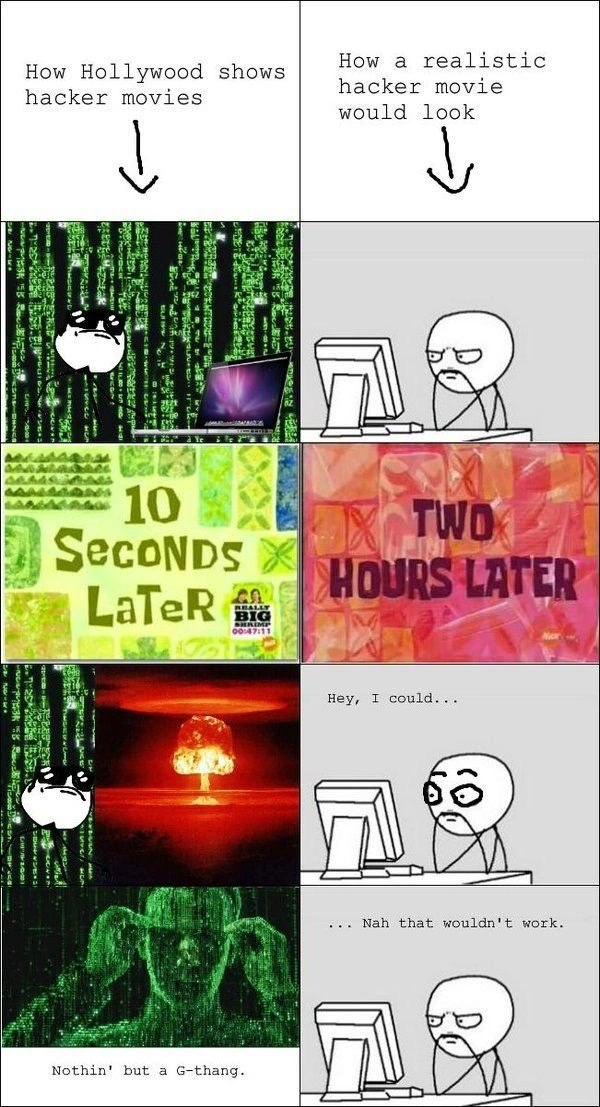
Let’s break down the meme in simpler terms. It’s essentially comparing what people see in movies versus what actually happens in real life, especially for computer hacking. On the left side (the Hollywood version), everything is in fast-forward: hacking looks instant. We see what looks like Matrix code – glowing green text raining down a screen – which has become a pop-culture visual for “hacker at work”. In movies, they often show something like that to represent complex programming or bypassing security, even if it’s nonsense. There’s also a little rage comic face character next to the code, drawn with a fierce expression, to show the hacker is intensely focused or furious (rage comics are those simple black-and-white meme faces from early internet culture used to convey strong emotions). Below that, a SpongeBob SquarePants time card appears saying “10 Seconds Later”. This is a reference to the SpongeBob cartoon’s gag where a narrator or title card shows messages like “10 seconds later” or “2 hours later” to humorously indicate time passing. In the meme, “10 Seconds Later” means the Hollywood hack only took a few seconds to reach the next big event. And indeed, right after that, we see an image of a nuclear explosion. That implies the movie hacker’s actions in mere seconds have caused some huge dramatic result (like launching a missile or blowing up a system). Finally, the bottom of the left column shows another Matrix-like screen with a green-tinted figure and the caption “Nothin’ but a G-thang”. That phrase comes from a famous 90s rap song by Dr. Dre and Snoop Dogg (“Nuthin’ but a ‘G’ Thang”) – it’s likely used here just to add a cool one-liner vibe, as if the hacker is saying “No big deal, just doing my thing.” In short, the left column is every hacking movie stereotype exaggerated: super-fast hack, fancy visuals, big impact, and the hacker looking cool with a catchphrase. It’s tech hype on full display – the kind of thing that makes people think hackers are wizards who type a few keys and cause explosions.

Now, look at the right side (the realistic version). The top has the text “How a realistic hacker movie would look” with a down arrow, hinting that the panels below will show that story. Instead of green code and a fancy laptop, we have a plain drawing of a stick-figure guy at a very old-looking computer (a boxy CRT monitor like computers from the 90s). The expression on his face is just “meh” – looking tired or unamused. This already sets the tone: unlike the dramatic hacker on the left, this guy is just plodding along. Below him is another SpongeBob time card, but this one says “TWO HOURS LATER” on a duller, reddish background. So, in the realistic scenario, two hours pass. That’s a huge difference from 10 seconds! And what happens after two hours? The next panel shows the same bored stick figure, now thinking to himself: “Hey, I could…” and then the final panel: “…Nah that wouldn’t work.” No explosion, no action – just an idea popping into his head and then him realizing it’s probably a dead end. This right column is portraying how boring and slow real hacking can be. It’s basically saying: if a movie showed hacking accurately, you’d watch someone sit at a computer for hours, try a bunch of things that lead nowhere, and mumble to themselves. Not very exciting, right? Exactly – that’s the joke.

To connect this with real terms, realistic hacking (often called penetration testing when done ethically) involves steps that take a lot of time. There’s usually a phase of reconnaissance – finding out information about the target system, such as scanning which ports are open, which services are running, etc. Tools like nmap (a popular network scanner) are used, and those can take a long time to finish especially if scanning a large range of addresses or ports. That waiting period might be like the “two hours later” in the meme (sometimes it’s actually many hours later in real life!). After recon, a hacker might try different known exploits or perform a brute force attack (which means trying many possible passwords or keys until one works). Brute forcing is inherently slow if the password is at all decent, because as we mentioned, it may have to go through millions of guesses. In a movie, they might show a progress bar zooming to 100% in seconds – a classic hollywood trope – but in actuality, you’d maybe see a command-line tool output trying password 1, password 2, password 3... up to password 1000000, and it could take hours or days, and likely get stopped by security lockouts long before completion. Real hackers also often hit walls where their current approach isn’t working (like the stick figure thinking “maybe I could try X… no, that won’t work”). They have to come up with new ideas, maybe research online (reading documentation, searching for other vulnerabilities). It’s a lot like debugging a broken program: you try something, it fails, you see an error, you adjust your strategy, and sometimes you feel stuck.

We also see the term “Security Theater” in the tags, which is a concept where something just looks secure (or in this case, looks technically impressive) but isn’t effective. The Hollywood depiction of hacking is a form of theater: it’s all for show. The hacker types furiously but realistically typing speed isn’t what gets you through encryption. It just feels intense to an audience. Meanwhile, industry trends hype refers to how the tech industry (and media) often hype up certain concepts – here the idea of hacking is hyped as this glamorous, speedy thing. Then we, as developers or security folks, often have to temper expectations (“Actually, it doesn’t work like that…”). This meme is basically doing that in a humorous way.

If you’re a junior developer or just starting in cybersecurity, you might recall times you expected something to be quick because of what you’ve seen or heard. For example, maybe you thought running a certain program or script would be instant, but then you found yourself staring at the screen loading for ages – that’s a relatable experience. It’s like how installing dependencies or building a project can make you wait (and wait…) when movies always show code just running snappily. Similarly, a newcomer to hacking might load up a tool to crack a Wi-Fi password, expecting movie-like “we’re in!” results, but after an hour it’s still chugging through possibilities. The first time you do a CTF (Capture the Flag) hacking challenge or a coding contest, you might be surprised how long everything takes and how many attempts fail. That’s normal! The movies just skip over those boring parts.

We can break down some key terms and visuals in this meme:

  • Unrealistic hacking tropes: These are clichés that movies use to depict hacking. Examples include incredibly fast typing, dramatic progress bars, techno music, instant “Access Granted” messages, hacking any system with ease (whether it’s a bank or an alien spaceship). The left column is composed of these tropes.
  • Hollywood vs realism: This is the core contrast. Hollywood shows the flashy version; realism is the dull truth. The meme explicitly labels each column to make it clear.
  • Matrix green code visual: Inspired by The Matrix movie’s iconic screen display. It doesn’t actually represent code from real hacking tools; it’s more of a stylistic choice to indicate “computer stuff going on”. Real hackers do use terminals with green text sometimes (you can set text color to green in a terminal for that retro look), but the content is usually meaningful commands or code, not random katakana characters flowing downward 😉.
  • SpongeBob time card reference: In SpongeBob SquarePants (a children’s cartoon), these title cards like “Two Hours Later” are used humorously to show time passing. They’ve become a meme in their own right. Here, the meme creator used actual images of those cards. “10 Seconds Later” vs “Two Hours Later” directly shows the time difference joke.
  • Long debugging sessions: This phrase from the tags draws a parallel between hacking and debugging code. Both require patience and lots of trying different things. If you’re a junior developer, you likely understand the frustration of a long debugging session: you thought you’d fix that bug in 5 minutes, but 3 hours later, you’re still searching for the cause. Real hacking is very similar — it’s basically debugging someone else’s system from the outside, trying to find a “bug” you can exploit.
  • Hacking movie stereotypes: This refers to the common scenes that appear in many movies/TV shows about hacking. Apart from what we already mentioned (fast typing, green text, “I’m in!”), other stereotypes include: the hacker is often portrayed wearing a hoodie in a dark room, multiple monitors with scrolling code, somehow magically guessing passwords (“Let me try “password123”. I’m in!”), or typing so fast that progress bars fill up in real-time. One famous silly example was from a TV show where two people used a single keyboard at the same time to try to “double hack” faster – obviously, that doesn’t make any sense in reality, but it was used for dramatic effect. People in tech often laugh about that scene now.

The meme is very relatable because many of us have had to explain to friends or family that real cybersecurity work isn’t like the movies. For instance, someone might ask, “You’re a programmer, can you hack into my email for me? I saw people do it in movies in like 5 minutes.” And we have to say, “Uhh, no, it doesn’t exactly work that way!” Real hacking (ethical hacking, at least) involves planning, patience, and persistence. It can take days of boring work to achieve something minor. The payoffs are usually not visually exciting either – maybe you get a confidential file or a user account access. There’s no fireworks or explosion graphic; it’s often just quietly knowing you got in and then reporting it if you’re doing a security audit.

So, in summary, the meme is comparing fast-forwarded, hyped-up movie hacking with real-time, tedious actual hacking. It’s educating (in a funny way) that in cybersecurity and IT, things move a lot slower than how they’re portrayed in media. Tech hype cycle thinking might make outsiders believe hacking is a mystical superpower, but this meme (and many like it in developer humor circles) brings it back to earth: it’s just like any other complex task – it takes time, trial-and-error, and isn’t very glamorous to watch.

Level 3: Matrix vs Mundane

From a seasoned developer or security engineer’s perspective, this meme is a spot-on satire of unrealistic hacking tropes. On the left, you have the quintessential Hollywood hacker montage: neon green alphanumeric rain (straight out of The Matrix), a rage-comic style face contorted in intense concentration, and within a mere “10 Seconds Later” title card, there’s a cinematic payoff – in this case, a nuclear explosion on screen implying the hack hit some critical system. It’s the ultimate tech hype: everything is flashy, fast, and unbelievably effective. On the right, labeled “How a realistic hacker movie would look,” a stick figure sits at a plain old beige CRT monitor looking exasperated or bored. Two hours elapse (cue the SpongeBob-esque “TWO HOURS LATER” card), and nothing dramatic has happened – the figure is still there, now thinking "Hey, I could…", only to conclude "...Nah that wouldn't work." This split-screen joke encapsulates a truth every developer or penetration tester knows too well: real hacking (or honestly any complex coding task) is often a slow, iterative grind, not an instant fireworks show.

The humor draws on our shared experiences in the tech industry. It’s tech industry satire aimed at the disparity between Hollywood’s portrayal vs reality. We’ve all seen those movie scenes: frantic typing, multiple windows of scrolling green text, maybe a 3D rotating cube or a progress bar that zooms to 100% in seconds. The hacker character shouts “I’m in!” and triggers some grand event, all within the span of a minute accompanied by dramatic music (sometimes even a hip-hop soundtrack like “Nothin’ but a G-thang” just to amp up the cool factor). These are classic hacking movie stereotypes. They’re as over-the-top as it gets – entertaining, yes, but completely divorced from the actual experience of cybersecurity work. In reality, no firewall is “bypassed” because someone typed faster or enhanced the GUI with green glyphs; instead, an attacker might spend hours just doing recon (like scanning IP ranges with tools like Nmap), and even more hours analyzing results, writing scripts, and patiently testing exploits that often fail. The meme nails this contrast by literally spelling out the time difference: 10 seconds vs 2 hours, which in practice might as well be 2 weeks or 2 months of effort depending on the target.

This is incredibly relatable developer experience beyond just hacking. Any programmer who’s tried to debug an elusive issue or compile a large codebase can identify with the right panel’s “two hours later...” despair. It’s reminiscent of those times you run your test suite or deploy script and then watch the terminal scroll slowly while you sip yet another coffee. The left panel is the hype, the right panel is the reality check — a mini tech hype cycle compressed into a meme. We start with high expectations set by sensational media (peak hype: “this will be quick and epic!”) and then crash into the trough of reality (“this is taking forever and might not even work”). Every senior engineer has their war stories of an “easy fix” or “quick penetration test” that ballooned into an all-nighter of tedium and frustration. The meme resonates because it’s a comedic exaggeration of those war stories that we usually tell with a wry smile.

Let’s talk about the security theater aspect, because it’s directly in play. “Security theater” typically refers to superficial security measures that make people feel safe without actually improving security (like flashy airport screenings). In Hollywood, we get “hacker theater” – flashy visuals and techno-babble that make the audience feel like something sophisticated is happening, when in truth it’s pure fiction. The green Matrix-style code is a perfect example of this theatrical flair: it looks complex to a layperson, but it’s completely meaningless in context. (Fun fact: In the actual Matrix movies, those falling green characters were based on sushi bar menu code and have no inherent meaning — pure style!). Yet, somehow that visual has become the universal sign of “hacking” on screen. Real hackers, conversely, might just have a boring terminal with white or amber text on black, or a simple IDE open — visually indistinguishable from what any ordinary programmer does. There’s even an insider joke: one of the most realistic hacking scenes in a movie was Trinity using a real tool (nmap and an SSH exploit) in The Matrix Reloaded. Even that scene, praised for accuracy, is condensed into seconds when in reality it would involve careful setup and likely multiple tries. So Hollywood usually chooses entertainment over accuracy, compressing hours of work into a hyperactive 30-second montage. As a result, infosec professionals roll their eyes yet secretly enjoy how ridiculous it is, much like how real doctors chuckle at medical dramas.

The second half of the meme (the right column) is basically the no-nonsense truth: hacking, if portrayed faithfully, would bore an audience to tears. It would involve scenes of a person sitting at a desk, waiting for a script to finish or a response to come back. The SpongeBob time cards “TWO HOURS LATER” (an iconic meme format on their own) highlight this comedic timing: we literally watch paint dry in the realistic version. The stick figure’s thought "Hey, I could… Nah that wouldn’t work" is hilariously authentic. Any experienced dev or hacker has an internal monologue like that: you get a spark of a new approach (“Maybe this angle will crack it?”) followed by the harsh self-assessment (“Nope, scratch that idea, back to the drawing board”). In a major Hollywood hacker movie, you rarely see the main character doubting their method or hitting dead ends – they miraculously get it right on the first try. But in real engineering, trial-and-error is the norm. We often joke that being a senior developer isn’t about knowing everything, but about knowing how to Google errors and try multiple angles until something works. The meme reflects that reality: the hacker dumps one idea after another during those two hours of nothing happening.

It’s also worth noting the artistic choice of a beige CRT monitor and a crudely drawn stick figure on the right. That beige monitor is nostalgia — it represents the opposite of sleek high-tech glam. It’s as mundane and un-sexy as computing gets (think 90s office cubicle PC). This emphasizes how unglamorous real hacking can be. No RGB backlit keyboard, no futuristic holographic screens — just a tired person, an old monitor, and a lot of waiting. It’s a nod to the gritty truth that much of our advanced tech work is done on fairly ordinary equipment, without any Hollywood sparkle. The rage comic faces used (the left probably using a classic “FUUUU” style rage face for intensity, the right using a poker face or bored face) are themselves part of internet meme culture that developers would recognize from the early 2010s. By using those, the meme speaks in the visual language familiar to Reddit-reading, 4chan-browsing nerds, which adds to the communal inside-joke feel.

In the security community, this meme hits a sweet spot. It’s both a CyberSecurity meme and commentary on TechIndustry hype. It brings up the ongoing gripe: the public and sometimes even executives have a skewed perception of what “hacking” entails. A senior security engineer might chuckle, remembering that time a non-technical manager expected them to “just hack into the system real quick” because that’s how it looked in a spy film. In reality, that engineer spent a week uncovering a minor misconfiguration after painstaking testing. This disconnect is exactly what’s being lampooned. The meme format of Hollywood vs. reality is common in developer humor because almost every aspect of software engineering has this gap (e.g., coding, hacking, server maintenance, AI development – they all have glamorized versions versus the real slog).

To boil it down: the left column is the sizzle, the right column is the steak (tough and chewy). One is all style, the other is the substance. The comedy works because anyone in on the joke (i.e., those with tech or security experience) immediately recognizes how absurdly true it is. It’s funny and a bit cathartic – we laugh at how we wish things were exciting like the movies, but also at how glad we are that real life isn’t actually that chaotic. After all, if someone could really launch nukes in 10 seconds by “typing faster”, we’d have much bigger problems! Instead, real hackers will keep patiently plugging away, and we’ll keep laughing whenever Hollywood shows someone “enhancing the mainframe” with green code rain and dubstep music.

Here’s a quick side-by-side breakdown that the meme implies:

Hollywood Hacking Real World Hacking
Frenetic typing on multiple keyboards, often two hackers on one keyboard for extra speed (yes, NCIS, we’re looking at you) 😅. Lots of waiting on progress bars or terminal outputs, often one person staring at a screen alone at 3 AM.
Glowing Matrix green code flying by; gratuitous 3D graphics of “firewalls” being penetrated. Static text terminals or code editors; maybe a simple ping or nmap scan output slowly listing open ports.
“Access Granted” pops up after 10 seconds, hacker exclaims “I’m in!” triumphantly. After 2 hours, maybe a single low-privilege shell prompt appears, and the hacker quietly thinks “hmm, got something... now need to escalate privileges” (no pop-up fanfare).
One brilliant idea or single keystroke triggers a massive payoff (explosions, system takeover, money transfer). Dozens of ideas attempted; most don’t pan out (“...Nah, that wouldn’t work”). If eventually successful, the result is often subtle – e.g. a config file access or a small foothold requiring further work.
Hacker portrayed as ultra-cool, background music, witty one-liners (“Nothin’ but a G-thang” as a catchphrase). Hacker is exhausted, possibly caffeinated, muttering to themselves in a quiet room. The only soundtrack is the hum of the PC and sighs of frustration.

This table highlights why the meme is so spot-on. It contrasts the Hollywood hype (quick, explosive, and glamourized) against the mundane reality (slow, methodical, often anticlimactic). Seasoned developers and security folks share a knowing laugh at this because every bullet point on the right rings true from lived experience. It’s a gentle poke at the industry’s own insider knowledge: we know that a realistic hacker movie would involve plenty of scenes of a progress bar crawling or a person scouring Stack Overflow for hints – not exactly blockbuster material, but that’s how it really is. The meme distills that inside joke into a visual form immediately understandable to anyone who’s been in the trenches of IT or security work.

Level 4: 0-Day vs Day-to-Day

At the deepest technical level, this meme underscores the fundamental limitations and complexities of real-world hacking versus the near-magic seen on film. Hollywood hacking scenes often ignore computational complexity and cryptographic hardness. In movies, a hacker can break a 2048-bit encryption or penetrate a secure network in seconds. In reality, that feat would require solving problems that border on the P vs NP conundrum of computer science. For instance, brute-forcing a strong password or key is an exponential time problem: even a modest 8-character password (62^8 possibilities if using letters and digits) could take on the order of $10^{14}$ tries. Even at a million guesses per second (which is unrealistically high for most systems without being detected), that's on the order of $10^8$ seconds – about 3 to 7 years of continuous trying. Hollywood conveniently fast-forwards through this impossible math as if modern CPUs and GPUs suddenly became magical supercomputers. Essentially, a cinematic hacker is implicitly assuming that P = NP and breaking encryption is trivial – something our current understanding of algorithms flatly denies.

Real hacking (especially something like penetrating a critical system) is a day-to-day grind of meticulous work, often leveraging months of preparation or leveraging existing flaws. The meme’s left panels show green “Matrix” code cascading and within “10 Seconds Later” a nuclear explosion – implying the hacker triggered catastrophic results almost instantly. This is poking fun at the notion of an immediate 0-day exploit that grants full control in moments. A 0-day is a vulnerability unknown to the defenders, and exploiting one in real life is a painstaking process: it may involve reverse-engineering software, crafting a precise payload (perhaps a buffer overflow or RCE – Remote Code Execution), and a lot of trial and error in a controlled environment. Even with a known flaw, executing it successfully often requires careful timing and target-specific adjustments. If the system is well-designed, it might have intrusion detection systems or rate limits that force an attacker to move slowly and stealthily. No hacker is literally pounding keys at light speed to “override the firewall” in real life – they might be quietly injecting code or coaxing the system over hours or days.

The right side of the meme says “TWO HOURS LATER” with a bored stick figure thinking "Hey, I could… Nah that wouldn’t work." This starkly represents the common scenario in penetration testing or exploit development where many ideas are attempted and discarded. Advanced hackers (like those in APT – Advanced Persistent Threat groups) operate with patience; they perform extensive reconnaissance, wait for the right moment, and often use social engineering or multi-stage attacks. It’s persistent and methodical, not a single keyboard solo that cracks a mainframe wide open.

Another hidden gem: causing a nuclear explosion via hacking (as humorously shown in the meme’s left third panel with the red mushroom cloud) is practically science fiction. Actual nuclear launch systems or power grids are usually air-gapped (isolated from the internet) and have multiple fail-safes. The only somewhat real analogy is the Stuxnet attack (circa 2010) on Iranian nuclear centrifuges, which did cause physical destruction via code. But Stuxnet was the result of nation-state-level resources, exploiting multiple 0-days over possibly months or years, and even then it was introduced via infected USB drives – a far cry from an instant remote hack. In other words, real cyber warfare is closer to a prolonged chess match than a quick overclocked street race.

In summary, at this deep level the meme humorously contrasts algorithmic reality with cinematic fantasy. It’s highlighting that a real hacker can’t just sudo hack_the_gibson and scream “Nothin’ but a G-thang” after 10 seconds. They have to contend with the gritty details: cryptographic entropy, network latency, buffer lengths, meticulous exploitation technique, and the relentless time complexity that no amount of Hollywood editing can overcome. The joke lands because anyone versed in security or computer science knows that breaking into a system in seconds is about as plausible as dividing by zero to solve all equations – fun to imagine, but fundamentally impossible under our current understanding of computing.

Description

Four-panel meme laid out as two vertical columns compares cinematic hacking with reality. Top row text reads "How Hollywood shows hacker movies" over the left column and "How a realistic hacker movie would look" over the right, each with a hand-drawn downward arrow. The left column shows a rage-comic face beside green Matrix-style code and a glowing laptop; the right shows a bored stick-figure at a beige CRT monitor. Second row uses SpongeBob title cards: left says "10 Seconds Later" with tiny "REAL BIG 004711" in the corner, right says "TWO HOURS LATER" on a reddish patterned background. Third row left stacks more green code beside a red nuclear explosion; right shows the stick-figure thinking "Hey, I could..." while staring at the screen. Bottom row left reveals another Matrix screen with a green-tinted figure and the caption "Nothin' but a G-thang"; right ends with the stick-figure concluding "... Nah that wouldn't work." Technically, the meme riffs on the security community’s gripe that Hollywood depicts instant, flashy exploits, whereas real penetration testing involves hours of trial-and-error, long waits, and discarded ideas - highlighting the gap between hype and actual engineering effort

Comments

9
Anonymous ★ Top Pick Hollywood: 10 keystrokes and the nukes launch; reality: two hours watching nmap stall at 87% until you spot the real exploit - a forgotten Struts2 box no one’s budgeted to retire since 2008
  1. Anonymous ★ Top Pick

    Hollywood: 10 keystrokes and the nukes launch; reality: two hours watching nmap stall at 87% until you spot the real exploit - a forgotten Struts2 box no one’s budgeted to retire since 2008

  2. Anonymous

    The most unrealistic part isn't the nuclear explosion in 10 seconds - it's that the Hollywood hacker's MacBook has enough ports to connect to anything without carrying a bag full of dongles

  3. Anonymous

    In Hollywood, hackers breach Pentagon security in 10 seconds with dramatic explosions. In reality, senior engineers spend two hours debugging why their SSH key suddenly stopped working, only to realize they're connected to the wrong VPN. The most dangerous exploit? Convincing yourself 'maybe if I just restart the container one more time...'

  4. Anonymous

    Hollywood: One Matrix keystroke to nuke. Reality: two hours in Ghidra, muttering 'buffer overflow? Nah, it's the upstream auth token rotation'

  5. Anonymous

    Hollywood: green rain, root in 10 seconds; reality: two hours of Wireshark and RFC archaeology, then “I could…” - “nah, WAF, MFA, and the CAB would nuke prod faster than my exploit.”

  6. Anonymous

    Hollywood: “I’m in” in 10 seconds; reality: two hours of recon, patch‑level diffing, rate‑limits, and quietly killing the PoC because prod isn’t on that vulnerable version

  7. @mpolovnev 3y

    Btw, Mr.Robot looks prisiming. Is it actually worth watching?

    1. @prirai 3y

      Yes, it is realistic

  8. @azizhakberdiev 3y

    Mega-SQL-Injection attack in films can crack not only SQL injection secure servers, but also ones that do not even use SQL at all

Use J and K for navigation