Skip to content
DevMeme
422 of 7435
The Highly Educated Software Engineer Paradox
Bugs Post #489, on Jul 24, 2019 in TG

The Highly Educated Software Engineer Paradox

Why is this Bugs meme funny?

Level 1: Counting Pennies

Think about money: would you rather have 90 cents or 10 cents? Ninety cents (which is $0.90) is clearly more money than ten cents ($0.10). If someone said “I have a lot of math education” and then claimed 10 cents is greater than 90 cents, you’d probably giggle. It’s obviously wrong — they just mixed up the idea that the "10" in 10 cents looks bigger than the "9" in 90 cents, even though 90 is a larger amount. This meme is laughing at that kind of silly mistake. It shows that even really smart software engineers can momentarily get confused about a basic thing like which decimal number is larger. It’s like a teacher accidentally saying 2+2=5 and then laughing at themselves. We find it funny and charming because it reminds us that everyone makes mistakes, no matter how smart they are.

Level 2: Place Value 101

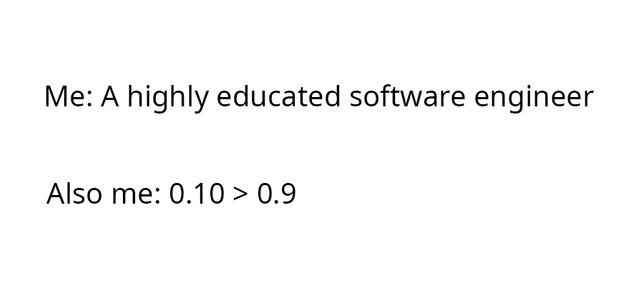
Let’s break down why “0.10 > 0.9” is wrong (and why it’s funny that even a pro developer got it wrong momentarily). In the meme, the person says, “Me: A highly educated software engineer,” and then admits to thinking, “Also me: 0.10 > 0.9.” This is like saying, “I’ve learned a lot of math and coding… yet I just claimed ten cents is more than ninety cents.” 😅

In mathematics and computer science fundamentals, we learn about place value early on. The number 0.10 is the same as 0.1 (adding a zero after the 1 doesn’t change its value, it just means one-tenth with extra formatting). The number 0.9 means nine-tenths. Clearly, one-tenth is smaller than nine-tenths. So mathematically, 0.10 > 0.9 is false – it should be 0.10 < 0.9.

So why would an educated developer think it’s greater? It might be a quick slip or a context mix-up. One possibility is thinking of them as strings (text) instead of numbers. Computers actually face this issue too if we’re not careful: for example, if "0.10" and "0.9" are stored as strings and you compare them lexicographically (alphabetical order), the comparison goes character by character. "0.10" would be analyzed as "0", ".", "1", "0" and "0.9" as "0", ".", "9". Up to "0." they’re equal, then it compares "1" to "9" – and since "1" is less than "9", "0.10" as a string is considered less than "0.9". That actually matches the numeric reality (0.1 < 0.9), but you can see how treating numbers as text can lead to strange results in general. A more blatant example: "10" < "2" as strings, because "1" is less than "2" in the first character position, even though 10 is obviously greater than 2 as a number. This kind of bug happens in software when we forget to convert text input into numeric types.

Now, the meme’s joke is that the human made this mix-up without the computer’s help. It's like the engineer’s brain did a faulty string comparison! Every developer, junior or senior, has had moments of confusion like this. Maybe you’re sleep-deprived or looking at too many values at once, and you momentarily think a smaller number is bigger because of how it’s written. We also commonly see confusion around floating-point precision. That term refers to how computers approximate decimal numbers. For instance, adding 0.1 + 0.2 in code might give 0.30000000000000004 instead of exactly 0.3. That’s not because the math is wrong, but because in binary (the language of computers), 1/10 and 2/10 don’t have neat exact representations. Developers learn to be careful with these things, e.g., not to directly trust equality of floats and to use proper formatting when displaying them.

However, the comparison 0.10 > 0.9 doesn’t involve those tricky rounding errors – it’s straightforward. That’s what makes it funny and a bit embarrassing: it’s so straightforward that it’s like forgetting 2+2. The engineer “knows” the right answer, but their brain glitched. RelatableHumor indeed! Many of us have tried to debug a piece of code or solve a problem and made a silly oversight. It’s part of the relatable dev experience to sometimes question basic facts when you’re deep in complex problems.

The mention of being "highly educated" sets up an expectation that this person wouldn’t make a simple mistake. The second line shatters that expectation for comedic effect. It humanizes the developer – no matter how much you know about algorithms or math, you can still have a humble moment where you, say, put a > the wrong way or misread a decimal. It teaches (in a lighthearted way) the importance of double-checking the basics. Even senior engineers go back to 101-level sanity checks sometimes!

So if you’re new to coding and you ever compare numbers wrong or get confused by decimals, don’t worry – the pros do it too. The key takeaway: always pay attention to what you’re comparing. Is it text or number? Do you understand the format (like 0.10 is just another way to write 0.1)? And remember that more digits doesn’t necessarily mean a bigger value when there’s a decimal point involved. As simple as that sounds, it’s an easy thing to overlook, which is exactly why this meme gets a knowing laugh from developers.

Level 3: Floating Point Facepalm

Even the most highly educated developers sometimes slip on the simplest of CS fundamentals. This meme captures that irony perfectly: a veteran software engineer, fluent in mathematics and floating-point arithmetic, momentarily writes or believes 0.10 > 0.9. On paper (or in code), that's as wrong as saying 0.1 > 0.9. Yet the humor comes from how relatable this brain glitch is. We've all had a long day debugging where our brain parses numbers incorrectly – effectively treating them like strings or just seeing the digits out of context.

In a split-second of confusion, you might catch yourself thinking:

Developer brain: "Hmm, 0.10 has a '10' in it, which is bigger than '9', so 0.10 > 0.9... right?"
Logic kicking in: "Wait, what am I saying? Of course 0.1 is less than 0.9!" 🤦

That facepalm moment is exactly what this meme exaggerates. It’s poking fun at the cognitive bias where our pattern-matching brain misreads 0.10 as if it’s somehow numerically larger than 0.9 (after all, 10 > 9 as plain integers). We know place value matters – the zero after the 1 in 0.10 is just a placeholder, not a sign of a bigger number – but our tired minds can ignore that detail for an instant.

From a senior developer perspective, this scenario also hints at common pitfalls with numbers in code. It’s a tongue-in-cheek reminder of bugs we've seen in the wild:

  • String vs Numeric comparison: Treating numeric input as text can lead to hilarious bugs. For example, "10" > "2" is False if you compare as strings (since "1" comes before "2"), even though 10 > 2 numerically. A careless implementation might sort version "2" above "10" because of this. In the meme’s spirit, viewing "0.10" as a string could trick someone into thinking it's "bigger" than "0.9" lexicographically.
  • Floating-point precision quirks: Any seasoned dev has been scarred by floating-point precision issues. The classic example:
    >>> 0.1 + 0.2  
    0.30000000000000004  # Not exactly 0.3, thanks IEEE 754!  
    
    We expect weird results like 0.30000000000000004 from the computer because binary fractions can’t exactly represent 0.1 or 0.2. But here the meme flips the script: it’s not the machine being irrational, it’s the developer’s own mental math going haywire! It’s a gentle jab at the fact that, despite knowing how decimals and binary fractions work, even experts can momentarily question a basic comparison.

Technically speaking, 0.10 and 0.9 are just different representations of the numbers 0.1 and 0.9. Any code or calculator will correctly tell you 0.1 < 0.9. Yet, the human in the loop can misread the notation. Perhaps they were thinking in terms of string length or just saw the digits “10” vs “9” without processing the decimal point. It’s a bit like an optical illusion for our brains, but with numbers – a decimal delusion.

The meme also underscores a truth in software development culture: no matter how educated or experienced you are, you'll occasionally make dumb mistakes. It’s why we do code reviews and write tests for even “obvious” logic. The phrase “Me: A highly educated software engineer. Also me: 0.10 > 0.9” follows a popular format where the second line contradicts the first, delivering the punchline. Here, the punchline is that an engineer who has likely aced calculus and data structures can still flub first-grade math for an instant. It’s funny and humbling.

In summary, the humor works on multiple levels – from the specific nerdy nod to floating-point arithmetic woes, to the universal “oops” of a human mistake. Seasoned devs chuckle (or cringe) because they’ve been there: confidently reasoning about complex systems one minute, then double-checking if 0.1 is indeed less than 0.9 the next. Bug or brain-fart, it’s a reminder that we’re all glorified humans in front of a keyboard, susceptible to the occasional 0.10 > 0.9 moment.

Description

A minimalist, text-based meme presented on a plain white background. The meme consists of two lines of black text. The first line says, 'Me: A highly educated software engineer'. The second line, positioned below, says, 'Also me: 0.10 > 0.9'. This meme humorously points out a common pitfall for developers: confusing numerical comparison with lexicographical (alphabetical) string comparison. While mathematically false, the statement '0.10 > 0.9' can be misinterpreted as true by a human brain momentarily thinking of '10' vs '9', or by a program that incorrectly compares the version numbers as strings. It's a self-deprecating joke about how even skilled engineers, who handle complex systems, can make simple, fundamental mistakes, especially when dealing with data types and versioning
Comments

7
Anonymous ★ Top Pick A junior dev makes this mistake and learns about data types. A senior dev makes this mistake and learns to name the resulting hotfix after the client who reported it
  1. Anonymous ★ Top Pick

    A junior dev makes this mistake and learns about data types. A senior dev makes this mistake and learns to name the resulting hotfix after the client who reported it

  2. Anonymous

    After two decades of warning juniors about implicit type coercion, my brain reads that diff and happily does a lexicographic compare: “0.10” > “0.9” - apparently the undefined behavior was in my own prefrontal cache

  3. Anonymous

    Twenty years of explaining IEEE 754 to juniors, yet here I am adding epsilon to my grocery list comparisons because I don't trust 0.1 + 0.2 anymore

  4. Anonymous

    This is the software engineering equivalent of a PhD physicist forgetting which way gravity points. We've all been there - spending three hours debugging a distributed consensus algorithm only to realize we compared '0.10' as a string. The real kicker? This exact bug has probably caused more production incidents than any zero-day exploit, because it passes code review when everyone's thinking about the elegant architecture instead of the pedestrian type coercion. IEEE 754 sends its regards

  5. Anonymous

    Semver: yes. Math: no. Every npm update since 2009

  6. Anonymous

    My brain implements SemVer; the database implements IEEE-754; every meeting is reconciling those two comparison operators

  7. Anonymous

    0.10 > 0.9 is only true in semver - which is why our dashboard says the outage got upgraded instead of resolved

Use J and K for navigation