A Historical Perspective on Software Testing
Why is this Testing meme funny?
Level 1: When It Rains, It Pours
Imagine you have a few difficult things to do, but you get to handle them one at a time. Maybe on Monday you have a big homework assignment, on Tuesday you have a tough soccer practice, and on Wednesday you have to clean your messy room. Each day, you tackle one hard thing and you manage to get through it. Not too bad, right? Now picture one single day when all those hard things happen at once – you have homework, soccer practice, and a big cleaning chore all in the same day, back-to-back. That would be totally overwhelming! You’d feel like, “Whoa, this is too much happening together!” This meme is making a joke just like that, but with real-world bad events. It says: in the past, really bad things (like a big sickness outbreak, a time when many people had no jobs, or times of major protests) happened in different years, and we handled each of them individually. But in 2020, all those kinds of bad things happened in one year – almost like a giant mega-problem. It’s funny in a kind of “oh no!” way because it’s so extreme you have to chuckle. It’s like saying, normally problems come one by one, but 2020 decided to give us everything at once. When too many problems pile on together, it’s just absurd – you can only smile and shake your head, kind of how the man in the picture is smiling even though everything is going wrong. The phrase “when it rains, it pours” fits perfectly here: it means once trouble starts, sometimes it comes down all at once like a heavy storm. The meme makes us laugh because we recognize how ridiculous and hard that all-at-once situation was, whether in life or in a computer program.
Level 2: One by One vs All Together
Let’s break down the tech terms and the joke. In programming, a unit test is a small, focused test of a single piece of code (for example, testing one function or one module by itself). Think of it like checking one LEGO piece or one machine part to be sure it works correctly on its own. A integration test is a bigger test that checks if multiple pieces work together correctly. That’s like assembling those LEGO pieces into a whole model or putting all the machine parts together to see if the entire machine runs. Unit tests isolate each component, whereas integration tests see the outcome when components interact as a system.
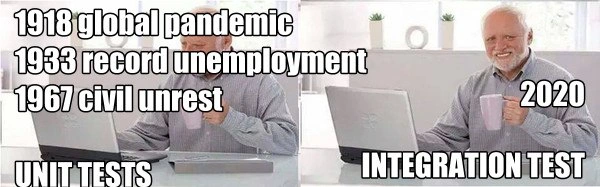
Now, the meme uses those concepts in a funny, metaphorical way. The left panel refers to three huge historical events: the 1918 global pandemic (the Spanish Flu), the 1933 record unemployment (the Great Depression era), and the 1967 civil unrest (a year of widespread protests and turmoil). Each of these happened in different periods, decades apart. The meme labels this panel “UNIT TESTS,” suggesting that each disaster was like a separate test of society, occurring one at a time. In other words, humanity faced those challenges individually and managed to get through each of them in isolation (just as a program passes individual unit tests one by one). The older man in the picture is smiling with a cup of coffee; meme enthusiasts call him “Hide the Pain Harold.” He’s basically a symbol for pretending everything is fine even if it’s not. Here, Harold smiling with those terrible events listed above him humorously implies “Yep, that was bad, but we got through it, test passed… just don’t think about it too much.” It’s like he’s proud (or at least relieved) that each unit test of disaster was eventually resolved.
The right panel shows the same Harold, same pose, but now there’s just one caption: “2020”, and it’s labeled “INTEGRATION TEST.” This is where the joke lands. In software, an integration test is running all parts together, so calling 2020 an integration test means that year combined multiple big problems at once. And indeed, in reality, the year 2020 hit us with a global pandemic (COVID-19), an economic crisis with mass unemployment worldwide, and significant civil unrest (for example, large-scale protests and social upheaval). All those kinds of events happened simultaneously in 2020, rather than separately. The meme humorously suggests that while each crisis alone was tough (but “handled”), putting them all together in one year was like testing the whole system – and it was a disaster. Harold’s same pained smile now implies “This is fine…😅” while everything is actually on fire around him.
For a junior developer (or someone new to testing), the takeaway is: a system can appear stable when tested in small parts, but you only know for sure when you test everything combined. In coding, you might see all your unit tests pass (each piece of your app works by itself), yet when you run an integration test or deploy the app, something unexpected goes wrong because those pieces conflict or overload each other. Here, the “system” being tested is essentially the world or society. The separate unit test events (1918, 1933, 1967) were each resolved in their time, but 2020’s integration test of having all these types of crises together overwhelmed systems everywhere (healthcare, economies, communities). It’s a form of TestingHumor that developer folks find relatable: we often joke that “well, it worked in unit tests…” as an excuse when something fails in a combined scenario. This meme applies that same joking logic to world events. It’s saying, maybe we should have tested these things together! Of course, you can’t really “test” historical disasters, but framing it that way is ironic and funny. It clicks with developers because it highlights the importance of comprehensive testing with a real-world analogy. Plus, the absurd understatement of Harold’s smile in face of 2020’s chaos is exactly the kind of irony tech folks love — it’s like laughing so we don’t cry.
Level 3: All Green, Then Red
In software testing, unit tests verify small parts of a system in isolation, while an integration test checks if those parts work together as a whole. This meme brilliantly recasts major historical disasters as passing unit tests and then jokes that the year 2020 was a catastrophic integration test. The left panel lists “1918 global pandemic”, “1933 record unemployment”, and “1967 civil unrest” as individual scenarios—each a huge crisis in its own era, yet each occurred separately. It’s as if society’s unit tests for those decades were these single challenges, and despite the pain, each of those tests was eventually “passed” (the world survived each event on its own). The familiar older gentleman sipping coffee with a forced smile is Hide the Pain Harold, a meme figure who embodies quietly enduring pain. Here Harold represents a developer cheerfully noting “All unit tests passed ✅” even though those tests were actually terrible events. The dark humor is that he seems okay with each tragedy isolated, much like an engineer feeling relieved when individual components behave during testing, perhaps unaware of lurking systemic issues.
Moving to the right panel, we see just “2020” labeled as “INTEGRATION TEST”. This implies that all those once-separate crises were combined into one horrendous scenario. It’s like the test runner decided to run all the unit tests at once – and the system couldn’t handle it. Harold is still smiling, but we know that grin: it’s the grimace of a developer at 3 AM watching their entire system crash after deployment. Every senior dev recognizes this scenario: all the unit tests were green, and then the integration test turned everything red. It’s the classic “works in isolation, breaks when combined” situation. In 2020, a global pandemic led to economic collapse and social unrest, all intertwined – an absolute worst-case combo that no one had integration-tested for. The meme exaggerates reality in a way engineers find hilarious (and a bit traumatic): it suggests whoever is running “Earth.v2020” failed to test how these major events would interact. The result? A system failure of global scale, revealed only when all subsystems (health, economy, society) were stressed simultaneously.
To a seasoned developer, this feels too real. We’ve had projects where every microservice or module passed its own tests, yet when you deploy the whole enchilada, unforeseen interactions cause a meltdown. Perhaps one module’s output wasn’t perfectly matched to another module’s input, or two processes each work fine alone but deadlock when run together. 2020 was the social equivalent: healthcare systems, governments, and economies all had untested assumptions exposed by the chain reaction of events. The meme’s humor lies in this parallel. It’s DeveloperHumor blending with dark real-world irony: as if history introduced a nasty “history_repeats” bug that triggered known failures all at once. In coding terms, it’s like seeing errors re-emerge in a new combined test because the underlying issues were never fully fixed or tested in tandem. No wonder so many devs share a wry chuckle at this meme — it perfectly captures that IntegrationPain of discovering that a system can still break in spectacular ways despite all the “passed” checks beforehand. It’s funny in a laughing through the pain way, much like Harold’s smile. After all, what else can you do when the whole integration goes up in flames? You sip your coffee, smile like Harold, and mutter, “Well, that escalated quickly.”
# Pseudo-code illustrating the meme's "tests"
assert run_year(1918, crises=["pandemic"]).system_ok # Passed ✅ (handled Spanish Flu)
assert run_year(1933, crises=["unemployment"]).system_ok # Passed ✅ (survived Great Depression)
assert run_year(1967, crises=["civil_unrest"]).system_ok # Passed ✅ (endured 1960s unrest)
# Integration test: combine all crises in one year
world = run_year(2020, crises=["pandemic", "unemployment", "civil_unrest"])
assert world.system_ok # ❌ Fails! (2020 breaks the system)
Above is a tongue-in-cheek pseudo-code of what the meme suggests. The first three unit test assertions pass individually (the world made it through each separate disaster). But the 2020 integration test fails spectacularly – in reality, our “system” (society) was not okay when everything hit at once. This comedic exaggeration resonates with senior devs because it highlights the importance (and sheer difficulty) of testing interactions. It reminds us that even if each part of a system (or each year’s crisis) is individually survivable, the combined load can reveal hidden faults. In software, that’s why we write integration tests and do chaos testing: to catch the “perfect storm” scenarios. In life... well, 2020 was the perfect storm. The meme cleverly delivers a hard truth with a smile: just because all components check out on their own doesn’t guarantee the whole system won’t crash when everything is thrown together. It’s a wry nod from one engineer to another — we’ve seen those green tests turn red, and boy, do we feel Harold’s pain.
Description
A two-panel meme featuring the 'Hide the Pain Harold' character sitting at a laptop with a mug. The left panel has overlaid text listing a series of historical crises: '1918 global pandemic', '1933 record unemployment', '1967 civil unrest', followed by the punchline 'UNIT TESTS'. In this panel, Harold has a pained, forced smile. The right panel shows Harold with a more genuinely content smile, with the overlaid text '2020' and 'INTEGRATION TEST'. The meme creates a humorous and exaggerated analogy, comparing the experience of dealing with a large suite of unit tests to navigating multiple, separate historical disasters - chaotic and stressful. In contrast, it ironically portrays a single integration test during the tumultuous year of 2020 as a singular, manageable, and even calming event. For senior developers, the joke resonates with the feeling that a large number of small, failing, isolated tests can create more noise and anxiety than tackling one larger, more complex system test
Comments
7Comment deleted
The project has so many failing unit tests, the CI pipeline looks like a history book. The single integration test passing is our 2020 - one massive disaster we've somehow learned to live with
1918, 1933, and 1967 were fine as mocked stubs - 2020 hit prod and we discovered the planet-scale event bus is set to fan-out with no circuit breakers
After 20 years in tech, I've learned that production always finds a way to combine your carefully isolated unit test failures into one spectacular integration test - except in 2020, even our disaster recovery plans needed disaster recovery plans
Unit tests are like preparing for every historical disaster individually - pandemic protocols, depression-era budgeting, riot gear - only to realize your integration test is just 2020, where all those disasters decided to merge their pull requests simultaneously without a code review
History had unit tests for pandemics, unemployment, and unrest; 2020 was the integration test where the global event bus fan-out was unbounded and the incident runbook 404’d
Unit tests: isolated tragedies you can stub. Integration tests: 2020's all-hazards speedrun where mocks betray you
2020 was the integration test where every rarely failing component shared the same global state and our mocks were swapped for reality - coverage 100%, confidence 0%