Tech Support for the Husband 1.0 Operating System
Why is this TechHistory meme funny?
Level 1: When Computers Explain Marriage
Imagine your life is like a big computer system, and the people in it are like programs on that computer. This meme tells a funny story about a lady who “updated” her boyfriend into a husband, kind of like upgrading an app on your phone to a totally new version. But after the update, she’s unhappy because things aren’t working the way they used to. It’s like if you updated your favorite game and suddenly a bunch of fun features were gone and it started running slower! In the story, when he was a Boyfriend (version 5.0), everything was running smoothly – he brought her flowers and jewelry (which were like special features of the Boyfriend app). But once he became Husband 1.0 (a brand new system), those nice features disappeared or got harder to use. Instead, the “Husband system” is now mostly busy with serious stuff like news, money, and football. That’s like your computer suddenly focusing on boring work programs and not letting you play games as much. No wonder she wrote for help!
The funny part is how she asks for help and the kind of advice she gets. She writes to a tech support person as if her husband were a computer program with bugs. The support guy plays along perfectly, answering in the same computer language. He basically says: “Well, ma’am, your boyfriend was just for fun (like a simple entertainment program), but your husband is like an entire operating system (the main software that runs everything). They’re not the same, so you can’t expect the same behavior.” It sounds so formal and technological, which is silly because they’re talking about a person! He even tells her to enter a special command: ithoughtyoulovedme.html. That looks like some complicated computer code, but read it out loud and it says “I thought you loved me.” He’s humorously instructing her to say this to her husband and start crying (that’s what “download Tears 6.2” means in the joke). Why? Because, according to the support guy, if she cries and says “I thought you loved me,” it will automatically make the husband do what? Launch Flowers 3.5 and Jewellery 2.0! In non-computer terms, that means he will bring her flowers and gifts to make her feel better. It’s portraying a common situation (a wife crying to get attention, and the husband responding by buying gifts) as if it were just cause-and-effect in a software program. That’s pretty hilarious if you think about it – it treats human emotions like they’re part of a computer routine.
But the tech support also gives a tongue-in-cheek warning: if she uses this crying trick too often, the husband program will switch to “Silence 2.5” as a default. That’s basically saying if you cry all the time to get what you want, eventually your husband might just go quiet and stop reacting. Just like if you keep hitting the same key on a game, sometimes the game might freeze or your character just stops responding. It’s a funny way to say “don’t overdo it” – even in a joke guide for “installing a husband” there are limits, apparently!
Then comes an even bigger warning: don’t mess with the Husband system’s internal settings or else you might accidentally download a “Girlfriend 2.5” virus. In everyday talk, that warns her not to tamper with her marriage too much or neglect her husband, because a “virus” (another woman, called Girlfriend 2.5) could sneak in and cause a lot of damage. Calling another woman a virus is a jokey way of saying it would be a disaster for the marriage if the husband got a new girlfriend – like a computer getting infected and breaking down. This part is a bit like an exaggerated caution: just like you wouldn’t want to download a virus on your computer, you definitely wouldn’t want an outside girlfriend to “install” herself into your husband’s life. It’s a goofy metaphor, comparing cheating to malware!
Finally, the tech support guy advises her not to try reinstalling Boyfriend 5.0. In simple terms, he’s saying “you can’t go back to the way things were before, and definitely don’t try to have a boyfriend again now that you’re married, because it will crash the system.” That’s like trying to run two big programs on one tablet that just can’t handle it – the whole thing would break. In real life, that would mean major heartbreak and chaos. So he recommends a different solution: install Cooking 3.0. This is the punchline: instead of trying to change her husband back, maybe she should do something nice like cooking. It suggests that if she makes him a nice meal (something the stereotype says husbands enjoy), the “Husband 1.0” system will run more smoothly and happily, just as a computer might run better if you add the right software. It’s a playful (if old-fashioned) bit of advice disguised as a technical fix.
So, why is all this funny? Because it’s taking a personal problem – “my husband isn’t as romantic or fun as he used to be” – and explaining it in complete computer gibberish. It pokes fun at both sides: it gently teases people who expect marriage to be just like dating (with constant flowers and attention), and it also teases how tech support can sound overly complicated. The idea of treating love like a software program is absurd. Imagine calling customer support because your spouse isn’t behaving how you want! The serious tone of the support response, using words like “virus,” “upgrade,” and “unsupported applications,” makes the whole thing sound like a real IT issue, and that contrast is what makes people laugh. Even if you don’t get every tech term, you can understand that the wife’s emotional tactics (crying, complaining “you don’t love me”) are being described as if they were computer commands, and the husband’s stereotypical behaviors (watching football, not being romantic) are listed like software features. It’s humor in the mix-up: human relationships are nothing like computers, but here someone is pretending they are, and it oddly fits in a tongue-in-cheek way. Basically, the meme is saying marriage is an upgrade that changes your “system” drastically, and there’s no easy uninstall. It’s a playful reminder that some changes in life are one-way, and you have to learn the new system’s quirks! And of course, seeing something as serious as love life being handled with the nerdy style of a tech manual is just plain silly – that’s why so many people found it entertaining enough to share.
Level 2: Tech Support Romance
This meme is presented as if it were a tech support Q&A on Facebook, but it's really a joke about marriage told through a programmer’s lens. The "question" is written by a woman who jokingly treats her relationship change (getting married) like she installed new software. She says: “Last year I upgraded from Boyfriend 5.0 to Husband 1.0…” Using the word “upgrade” here is key – in technology, an upgrade means moving to a newer, hopefully better version of something. By calling marriage an upgrade, she sets up a funny comparison: Boyfriend 5.0 was the old software and Husband 1.0 is the new one. The numbers sound like software version numbers, a nod to how developers use Semantic Versioning (SemVer). (SemVer is a system for naming software versions, usually as Major.Minor – so 5.0 might mean “fifth major release,” and 1.0 means “first release.”) In real life you wouldn’t think of a husband as “version 1.0,” but this silly framing makes it a TechHumor piece right away.
Now, in her "support ticket," the woman complains that after installing Husband 1.0, her whole system performance slowed down, especially in areas she cares about like the Flowers and Jewellery applications. In plain terms, she means her husband isn’t giving her flowers or jewelry like her boyfriend did, and overall he’s not as fun or attentive as before. The tech support reply takes this complaint literally but keeps the joke going. He explains that Boyfriend 5.0 was an Entertainment Package, whereas Husband 1.0 is an Operating System. In computing, an Operating System (OS) (like Windows, macOS, or Linux) is the main software that runs the whole computer. It controls everything and comes with built-in programs. An Entertainment Package sounds like just a fun add-on or a single-purpose program (for example, a video game or a media player) whose only job is to entertain. So the support is humorously saying: “Of course the experience is different – you switched from a simple fun program to a whole complex system!” This implies that a boyfriend is only meant to entertain and please you, while a husband, like an OS, has to handle the serious background tasks of life (which might not be as exciting). The slowdown she notices is akin to how sometimes a new OS can feel slower if it’s doing more work or running on older hardware – except here the "hardware" might be the husband’s stamina or effort, stretching the metaphor 😄.
The woman also observes that Husband 1.0 removed a valuable program called Romance 9.5 and instead installed programs like NEWS 5.0, MONEY 3.0, and FOOTBALL 4.1. This is a funny way to say “after marriage, my husband stopped being romantic and now he mostly watches the news, worries about money, and follows football.” In software terms, when you install a new OS, it might indeed uninstall some old applications (maybe because they aren’t compatible or needed anymore) and add new default ones. For example, a new operating system might drop a beloved old game and bundle a finance app and a news app by default. Here, Romance 9.5 (a high version number suggesting it was really advanced or important) was like an app on Boyfriend that made him do romantic things. Under Husband 1.0, that app is gone. Instead, Husband OS has different defaults – News 5.0 could be him reading or watching news every day, Money 3.0 might be him focusing on budgeting or work (bringing money in), and Football 4.1 obviously is him spending time watching or playing sports. The version numbers are just there to make it sound techy, but they also imply these are established habits (like version 5.0 or 4.1 suggests they’ve been around a while). This part of the meme taps into a common joke: after marriage, people often shift priorities. It’s exaggerated for effect, but that’s the core relatable scenario.
Now the "Reply" from tech support reads like a genuine helpdesk response but is full of playful tech metaphors for relationship advice. It first suggests a "command": ithoughtyoulovedme.html. This looks like a file name or a web page link, but it’s actually the sentence “I thought you loved me” disguised as a computer command. The support is effectively telling her, “say the phrase ‘I thought you loved me’” (with the idea she’ll probably say it tearfully). He even calls it a download of Tears 6.2, treating crying as if it were a software program or update. In everyday terms, Tears 6.2 means cry a lot – version 6.2 just makes it sound like a specific tool or feature. So the instruction is: use an emotional appeal (“I thought you loved me”) which will cause you to cry (Tears software runs). The humor here is that an IT support guy would never normally advise “have a good cry” as a solution to a problem, but phrasing it like an installation step makes it absurd and funny.
Why do that? Because according to the "support guy," running the Tears program will automatically trigger Husband’s Jewellery 2.0 and Flowers 3.5 applications. In non-tech terms: if she cries and says “I thought you loved me,” the husband will likely feel guilty or moved and respond by buying her jewelry and flowers – the classic make-up gifts. The meme is anthropomorphizing the husband’s guilt response as if it's software that auto-launches when it detects tears. Dependencies in tech are when one program triggers or requires another. Here, Tears 6.2 is depicted as something that calls the Jewelry and Flowers programs as dependent responses. It’s a light-hearted way to say “if you cry, he will probably do something nice.” Most developers can relate this to event-driven behavior: one event (user cries) triggers a handler that performs actions (husband brings gifts). It’s both funny and a bit poking fun at how some relationships work.
However, the tech support warns her: don’t overuse this trick. Like any feature, if you spam it too much, it loses its effect. In tech-speak, he says overuse of that application (crying) can cause Husband 1.0 to default to Silence 2.5. Here Silence 2.5 is a metaphor for the husband shutting down communication (the silent treatment or just tuning out). We can interpret it like a device going into a default state or standby mode. So if she cries too often to get her way, the husband might start ignoring it (the tears “button” won’t work anymore). This is a playful acknowledgement that while tears might work occasionally as an “exploit,” abuse of it will patch the bug – i.e., the husband will become unresponsive to that stimulus. Technically, a default state means the normal mode the system falls back to. So "default to Silence" suggests the husband’s new normal could become being quiet and disengaged if pressured too frequently in that manner. So moderation is key, hinting at a bit of real relationship advice hidden under the joke.
Next, the support message strongly cautions: do NOT disturb the original package of Husband 1.0. In regular computer terms, that means don’t tamper with the core installation files or the fundamental setup of the Husband software. If you do, a new virus Girlfriend 2.5 will automatically be downloaded into your system. This is a humorous way to say, “don’t mess around or you might inadvertently introduce a virus called Girlfriend.” Obviously, in human terms, that means if she messes up the marriage or “disturbs” her husband too much (perhaps by snooping, nagging excessively, or trying to tweak his behavior in an unsupported way), he might end up getting a Girlfriend 2.5 – essentially, he might cheat with another woman, seen here as a malicious program invading their marriage. In computing, a virus is a harmful program that sneaks into your system, often due to some security lapse or user error. So calling a potential affair a “virus” is a comedic analogy: it’s unwanted, harmful to the relationship system, and often gets in when something is wrong with the main system’s security or stability. The version number 2.5 for this hypothetical Girlfriend suggests maybe this is an upgraded threat (implying girlfriends have been around before, version 2.5 meaning it’s not a new concept!). The support person saying "So please be careful!" in this context is like a final warning: in non-tech terms, "guard your marriage from this kind of problem."
Then the support adds, “please do not attempt to reinstall the Boyfriend 5.0 program.” She might be wondering if she can somehow go back to how things were when her partner behaved like a boyfriend (maybe by trying to bring back old habits or even daydreaming about an old flame). The tech analogy is clear: trying to reinstall Boyfriend 5.0 is like attempting to roll back to old software that is not supported anymore. The support says these are unsupported applications now and will crash Husband 1.0. In plainer language: you can’t have a husband and try to have a boyfriend on the side, or even make your husband act exactly like the boyfriend version he used to be – that will crash the system (cause a relationship crash, e.g. huge fights or a breakup). In real computer scenarios, installing an old program that conflicts with a new OS can cause the system to freeze or crash. Similarly, juggling an old relationship or old expectations within a marriage is bound to fail. It’s a humorous way to enforce the idea that marriage is a one-way upgrade; rollback is not supported! This draws a clever parallel to version control in software – once you’ve merged major changes, going back to a previous state is non-trivial and may break everything. Developers often joke that in life, unlike code, you don’t get easy Git revert or rollback buttons. This meme uses exactly that concept for laughs.
Finally, the tech support says, “We recommend: Cooking 3.0.” This line is both funny and a bit eyebrow-raising. Essentially, the “support solution” for her problem is to install a program called Cooking 3.0. Translation: maybe try cooking something nice for your husband. The implication is that if she engages in something the husband likely appreciates (a good home-cooked meal), it might improve the overall performance of Husband 1.0 – possibly enabling those previously sluggish “flowers and jewelry” features to run more willingly, or at least keeping the system stable and content. In tech terms, it reads like telling the user to install a complementary software to resolve compatibility issues or to improve performance. For example, “We recommend installing Driver 3.0 or Plugin 3.0” to fix a problem. Here Cooking 3.0 is that recommended add-on. While it plays into an old-fashioned stereotype (the wife should cook to keep the husband happy), within the joke’s structure it’s presented deadpan, as if it’s just another normal tech support recommendation. This adds to the humor because it maintains the illusion that we’re talking about software, not real life duties.
The whole Facebook post topped off with lots of laughing emojis and shares shows that people found this scenario amusing and relatable. It’s a piece of TechSatire that uses the language of programmers (versions, updates, commands, viruses) to poke fun at the communication issues and adjustments that happen in a marriage. The category tags like husband_1_0, relationship_upgrade_metaphor, and unsupported_applications all point to this central idea: treating a relationship change like a technical upgrade with compatibility issues. For a junior developer or someone new to these terms, it’s a fun exercise in translating between tech-speak and real life:
- Version 5.0 vs 1.0 – Indicates how advanced or established something is. Boyfriend felt like a well-evolved thing (5.0) but Husband is a brand new phase (1.0) in her life, with some first-version hiccups.
- Operating System vs Application – An OS (Husband) runs the whole show with many processes (jobs, responsibilities), whereas an application (Boyfriend app) had a single focus (keep user entertained and happy).
- Uninstalling/Installing programs – Just like new OS might remove some old software features and add new ones, the husband no longer does some “romantic” things and instead does other “everyday” things.
- Command/HTML – The wife using an “
ithoughtyoulovedme.htmlcommand” is like entering a special code to provoke a reaction, in reality meaning she confronts him emotionally. - Download Tears 6.2 – “Download” in tech means to fetch and run something; here it’s a playful phrase for start crying. The number 6.2 is arbitrary, just making it sound like a specific tool.
- Triggers Flowers 3.5 and Jewellery 2.0 – In software, one program can trigger others; here her crying triggers him buying gifts (flowers, jewelry) as if those actions were programs with version numbers.
- Overuse leading to default Silence – If you do something too often, the system’s default behavior might kick in to protect itself. So if she cries too much, the husband’s default becomes being silent (shutting down communication) to cope.
- Virus Girlfriend 2.5 – A virus is bad software you don’t want. Calling a potential other woman a “virus” means she would be an unwanted, harmful intrusion into the system (the marriage). Version 2.5 jokingly suggests this scenario has happened before (like a known bug).
- Unsupported reinstall – In tech, an unsupported operation means the manufacturer doesn’t allow or guarantee it’ll work. Reinstalling Boyfriend program after having Husband OS is “not supported” – i.e., you can’t go back to just dating or having a boyfriend when you’re on the marriage track. Attempting it will break the system (the relationship will collapse).
- Cooking 3.0 – Presented like a software package, but it means doing a traditional nice deed. It’s recommended as a solution, like how tech support might suggest installing a patch or update to fix performance issues.
All of these analogies piece together a clever relationship_upgrade_metaphor. The humor is amplified by how straight the tech support response is written – it reads like a legitimate IT professional responding to a service ticket, complete with a polite greeting and regards at the end. This formal, technical tone applied to a personal situation creates a funny contrast. For a junior dev just getting into tech culture, it’s a good example of how we often pepper TechIrony into daily life for laughs. We take something non-technical (here, the ups and downs of marriage) and describe it in a completely technical way. The result is both educational (if you understand the tech terms) and humorous because of the absurdity of the comparison. It's the kind of post you'd see in DevCommunities online where programmers share inside jokes and TechHumor that only people with some IT background would fully appreciate. Even so, the scenario is understandable enough that many people find it funny – you don’t have to be a coder to get the gist, but knowing the lingo adds an extra layer of chuckles (and occasional cringe at the old-school gender stereotypes).
Level 3: Spouseware Upgrade
At first glance, this meme reads like a cheeky tech-support ticket about a botched software upgrade, but the "software" in question is a romantic relationship. It's a classic piece of DeveloperHumor that turns everyday marriage woes into an IT problem. The wife complains that after upgrading from Boyfriend 5.0 to Husband 1.0, her system slowed down and lost cherished features (no more surprise Flowers 3.5 or Jewellery 2.0 apps running smoothly). In their place, new programs like NEWS 5.0, MONEY 3.0, and FOOTBALL 4.1 are hogging resources. Anyone familiar with real software upgrades can see the TechIrony: major upgrades often come with unexpected breaking changes and bloatware, and here the poor "user" (wife) is feeling the pain.
Tech Support: "Boyfriend 5.0 is an Entertainment Package, while Husband 1.0 is an Operating System."
That one line sets the stage for the entire joke. In developer terms, the support agent explains that what she thought was a straightforward version bump is actually a platform change. Boyfriend 5.0 was like a fun plugin or Entertainment Package – lightweight, focused on keeping the user happy (think of a single-purpose app that showers the user with flowers and gifts). Husband 1.0, on the other hand, is an entire Operating System – a complex, all-encompassing platform with many background processes (career, household duties, couch-bound sports analysis…). An OS naturally has more responsibilities and might not dedicate all its CPU cycles to pretty UI flourishes like flower deliveries. In software terms, she migrated from a specialized application to a whole new runtime environment, and unsurprisingly, her "user experience" changed drastically.
This parody brilliantly plays on Semantic Versioning (SemVer) and software lifecycle semantics. Upgrading from version 5.0 down to 1.0 is immediately humorous to developers – it’s like downgrading from a mature product to a 1.0 release. Usually a move to 1.0 suggests a completely new system build, likely with some rough edges. Indeed, Husband 1.0 behaves like many v1.0 releases: slower performance and missing features that were available in the older version. The meme jabs at this by implying the Romance 9.5 module (which ran flawlessly under Boyfriend) was deprecated in the new Husband OS. Instead, Husband 1.0 comes bundled with serious, perhaps unwanted bloatware – news feeds, financial apps, sports updates – that consume memory and attention. This is a tongue-in-cheek reference to the stereotype that after marriage, men pay less attention to romance and more to worldly affairs (the RelatableHumor here being almost painfully familiar to some). It's tech satire turning age-old relationship tropes into a faux bug report.
From a systems perspective, the humor lies in dependency management and event-driven scripting within this “relationship OS.” The tech support gives the wife a hilariously convoluted workaround: run the command ithoughtyoulovedme.html to initiate Tears 6.2. This reads like a support engineer instructing a user to run a cryptic script, but it’s obviously poking fun at an emotional exploit. In plain speak, “I thought you loved me” with a dose of tears is an age-old trigger. In our tech metaphor, Tears 6.2 is a program (maybe a script or macro) that the wife can "download" (i.e., start crying) which in turn automatically launches the dormant Jewellery 2.0 and Flowers 3.5 services. This is a perfect example of event-driven programming in the comedy: a specific user action (crying) triggers a cascade of dependent subroutines (husband buys gifts) that restore some of the missing functionality (romance). Seasoned devs might chuckle at how this resembles a hacky workaround or hotfix – not a real solution, but a temporary trick to get those legacy features working under the new OS. It's also wry commentary on how emotional blackmail (let's be honest, that's what it is) can be seen as an unofficial patch in the relationship domain.
But like any hack, overuse has consequences. The support warns that excessive use of the Tears script can make Husband 1.0 default to Silence 2.5. In software terms, the system might enter a safe mode or just stop responding to that event – essentially the husband becomes unresponsive or gives the silent treatment. This is a fun parallel to rate-limiting or alert fatigue: you spam the system with the same alert too many times, eventually it ignores you (or in networking, triggers exponential backoff). The version number "2.5" for Silence suggests maybe it's an older, well-established feature – implying men have been going silent for a long time, now in its 2.x iteration 😅. A grizzled sysadmin might analogize: “That’s basically a /dev/null route for nagging processes,” meaning the husband is now dumping all those tearful requests into a black hole.
The cautionary note about not disturbing the original package of Husband 1.0 or else risking a Girlfriend 2.5 virus download is where the meme gets spicy. In real IT terms, messing with core system files or settings can open security vulnerabilities that let viruses in. Here, it’s a sly warning: if the wife tampers too much with her husband’s "operating parameters" – perhaps nagging, or trying to fundamentally change him – a malicious program called Girlfriend 2.5 might slip in. The idea of a "girlfriend virus" is darkly comical: it frames infidelity (the husband acquiring a new girlfriend) as a malware infection that she inadvertently caused by not maintaining the system properly. This part of the joke satirizes the blame-shifting tech support clichés ("user error causes virus") and also nods to an old-fashioned (and rather toxic) trope implying a nagging wife drives the husband to stray. In a dev context, it's like saying be careful with those unsupported mods, or you'll introduce a virus that’s very hard to remove. Seasoned developers recognize this humor pattern from other jokes about Girlfriend 1.0 vs Wife 1.0 – a genre of TechSatire that anthropomorphizes relationship drama as system crashes and viruses. It’s a bit cringey by modern standards, but it’s a well-known meme archetype in geek history.
The support’s final advice, “We recommend: Cooking 3.0,” is delivered with the dry tone of a helpdesk solution, but it’s obviously a punchline steeped in stereotype. Essentially, the "patch" for Husband OS’s performance issues is for the wife to install a Cooking 3.0 application – in other words, try feeding the man his favorite meals. This plays on the ancient gimmick of “the way to a man’s heart is through his stomach,” dressed up as if it were a software add-on to improve system stability. On a technical level, you can think of it as installing a compatibility layer or a resource boost that keeps the OS happy and running smoothly (maybe akin to keeping your server cool to prevent overheating – except here we keep the husband well-fed to prevent emotional overheat). It’s definitely a boomer humor solution, and modern audiences might roll their eyes (the post even acknowledges the cringe). Still, as far as the meme’s internal logic goes, it fits the pattern: treat an age-old relationship tip as if it were an official update recommended by the vendor.
Historically, this meme format is a bit of a TechHistorian’s time capsule. Similar “Dear Tech Support” letters about spouses as software have circulated in dev circles since at least the 1990s. Back then it was often “Upgrading Girlfriend 7.0 to Wife 1.0” with the roles reversed, reflecting the same version control humor and stereotypes of married life. This variant flips the perspective to the wife’s complaint about her upgraded husband, but the structure and jokes are nearly identical. It’s a testament to how DevCommunities share culture: we use version numbers, upgrades, unsupported applications, and viruses as metaphors to laugh about human quirks. Even if the humor is a bit outdated, it’s RelatableHumor for anyone who’s ever joked that their partner has bugs or that relationships need a manual and tech support. The post's author joked about people "hating SemVer," poking fun at how the version numbering in these jokes never strictly follows real VersionControl or release naming conventions – it’s deliberately absurd (Boyfriend 5.0 to Husband 1.0 would drive a pedantic SemVer purist up the wall!). But that’s part of the charm: mixing TechIrony with domestic life in a way that’s knowingly exaggerated and playfully nerdy.
In summary, the meme gets its laughs by framing a relationship upgrade metaphor in strict tech jargon. It highlights the communication gap between expectations and reality after a big life change (just like unrealistic user expectations after a software upgrade). The joke lands because it’s TechSatire that rings true: major upgrades (be it software or marriage) do come with trade-offs, lost features, and strange workarounds – but hearing those issues described in the dry, matter-of-fact tone of an IT support engineer is hilariously incongruous. It’s the collision of romantic reality with the logical, binary world of programming, and that absurd contrast is what makes developers smirk (and also maybe cringe a little).
Description
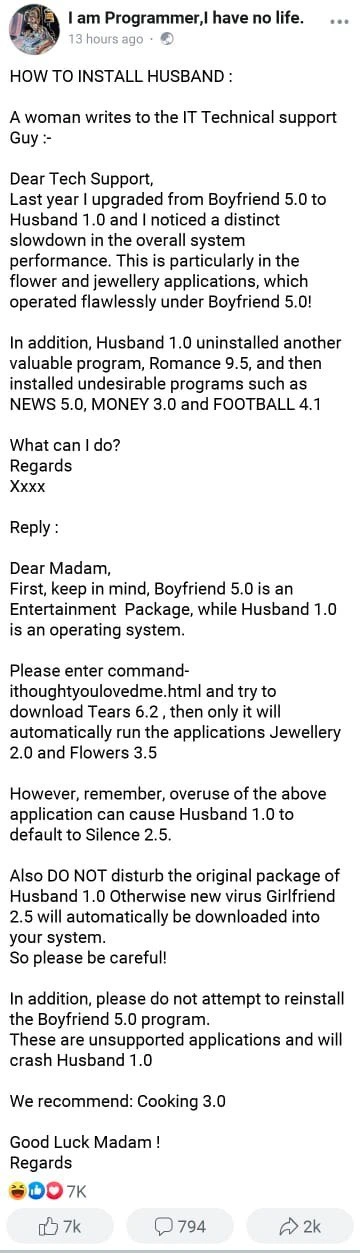
A screenshot of a Facebook post from the page 'I am Programmer, I have no life.' The post is titled 'HOW TO INSTALL HUSBAND' and presents a long-form text joke formatted as a tech support ticket. A woman writes to IT support complaining about performance issues after 'upgrading' from 'Boyfriend 5.0' to 'Husband 1.0.' She notes that 'flower and jewellery applications' have slowed down, while undesirable programs like 'NEWS 5.0', 'MONEY 3.0', and 'FOOTBALL 4.1' have been installed. The detailed reply from tech support explains that 'Husband 1.0' is a full operating system, unlike 'Boyfriend 5.0' which was just an 'Entertainment Package.' The support agent provides a series of metaphorical solutions, such as running 'command-ithoughtyoulovedme.html' to download 'Tears 6.2' and warns that overuse can cause the system to default to 'Silence 2.5.' It also cautions against disturbing the original package to avoid the 'new virus Girlfriend 2.5' and states that reinstalling 'Boyfriend 5.0' is unsupported and will crash the main system. This is a classic internet joke that uses software development and IT support concepts as an analogy for the complexities and changes in a long-term relationship versus dating. For seasoned developers, it's a piece of nostalgic 'boomer humor,' as noted by the post's original caption. The humor derives from the relatable, albeit stereotypical, mapping of technical problems onto domestic life, a trope common in early internet culture
Comments
7Comment deleted
The critical mistake was treating it as an upgrade. It's a full migration to a new architecture with a different resource management model. She should have read the (non-existent) documentation
Upgrading Boyfriend 5.0 to Husband 1.0 isn’t a patch - it’s a cross-schema migration: Romance() gets deprecated, Flowers() switches to lazy-load, and the only rollback is a painfully expensive two-node split-brain they call divorce court
This is basically semantic versioning for relationships - going from Boyfriend 5.0 to Husband 1.0 violates SemVer because marriage is clearly a breaking change that should've been Boyfriend 6.0.0, not a major version downgrade to 1.0
This is a masterclass in technical debt management - turns out upgrading from Boyfriend 5.0 to Husband 1.0 is a major architectural shift from a stateless entertainment microservice to a monolithic operating system with persistent state. The real kicker? It's a breaking change that deprecates the Romance API without proper migration documentation, and the rollback strategy is explicitly unsupported. Classic case of vendor lock-in where the SLA guarantees decrease post-acquisition, and you discover the 'Silence 2.5' fallback mode is actually a feature, not a bug. At least the troubleshooting involves running emotional dependency injection via 'ithoughtyoulovedme.exe' - though I suspect that command has O(n²) complexity in production environments
Treating Boyfriend 5.0 to Husband 1.0 as a minor upgrade is how you discover you’ve migrated from a stateless demo service to a stateful monolithic LTS kernel with undocumented side effects, hard dependencies on NEWS 5.0 and FOOTBALL 4.1, and no rollback plan
Dependency hell IRL: Install Husband 1.0 and watch it chain-uninstall every Boyfriend module - no semver coexistence policy
Classic migration: Boyfriend 5.0 was a stateless microservice; Husband 1.0 is a stateful monolith with an incompatible API - rollback is prohibited by the marital EULA, and the only shipped feature flag is Tears 6.2 (great for demos, atrocious for SLOs)