Skip to content
DevMeme
5429 of 7435
Haskell Developer Demand Reaches Critical Mass
Languages Post #5951, on Apr 2, 2024 in TG

Haskell Developer Demand Reaches Critical Mass

Why is this Languages meme funny?

Level 1: Collect Them All

Imagine your friend asks for something super rare, like 20 unicorns for their birthday party. You'd laugh because there probably aren't even two unicorns out there, let alone twenty! That's basically what's happening in this joke. A boss wants to hire a whole bunch of Haskell programmers, but Haskell programmers are as rare as unicorns. It's funny because the request is so unrealistic – it's like saying "I want every single one that exists!" Everyone gets that asking for something impossible is silly, and that's why this makes people smile.

Level 2: Niche Language Woes

Let's break down what's happening for a newer developer or someone outside the Haskell world. Haskell is a programming language, but it's not a common one you see in most everyday software jobs. It's part of the functional programming family, meaning it treats coding very differently from languages like Python, Java, or C++. In Haskell (and functional languages in general), you write functions that avoid changing state or mutable data (meaning once you set a value, it never changes). This can make programs more predictable and bug-resistant, but it also makes the language harder to learn and use for many people. Think of it as a very strict way of coding that feels more like math – that's Haskell's vibe.

Now, a Haskeller is simply a person who codes in Haskell (like how a "Java developer" writes Java, a "Haskeller" writes Haskell). The joke in the meme revolves around how few Haskellers there are. Haskell is loved in academic circles and certain niche industries, but it's not mainstream. You won't find tens of thousands of Haskell programmers looking for jobs in the way you might for, say, JavaScript or Python developers. Because of this, companies that do want Haskell experts often struggle to find even a handful. It's a classic case of supply being very limited. In fact, you could say there's a shortage of Haskell talent in the industry – not because Haskell isn't powerful, but because relatively few programmers specialize in it.

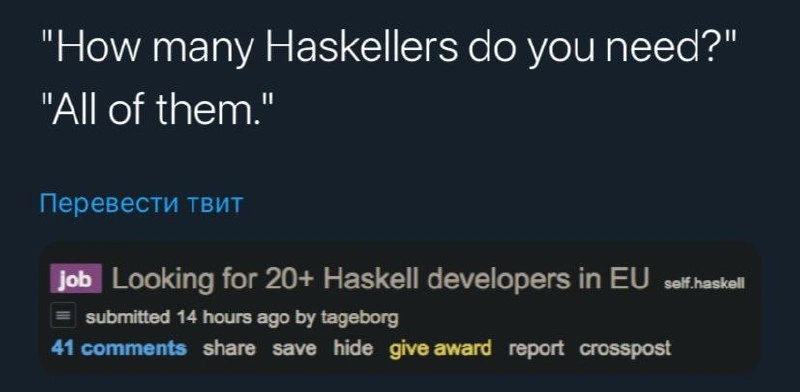
In the image, the text "How many Haskellers do you need?" and the answer "All of them." is a humorous exaggeration. It's like someone asked a hiring manager how many Haskell programmers they were looking to hire, and the manager essentially replied, "Give me every single Haskell programmer that exists." Beneath that, the screenshot shows an actual Reddit post with the title "Looking for 20+ Haskell developers in EU". The purple tag labeled "job" indicates it's a job advertisement. The poster (a user named tageborg) is searching for more than 20 Haskell developers in the EU (European Union) region. For context, that's a huge number for such a specific skill in one region – hence the incredulous reaction from readers.

All the interface details in the meme image (the dark theme, the "Перевести твит" link, and the Reddit buttons like "share", "save", "hide") set the scene but aren't part of the joke's punchline. "Перевести твит" is Russian for "Translate Tweet," showing that whoever took the screenshot had their Twitter interface in Russian. The important part is the content: the tweet text joking about hiring Haskellers, and the Reddit post showing the real request for 20+ Haskell devs. It’s the combination of those that makes it funny.

To put it simply, the humor comes from the mismatch between how many people are needed versus how many people actually know Haskell. Most new developers learn popular languages first; Haskell is usually taught in specialized courses or picked up by enthusiasts, so the pool of experts is pretty small. When a job ad asks for that many Haskell devs at once, experienced folks find it unrealistic to the point of being funny. It's as if the hiring manager didn't realize how rare this expertise is. The meme highlights this in a tongue-in-cheek way: the boss is basically saying "I want every single one that's out there, thank you."

For a young developer reading this, the takeaway is: Haskell is a cool but niche technology. If you become skilled in it, you'll be in a small, in-demand group – but don't be surprised if job postings sound a bit desperate to find people like you! And if you ever see a post looking for an army of Haskell programmers overnight, you'll understand why the entire developer community starts chuckling.

Level 3: Wanted: Unicorn Devs

"How many Haskellers do you need?"
"All of them."

At a senior level, this exchange lands as classic developer humor. It's a parody of those head-scratching meetings where a non-technical manager cheerfully declares, "We'll just hire a whole team of experts in [insert obscure tech du jour]." Every seasoned engineer in the room immediately thinks: "Good luck with that." Here, the tech du jour is Haskell, and the punchline "All of them" implies that if you need 20+ Haskell devs, you essentially have to hire every living Haskell developer on the planet (and you still might come up short). Haskell coders are the unicorns of the software world – mythical in number, elusive to find. Jaded veterans have seen this movie before: a project chooses a bleeding-edge or niche technology without planning for the Haskell talent shortage that inevitably follows.

This meme perfectly skewers the absurdity of niche language recruiting. The Reddit post (with its purple "job" flair and title "Looking for 20+ Haskell developers in EU") is a real-life example of what devs call a unicorn hunt. Finding one great Haskell dev is hard; finding twenty is like asking for a brigade of Bigfoot sightings on demand. In Europe, or anywhere really, that many Haskellers available at once is a fantasy. The experienced folks reading this will recall other times when hiring managers treated rare skills as if they were as common as Java. It's reminiscent of job listings that wanted "10+ years of Kubernetes experience" when Kubernetes hadn't even existed that long, or demanding every framework under the sun in one role. In the world of career/HR and recruiting, these kinds of wishful-thinking postings have practically become a meme themselves.

From the senior engineering perspective, a request for 20 Haskell devs triggers alarm bells. It suggests a few possibilities, none comforting:

  • Management has massively underestimated how rare Haskell expertise is.
  • Perhaps a decision was made to rewrite some system in Haskell (drawn by its theoretical benefits), and now recruiters are scrambling to staff up, fast.
  • The company might be trying to appear cutting-edge in the job market ("We use cool functional programming!") without grasping the hiring challenge.
  • It's also possible they have a big legacy Haskell codebase (maybe inherited or from an acquisition) and suddenly realized they need bodies to maintain it. Cue the panic recruiting.

In any case, seasoned devs know there's a huge gap between best practices and reality here. Best practice would be: pick a tech stack you can actually hire for and support. Reality: someone fell in love with Haskell's elegance or a false promise that "if we build it in Haskell, bugs will disappear," and only later do they realize they don't have enough devs who speak that language. It's the kind of systemic issue that keeps happening — smart people making the same "let's use this exotic tech" mistake because incentives (or sheer optimism) got the better of them.

The unspoken shared experience is the scramble that follows. If you've ever been on a team that picked an uncommon language, you know the drill: the lone resident expert becomes swamped, new hires are unicorn-rare, and management starts eyeing a Plan B ("Can we maybe rewrite this in something mainstream?"). There's a human cost too: existing Haskell devs get overworked because there are no reinforcements coming, and recruiters start cold-calling anyone who even mentioned the word "Haskell" on LinkedIn. It's burnout on one side and frustration on the other.

The fact this particular job post ended up screenshotted on Twitter (with a sarcastic "How many do you need? All of them." caption) shows how the developer community reacts to such hiring shenanigans. It's a gentle roast. The "Перевести твит" bit (Russian for "Translate Tweet") in the image is just incidental – someone with their interface in Russian captured the tweet – but it adds to the authentic "we found this in the wild" vibe. And indeed it was found on Reddit: posted in the Haskell subreddit (self.haskell as noted), by a user hoping to net candidates. That context is gold for veterans chuckling at it. The company essentially went fishing in the smallest pond imaginable (a subreddit of Haskell enthusiasts) and still cast a net wide enough for an ocean. No wonder it became known jokingly as the "All the Haskellers" meme: the only way to fulfill that request is to scoop up every single Haskell programmer out there.

To put it in perspective, many senior devs could count the known good Haskell engineers they've met on one hand. It's a tight-knit community. They show up at the same conferences, recognize each other's GitHub handles, and swap war stories about convincing their employer to give Haskell a shot. Those war stories often end with "...and then we couldn't find enough people to continue the project." So a job advert asking for 20+ Haskell devs in one go sounds like a setup for a punchline. The first comment on such posts is probably something like, "20 Haskellers? Why not ask for flying pigs while you're at it?".

In true meme fashion, there's even an underlying reality: if a company actually succeeded in hiring "all of them," they'd basically drain the market. It'd be a zero-sum game where no other company can find a Haskell dev for a while. The trajectory of Haskell in the industry has always been a niche within a niche – high demand in tiny pockets and virtually no supply elsewhere. So when this tweet says "All of them," senior devs smirk because they know it's only half-joking. If you really want that many Haskell experts, yeah, you'll have to take them all.

And just to drive the absurdity home, here's a tongue-in-cheek Haskell snippet illustrating the situation:

-- Let's check if we can meet the hiring goal
let availableHaskellers = ["Alice", "Bob", "Carol"]  -- hypothetical pool of known Haskell devs
let neededHaskellers    = 20

if length availableHaskellers < neededHaskellers
  then putStrLn "404: Haskellers Not Found"  -- Not enough Haskell devs available
  else putStrLn "Haskell dream team assembled!"

In practice, that 404: Haskellers Not Found is the outcome. Any grizzled software veteran reading this can almost hear the resigned laughter. It's funny because it's true: hiring for a niche like Haskell often ends in a "not found" error. The meme delivers a clever one-two punch — it mocks the unrealistic demand and commiserates with every developer who's watched such recruiting quests faceplant into reality.

Level 4: Lambda Calculus Labor Pool

Haskell isn't just another programming language – it's practically an academic thesis in executable form. Born from pure lambda calculus and honed by computer science theorists, Haskell embraces concepts like category theory and ultra-strict type systems that make typical enterprise languages look primitive. This language was designed by a committee of academics in the late '80s aiming to explore functional purity: in Haskell, functions have no side effects, and variables never change once set. The result is beautifully provable code – and a paradigm so mind-bending that only a small, devoted tribe ever masters it.

To a veteran engineer, Haskell's math-heavy foundations (think monoids, functors, and the notorious monad pattern) feel like an ivory tower. Yes, a well-written Haskell program can guarantee fewer bugs (thanks to its strong type system and emphasis on correctness), but that guarantee comes at the cost of a steep learning curve. Many programmers simply bounce off the complexity. The notion of Hello World turning into a discussion about monadic IO (to handle output without breaking purity) is enough to send most coders running back to Python or Java. As a consequence, the community of Haskell experts – the labor pool of people fluent in this esoteric functional style – remains tiny. It's a classic supply-and-demand imbalance created by theoretical brilliance: the language is powerful and elegant, but the talent pipeline is narrow, almost academia-exclusive. In short, Haskell lives in a rarified world where every practitioner is a specialist, which means finding even a handful of Haskellers in the wild is tough.

So when a hiring manager asks for dozens of these specialists at once, they're bumping up against fundamental math (and human) limits. It's as if the theoretical constraints of functional programming (immutability, category theory abstractions, and all) manifest as a constraint on hiring. The humor hides in this truth: no clever algorithm or brute force approach can instantly yield 20 seasoned Haskell devs, because the genuinely complex nature of the language itself keeps that number low. We've essentially defined a niche so narrow that any attempt to rapidly scale up a team runs smack into reality. All the monads in the world won't conjure more Haskell wizards overnight.

Description

A two-part meme commenting on the market for Haskell developers. The top section displays a short, text-based exchange against a dark blue background: '"How many Haskellers do you need?"' followed by the answer, '"All of them."'. Below this, a screenshot of a Reddit post provides real-world context. The post, tagged as 'Job', has the title 'Looking for 20+ Haskell developers in EU' and was submitted to the 'self.haskell' subreddit. This juxtaposition creates a humorous commentary on the niche status and high demand for developers skilled in Haskell, a purely functional programming language. The joke is that while the community is small, the need for skilled practitioners is apparently vast and urgent, making the exaggerated claim 'All of them' feel amusingly close to the truth for those familiar with the tech hiring landscape
Comments

11
Anonymous ★ Top Pick The company looking for 20+ Haskell developers doesn't have a hiring problem; they have a side effect they're trying to contain
  1. Anonymous ★ Top Pick

    The company looking for 20+ Haskell developers doesn't have a hiring problem; they have a side effect they're trying to contain

  2. Anonymous

    PM: “Need 20 senior Haskell devs by quarter-end.” Architect: “That request doesn’t type-check unless you enable -XCloneDevelopers.”

  3. Anonymous

    The irony of needing 20+ Haskell developers is like requiring 20+ people who've successfully implemented a monad tutorial that actually makes sense - theoretically possible, but you'll spend more time proving the solution exists than actually finding it

  4. Anonymous

    When your company finally commits to Haskell in production and you realize the entire global talent pool fits in a single Slack channel. The recruiter's nightmare: a language so pure that even its practitioners are immutable and impossible to mutate into your organization. At least with the hiring strategy of 'all of them,' you won't have to worry about competitive offers - you're literally cornering the market

  5. Anonymous

    Looking for 20+ Haskell devs in the EU? At that point you’re either the GHC team or buying a bank; anything else evaluates to an IOException

  6. Anonymous

    Hiring 20+ Haskellers? That's a job req where the talent pool is a finite list shorter than your foldr

  7. Anonymous

    The headcount plan reads like a type signature: forall a. Haskeller a => hire a; basically HR running foldMap All over the EU talent pool

  8. Deleted Account 2y

    Did you mean Lambdas?

  9. @disputatious 2y

    and roll in monads?

  10. @SamsonovAnton 2y

    So, what about keyboard?

    1. dev_meme 2y

      That’s some old and not funny story to share on 10th anniversary of the channel or something

Use J and K for navigation