The Array of the Chosen One
Why is this Languages meme funny?
Level 1: Seeing Triple
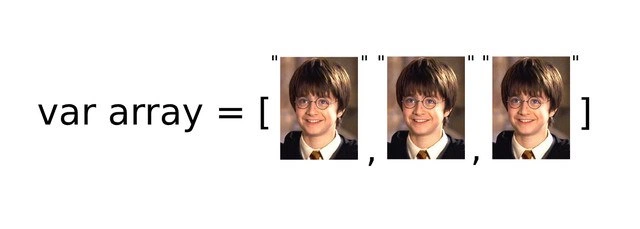
Imagine you have three picture frames on a shelf, and you decide to put the exact same photo of your friend in each one. Now you step back and look at the shelf: you see your friend’s same smiling face, over and over, in all three frames. It’s a little funny, right? Usually you’d have different photos, but here it’s like you copied one photo three times.
This meme is doing that, but inside a computer list. Think of a list as a row of buckets where you can put things. Here, someone made a list and put a picture of the same boy into the first bucket, the second bucket, and the third bucket. So no matter which bucket you peek into, you see the same face staring back at you! It’s silly because normally a list might have a bunch of different things (like a grocery list: apples, bananas, carrots), but this one is like a list that goes "face, face, face."
Why is that funny? It’s the surprise and absurdity of repetition. It’s like if you asked your friend to say a three-word sentence and they just chose one word and repeated it three times: “Pizza pizza pizza!” It technically fits the format, but it’s unexpected and makes you giggle. Or imagine you have triplet brothers who all look exactly alike, and you introduce them as your three unique friends — when in fact, at first glance, they all appear to be the same person copied thrice! That’s the kind of simple laugh this meme goes for.
In the end, the joke is just about seeing the same thing three times in a context where you’d usually see variety. Even if you don’t know anything about coding, you can chuckle at the idea of a list with identical entries. And if you do know coding, you smile because it reminds you of the most basic example possible, made entertaining by the goofy literal twist of using a real face. It’s a playful, nerdy kind of humor — the kind that makes you go, “Haha, I see what they did there,” even if it’s a bit corny. It’s funny because it’s so straightforward – sometimes the simplest, silliest things bring a smile.
Level 2: Identical Elements
So, what’s going on here? We have a snippet that looks like code: var array = ["😃", "😃", "😃"] (except the smiley face in the meme is actually the same boy’s face repeated). Let’s unpack that in plain terms:
- JavaScript Array: In programming, an array is just a list of items. You create one in JavaScript by using square brackets
[ ]and separating items with commas. For example,["apple", "banana", "cherry"]is an array of three fruits. In the meme, the array is["face", "face", "face"]– literally a list of three identical faces. var array= ...: The code usesvarto declare a variable namedarray. In JavaScript,varis a keyword that says “I’m creating a variable.” Here that variable will hold our array. (varis a bit old-fashioned now; these days you’ll often seeletorconst, butvarstill works and was the standard for a long time.)- Elements and Values: Each thing inside an array is called an element. In this meme’s array, all three elements are the same photo of a boy in a school uniform. The photo is placed between quotes like
"👍", which means the photo is being treated as a string (text). In actual code, that might represent a filename or an emoji or some text – but here the meme literally shows tiny pictures to make it obvious. All three elements are identical, meaning if you look at index 0, 1, or 2 of this array, you’d find the exact same content.
Now, having an array with all identical values is totally okay in programming. There’s nothing in code that says "each item must be different." We often intentionally do this when we need a default list. For example, if you were making a game and wanted to start with three lives, you might have an array like [1, 1, 1] to represent three lives all starting full. Or if you initialize a tic-tac-toe board, you might do ["", "", ""] (three empty strings) meaning all cells are blank at the start.
Why is it funny then? Because usually when someone shows off an array in a code example, they put a variety of things in it to make it interesting. Seeing the same face three times is like a joke about an extremely simple or lazy example. It’s as if the person writing the code couldn’t think of a second or third item, so they just used the first item again and again! It’s a running gag among programmers that some examples or tests are overly simplistic – like using the same value everywhere – which wouldn’t catch real-world issues. Here, it’s done on purpose for humor.
Another part of the humor is the blending of real-life image with code. Normally, in a program, if you wanted to use an image of a face, you’d reference it by a filename or URL (e.g., "face.jpg"). You wouldn’t literally copy-paste the photo itself into your code. But the meme pretends you can just stick the boy’s photo right in the code as data. The quotes around the image in the meme mimic how you’d include a string in code. It’s syntax humor: only people who have seen code would recognize, "Oh, they’re treating that picture like a string in an array literal." It looks goofy to have quotes around a picture, and that goofiness is the point.
Also, note the word "Initializing" in the title. Initializing an array means creating a new array and giving it some initial values in one go. The meme explicitly initializes the array with three values (the three identical faces) immediately. This is common in many languages. In Python, for instance, you might do my_list = [1, 2, 3]. In JavaScript, var array = [1, 2, 3] does the same thing. Here it’s var array = ["face", "face", "face"]. If you read that out loud, it’s like saying “create a variable called array, and set it equal to a list containing face, face, and face.” Kinda redundant sounding, right? Exactly! The redundancy is what makes it silly and thus meme-worthy.
For a newer coder, there’s also a tiny lesson: you can have duplicate entries in an array. If you only ever used arrays for all-unique items, you might wonder, is it okay to repeat? Yes, it is. The computer doesn’t mind at all. It will store each entry at different positions (index 0, index 1, index 2) even if the content is the same. Later, you could change one of them (if they are separate values) without affecting the others — unless, as mentioned, they all refer to the exact same object under the hood. But if they're just three instances of the same text or number, they’re essentially independent even if they look identical. It’s similar to writing the same word on three separate sticky notes: you have three notes that all say "Hello". The content is the same, but they are three distinct notes you could alter individually.
In summary, this meme is a lighthearted take on a programming fundamental (arrays) using a bit of tech humor. It shows how an array works in a very basic way (listing items in brackets), and it makes us laugh by choosing the quirkiest, most low-effort example: an array where nothing ever changes from one element to the next! It’s the kind of thing that makes both new and experienced coders grin — new coders because they recognize the syntax and think “hey I get that!”, and experienced coders because they remember writing toy examples just like this (and maybe getting gently teased for it).
Level 3: Attack of the Clones
At first glance, this meme looks like a snippet of JavaScript code initializing an array with three elements, and hilariously all three are the same exact face. The code shown is var array = [ ... ] with the same kid's photo inserted three times in between quotes. To an experienced developer, several layers of humor pop out here.
First, the use of the old-school var keyword hints at classic JavaScript syntax. These days, we'd more likely use let or const to declare variables, especially since ES6 (2015) popularized them. Seeing var gives a nostalgic vibe – a bit of syntax humor that screams "hello from the 2000s!" It’s a delightful detail for those who know the language's evolution.
Second, the array literal itself is filled with identical elements. In real coding, if we needed an array of three identical values, a seasoned dev might use a loop or an array utility (Array.fill() in modern JS) instead of literally writing the same item three times. The meme exaggerates a naive approach: "Need three of the same thing? I'll just copy-paste it thrice." This over-the-top literalness is funny because it breaks the DRY (Don't Repeat Yourself) principle on purpose. It's like the coder didn't get the memo that you could automate repetition – which is a tongue-in-cheek nod to every time we’ve seen a newbie do something the “long way.”
Third, there’s a subtle technical poke: if those face entries were variables or objects, writing array = [face, face, face] might mean all three array slots point to the exact same object in memory. Seasoned devs know this can be a gotcha. For example, in JavaScript:
// Modern way to make an array of 3 identical values
const fillExample = Array(3).fill("😀");
console.log(fillExample); // ["😀", "😀", "😀"]
// But if we fill with an object, all elements reference the SAME object:
const singleObj = { name: "Clone" };
const cloneArmy = Array(3).fill(singleObj);
cloneArmy[0].name = "Modified";
console.log(cloneArmy);
// Output: [{ name: "Modified"}, { name: "Modified"}, { name: "Modified"}]
In the snippet above, after changing one entry’s name to "Modified", every element shows that change – because they were all the same object reference. A senior dev might chuckle, thinking how an array of identical objects can lead to spooky action-at-a-distance bugs (all three faces would change together like a synchronized clone army!). The meme’s array is just three identical strings (the face image filenames, essentially), so it’s not actually a bug – but this inside detail about references vs. copies adds an extra flavor for the experienced. It’s the classic "one Face to rule them all" scenario: multiple indices, one underlying data instance.
Also, consider the data structure fundamentals being highlighted. An array in programming is a basic sequence of items. It will happily hold duplicates; it doesn’t enforce uniqueness (unlike, say, a set). Seeing an array initialized with the same entry repeated thrice playfully underscores that concept. It's like the meme is waving a flag: "Look, arrays don’t care if every element is the same – only humans find this odd!" It’s a simple idea from CS 101 presented in a comically literal way.
Finally, the visual gag of embedding actual photos inside what looks like code is brilliant. In real code, you’d never see a photo thumbnail right in your source file – you’d see perhaps a filename string or an ID. By framing each image with quotes, the meme creator treats the picture as a string literal, which is absurd and funny. It blurs the line between code and reality for comedic effect. This combination of coding humor and visual pun makes experienced devs smirk: it reminds us of toy examples from programming tutorials, but with a wacky twist. In essence, the meme is laughing at how utterly simple and redundant this code is, and anyone who’s written a trivial array like this (especially in JavaScript) can appreciate the joke on multiple levels.
Description
A visual pun meme combining programming with pop culture. The image displays a line of code, likely JavaScript, declaring a variable: 'var array = [ ]'. Inside the square brackets, which denote an array, are three identical, comma-separated headshots of the character Harry Potter. Each image is flanked by double quotes, as if it were a string element. The humor comes from the literal interpretation: it is an 'array of Potters'. This simple joke is relatable to any developer familiar with basic data structures and the Harry Potter franchise
Comments
7Comment deleted
Accessing `array[9.75]` doesn't throw an `IndexOutOfBoundsException`, it just causes a platform-specific redirect to King's Cross Station
“Ship it,” they said - meanwhile your `var faces = [kid, kid, kid];` is just three pointers to the same mutable object, so when Marketing recolors the hair at index 0, the whole array turns ginger and prod blames the caching layer
This is exactly the kind of code review comment that makes you realize the junior dev took "use descriptive variable names" way too literally - though at least they're consistent with their object references, unlike our microservices
A perfect example of why we moved from 'var' to 'const' and 'let' - with var, you never know if you're getting an array of primitives, objects, or apparently, The Boy Who Lived. At least the hoisting behavior is more predictable than Voldemort's resurrection schedule
Spec said array<string>; frontend shipped three base64 images in quotes. TypeScript: string. Backend: 413 Payload Too Large
Spec said "string[]"; PM read it literally, design wrapped JPEGs in quotes, and it all worked - right up until someone called array.join(',') and shipped "[object HTMLImageElement]" to prod
The Set constructor's worst nightmare: an array that laughs at uniqueness constraints