Skip to content
DevMeme
6433 of 7435
My Code Playing Pool While Architects Interns and Devs Watch in Awe
CorporateCulture Post #7054, on Aug 18, 2025 in TG

My Code Playing Pool While Architects Interns and Devs Watch in Awe

Why is this CorporateCulture meme funny?

Level 1: The Show-Off and the Crowd

Imagine you put on a big, crazy show in front of a crowd of people of all ages. Let’s say you’re at a family gathering and you decide to do a wild skateboard trick or a super dramatic dance move on the dining table. You’re basically showing off in a really flashy way. Now picture the audience:

  • Your little cousins (the very young kids) are watching with eyes as big as saucers. They’ve never seen this trick before, so they’re either amazed or just shocked, not sure what to think. They might even think it’s cool because it’s so out-there.
  • Your teenaged siblings or friends (a bit older kids) are half-laughing, half-covering their eyes because they’ve got a feeling this could go wrong or that it’s a bit much. They’re excited but also a bit embarrassed for you, like “Oh no, what is he doing?”
  • Your parents or aunts/uncles (the adults with experience) are probably shaking their heads or chuckling in that “I can’t believe you’re doing this” way. They’ve seen stuff like this before and know that while it’s kind of funny, it’s also not very smart. They might be thinking about the last time someone tried a silly stunt and broke a lamp or got hurt.
  • Your grandparents (the really experienced folks) are just sitting there, arms crossed, not laughing at all. They’ve seen many crazy things in their life, and they’re not impressed by someone dancing on the table. They’re more worried about the table breaking or the mess it’ll cause. They might say something practical like, “Get down from there before you hurt yourself or ruin the furniture.”

In this story, you showing off with the crazy trick is like writing super flashy, complicated code, and the different family members are like different reviewers seeing your code. The point is, the exact same stunt gets very different reactions depending on how experienced or wise the person is. The young ones are impressed or stunned because it’s new to them. The ones with a bit more experience feel uneasy because they sense the potential problems. The very experienced just want it to stop because they can already foresee the consequences and they know it’s not a great idea.

So the meme is making a joke: when a programmer writes code that’s like a wild trick, newbies go “Wow!”, mid-level folks go “Uh oh…”, and the old pros go “Not this again.” It’s funny because it’s true – as people gain experience, they care less about flashiness and more about safety and simplicity. In the end, it’s saying being clear and simple is usually better than showing off, whether you’re doing skateboard tricks or writing code.

Level 2: Code Review Reality

Let’s break down what’s happening in simpler terms. In software teams, there’s a practice called a code review – whenever you write code (often as a Pull Request or Merge Request on platforms like GitHub or GitLab), your teammates of various experience levels will examine it before it’s merged into the main codebase. It’s like turning in an essay and having all your classmates and teachers read it aloud in front of you. This meme imagines that scenario: your code is on display for everyone, from the newest intern to the lead architect.

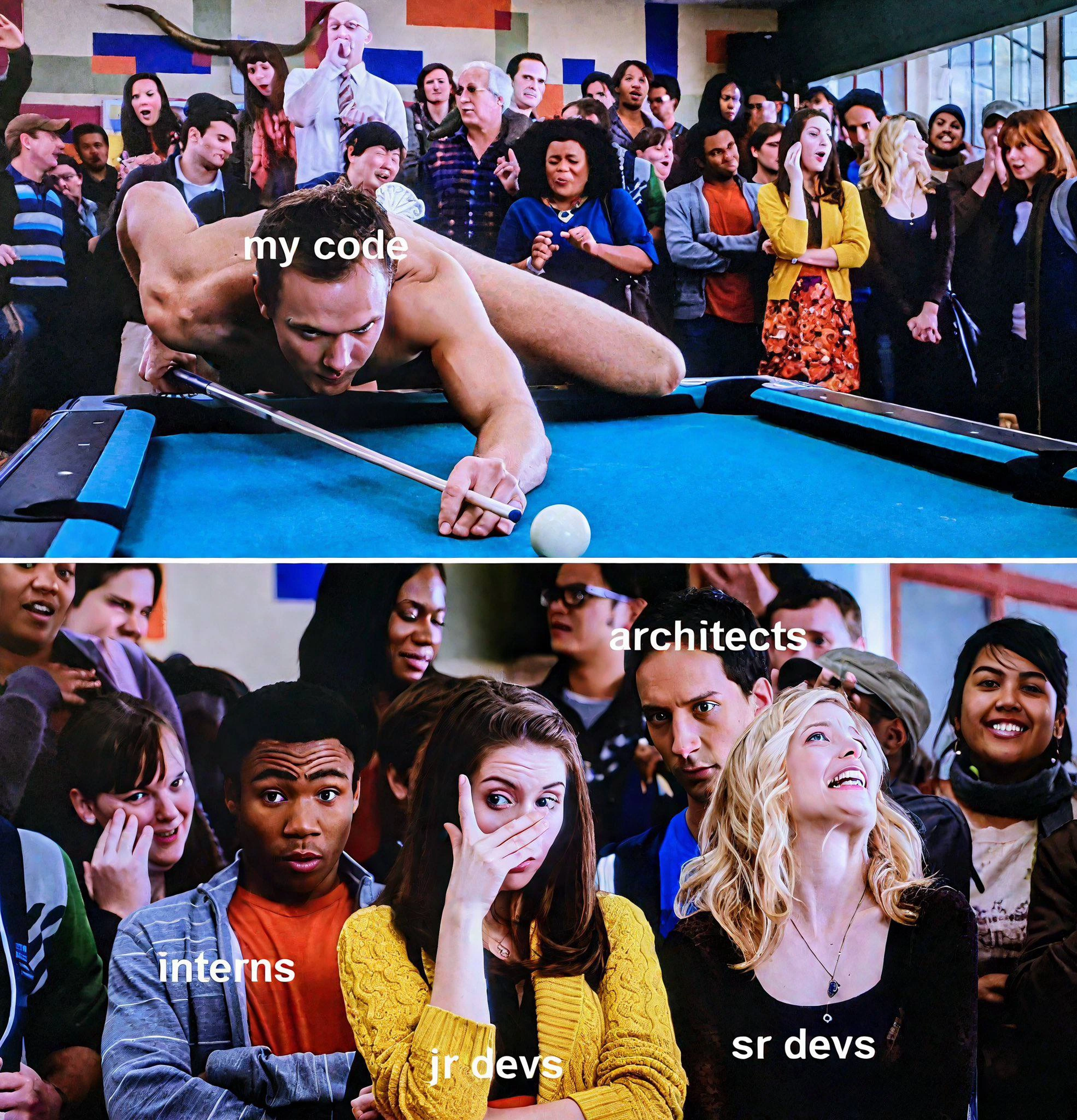
The top part with the man sprawled dramatically on the pool table labeled “my code” symbolizes a programmer’s code that is over-the-top and flamboyant. Flamboyant code means code that is very showy or elaborate – maybe it uses very fancy programming tricks, or it’s written in a way that’s meant to impress people rather than to be simple and clear. It’s like writing a solution in a super convoluted way when a simple one would do, just to say “look how clever I am.” In the image, the guy on the pool table is doing a theatrical pose to take a pool shot, which is a funny exaggeration of someone showing off. In a code context, a developer writing flamboyant code might do things like:

  • Cramming a lot of operations into one single line of code, using complex syntax.
  • Using advanced language features or obscure shortcuts that aren’t really needed for solving the problem (just because they know them).
  • Adopting an unnecessary design pattern or extra layers of abstraction for something basic, making the code more complex than it needs to be.

Now, the bottom part shows four groups of people watching, each labeled with a role: “interns,” “jr devs” (junior developers), “sr devs” (senior developers), and “architect.” These represent increasing levels of experience in a typical software team. The expressions on their faces tell the story of how each group perceives that flamboyant code:

  • Interns (usually college students or very new trainees): The interns in the picture look shocked and wide-eyed. At work, interns are often still learning the ropes. If they see some very fancy, complex code, they might be either confused or kind of impressed just because it’s beyond what they know. They don’t have enough experience to immediately tell if the code is good or bad, so they might be thinking something like, “Wow, I didn’t even know you could do that in code!” or “I have no idea what this does…” Their reaction is a mix of surprise and naive admiration.

  • Junior Developers (a step up from intern, maybe 1-2 years of experience): The junior dev in the meme (the woman in the yellow sweater) is covering her face in worry or embarrassment. Junior devs have learned coding conventions and probably read books or guidelines about writing clean code (code that is easy to read and maintain). They likely recognize that this flamboyant code breaks those conventions. For example, maybe it doesn’t follow the team’s style guide or it’s doing too many things at once. A junior dev might react with nervous laughter or concern because they sense, “This is going to be hard to understand or debug.” They might not be confident enough to challenge a more experienced coder, but internally they’re thinking it’s not a great approach. In a real code review, a junior might ask timid questions like, “Could we maybe simplify this?” or they might just silently take note that this looks tricky.

  • Senior Developers (many years of experience, the backbone of the team): In the image, the senior devs are represented by a blonde woman laughing and a guy next to her (also smiling but in disbelief). Senior devs have seen a lot of code in their career – the good, the bad, and the ugly. When they see code that is too clever for its own good, they often react with an eye-roll or a chuckle because it’s a familiar scenario. They likely immediately spot potential problems. For instance, a senior dev knows that if code is hard to read, it will cause trouble later (bugs, difficulty onboarding new team members, etc.). So they might laugh and say something like, “Oh wow, someone was feeling smart, huh?” Their laughter isn’t because it’s truly funny like a joke, but more out of incredulity – they can’t believe someone actually wrote this and expected it to pass review. Seniors also might be the ones to actually leave strong comments in the review: “This is way too complex. Can we break this into simpler parts?” or “This clever trick will confuse others; please refactor (rewrite) for clarity.” They’ve likely fixed code like this under pressure, so there’s a bit of dark humor in seeing it happen again.

  • Architect (the most experienced, often a technical lead or systems architect): The architect in the meme (the man with glasses, looking serious) is totally unimpressed. Architects are concerned with high-level design and long-term maintenance. They’re often the gatekeepers of architecture – the big-picture structure of the code and how everything fits together. When an architect reviews code, they care about whether it meets standards, fits the overall design patterns chosen for the project, and will be maintainable in the long run. If they encounter a flashy bit of code, they’ll scrutinize it hard. The architect’s stoic face suggests he’s thinking, “This doesn’t align with our architecture,” or “This is going to cause issues later.” Architects often write or enforce the coding standards and best practices for a team. So an architect might give very direct feedback: “This needs to be rewritten in a simpler way,” or even reject the code change until it meets the quality bar. They’ve just seen too many projects suffer because of one developer’s clever-but-untamed code. In the meme, he’s not laughing or cringing – he’s just stone-faced, which could mean he’s not amused and is already mentally planning how to correct this.

The whole joke is essentially showing the range of reactions during a code review of an extravagant piece of code. It’s highlighting a common experience in programming teams: the more experience you gain, the more you value simplicity and clarity in code. What looks cool at first can actually be a red flag for those who’ve maintained code for years. There’s even a saying, “Keep it simple, stupid (KISS),” which many developers follow, meaning a straightforward solution is usually better than a complicated one.

In a real code review scenario, a piece of flamboyant code might spark a lot of comments. For example, someone might label it as “over-engineered” (too complex for no good reason). A senior or architect might mention it’s hard to read or ask for it to be broken into smaller, well-named functions. The junior might be quiet or only point out small issues because they’re still learning how to give feedback. Interns usually observe and learn in these moments. The author of the code (the person who wrote “my code”) might get defensive or embarrassed when seeing these reactions, realizing that what they thought was a clever solution is being met with concern.

It’s also worth noting the meme uses a scene from the TV show Community (a comedy series). In that scene, the character is doing an absurd, half-naked pool trick to make a point, and everyone around reacts in shock or disbelief. In our developer meme context, that scene perfectly represents the idea of putting on a show (the crazy code) and having a crowd react at different levels of WTF. Even the caption suggests the idea of a “display” – your code is basically performing in front of an audience of reviewers. It’s a funny way to visualize what can otherwise be a tense experience: a code review where you realize maybe you went too far in trying to be clever.

So, for a junior or someone new: the key takeaway is why the flashy code is getting negative reactions from more experienced folks. It’s because experienced developers have learned that code needs to be easily understood by others, not just executed by the computer. Code is read many more times than it’s written. If you write something in a confusing way (even if it works), you’re making life harder for your teammates and your future self. The intern might just be dazzled that it works at all, but the senior knows that six months from now, when something breaks, that “cool” code will be a pain to debug. And the architect knows that if everyone wrote code like that, the whole system would become a fragile mess.

In summary, this meme in a teaching context is saying: When you put overly flashy/complex code in a code review, expect mixed reactions. The less experienced might be impressed or unsure, but the veterans will likely ask you to simplify it. It’s a lighthearted reminder that clean, simple code tends to earn more praise in code reviews than code that’s trying too hard to show off.

Level 3: Trick Shots vs Clean Code

This meme is a code review circus where one developer’s flashy, spectacle-driven development steals the show. The top panel shows “my code” performing a wild trick shot on a pool table – analogous to a programmer writing an overly clever, dramatic solution to a problem. In code terms, this is the kind of commit that screams “look what I can do!” by using every fancy language feature, bit of syntactic sugar, or arcane design pattern imaginable. It’s the programming equivalent of a behind-the-back pool shot: technically impressive, questionably practical. The humor hits because in real-world CodeReviews, such flamboyant code is usually a code smell. It might involve things like:

  • Unnecessarily complex one-liners: e.g. chaining five operations in a single statement with nested ternaries or lambdas just to compress the code.
  • Over-engineered patterns: perhaps implementing an entire Abstract Factory or recursive template metaprogramming for something a simple loop could do.
  • Clever hacks: exploiting language quirks (like abusing eval, pointer arithmetic, or regex magic) to achieve a “neat” effect that’s fragile or opaque.

Seasoned developers recognize these as trick shots — high-risk moves that sacrifice readability, maintainability, and clarity for a moment of “wow.” The code might run, but maintaining it will be a nightmare for the poor soul on an on-call rotation at 3 AM. In a shared codebase, flashy hacks can quickly turn into technical debt once the novelty wears off.

Now, the bottom panel labels the crowd of reviewers by seniority (interns, junior devs, senior devs, architects), each reacting differently. This nails a core truth of the DeveloperExperience: how code is perceived depends on the viewer’s experience level. The interns in the meme look wide-eyed and astonished – they’ve never seen a pool stunt (or code stunt) like this before, and it’s blowing their minds. Intern-level reviewers often lack context, so they might think, “Whoa, this code is genius!” or be utterly confused but too green to critique it. They represent the naïve awe or shock factor.

Next, the junior developers are pictured as worried or cringing (one even covers her face). Junior devs have learned the basics of CodeQuality and best practices, so they sense something is off. They might be thinking, “Is this even allowed by our style guide?” or “How will I ever debug this?” They know just enough to be nervous. This reflects the typical junior reaction to over-complicated code: discomfort, because they can’t easily follow the logic and they’ve been taught that clear > clever. It’s relatable developer humor: many of us remember our first time reading a codebase that felt like a circus act and feeling equal parts impressed and horrified.

Then we have the senior developers – the blonde in the meme is laughing in disbelief, eyes heavenward. Seniors have been around the block; they likely immediately recognize the flamboyant code for what it is. Maybe they wrote something similar back in their own reckless days and got burned, or they’ve spent long nights untangling such “creative” solutions in legacy systems. Their reaction is a mixture of exasperation and dark amusement. A senior might sarcastically comment in the code review, “Well, that’s one way to solve it… care to add a comment explaining what on Earth it does?” They know that beneath the flashy exterior, this solution might hide edge-case bugs or maintenance traps. This is shared pain: everyone with enough experience has seen clever code go horribly wrong. The meme capitalizes on that SeniorEngineerPain – the eye-roll and “here we go again” feeling when encountering a too-fancy pull request.

Finally, the architect (the stoic guy with glasses) stands unfazed. Architects are veterans responsible for the big-picture DesignPatterns & Architecture of the system. By the time code reaches an architect’s review, they’ve seen every trick in the book. Nothing surprises them – they remain stone-faced, already calculating how this flashy code might violate architecture principles or scalability requirements. The architect isn’t impressed by surface-level cleverness; they’re likely thinking, “How does this fit into our system’s design? Will this be supportable in 6 months?” If anything, an architect might insist on refactoring this stunt into something align with the overall architecture (hence the tag “underwear_refactor” hinting that the code might need to be stripped down to basics). Their reaction is an architecture_eye_roll: a silent judgement that this spectacle of code belongs in a tech demo, not in mission-critical production code.

The humor shines through the contrast: the same code snippet evokes awe, concern, laughter, and stoic disapproval up the chain of command. It’s an inside joke about CodeReviewPainPoints – as you move from intern to architect, your perspective on what’s important in code shifts drastically. Interns care that it works (or are just wowed by the magic), juniors worry if it's right, seniors worry if it’s supportable, and architects worry if it should exist at all in its current form. The meme captures a RelatableDevExperience: any developer who’s been in a multi-level review has seen this dynamic play out. It’s both funny and a bit painful because we’ve been on both sides – at some point every dev writes a peacock-proud piece of code and later faces the gauntlet of peer review. This image says, “Go on, put your wild code out there, and watch how each level reacts.”

In summary, at the senior perspective this meme is laughing at flamboyant coding and highlighting the unwritten lessons of software engineering: just because you can do something in code doesn’t mean you should. Clever code can quickly turn into “clever trap” for those who maintain it. Experienced devs favor simple, clean code (the boring straightforward pool shot) over clever one-liners (the acrobatic shot) because they know the real trick is keeping code easy to understand for the whole team. This meme is a gentle poke and a bit of DeveloperSelfDeprecation: we’ve all been the show-off or the eye-roller at some point, and it reminds us that in coding, clarity and simplicity age better than a flashy hack.

Description

A two-panel meme using scenes from the TV show Community. Top panel: a shirtless man (Jeff Winger) intensely lining up a pool shot, labeled 'my code', surrounded by a crowd of onlookers. Bottom panel: the crowd reaction shot showing characters labeled 'interns' (Troy, looking shocked), 'jr devs' (Annie, covering her mouth in disbelief), 'sr devs' (Britta, looking amused/impressed), and 'architects' (Abed, watching intently). The meme humorously depicts a developer's self-perception that their code is so impressive/dangerous that all levels of the engineering hierarchy stop to watch in a mix of awe and horror

Comments

15
Anonymous ★ Top Pick My code is like Jeff Winger playing pool shirtless - technically impressive, completely unnecessary, and everyone's watching because they know something's about to break catastrophically
  1. Anonymous ★ Top Pick

    My code is like Jeff Winger playing pool shirtless - technically impressive, completely unnecessary, and everyone's watching because they know something's about to break catastrophically

  2. Anonymous

    The intern is worried the code will break. The junior is worried it's not 'best practice.' The architect is worried it will set a precedent. The senior is just wondering if it's clever enough to be interesting or dumb enough to be hilarious during the post-mortem

  3. Anonymous

    Sure, the shot looks impressive, but wait until the architect asks why the cue stick is an inline SQL string

  4. Anonymous

    The only thing more precarious than that pool shot is explaining to the architects why your 'temporary workaround' from 2019 is now load-bearing infrastructure supporting half the company's revenue stream

  5. Anonymous

    The real tragedy isn't that the code works - it's that by the time the architects finish calculating the blast radius of the inevitable refactor, the intern who wrote it will have been promoted twice and moved to a different team. Meanwhile, the senior devs are already updating their résumés, having seen this exact Jenga tower collapse in production at their last three companies

  6. Anonymous

    Nice trick shot - but when the cue ball is global state and the chalk is a singleton, the only pocket it sinks is the error budget

  7. Anonymous

    Cool trick shot - if your code sprawls across UI, service, and persistence layers just to bank an edge case, that’s not architecture; that’s technical-debt interest compounded daily

  8. Anonymous

    Code so SOLID it pockets the 8-ball flawlessly - architects applaud, juniors idolize, sr devs mutter 'finally refactorable'

  9. @Omegarofl 10mo

    bro

    1. @riggardo 10mo

      Upscaled

      1. @f0cu53d 10mo

        Poorly

  10. @evmyshkin 10mo

    PM

  11. @drznpy 10mo

    PMs in the meantime

  12. @drznpy 10mo

    (Gantt charts go brrr)

  13. @HarrisonDv 10mo

    Me reviewing my own PR with Copilot, knowing we're still breaking things & fixing nothing..😂

Use J and K for navigation