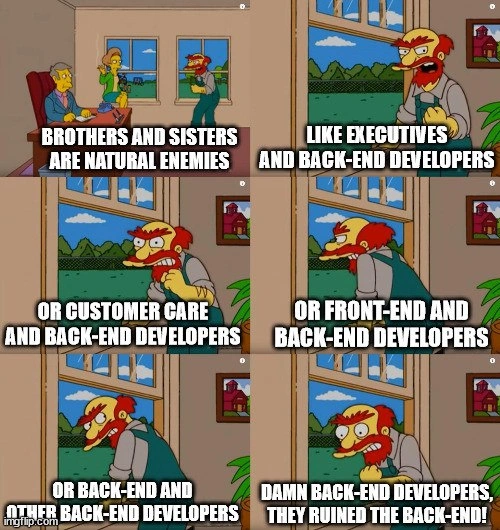
Groundskeeper Willie lists every group at odds with backend developers, including themselves
Why is this Backend meme funny?
Level 1: Pointing Fingers
Imagine a big group of kids who were all supposed to work together on a school project, but it went wrong. When the project falls apart, the kids start blaming each other instead of fixing it. The bossy kid in charge yells, “It’s all because of them!” The kid who talks to the teacher (like customer support for users) says, “No, it’s their fault for messing up!” The kid painting the poster (front-end) says the kid writing the report (back-end) spoiled everything, and that writing kid fires back that the painter kid ruined it. In the end, one frustrated kid throws up his hands and shouts, “Ugh, kids are the worst! They ruined our project!” 🤷♂️ It’s silly because he’s a kid too – he’s basically blaming his own team. The meme is funny in the same way: it’s showing how, when things go wrong, people often point fingers at each other (even at their friends on the same team) instead of working together to solve the problem. It’s like a bunch of siblings making a mess and each one yelling “It’s your fault!” even though they’re all in it together. The joke makes us laugh because we know that fighting like that doesn’t help at all – and it’s a little ridiculous to see everyone, even the ones who should be on the same side, blaming each other.
Level 2: Team Silos 101
In simpler terms, this meme humorously highlights how different groups in a tech company often end up at odds with each other. It uses a scene from The Simpsons (with Groundskeeper Willie yelling out a window) to list out these “natural enemies” in the software world. The original Simpsons joke had Willie claiming “Brothers and sisters are natural enemies… like Englishmen and Scots! Or Welshmen and Scots! Or Scots and other Scots! Damn Scots, they ruined Scotland!” Here, it’s been adapted to tech culture: each panel replaces the feuding groups with tech roles. The result is a tongue-in-cheek rundown of inter-team rivalry: “Executives and back-end developers,” “Customer Care and back-end developers,” “Front-end and back-end developers,” and finally even “Back-end and other back-end developers.” The punchline has Willie declaring, “Damn back-end developers, they ruined the back-end!” It’s a playful jab at how back-end devs seem to get blamed by everyone — even by their fellow back-end engineers.
Let’s clarify who these groups are. A Back-end Developer is an engineer who works on the server-side of a software application — the behind-the-scenes functionality that users don’t directly see. If a website were a restaurant, the back-end devs are like the kitchen staff cooking the food: they manage the database (the recipes and ingredients), the server logic (how the dishes are prepared), and the APIs (the windows through which dishes are served to waiters). Now, a Front-end Developer, by contrast, works on the client-side — what users interact with in their browser or app. In our restaurant analogy, front-end devs are like the waiters and presentation chefs: they design the plate, set the table, and make everything look appealing and easy to consume for the customer. Both roles are crucial and have to work closely together, but you can imagine how they might clash: if the kitchen (back-end) is slow or the food is undercooked, the waiter (front-end) gets frustrated. If the waiter keeps changing the orders or promises something the kitchen can’t make, the kitchen staff get annoyed. This is the classic FrontendHumor vs BackendHumor scenario in the meme — front-end and back-end blaming each other when the “meal” (the software) has issues.
Customer Care (or customer support) is the team that talks to the users or customers directly, helping them resolve problems, answering questions, and logging their complaints. They’re like the restaurant’s customer service desk or the waitstaff who hear immediately if a customer says, “This soup is cold” or “I never got my dessert.” In a tech company, customer support agents often have the tough job of dealing with frustrated or confused users when a bug occurs or a service goes down. It’s common for support to feel exasperated with developers if they believe the software’s quality is causing too many support calls. From their perspective, if the back-end developers “did their job right,” users wouldn’t be encountering so many issues. On the flip side, developers sometimes get defensive, thinking that support might be miscommunicating the problem or not providing enough details. This can lead to friction: support might say “Development isn’t fixing our top issues!”, and devs might retort “Support keeps blaming us for user errors.” It’s a CommunicationBreakdown where both sides actually want the users to be happy, but stress and siloed perspectives cause them to butt heads. The meme calling out “Customer Care and back-end developers” as natural enemies is a jokey way to point out this common miscommunication between those who make the product and those who support the product.
Now, Executives vs. Back-end Developers refers to the age-old tension between management (the business side) and the engineering team. Executives are people like the CEO, CTO, product managers, or any higher-ups who make business decisions, allocate budgets, and set priorities for the company. Think of them as the restaurant owners and managers who decide the menu, the opening hours, and the budget for ingredients. They’re concerned with things like strategy, profit, timelines, and keeping investors or stakeholders happy. Back-end developers, on the other hand, are down in the kitchen (coding the servers), concerned with code quality, system stability, and realistic timelines for development. Problems arise when, say, an executive promises a new feature to customers by next month to boost sales, but the developers know that timeline is nearly impossible without cutting corners. Management might view the developers as being slow or not business-savvy, while developers see executives as out of touch with technical reality. Stereotypically, this is depicted as the suit-wearing executive pushing for speed and new features, versus the hoodie-wearing engineer insisting on caution and saying “it’s not that simple.” When deadlines are missed or projects go awry, tensions flare up. The joke “Executives and back-end developers are natural enemies” exaggerates this friction many tech folks have experienced: each group blaming the other for things like project delays or product issues. It’s a staple of DeveloperHumor because so many developers have had a meeting where they had to explain to a non-technical boss why “No, we can’t just **optimize the entire database overnight,” often feeling like they’re speaking different languages.
Finally, the meme even jokes that Back-end developers fight among themselves — “back-end and other back-end developers.” This might seem odd: why would people on the same team be enemies? Usually, they’re not! But this line pokes fun at the reality that even within a development team, disagreements happen. For example, two back-end engineers might argue over coding style or the right way to design an API. In large companies, there might be multiple back-end teams responsible for different microservices or systems, and they can sometimes get territorial. Think of separate kitchen teams: one for appetizers and one for main courses. If a dinner service goes badly, the appetizer chefs might say the main course team ruined the meal, and vice versa. In software, if one back-end service (say the authentication service) fails, another back-end team (say the user profile service) might blame them for making everyone look bad. There’s also a common scenario where a developer blames the code written by a coworker (or by a prior team) for current problems – “This module is so poorly written, it’s ruining the whole application!” That’s basically Willie yelling “They ruined the back-end!” about his own peers. It’s a comedic exaggeration of internal team rivalries or legacy code blame. Developers often joke about inheriting “crappy legacy code” from others and grumble about it, even though, in the end, they’re all on the same side trying to fix it. This part of the meme resonates because many in tech have felt that frustration of one part of a project messing up other parts, leading to some internal finger-pointing.
Overall, this meme is highlighting communication issues and silo mentality in a fun, exaggerated way. Each group – execs, support, front-end, back-end – has its own viewpoint and priorities, and without good communication, they end up in a blame loop. In a healthy corporate culture, all these roles actually complement each other: executives provide direction, developers build the solution, front-end and back-end collaborate to create a smooth product, and customer support relays user feedback and issues so the team can improve the software. They’re all supposed to be on the same team, working towards the same goal (happy users and a successful product). But as this meme jokes, in practice it often feels like a bunch of separate camps at war. This is why people tag it with BackendVsFrontend and CommunicationBreakdown – it captures the stereotype that these roles just naturally clash. Of course, reality is more nuanced and many teams work very well together, but the reason tech folks find the meme funny is because it’s an exaggeration of those real tensions. We laugh at it because on some tough days it does feel like “Damn back-end developers, they ruined everything!” is the refrain echoing through the halls 😅. The humor acts as a bit of a relief – acknowledging the friction so we can hopefully rise above it and remember we’re all ultimately trying to build great software together.
Level 3: Blame-Driven Development
At the highest level, this meme hits on a bitter truth of corporate tech culture: every department seems to have an axe to grind with the Back-end developers, sometimes even including other back-end folks themselves. It’s a satirical take on blame-driven development, where solving a problem takes a back seat to finding someone (or some team) to pin it on. Seasoned engineers recognize this familiar pattern: a critical bug surfaces or a project slips, and suddenly it’s a frenzy of finger-pointing across organizational silos. Instead of collaborative debugging, you get a cross-department blame ping-pong match at the outage post-mortem.
Let’s break down Willie’s raging rolodex of grudges in tech terms. First up, Executives vs. Back-end Developers: a natural enemy pairing as old as mainframes. Why? Executives chase business goals, deadlines, and investor demands, while back-end devs wrangle code complexity, technical debt, and scaling nightmares. When a release runs late or an ambitious feature isn’t feasible, the C-suite might see the engineering team as “roadblocks” to ROI. From the exec side, there’s often pressure like “just ship it now” for a big demo or KPI target, leaving developers muttering under their breath about unrealistic expectations. In turn, back-end engineers joke about “pointy-haired bosses” (in true Dilbert fashion) who promise magical results without understanding system constraints. When Willie shouts “Like executives and back-end developers,” senior devs smirk because they’ve witnessed that tense stand-off in countless planning meetings—each side convinced the other is ruining the product or slowing things down.
Next, Customer Care vs. Back-end is another classic oil-and-water scenario. Picture a frustrated support rep fielding angry calls about a glitch: to them, it’s clearly the dev team’s fault that users are unhappy. From the support perspective, if only those back-end devs wrote bug-free code, their helpdesk wouldn’t be flooded. Meanwhile, the back-end developer on call at 3 AM might grumble that support never provides clear bug reports or escalates issues without triage. I’ve seen this dynamic devolve into what we jokingly call a “ticket tennis” match: support lobs a bug report over the net, devs send it back with “can’t reproduce, works on my machine,” support returns it saying “customer still hitting it,” and so on. This communication breakdown breeds frustration on both sides. The meme highlights that friction with Willie’s exaggerated snarl, effectively saying “user support and devs just naturally butt heads.” Seasoned engineers wryly recall war stories of being caught between an irate customer and a panicking support agent — each implicitly blaming the back-end for the trouble.
Then we have Front-end vs. Back-end Developers, a rivalry as famous as front-end’s Chrome DevTools vs back-end’s server logs. This one’s a lighthearted nod to DeveloperHumor about the different mindsets and responsibilities of two halves of a software team. Front-end devs focus on the user interface and experience — the pretty visuals and smooth interactions in the browser. Back-end devs handle the behind-the-scenes logic — databases, servers, and APIs feeding data to that interface. When something goes wrong in a web app, each side is often convinced the other is the culprit. Front-end says, “The API is too slow or returning the wrong data.” Back-end fires back, “Your React code is calling the endpoint ten times a second – of course things are slow!” 😂 These developer stereotypes persist: front-enders joke the back-end is messy spaghetti code; back-enders tease that front-end is just “moving buttons around” without real complexity. In reality both are complex, but that doesn’t stop the blame game. The meme perfectly parodies this: Willie bellowing “Or front-end and back-end developers,” as if their feud is as inevitable as gravity. Any senior engineer who’s debugged an integration issue at midnight, mediating between a front-end error and a back-end response, knows exactly why this line gets a laugh. It’s an exaggeration of the BackendVsFrontend culture clash that yields plenty of DeveloperHumor, despite all our modern “let’s be one team” DevOps pep talks.
Finally, the most cynical twist: Back-end vs. Back-end. Yes, the meme goes full circle to say even “back-end and other back-end developers” are natural enemies. It’s funny because it’s painfully true in large dev teams or microservice architectures. Often there isn’t just one monolithic back-end team: there are multiple squads each owning different services, databases, or domains. When something in the system breaks, even back-end teams sometimes start the blame game amongst themselves: “It must be the database team’s fault, our API was fine” vs “No, the API code introduced a bug, our database was fine.” I’ve lived through incidents where microservice teams spent the first hour insisting the memory leak or latency spike was in someone else’s service. Even within a single back-end codebase, individual developers might low-key fault the person who wrote the module that’s failing. It’s a defensive reflex: nobody wants to be the one who “ruined” the back-end, so they deflect blame to another part of the system. Willie’s final punchline — “Damn back-end developers, they ruined the back-end!” — is a direct echo of a classic Simpsons line (“Damn Scots, they ruined Scotland!”). Here it doubles as an absurd image: a grizzled back-end engineer railing against his own kin. It’s the ultimate self-own, like a database admin cursing “DBAs ruined the database!” after a long outage caused by a misconfigured replication. Seasoned devs chuckle (or groan) because they’ve encountered that self-blame or intra-team blame when wrestling with a messy legacy system. Who hasn’t opened a gnarly piece of legacy code and grumbled, “Those who wrote this (probably my past self) ruined everything!”
The deeper comedic sting of this meme comes from how relatable this inter-team strife is, despite all our efforts to avoid it. In theory, modern engineering teams strive for collaboration over antagonism. We hold blameless post-mortems where instead of pointing fingers, we identify process failures and learn from mistakes. Many companies adopt DevOps culture to break down walls between development and operations, and encourage cross-functional respect. We know the best practice is a “no blame” culture, focusing on fixing systemic issues rather than shaming individuals or teams. Yet, in the chaos of real corporate life, old habits die hard. Tight deadlines, production outages, and pressure from above can reduce even well-meaning teams into a round of the blame game. It’s almost an instinctive coping mechanism: if the front-end is yelling at the back-end for an outage, the back-end might turn around and yell at the database team, who then rant about the cloud provider’s issues. Everyone feels better if they can say “It’s not our fault!” – until the chain reaches the last link and someone like Willie basically shouts at a mirror. The meme exaggerates this to absurdity, but it’s poking at a real dysfunction: communication breakdown and silo mentality in tech organizations. Those of us who’ve been in the industry long enough have learned to recognize when a culture is sliding from cooperation into “us vs them” territory. We’ve seen how it ruins the back-end (and the front-end, and everything else) by distracting from solving problems. That knowing grimace this meme elicits from veteran devs is the acknowledgement that, yeah, we’ve all heard some version of these blame lines in stand-ups or incident calls. It’s funny in a dark humor way because it’s true — and it serves as a cautionary tale that even the other back-end developers aren’t safe from the wrath of a frustrated engineer looking for a culprit.
Description
Six-panel Simpsons meme featuring Groundskeeper Willie angrily yelling out of an open classroom window at unseen listeners. Panel 1 shows Principal Skinner talking with Willie; the caption reads "BROTHERS AND SISTERS ARE NATURAL ENEMIES." Panels 2-5 show close-ups of Willie gesturing outside, each overlayed with white impact text: "LIKE EXECUTIVES AND BACK-END DEVELOPERS," "OR CUSTOMER CARE AND BACK-END DEVELOPERS," "OR FRONT-END AND BACK-END DEVELOPERS," and "OR BACK-END AND OTHER BACK-END DEVELOPERS." The final panel zooms on Willie’s scowling face with the punch-line "DAMN BACK-END DEVELOPERS, THEY RUINED THE BACK-END!" The joke satirizes perennial friction among tech roles - executives, support, frontend, and even fellow backend engineers - highlighting team silos and inter-department blame culture familiar to senior software engineers
Comments
6Comment deleted
We split the monolith so everyone could blame “the other service,” and now my biggest rival in every post-mortem is basically me with a slightly different Git remote
The real tragedy isn't that backend developers fight with everyone - it's that we've spent 20 years building abstractions to avoid talking to each other, and now our microservices have better communication protocols than our teams do
The real tragedy is that back-end developers are indeed their own worst enemies - nothing quite matches the existential dread of inheriting a microservices architecture from another back-end team who thought eventual consistency was just a suggestion, not a guarantee. At least when front-end blames you for the API being 'slow,' you can point to their 47 sequential network calls. But when another back-end dev's 'temporary' message queue workaround from 2019 becomes your 3 AM pager duty? That's when Willie's rage becomes uncomfortably relatable
Back-end: the universal scapegoat - execs blame it for velocity, support for 500s, front-end for renamed fields, and other back-end teams for thinking eventual consistency means “after their SLA.”
Back-end devs: the only full-stack handling the entire blame pyramid from UI renders to executive dashboards
In microservices, the back-end’s apex predator isn’t the front-end - it’s the other back-end that ‘owns’ the same table and slips a column rename into a minor release